Mary Simon
Mary Simon is a Canadian civil servant, diplomat, and former broadcaster who served as the 30th Governor General of Canada from 2021 to 2026. She is Inuk on her mother's side, making her the first Indigenous person to hold the office. Simon's five-year tenure spanned significant national events including the Platinum Jubilee of Queen Elizabeth II, the papal visit of Pope Francis, and the transition to the reign of King Charles III. Her mandate was defined by a commitment to reconciliation and the Inuktitut concept of ajuinnata, a vow to persevere.
Early Life and Formative Years
Mary Jeannie May Simon was born on August 21, 1947, in Fort Severight, a remote community in northern Quebec now known as Kangiqsualujjuaq. Her father, Bob May, was a Hudson's Bay Company manager of English descent from Manitoba, and her mother, Nancy, was Inuk. Simon's father noted he was the first white HBC employee to marry an Inuk woman, a practice the company banned at the time. She was given the Inuk name Ningiukudluk, which translates to "bossy little old lady". Simon was raised immersed in traditional Inuit culture, learning skills like hunting, fishing, sewing traditional clothing, and travelling by dog sled. Her education began at a federal day school in Fort Chimo, now Kuujjuaq, and she later attended Fort Carson High School in Colorado before completing her high school studies via correspondence back in Fort Chimo. The oral history and cultural teachings passed down from her mother and maternal grandmother, Jeannie Angnatuk, provided a foundational connection to her Inuit heritage that would inform her lifelong advocacy.
Career in Advocacy and Diplomacy
Mary Simon's professional journey began with teaching Inuktitut at McGill University and working as a producer and announcer for the CBC Northern Service from 1969 to 1973. Her entry into public service was through Inuit organizations, starting with her election as secretary to the board of the Northern Quebec Inuit Association. She rose to become vice-president and later president of the Makivik Corporation, a role she held until 1985. During this period, Simon became deeply involved with Inuit Tapiriit Kanatami, Canada's national Inuit organization, and served as a senior Inuit negotiator during the patriation of the Constitution and the Charlottetown Accord discussions. She also contributed as a member of the Nunavut Implementation Commission and as co-director of policy for the Royal Commission on Aboriginal Peoples.
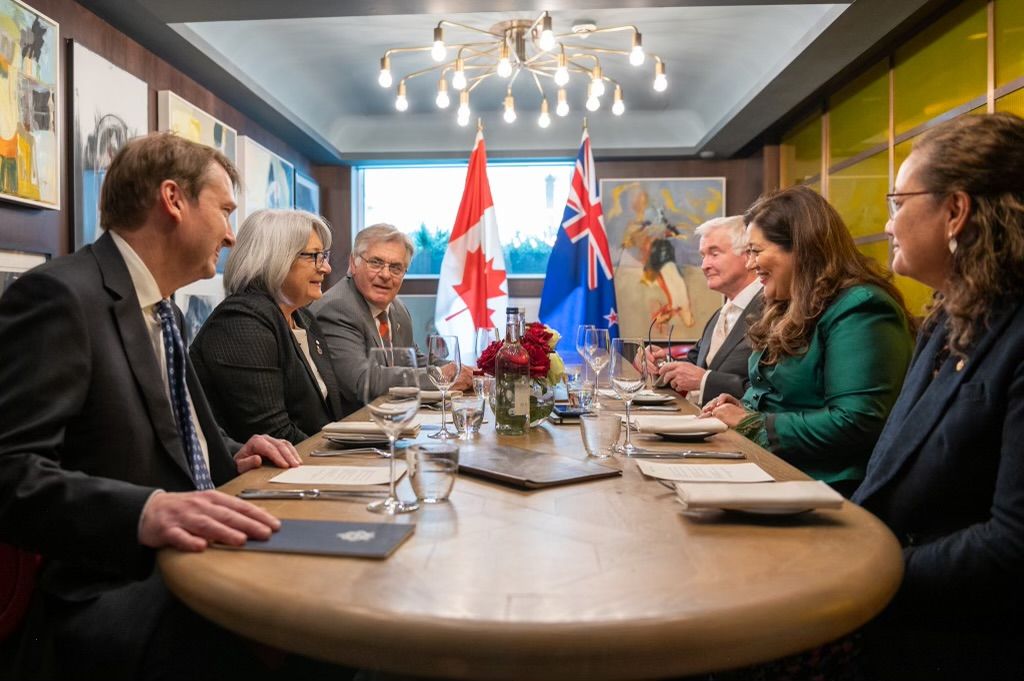
Simon's international profile grew through her work with the Inuit Circumpolar Conference, where she served as an Executive Council member from 1980 to 1983, president from 1986 to 1992, and Special Envoy from 1992 to 1994. In 1986, as president, she led a delegation of Canadian, Alaskan, and Greenland Inuit to Moscow and Chukotka to meet with Russian officials and the Inuit of far eastern Russia. Her diplomatic career reached its peak in 1994 when Prime Minister Jean Chrétien appointed her as Canada's first Ambassador for Circumpolar Affairs, a position she held until 2004. In this role, she was the lead Canadian negotiator in the creation of the eight-nation Arctic Council, formally established by the 1996 Ottawa Declaration which notably included the active participation of Indigenous peoples. Concurrently, from 1999 to 2002, she served as the Canadian Ambassador to Denmark. Following her ambassadorial posts, Simon continued her advocacy work, serving as president of Inuit Tapiriit Kanatami from 2006 and on various boards including the International Institute for Sustainable Development. From 2004 to 2005, she was a special advisor to the Labrador Inuit Association on the Labrador Inuit Land Claims Agreement.
- Elected secretary of the Northern Quebec Inuit Association board, beginning her public service career.
- Served as President of the Makivik Corporation from 1978 to 1985.
- Acted as a senior Inuit negotiator during the Constitution patriation talks and First Ministers' conferences from 1982 to 1992.
- President of the Inuit Circumpolar Conference from 1986 to 1992, leading a delegation to Russia in 1986.
- Appointed Canada's first Ambassador for Circumpolar Affairs in 1994, serving until 2004.
- Canadian Ambassador to Denmark from 1999 to 2002.
- Elected President of Inuit Tapiriit Kanatami on July 7, 2006.
- Served as a board member for the International Institute for Sustainable Development from 2004 to 2007.
Historic Appointment as Governor General
Following the resignation of Governor General Julie Payette in early 2021, Prime Minister Justin Trudeau nominated Mary Simon for the vice-regal office. Queen Elizabeth II approved the appointment on July 6, 2021, making Simon the 30th Governor General and the first Indigenous person to serve in the role. Her appointment broke the long-standing tradition of French-English bilingualism for governors general, as Simon speaks English and Inuktitut but was not proficient in French, a point that drew criticism from some Francophone communities. She undertook a virtual audience with the Queen on July 22 due to the pandemic and was formally installed at the Senate of Canada Building on July 26, 2021. Upon installation, she assumed the roles of Chancellor of the Order of Canada, the Order of Military Merit, the Order of Merit of the Police Forces, and the Order of St. John within Canada, and received the Canadian Forces' Decoration.
Tenure and Key Events
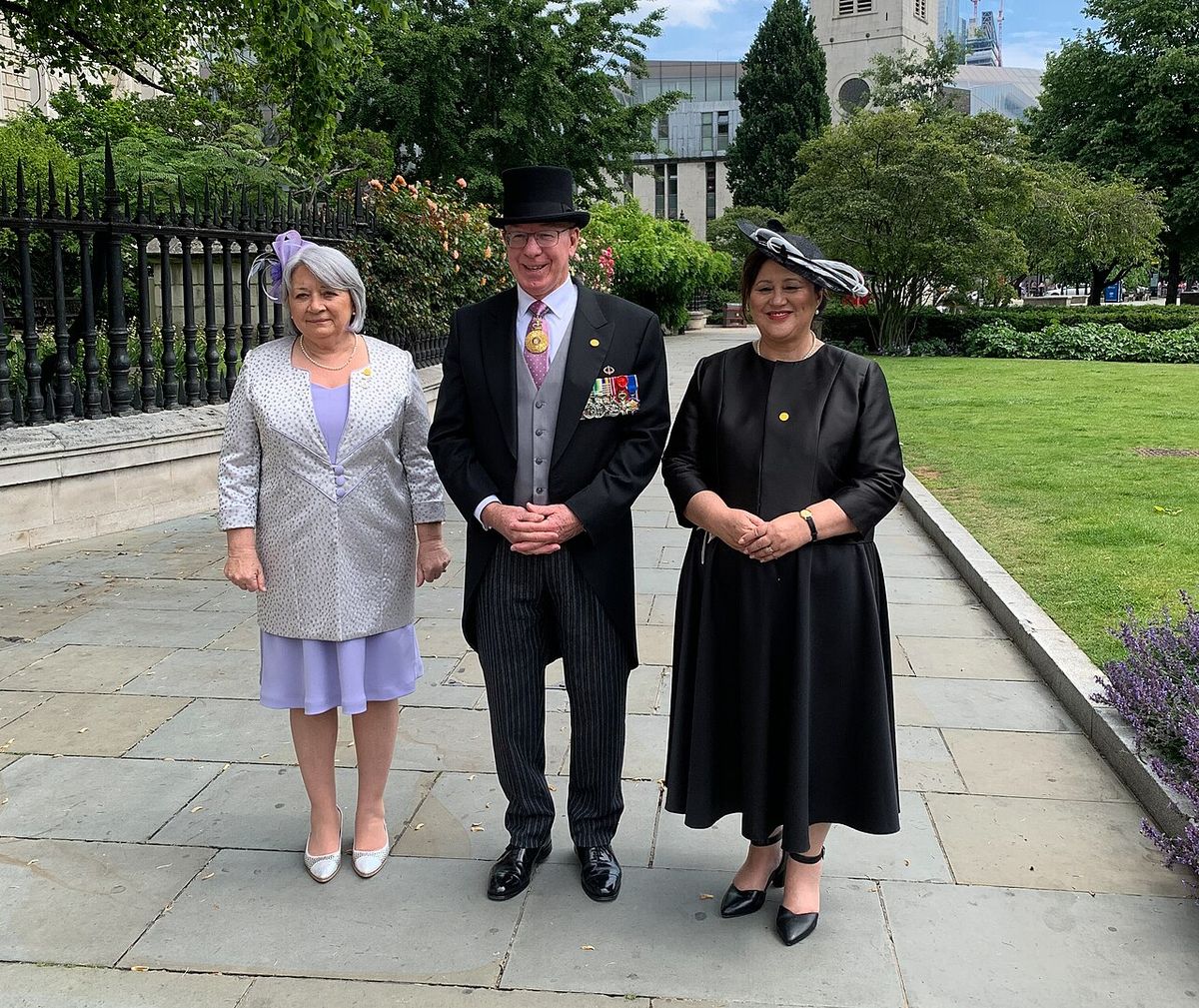
Governor General Simon framed her mandate around the Inuktitut concept of ajuinnata, which she described as a vow to never give up, a commitment to action no matter how daunting the task. Her tenure oversaw a period of significant royal and national events. In October 2021, she made her first state visit to Germany, meeting with President Frank-Walter Steinmeier and Chancellor Angela Merkel. The year 2022 was particularly eventful, marked by the Platinum Jubilee of Queen Elizabeth II. Simon and her husband met the Queen for the first time at Windsor Castle in March, and in May they hosted the then-Prince of Wales and Duchess of Cornwall on a Jubilee tour of Canada. Simon later travelled to London to participate in the United Kingdom's Jubilee celebrations in June.
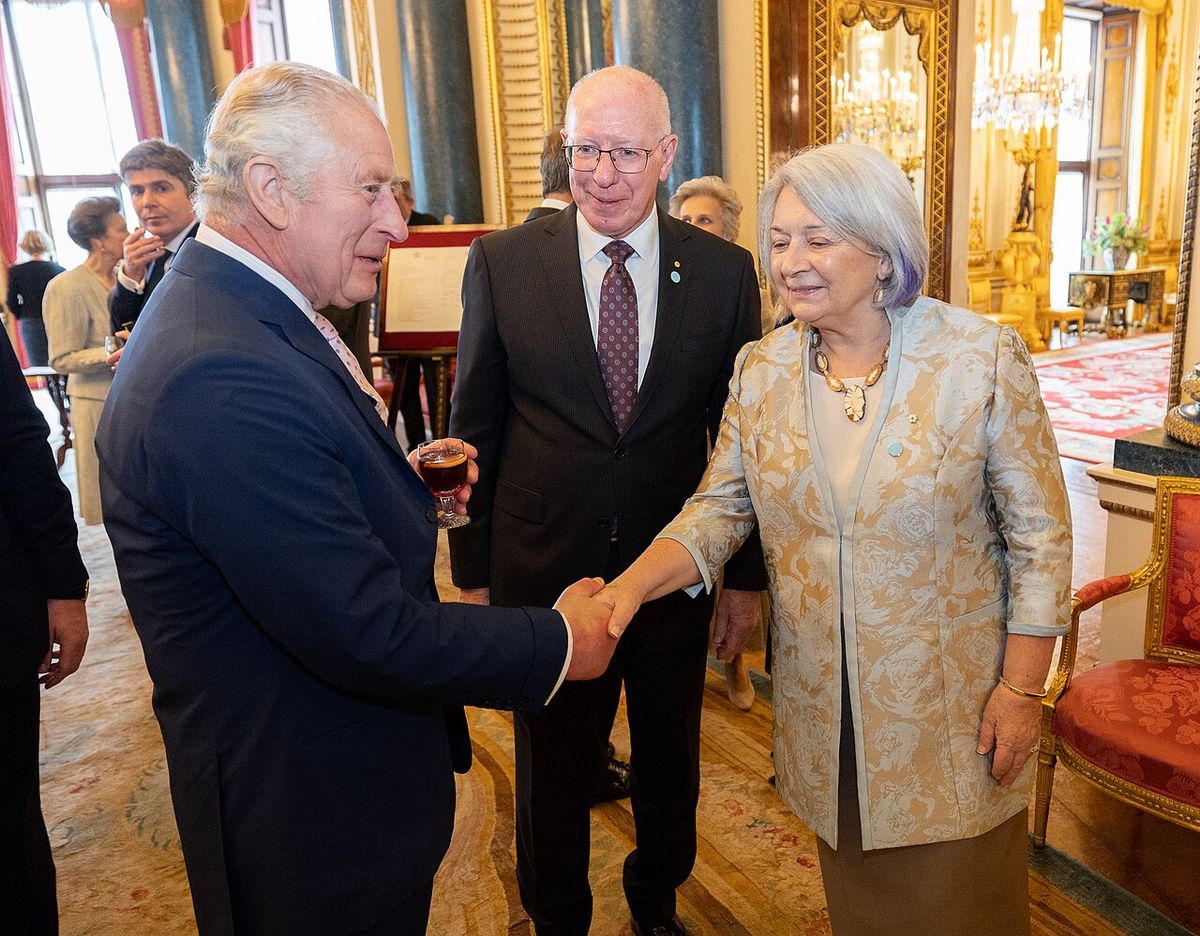
Simon played a central role during Pope Francis's penitential pilgrimage to Canada in July 2022, participating in events and acknowledging the complex emotions stirred by the papal apology for the Catholic Church's role in the residential school system. The death of Queen Elizabeth II on September 8, 2022, made Simon the first governor general to serve under two monarchs since Lord Tweedsmuir in 1936. She signed the proclamation of accession for King Charles III and led the Canadian delegation to the Queen's state funeral in London. In May 2023, she facilitated an audience at Buckingham Palace between the King and three national Indigenous leaders ahead of the coronation, which she and her husband attended. Her term concluded on June 8, 2026, when she was succeeded by jurist Louise Arbour. Before her departure, the federal government announced $5 million in funding for a mental health initiative in northern and rural communities named after Simon.
- First state visit to Germany in October 2021, meeting with Chancellor Angela Merkel.
- Hosted Prince Charles and Camilla, Duchess of Cornwall, during their Platinum Jubilee tour of Canada in May 2022.
- Attended the Queen's Platinum Jubilee celebrations in London from June 2 to 6, 2022.
- Participated in events during Pope Francis's visit to Canada from July 24 to 29, 2022.
- Signed the proclamation for King Charles III's accession on September 10, 2022.
- Led the Canadian delegation to Queen Elizabeth II's state funeral in London on September 19, 2022.
- Attended the coronation of King Charles III at Westminster Abbey on May 6, 2023.
- Concluded her term and departed Rideau Hall on June 8, 2026.
Notable Initiatives and Departure Legacy
Throughout her term, Governor General Simon championed mental health awareness, particularly in Northern and Indigenous communities, undertaking a two-year Mental Health Learning and Listening Tour. As she prepared to conclude her service, the federal government, in partnership with the Rideau Hall Foundation, announced a legacy project in her honour. The initiative, named "Ajuinnata: The Mary Simon Catalyst for Mental Wellness," was launched with an initial federal investment of $5 million, with a commitment to match further fundraising up to $10 million. The project aims to provide counselling, culturally grounded services, and peer-led mental health care. At her farewell ceremony in early June 2026, Simon described serving as governor general as the "honour of a lifetime". Prime Minister Mark Carney thanked her for her devotion and for embodying the ongoing responsibility of reconciliation in her service to the country. Before her departure, a farewell reception was held in Ottawa on June 3, 2026, and she presided over her final Order of Canada ceremony at Rideau Hall on May 13, 2026.
Controversies and Criticism
Simon's tenure was not without controversy. Her lack of proficiency in French remained a point of contention throughout her mandate. Despite commitments to learn the language, reports in September 2024 indicated she was still unable to hold a conversation in French beyond simple greetings, which led to criticism from figures like Bloc Québécois Leader Yves-François Blanchet. In April 2026, Prime Minister Carney explicitly stated the next governor general would speak French, leading to the nomination of francophone Louise Arbour. Simon also faced scrutiny over official expenses, notably in June 2022 for reported in-flight catering costs exceeding $93,000 during an eight-day trip to the Middle East. She called the criticism unfair as she was not involved in logistical planning. In February 2023, her office closed public commenting on social media posts due to a growing number of abusive comments. In a June 2025 legal commentary, analyst Murray Simser criticized Simon for public remarks on issues like Indigenous affairs and residential schools, arguing they risked undermining the constitutional impartiality expected of the office.
Personal Life, Honours and Affiliations
Mary Simon is the second-oldest of eight children. Her brother Johnny May is a well-known bush pilot in Nunavik. She has been married three times: first to Robert Otis in 1967, then to George Simon, and finally in 1994 to journalist and author Whit Fraser, the former head of the Canadian Polar Commission. She has three children. At age 40, Simon experienced depression and burnout, which she gradually overcame. Her many honours and affiliations reflect a lifetime of service. She served as Chancellor of Trent University from 1995 to 1999 and again in 2002. Simon is a fellow of both the Arctic Institute of North America and the Royal Canadian Geographical Society. She has held numerous board and advisory positions, including with Indspire, the University of the Arctic, and the Arctic Children and Youth Foundation. She is also an advisor to the European Space Agency's Arctic Monitoring Program and a member of the Advisory Circle for the Walter and Duncan Gordon Charitable Foundation.
- Chancellor of Trent University (1995 to 1999, 2002).
- Fellow of the Arctic Institute of North America.
- Fellow of the Royal Canadian Geographical Society.
- Chairperson of the Arctic Children and Youth Foundation.
- Board Member of Indspire.
- Member of the Board of Governors of the University of the Arctic.
- Advisor to the European Space Agency's Arctic Monitoring Program.
- Member of the Advisory Circle for the Walter and Duncan Gordon Charitable Foundation.
Questions about Mary Simon
What is ajuinnata and why was it important to Mary Simon?
Ajuinnata is an Inuktitut concept that Simon described as a central theme of her mandate. It does not have a single-word English translation but encompasses a vow or promise to never give up, and a commitment to action no matter how daunting the cause. Simon learned the concept from her mother and grandmother and stated that the spirit of ajuinnata drove her involvement in movements to improve the lives of Inuit. She applied this philosophy to her work on reconciliation and mental health advocacy.
Did Mary Simon speak French?
Mary Simon is not proficient in French. She speaks English and Inuktitut. Her lack of French fluency broke the long-standing tradition of French-English bilingualism for governors general and became a point of criticism following her 2021 appointment. Despite stating a commitment to learn the language, reports as late as 2024 indicated she could not hold a conversation in French. This was a factor cited when her successor, the francophone Louise Arbour, was nominated in 2026.
What is the legacy project launched in Mary Simon's honour?
As Simon concluded her term, a legacy project named "Ajuinnata: The Mary Simon Catalyst for Mental Wellness" was announced. Led by the Rideau Hall Foundation, the initiative focuses on providing mental health supports like counselling and culturally grounded services to Northern and Indigenous communities. The federal government committed an initial $5 million and pledged to match further fundraising up to $10 million. The project builds on Simon's two-year Mental Health Learning and Listening Tour undertaken during her mandate.
Who succeeded Mary Simon as Governor General?
Mary Simon was succeeded by jurist Louise Arbour. Prime Minister Mark Carney announced Arbour's nomination in May 2026, noting that the next governor general would be a French speaker. Arbour, a retired Supreme Court justice from Quebec, formally assumed the office on June 8, 2026, following a farewell ceremony for Simon. Simon's five-year term concluded on that date, marking the end of her historic service.
Why was Mary Simon's appointment as Governor General historic?
Mary Simon's appointment was historic because she became the first Indigenous person to serve as Governor General of Canada. She is Inuk on her mother's side. Prime Minister Justin Trudeau nominated her following the resignation of Julie Payette, and Queen Elizabeth II approved the appointment in July 2021. Her tenure represented a significant milestone in the Crown's relationship with Indigenous peoples. As the 30th governor general, she served from 2021 until the conclusion of her five year term in 2026. During her installation, she was vested as Chancellor of the Order of Canada and other national orders.
What was Mary Simon's role in the creation of the Arctic Council?
Mary Simon was the lead Canadian negotiator for the creation of the Arctic Council. She undertook this role while serving as Canada's first Ambassador for Circumpolar Affairs, a position she held from 1994 to 2004. Acting on instructions from the Government of Canada, she negotiated the establishment of the eight country council. The forum was formally created by the 1996 Ottawa Declaration, which uniquely included the active participation of Indigenous peoples as permanent participants. Under her leadership, she worked closely with the other Arctic states and Indigenous representatives in the circumpolar world.
Sources and further reading
- Mary Simon (Wikipedia)
- Governor General Mary Simon to join Prime Minister for ... (gg.ca)
- Statement by Prime Minister Carney to thank Her Excellency ... (pm.gc.ca)
- Mary Simon says serving as Governor General was the ' ... (ipolitics.ca)
Checked by the Nosy Mag desk. Last updated 2026-10-22.