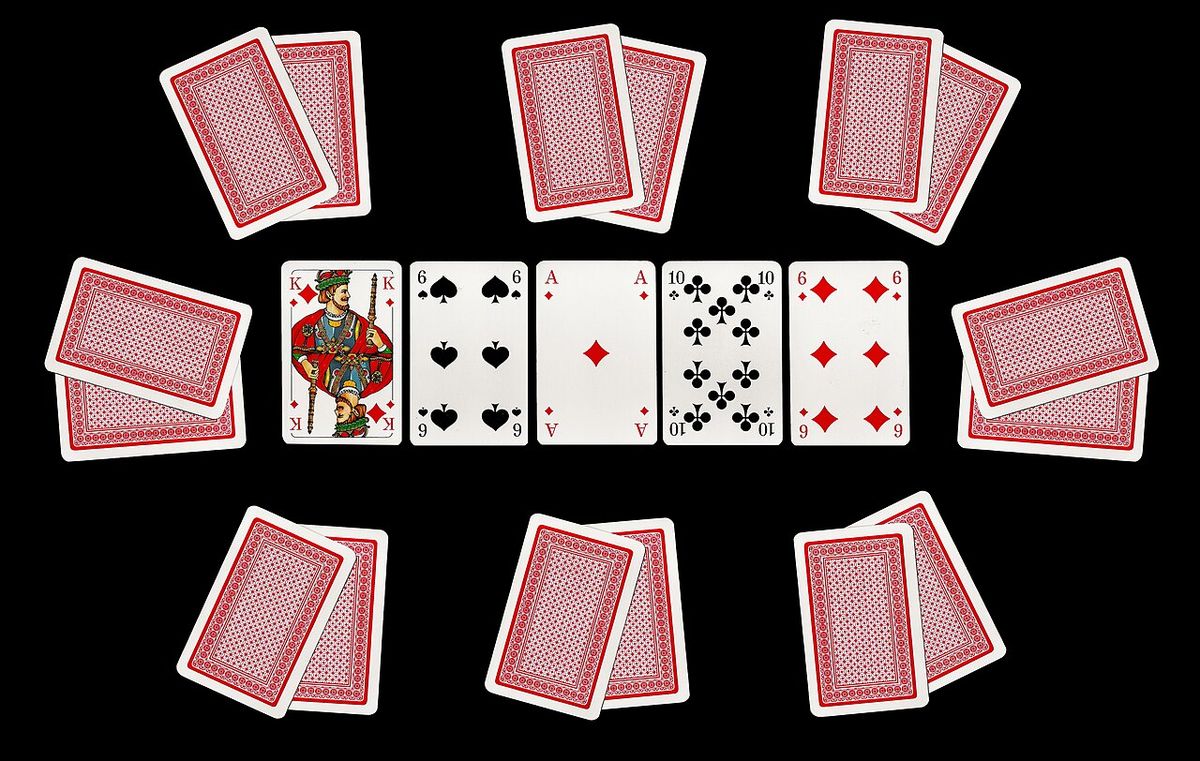
List of poker hands
In poker, a hand is a set of five playing cards that determines the winner of each round. The ranking of these hands is the universal foundation of the game, dictating strategy in popular variants like Texas hold 'em, Omaha, and seven-card stud. The system ranks hands from the exceptionally rare royal flush down to a simple high card. The relative strength of each hand is determined by mathematical probability and specific card combinations.
The Fundamental Hand Ranking System
The core principle of poker hand rankings is that a hand in a higher category always beats a hand in a lower category. This creates a clear and consistent hierarchy used across most poker games. The categories are defined by the patterns formed by the five cards, such as pairs, sequences, or suits. Individual card ranks are ordered from highest to lowest as Ace, King, Queen, Jack, 10, down to 2, though the Ace's role can change in specific game types. It is crucial to note that the four suits, clubs, diamonds, hearts, and spades, are considered equal in value. A flush in hearts is neither better nor worse than a flush in spades. The entire system is built on the mathematical scarcity of certain combinations, making the hardest hands to achieve the most valuable.
Standard Poker Hands Ranked from Best to Worst
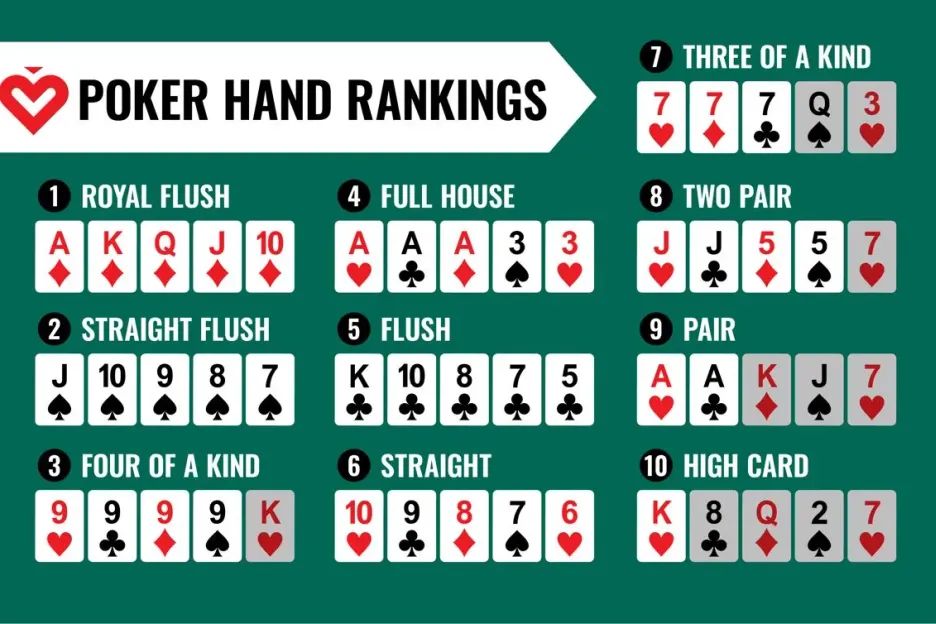
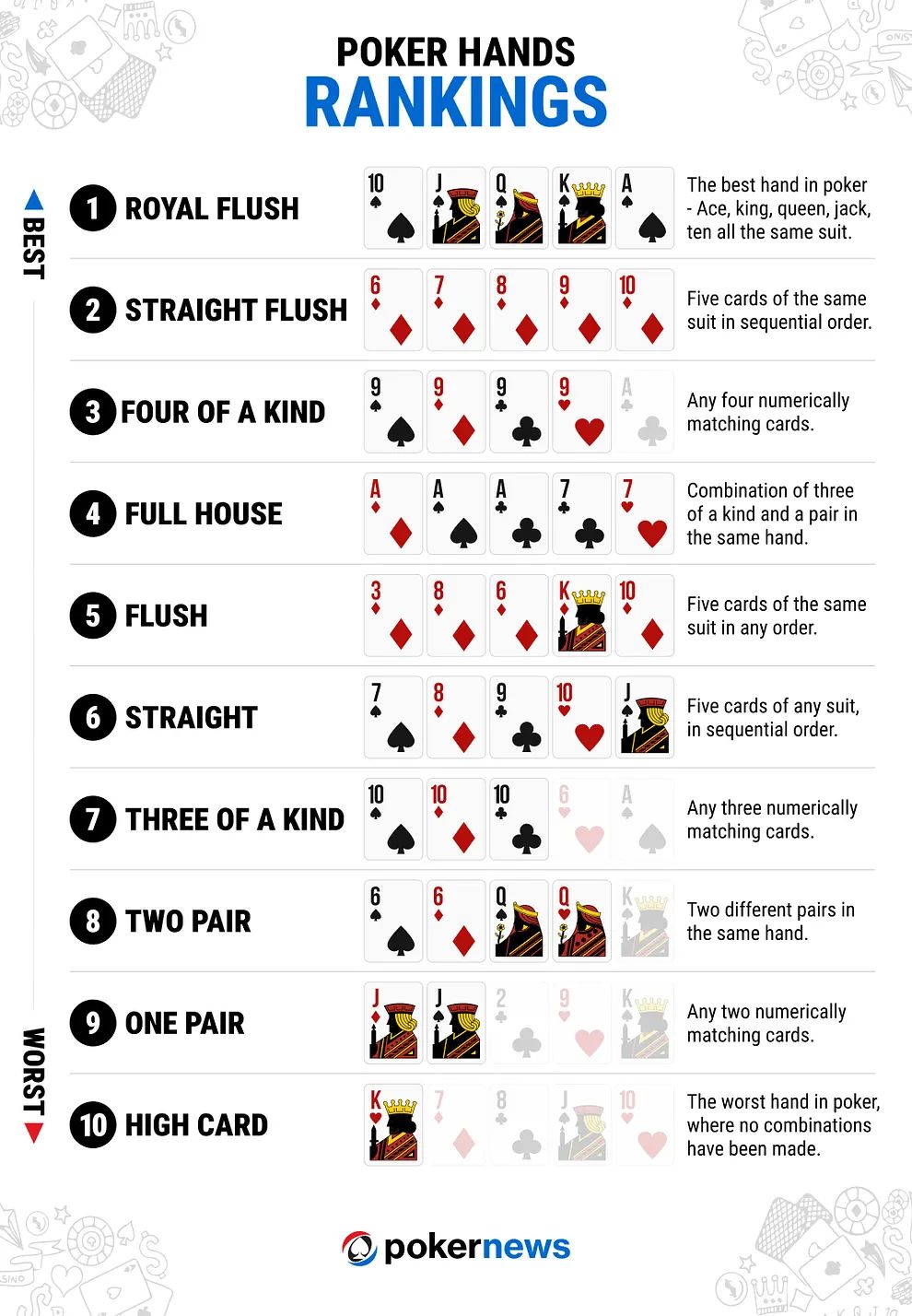
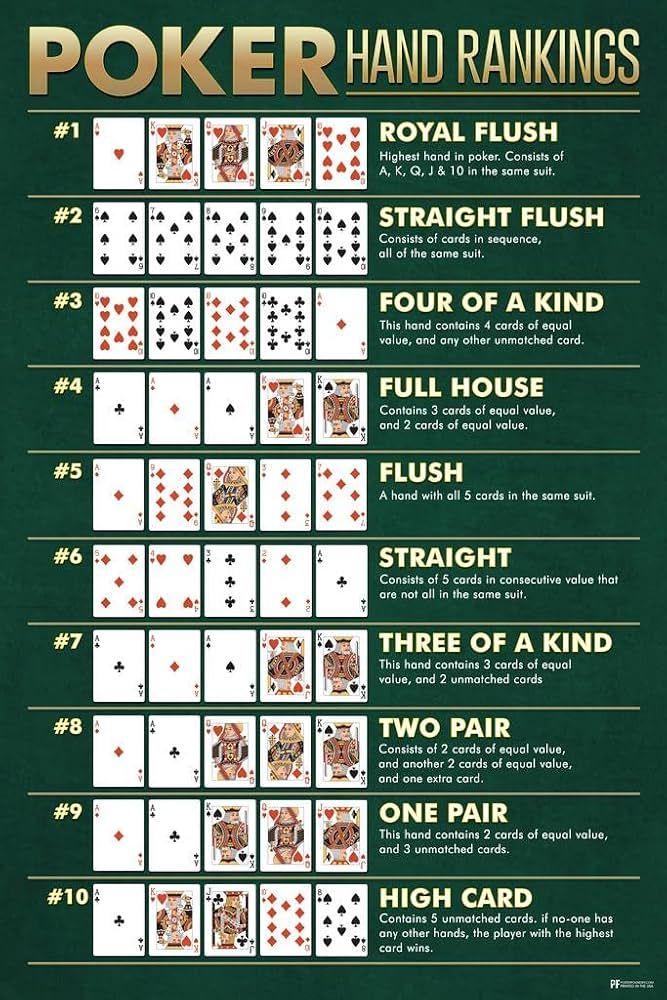
The following list details the nine standard poker hand rankings, from the strongest to the weakest, which form the essential knowledge for any player. This order is used in high games like Texas hold 'em, where the goal is to make the best possible hand. When using one or more wild cards, an additional category, Five of a Kind, becomes possible and ranks above a royal flush. Each five of a kind is ranked by the rank of its quintuplet, so five Queens beats five Sixes.
| Hand | Description | Example |
|---|---|---|
| Royal Flush | An Ace, King, Queen, Jack, and Ten, all of the same suit. | A♠ K♠ Q♠ J♠ 10♠ |
| Straight Flush | Any five cards in sequential rank, all of the same suit. | 8♥ 7♥ 6♥ 5♥ 4♥ |
| Four of a Kind | Four cards of the same rank, plus one unrelated kicker. | J♣ J♦ J♥ J♠ 3♦ |
| Full House | Three cards of one rank and two cards of another rank. | 9♠ 9♦ 9♣ 4♣ 4♥ |
| Flush | Any five cards of the same suit, not in sequence. | K♠ J♠ 8♠ 4♠ 3♠ |
| Straight | Five cards in sequential rank, of mixed suits. | 10♦ 9♠ 8♣ 7♥ 6♠ |
| Three of a Kind | Three cards of the same rank with two unmatched cards. | 7♦ 7♣ 7♥ K♦ 2♠ |
| Two Pair | Two cards of one rank, two of another, and a kicker. | Q♥ Q♣ 5♠ 5♦ 9♣ |
| One Pair | Two cards of the same rank with three unrelated cards. | A♠ A♦ J♣ 8♥ 3♠ |
| High Card | A hand that does not qualify for any other category. | K♦ J♥ 7♣ 4♠ 2♣ |
There are 2,598,960 distinct five-card hands and only 7,462 distinct hand ranks. Under standard rules, there are nine categories of hand. An ace can rank high or low in a straight but cannot wrap around. A five-high straight flush is called a steel wheel. A Broadway straight is an ace-high straight, while a wheel is a five-high straight. The hand categories are defined by the patterns formed by the cards, with rarer combinations being more valuable.
- Royal Flush: An Ace, King, Queen, Jack, and Ten, all of the same suit. This is the best possible hand in standard poker without wild cards.
- Straight Flush: Any five cards in sequential rank, all of the same suit, such as 8♥ 7♥ 6♥ 5♥ 4♥. A royal flush is the highest-ranking straight flush.
- Four of a Kind (Quads): Four cards of the same rank, plus one unrelated kicker card, for example, J♣ J♦ J♥ J♠ 3♦.
- Full House (Boat): Three cards of one rank and two cards of another rank, such as 9♠ 9♦ 9♣ 4♣ 4♥, described as nines full of fours.
- Flush: Any five cards of the same suit, not in sequence, like K♠ J♠ 8♠ 4♠ 3♠.
- Straight (Run): Five cards in sequential rank, of mixed suits, such as 10♦ 9♠ 8♣ 7♥ 6♠. An Ace can be high (A-K-Q-J-10) or low (5-4-3-2-A).
- Three of a Kind (Trips/Set): Three cards of the same rank with two unmatched cards, for instance, 7♦ 7♣ 7♥ K♦ 2♠.
- Two Pair: Two cards of one rank, two cards of another rank, and a kicker, like Q♥ Q♣ 5♠ 5♦ 9♣.
- One Pair: Two cards of the same rank with three unrelated cards, for example, A♠ A♦ J♣ 8♥ 3♠.
- High Card: A hand that does not qualify for any of the above categories. Its rank is determined by its highest card, such as King-high for K♦ J♥ 7♣ 4♠ 2♣.
Detailed Rules for Each Hand Category
Beyond the basic ranking order, specific rules govern how hands are formed and compared within each category. These rules address the role of the Ace, the treatment of suits, and the use of kicker cards to break ties. For a straight or straight flush, an Ace can rank either high, as in A-K-Q-J-10, or low, as in 5-4-3-2-A, but it cannot wrap around to form a sequence like K-A-2-3-4. In a full house, the hand is ranked first by the rank of its three cards, then by the rank of its pair. Therefore, a full house with three eights and two sevens beats a hand with three sevens and two aces. The ranking of a flush or a high card hand is determined by comparing the cards in descending order. For example, a flush of K♦ J♦ 9♦ 6♦ 4♦ beats a flush of Q♣ J♣ 7♣ 6♣ 5♣ because the king beats the queen. If the first cards are equal, the second-highest cards are compared, and so on. In community card games like Texas hold 'em, the term set is often used for three of a kind when a player holds a pocket pair and matches it with a third card on the board, while trips refers to using a single hole card to match a pair on the board.
- A Broadway straight is an ace-high straight (A-K-Q-J-10).
- A wheel or bicycle is a five-high straight (5-4-3-2-A), which is also the best possible hand in ace-to-five low games.
- A steel wheel is a five-high straight flush (5♥ 4♥ 3♥ 2♥ A♥).
- Under ace-to-five low rules, straights, flushes, and straight flushes are not recognized. A straight flush is simply considered a high card hand.
- In deuce-to-seven low rules, an Ace always ranks high, so 5-4-3-2-A is an ace-high hand, not a straight.
- There are 156 distinct kinds of full houses and 3,744 different full house card combinations in a standard deck.
- Five of a kind is only possible when using one or more wild cards, such as a joker acting as a bug or fifth ace.
How to Break Ties Within the Same Hand Category
When two or more players make hands of the same category, specific tie-breaking rules determine the winner by comparing the ranks of the cards involved. Suits are never used to break ties. For a straight flush or a straight, the hand with the higher top card wins. A 9-high straight flush beats an 8-high straight flush. With four of a kind, the rank of the four matching cards is compared first, and if those are identical, the rank of the kicker decides the pot. A full house is ranked first by the three of a kind component, then by the pair. Three Queens and two Fours beats three Jacks and two Aces. To compare flushes, high card hands, and the kickers in one-pair or two-pair hands, players compare their cards in descending order. For a flush, the player with the higher top card wins. If the top cards are equal, the second-highest card is compared, and so on. The same process applies to high card hands. When comparing two pair hands, the higher pair is evaluated first. If those match, the lower pair is compared, and if both pairs are identical, the rank of the fifth card decides the winner. If, after all comparisons, the hands are completely identical in rank, the pot is split evenly between the tied players. This can happen when the best five-card hand is entirely composed of community cards in games like Texas hold 'em.
Hand Rankings in Lowball and Split-Pot Games
Not all poker games reward the highest hand. In lowball games like Razz or 2-7 Triple Draw, the goal is to make the lowest possible five-card hand. Crucially, these games still use the standard hand ranking categories but in reverse order. A pair is worse than a high card, and a flush is a very bad hand. The specific rules for ranking low hands vary. Under ace-to-five low rules, commonly used in games like California Lowball, the best possible hand is 5-4-3-2-A, known as a wheel or bicycle. Straights and flushes do not count against the hand, so this 5-4-3-2-A is simply a five-high, the lowest possible hand. Under deuce-to-seven low rules, often called Kansas City lowball, the Ace is always high and straights and flushes do count as high hands. Therefore, the best possible hand is 7-5-4-3-2 of mixed suits, not forming a straight. In high-low split games like Omaha Hi-Lo, the pot is divided between the best high hand, ranked normally, and the best qualifying low hand, typically following the ace-to-five low rules. A single hand, like a steel wheel (5♥ 4♥ 3♥ 2♥ A♥), can win both the high and low halves of the pot, as it is both a straight flush and the best low hand. The treatment of low hands is critical for strategy in these split-pot variants.
Probability and Frequency of Poker Hands
The ranking order of poker hands is directly tied to their mathematical probability of occurring when five cards are dealt from a standard 52-card deck. There are 2,598,960 possible distinct five-card hands. The rarer a hand is, the higher it ranks. These probabilities shift in community card games like Texas hold 'em, where players use seven cards to make their best five-card hand, increasing the chance of making stronger combinations. Nevertheless, the relative scarcity that defines the hierarchy remains constant. The odds are foundational for understanding hand strength and making mathematically sound decisions during play.
Application in Major Poker Variants and Exceptions
The standard hand rankings are used in virtually all popular poker variants, though the method of forming a hand differs. In Texas hold 'em and Omaha, players combine their private hole cards with community cards shared by all to make the best five-card hand. In seven-card stud, players are dealt a mix of face-up and face-down cards and must construct their hand from the seven they receive. The five-card hand ranking remains the constant measure of strength. Even in games like Chinese Poker or Big Two, which use different structures, the core concepts of pairs, flushes, and straights are adapted from this foundational system. However, some notable exceptions and adaptations exist in other card games that use poker-like hand rankings. Understanding hand rankings is the first critical skill for any poker player. It allows for accurate assessment of one's own hand strength, informs betting and bluffing decisions, and is essential for reading the board to deduce opponents' possible holdings.
- In Chinese Poker, a three-card straight or three-card flush cannot be formed in the front hand, and three-of-a-kind is the highest rank for a three-card combination.
- In Big Two, the 2 is the highest rank and the 3 is the lowest, which changes straight rankings. The highest straight is 2-3-4-5-6 and the lowest is 7-8-9-10-J.
- In games using a 52-card deck with no wild cards, there are nine categories of hand. A tenth category is added when wild cards are used.
- Under ace-to-five low rules, straights and flushes are not recognized, so a hand like 9♣ 8♣ 7♣ 6♣ 5♣ is simply a nine-high hand, not a straight flush.
- Non-standard poker hands, like a 'blaze' or a 'dog', exist in some home games but are not part of the official ranking hierarchy.
Questions about List of poker hands
Does a flush beat a straight?
Yes, a flush beats a straight in the standard poker hand rankings. A flush is five cards of the same suit, while a straight is five cards in sequential rank of mixed suits. A flush ranks directly above a straight and below a full house. Therefore, a king-high flush would defeat an ace-high straight. This ranking is consistent across high games like Texas hold 'em.
What is the best possible hand in poker?
The best possible hand in standard poker, without wild cards, is a Royal Flush. This is an ace-high straight flush, consisting of the Ace, King, Queen, Jack, and Ten, all of the same suit. It is an unbeatable hand. With wild cards, Five of a Kind becomes the best possible hand, ranking above a royal flush.
How are ties broken in poker?
Ties are broken by comparing the ranks of the cards within the same hand category. For pairs, three of a kind, and four of a kind, the higher set wins. For flushes and high cards, players compare their cards from highest to lowest until a difference is found. For two pair, the higher pair is compared first, then the lower pair, then the kicker. If two hands are completely identical, the pot is split evenly between the tied players.
What is a 'full house' in poker?
A full house is a five-card hand containing three cards of one rank and two cards of another rank. It is also called a 'boat'. An example is 8♠ 8♦ 8♣ 4♣ 4♥, described as eights full of fours. It ranks above a flush and below four of a kind. When comparing full houses, the rank of the three-of-a-kind component is decisive.
Can an Ace be low in a straight?
Yes, in standard high poker games, an Ace can be used as the low card in a straight to form A-2-3-4-5, known as a 'wheel' or 'baby straight'. This is the lowest possible straight. The Ace cannot wrap around to form a sequence like Q-K-A-2-3. In lowball games, the treatment of the Ace varies by the specific rules being used.
What is the order of poker hands from best to worst?
The standard order of poker hands from strongest to weakest is Royal Flush, Straight Flush, Four of a Kind, Full House, Flush, Straight, Three of a Kind, Two Pair, One Pair, and High Card. This hierarchy applies to high games like Texas hold 'em and seven card stud using a standard 52 card deck. A hand in a higher ranking category always ranks higher than a hand in a lower category. There are nine categories under standard rules.
Sources and further reading
- List of poker hands (Wikipedia)
- Poker Hands: The Complete Guide to Hand Rankings (riverwind.com)
- Poker Hands Ranked: The Best Hands in Poker, MERKUR Slots (merkurcasinouk.com)
- Poker Hand Rankings (gldproducts.com)
- Poker Hands in Order (Highest to Lowest): Hand Rankings Explained (pokernews.com)
- Poker Hand Rankings In Order, Downloadable Cheatsheet (poker.org)
- Poker Hands Ranked and Charts (pokerstars.com)
Checked by the Nosy Mag desk. Last updated 2026-11-08.