Pauline Marois
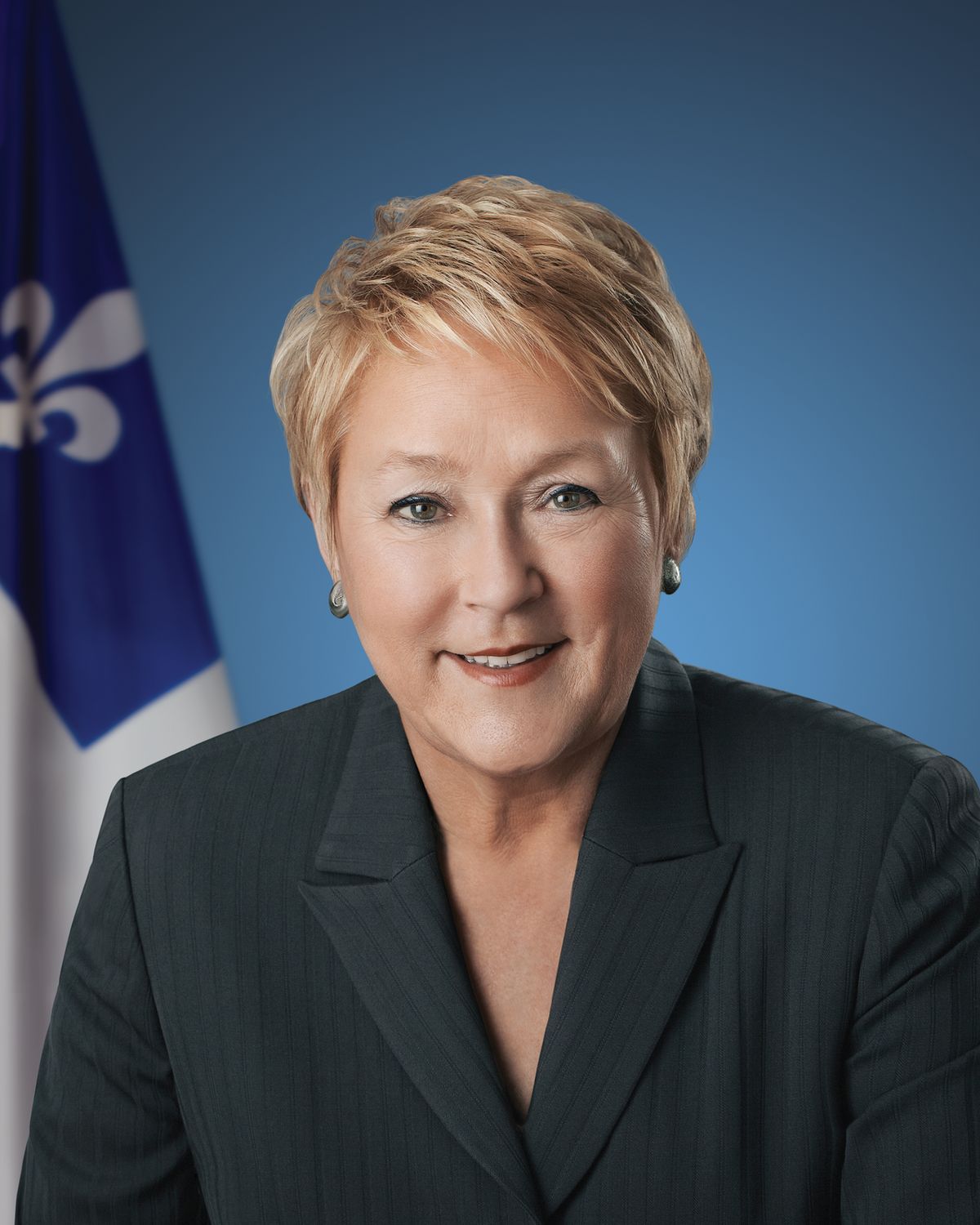
Pauline Marois is a retired Canadian politician who served as the 30th premier of Quebec from 2012 to 2014. A member of the Parti Québécois (PQ), she was the first woman to hold the office of premier in the province's history. Her political career spanned over three decades, during which she held numerous senior cabinet portfolios including finance, education, and health, and she led the PQ from 2007 to 2014. Marois's tenure as premier, though brief, was marked by significant policy initiatives such as the proposed Quebec Charter of Values and the closure of the province's nuclear reactor.
Early Life and Education
Pauline Marois was born on March 29, 1949, at Saint-François d'Assise Hospital in the working-class Limoilou neighbourhood of Quebec City. She was the eldest of five children born to Marie-Paule Gingras and Grégoire Marois, a heavy machinery mechanic who built the family's small two-story brick house in Saint-Étienne-de-Lauzon, a village later amalgamated into Lévis on the south shore of the Saint Lawrence River. Marois has described her parents as nationalists and devout Catholics, though not heavily involved in politics, with her father showing interest in the ideas of the Social Credit and Union Nationale parties and keeping current with the news on an early 1950s television. Her early education began at the parish school in nearby Saint-Rédempteur, where she excelled in French, history, and geography, developed an interest in reading, and received numerous books as prizes for her academic achievements.
At age 12, she experienced a significant cultural shift when she enrolled at the exclusive all-girls Catholic private school, Collège Jésus-Marie de Sillery, an environment she later described as a culture shock that left a permanent mark on her outlook. She became aware of her lower social status there, especially as her mother sometimes did housecleaning jobs in the affluent houses of Sillery to help pay the tuition. In 1968, Marois enrolled in the social work program at Université Laval in Quebec City. Her focus at the time was on poverty and international issues rather than Quebec sovereignty, and she participated in a study on housing in the city's Lower Town and demonstrated against the Vietnam War.
The following year, she married her high school sweetheart, Claude Blanchet, a budding entrepreneur who had bought his first gas station at age 17 while studying business administration. A key internship in Hull in 1970, coinciding with the October Crisis, deeply influenced her identity as she helped create a local chapter of a consumer advocacy group. In her 2008 autobiography, she stated she arrived in the Outaouais region as a French Canadian but left forever identifying as a Quebecer. She graduated with her degree in social work in the spring of 1971 and later pursued a Master of Business Administration at HEC Montréal, where she took classes with economist Jacques Parizeau.
Early Career and Entry into Politics
After university, Marois worked with several community organizations, helping to launch CFVO-TV, a community television station in the Outaouais region, and lectured in social work at the Cégep de Hull. She also served as the CEO of a local community service centre (CLSC) before moving to Montreal in July 1978. After completing her MBA, she was hired as the head of the childhood services division at the Centre des services sociaux du Montréal Métropolitain. Her initial foray into partisan politics was as a volunteer for the Parti Québécois, delivering barbecue chicken to election workers on election day in 1973.
In the fall of 1978, she joined Jacques Parizeau's office at the Department of Finance as a press officer but left after six months, feeling Parizeau was not utilizing her to her full potential. In November 1979, she accepted a role as chief of staff to Lise Payette, the minister responsible for the status of women, who famously told Marois she would make a feminist of her after Marois expressed hesitation about not being feminist enough. Marois entered electoral politics while seven months pregnant. With encouragement from her husband and Premier René Lévesque, she ran for the PQ in the 1981 general election, winning a contested nomination in the riding of La Peltrie. She was elected with a majority of 5,337 votes over her Liberal opponent, becoming one of only eight women elected that year.
Merely eleven days after taking her seat in the National Assembly, she gave birth to her second child, Félix, on April 24, 1981. Less than a week later, at age 32, she was appointed to the René Lévesque cabinet as minister for the status of women, replacing her former boss Lise Payette. She was appointed vice-chair of the Treasury Board in September 1982. She was promoted to minister of labour and income security and minister responsible for the Outaouais region at the end of 1983.
Ministerial Career and Policy Legacy
Marois was appointed vice-chair of the Treasury Board in September 1982 and was promoted to minister of labour and income security and minister responsible for the Outaouais region in late 1983. During the internal party strife following the 1984 federal election of Brian Mulroney, Marois was first approached by Pierre-Marc Johnson, leader of the moderate 'kangaroo' faction favourable to accommodations with Ottawa, but ultimately sided with the more hardline 'caribou' group. She was a signatory to a November 9, 1984, letter from half of Lévesque's ministers disavowing the Premier's 'beau risque' strategy and calling for sovereignty to be central to the next election, though she did not resign from cabinet as seven of her co-signatories did by the end of the month. After Lévesque's resignation in June 1985, Marois entered the leadership race, running on a platform of full employment and sovereignty, and finished a distant second with 19,471 votes (19.7 percent), behind winner Pierre Marc Johnson's 56,925 votes (58.7 percent).
Following the PQ's defeat in the 1985 general election, which saw Marois lose her seat in La Peltrie to Liberal Lawrence Cannon, she worked with feminist organizations, becoming treasurer of the Fédération des femmes du Québec and a consultant with the Elizabeth Fry Society, while lecturing at Université du Québec à Hull. She remained on the PQ executive until spring 1987 and, after Johnson left the party in shambles, decided not to run for leader, criticizing front-runner Jacques Parizeau's attitude towards women in a January 1988 interview. Parizeau convinced her to return to the PQ executive to oversee the party platform and to run in a 1988 by-election in Anjou, where she placed second with 44.8 percent of the vote. She returned to the National Assembly after winning the Longueuil-based riding of Taillon, once held by Lévesque, in the 1989 general election.
She served in Parizeau's shadow cabinet as critic for industry and trade and later Treasury Board, and was a PQ representative on the Bélanger-Campeau Commission after the failure of the Meech Lake Accord. When the PQ returned to power in 1994, Marois began a nine-year tenure as one of Quebec's most powerful ministers under premiers Jacques Parizeau, Lucien Bouchard, and Bernard Landry. She is the only politician in Quebec history to have held the three key portfolios of finance, education, and health. Her policy achievements during this period were substantial and long-lasting.
As education minister, she successfully piloted Bill 109 in 1997, which replaced the province's confessional school boards with language-based ones, a change requiring a bilateral constitutional amendment negotiated with Prime Minister Jean Chrétien's federal government. She introduced a controversial proposal to lift the two-decade tuition freeze, sparking the 1996 student protests, which led the government to reinstate the freeze while introducing fees for out-of-province Canadian students and for failing CEGEP courses. In 1997, she implemented the popular five-dollar-a-day subsidized daycare program. As health minister from 1998 to 2001 and later as finance minister and deputy premier under Bernard Landry, she was instrumental in implementing pharmacare and parental-leave plans and in slashing the provincial deficit under Premier Bouchard's 'zero deficit' agenda. By 2003, she had occupied 15 different ministries and was central to the legacy of the second PQ government from 1994 to 2003.
Path to Party Leadership and Premiership
Marois made two unsuccessful bids for the leadership of the Parti Québécois before ultimately securing the role. After the PQ's 2003 electoral defeat, she organized a leadership bid with support from figures like Danielle Rioux, Joseph Facal, and Pierre Langlois through the think tank Groupe réflexion Québec. She announced her candidacy following Bernard Landry's sudden resignation in June 2005 but placed second to André Boisclair, winning 30.6 percent of the vote. She subsequently retired from the National Assembly in March 2006, stating that after 25 years it was time to pursue other interests, and was succeeded in Taillon by Marie Malavoy.
Following the PQ's disappointing third-place finish in the March 2007 election, Boisclair resigned on May 8, 2007. Marois announced her candidacy on May 11 and, with the withdrawal of other potential candidates like Gilles Duceppe, was acclaimed as the seventh leader of the Parti Québécois on June 27, 2007. She returned to the legislature by winning a by-election in the riding of Charlevoix on September 24, 2007, where the governing Liberals chose not to field a candidate. She won with 58.2 percent of the vote against an Action démocratique du Québec opponent. Her campaign used the slogan 'Chez nous, c'est Pauline' on blue-green signs, though this populist image was contrasted in media with her affluent lifestyle, including a 12,000-square-foot mansion on Île-Bizard. From 2008 to 2012, she served as leader of the Official Opposition. Her leadership faced significant internal challenges in 2011 and early 2012, with prominent members of her caucus publicly questioning her direction. She survived these challenges, earning the nickname 'Dame de béton' or 'Concrete Lady' for her resilience.
Premiership and the 2014 Defeat
Marois's premiership lasted 19 months, the shortest of any Quebec government since Confederation. Her government pursued several notable policies, including the closure of Quebec's only nuclear reactor at Gentilly-2 and the cessation of all asbestos production in the province. The government's highest profile initiative was the proposed Quebec Charter of Values. The charter sought to establish state secularism by prohibiting the province's roughly 600,000 public sector employees from wearing conspicuous religious symbols such as turbans, hijabs, kippahs, and large crosses while at work. The charter notably would not have removed the crucifix hanging above the speaker's chair in the National Assembly, a point that drew significant criticism. The proposal sparked intense debate across Quebec and Canada and became a defining issue of her government. In March 2014, Marois called a general election seeking a majority mandate. The campaign was dominated by debates over sovereignty and the Charter of Values. The election on April 7, 2014, resulted in a decisive defeat for the Parti Québécois, which was reduced to 30 seats. Marois was personally defeated in her riding of Charlevoix, Côte-de-Beaupré by Liberal candidate Caroline Simard. The PQ's share of the popular vote fell to about 25 percent, its lowest since its first election in 1970. Following the loss, Marois announced her resignation as PQ leader on April 10, 2014.
Post-Premiership and Lasting Influence
Since leaving politics, Marois has remained an influential figure within the Parti Québécois and a commentator on Quebec affairs. Her legacy is frequently referenced in contemporary political discourse, particularly regarding sovereignty strategy and minority government management. In 2026, as the Parti Québécois prepared to form a new minority government under leader Paul St-Pierre Plamondon, Marois's experience was directly invoked. The incoming premier-designate announced that Marois, along with former Parizeau chief of staff Jean Royer, would help provide political training for the PQ's large cohort of 59 new members of the National Assembly, aiming to instill discipline and a strong work ethic.
Her policy record continues to be a touchstone for analysis. Commentators have noted that Plamondon's platform, with its focus on balanced budgets, a proposed $6.6 billion reduction in spending over five years, and a restrictive 'sustainable immigration model' that scapegoats newcomers, has more in common with the austerity of Lucien Bouchard and the ethnonationalist themes of Marois's Charter of Values than with the social democratic origins of the PQ under René Lévesque. Nicolas Marceau, who served as finance minister in Marois's cabinet from 2012 to 2014, was reappointed to the same portfolio in the 2026 PQ government, creating a direct link to her administration's fiscal policies. Marois's advice to the new minority government, drawing on her own experience, emphasized collaboration with opposition parties to succeed.
Electoral History and Political Offices
Pauline Marois's electoral career was marked by both significant victories and defeats across multiple ridings. She held several of the most senior positions in the Quebec government, shaping policy for nearly a decade before becoming premier. Her path included initial success, a period in the political wilderness, and a commanding return to the cabinet table. She first won election in the 1981 general election in the riding of La Peltrie, becoming one of only eight women elected that year and immediately being appointed to cabinet as minister for the status of women at age 32.
- 1981: Elected MNA for La Peltrie. Appointed Minister for the Status of Women at age 32, succeeding Lise Payette.
- 1985: Defeated in La Peltrie by Liberal candidate Lawrence Cannon in the general election.
- 1988: Lost a June 20 by-election in the riding of Anjou, placing second with 44.8 percent of the vote.
- 1989: Elected MNA for Taillon, a riding once held by René Lévesque. Began service as Official Opposition critic.
- 1994 to 1998: Re-elected in Taillon. Served as President of the Treasury Board and Minister of Family under Parizeau, then Minister of Education under Bouchard.
- 1998 to 2001: Re-elected in Taillon. Served as Minister of Health and Social Services.
- 2001 to 2003: Appointed Deputy Premier and Minister of Finance by Premier Bernard Landry, becoming the third woman after Lise Bacon and Monique Gagnon-Tremblay to assume the role.
- 2003: Retired from the National Assembly after the PQ's electoral defeat (briefly returned in 2005 to 2006).
- 2007: Won September 24 by-election in Charlevoix. Acclaimed as Leader of the Parti Québécois on June 27.
- 2008 & 2012: Re-elected in Charlevoix (riding later became Charlevoix, Côte-de-Beaupré). Served as Leader of the Opposition (2008 to 2012) and Premier (2012 to 2014).
- 2014: Defeated in Charlevoix, Côte-de-Beaupré, ending her elected political career.
Throughout her tenure as a minister from 1994 to 2003, Marois held an unprecedented 15 different cabinet portfolios. She became the only politician in Quebec history to hold the three pillars of government, which are the Finance, Education and Health portfolios. This experience earned her the informal title of 'Minister of Everything'. She was a dominant figure on the Quebec political scene for nearly a decade.
Comparison of Parti Québécois Election Results Under Marois
Pauline Marois led the Parti Québécois through two general elections as leader, resulting in one minority government victory and one decisive defeat. The table below compares the party's performance in these elections, highlighting the shift in popular support and seat count that defined her leadership's beginning and end. The 2012 campaign focused on a change from the Liberal government, while the 2014 campaign was dominated by the Charter of Values and sovereignty, which ultimately alienated many voters. The drop in popular vote from 2012 to 2014 represents one of the most significant declines for the party in its history.
| Election | Seats Won | Popular Vote % | Result |
|---|---|---|---|
| 2012 | 54 | Approximately 32% | Minority Government |
| 2014 | 30 | Approximately 25% | Defeat |
The 2012 election saw the PQ form a government with a narrow plurality of seats, though it secured less than a third of the popular vote. The 2014 campaign, which Marois called seeking a stronger mandate, backfired dramatically. The party lost 24 seats and its vote share dropped significantly, marking its worst popular vote result since 1970. This defeat ended Marois's premiership and her tenure as party leader, closing a chapter in PQ history defined by her pragmatic yet contentious leadership and setting the stage for a prolonged period of rebuilding for the party.
Personal Life and Public Perception
She is married to Claude Blanchet, former head of the Fonds de solidarité FTQ and Quebec's Société générale de financement, and is the mother of four children: Catherine (born June 1979), Félix (born April 1981), François-Christophe (born October 1983) and Jean-Sébastien (born July 1985). Blanchet, a successful businessman, was appointed president of the Société générale de financement (SGF), the Quebec government's investment arm, during the years Marois served as a senior minister. His substantial personal investments in public companies that did business with the government occasionally placed Marois in an uncomfortable position, particularly during her tenure as finance minister and deputy premier when questions about conflict of interest arose. The couple's affluent lifestyle, including their 12,000-square-foot mansion on Île-Bizard which sold for nearly seven million dollars in January 2012, sometimes contrasted with the populist image she sought to project, as seen in her 2007 by-election slogan 'Chez nous, c'est Pauline'. Marois is an atheist. Her autobiography, titled 'Québécoise!' and published in 2008, details her journey from a working-class childhood to the pinnacle of Quebec politics. In it, she recounts the formative experiences of her education and early career that solidified her Quebec nationalist identity. Public perception of Marois was often defined by her resilience, earning her the nickname 'Dame de béton' (Concrete Lady) for surviving internal party challenges, and by the controversial policies she championed, which ensured she remained a polarizing figure long after her premiership ended.
Questions about Pauline Marois
What is Pauline Marois best known for?
Pauline Marois is best known as the first woman to serve as premier of Quebec, holding the office from 2012 to 2014. She is also known for her long ministerial career where she implemented major policies like the five-dollar-a-day daycare program and the reform of Quebec's school boards. Her premiership was dominated by the controversial Quebec Charter of Values, which proposed banning public sector employees from wearing conspicuous religious symbols. Her 19-month government was the shortest in Quebec since Canadian Confederation.
What did Pauline Marois do after leaving politics?
After resigning as PQ leader following the 2014 election defeat, Pauline Marois retired from elected politics. She has remained an influential voice within the sovereigntist movement and a commentator on Quebec affairs. In 2026, her experience was formally tapped by the new Parti Québécois minority government under Paul St-Pierre Plamondon, who enlisted her and Jean Royer to provide political training for the party's incoming 59 members of the National Assembly. In 2019, she received an honorary doctorate from the Université du Québec en Outaouais.
What were Pauline Marois's major accomplishments as a minister?
As a senior minister from 1994 to 2003, Pauline Marois spearheaded several enduring policies. She successfully replaced Quebec's confessional school boards with language-based ones through a 1997 constitutional amendment. She implemented the province's universal subsidized daycare program at five dollars a day in 1997. As finance minister and deputy premier, she helped manage the province's finances under the 'zero deficit' agenda. Across various roles, she was instrumental in establishing pharmacare and parental-leave plans, restructuring post-secondary tuition, and holding an unprecedented 15 different cabinet portfolios.
How is Pauline Marois connected to the current Parti Québécois?
Pauline Marois remains a symbolic and practical link to the current Parti Québécois. In 2026, incoming Premier Paul St-Pierre Plamondon asked her to help provide political training for the PQ's new caucus members. Nicolas Marceau, who served as finance minister in Marois's cabinet from 2012 to 2014, was reappointed to the same portfolio in the 2026 PQ government. Commentators also frequently compare Plamondon's policy focus on austerity, balanced budgets, and a restrictive immigration stance to the direction of Marois's and Lucien Bouchard's governments, noting a continuity in approach.
How long was Pauline Marois premier of Quebec?
Pauline Marois served as premier of Quebec for 19 months, from September 19, 2012, to April 23, 2014. She became premier after leading the Parti Québécois to a minority government victory in the 2012 Quebec general election, which made her the first female premier in the province's history. Her government was defeated in the 2014 Quebec general election, an election that she herself had called. This electoral defeat marked the shortest stay of any Quebec provincial government since Canadian Confederation.
What was the Quebec Charter of Values?
The Quebec Charter of Values was a controversial proposal by Premier Pauline Marois's government. This initiative sought to ban the province's approximately 600,000 government employees from wearing conspicuous religious symbols, including Islamic veils, Jewish kippahs, and turbans. Notably, the charter would not have banned the crucifix hanging in the provincial legislature. The proposal was a high profile initiative during her tenure but was not enacted into law. Her party was defeated in the 2014 election, which ended her premiership after 19 months.
Sources and further reading
- Pauline Marois (Wikipedia)
- What to know about Quebec's new cabinet ahead of ... (cbc.ca)
- Parti Québécois winning candidates to be sworn in at ... (montreal.citynews.ca)
- A dangerous liaison looms in Québec (canadiandimension.com)
Checked by the Nosy Mag desk. Last updated 2026-10-24.