Elections in Canada
Elections in Canada are the formal processes by which citizens choose their representatives at the federal, provincial, territorial, and municipal levels of government. Governed by legislation like the Canada Elections Act and administered by independent bodies such as Elections Canada, these elections determine the composition of legislatures and, ultimately, which party or coalition forms the government. The most common electoral system is first-past-the-post, used in federal and provincial elections, though this has been a subject of ongoing debate and attempted reform. Formal elections have occurred in Canada since at least 1792, with the first recorded election held in Halifax in 1758 to elect the 1st General Assembly of Nova Scotia.
Structure and administration
Canadian elections are organized by independent, non-partisan agencies specific to each level of government. At the federal level, Elections Canada administers elections and referendums under the Canada Elections Act. Provincial and territorial elections are run by their own bodies, such as Elections Ontario or Elections BC. Municipal elections are administered by local clerks or similar offices. These agencies are responsible for maintaining voter lists, setting polling places, training officials, and enforcing electoral laws. The National Register of Electors, a permanent database of eligible voters, is updated continuously using data from the Canada Revenue Agency, Canada Post, and provincial motor vehicle registries. Each year, this register is updated with approximately 3 million address changes, 400,000 new voters reaching age 18, and 200,000 removals due to death. Over 150,000 individuals a year become naturalized Canadians and are added to the register based on information from Immigration, Refugees and Citizenship Canada.
The basic structure of representation differs between levels of government. Federally, citizens elect Members of Parliament to the House of Commons from 343 single-seat constituencies, known as ridings. Senators are appointed, not elected. Provincial and territorial legislatures are similarly composed of elected members from geographic districts. Municipal councils typically include a mayor elected at-large and councillors representing wards. First Nations governments hold their own elections under specific community codes or the Indian Act. The administration ensures that all elections adhere to principles of accessibility, secrecy, and fairness, providing multiple voting options including advance polls, mail-in ballots, and election day voting at assigned stations. The National Register of Electors is also updated using information from provincial electoral agencies with permanent voters lists.
The electoral system and voting
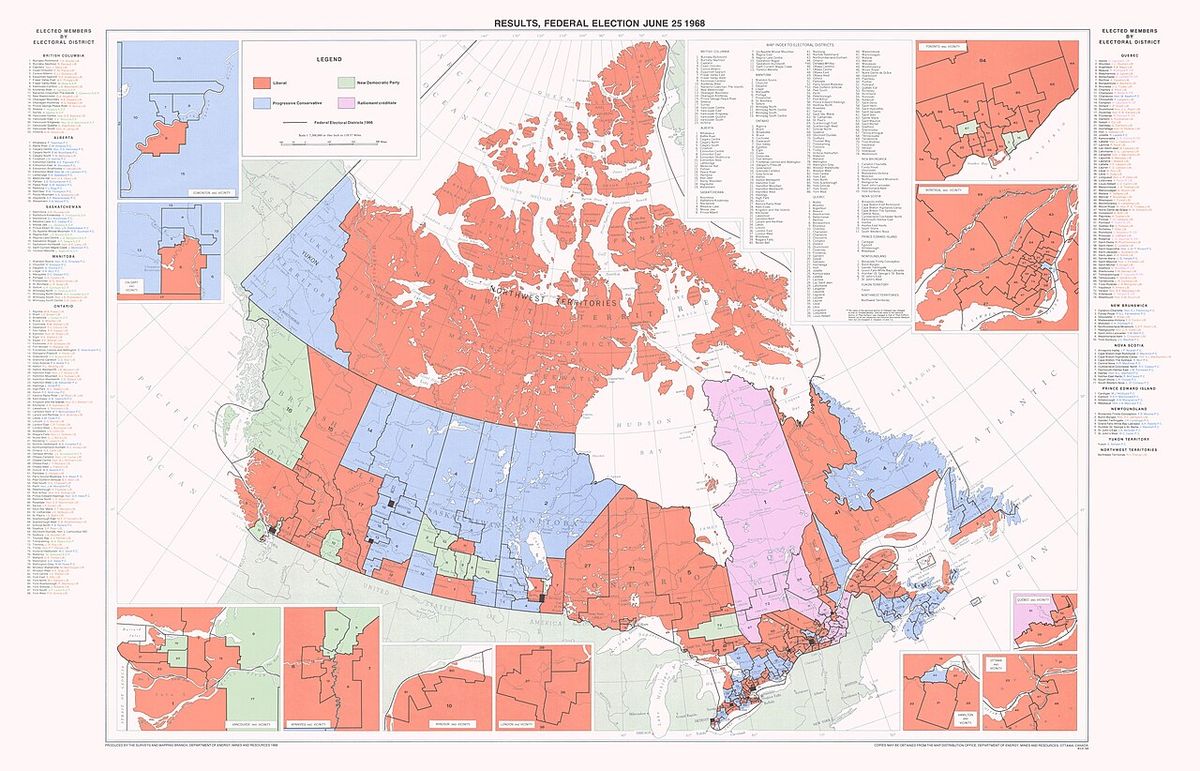
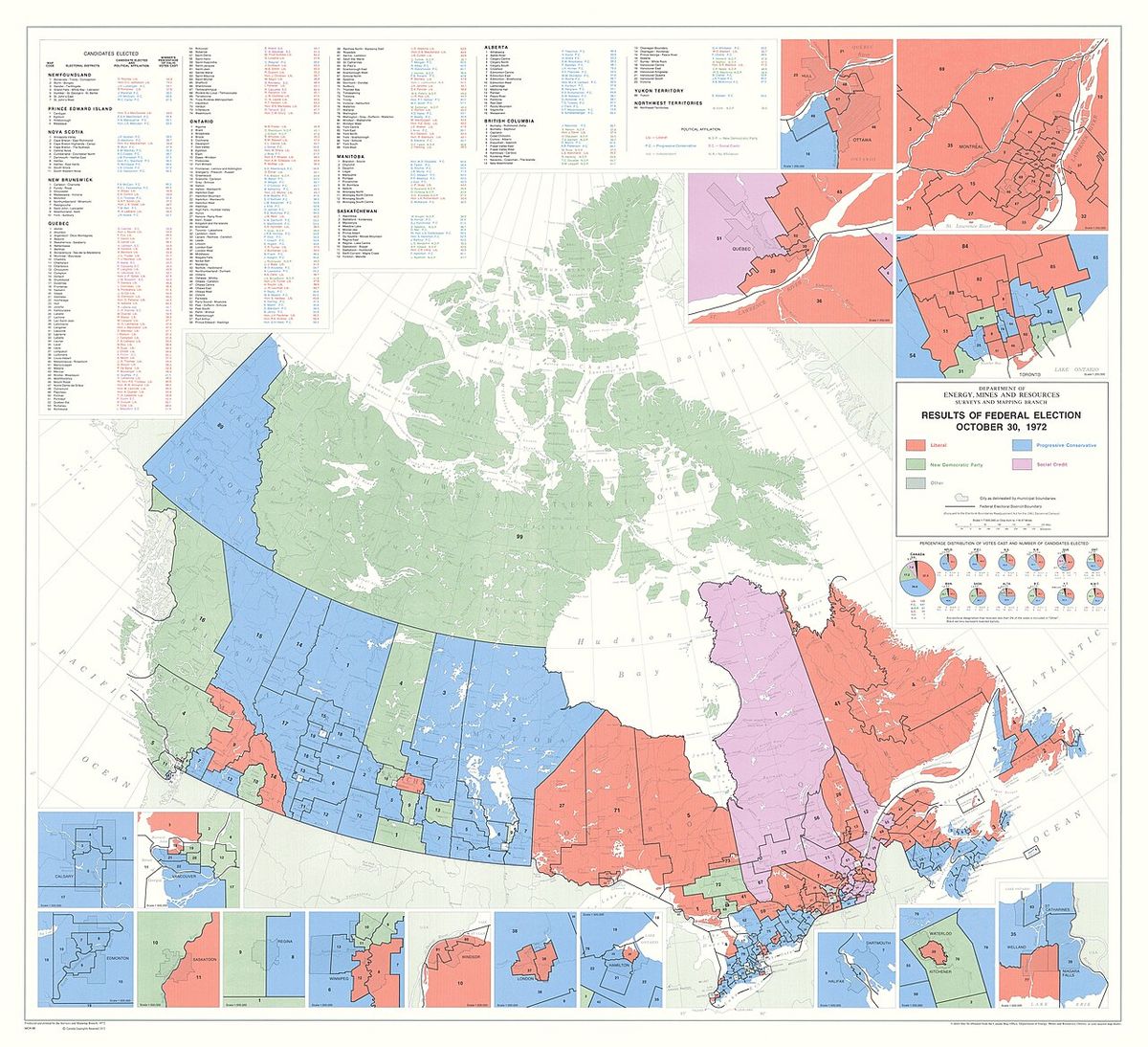
Canada employs the first-past-the-post voting system for federal and provincial elections. In each riding, the candidate who receives the most votes wins the seat, regardless of whether they achieve an absolute majority. This system tends to favour larger parties and can produce a disparity between a party's share of the national popular vote and its share of seats in the legislature. For instance, a party can form a majority government without winning a majority of votes cast across the country. Historically, the Liberal and Conservative parties have been the primary beneficiaries of this system, though other parties like the New Democratic Party have secured significant seat counts, as seen in 2011 when it became the Official Opposition for the first time.
All Canadian citizens aged 18 or older on election day have the right to vote, with few exceptions. Following a 2019 Supreme Court decision in Frank v Canada (AG), non-resident citizens can vote regardless of how long they have lived abroad, removing a previous five-year limit. Voters must prove their identity and address at the polls, with options including a driver's licence, other government-issued photo ID, or two pieces of acceptable identification. Those without documentation can still vote by making a sworn declaration and having another registered voter from the same polling division vouch for them. Elections Canada and provincial agencies undertake public education campaigns to inform voters of these requirements and the voting process.
Election campaigns have regulated lengths. Federal campaigns must be a minimum of 36 days and a maximum of 50 days, with election day set for a Monday. The 2025 federal election was held on April 28. Voters can cast their ballots on election day, at advance polls held on specific days before election day, or by mail using a special ballot. Accessibility services, including language interpretation, sign language, and Braille candidate lists, are available upon request. The voting process is designed to be inclusive, reflecting legal rulings such as Sauvé v. Canada in 2002, which affirmed the voting rights of incarcerated individuals serving sentences of less than two years. The federal election date must be set on a Monday, or Tuesday if the Monday is a statutory holiday.
Forming a government
After an election, the process of forming a government begins. The party that wins the most seats in the House of Commons typically has its leader invited by the governor general to become prime minister and form the government. However, this is not an automatic constitutional right. The governor general must appoint as prime minister the person who can command the confidence of the House, meaning they have the support of a majority of MPs. If no party wins a majority of seats, a minority government situation arises. In such cases, the party with the most seats may govern by seeking support from other parties on key votes, or parties may form a formal coalition or agreement. A notable modern example is the Confidence and Supply Agreement signed between the Liberal Party and the New Democratic Party in 2022, the first of its kind at the federal level.
This agreement allowed the Liberal minority government to function with predictable NDP support on confidence motions and budgetary matters. Historically, coalition governments have been rare in Canada, with the Unionist government during the First World War being a major exception. A government remains in power as long as it maintains the confidence of the legislature. If it loses a confidence vote, the prime minister usually requests the dissolution of parliament and a new election, though the governor general could alternatively ask another party leader to attempt to form a government, as occurred during the King-Byng Affair in 1926. The media's habit of announcing the next government before all polls close can misrepresent this nuanced constitutional process. The 1979 government of Joe Clark lasted just six months, demonstrating the potential brevity of minority governments.
Key dates and election types
Elections in Canada are not limited to general elections held on a fixed schedule. Canada holds elections for legislatures or governments in several jurisdictions including the federal government, provincial and territorial governments, and municipal governments. Municipal elections can be held for both upper-tier and lower-tier governments. Elections are also held for self-governing First Nations and for many other public and private organizations. Formal elections have occurred in Canada since at least 1792, when both Upper Canada and Lower Canada had their first elections.
- By-elections: Held to fill vacancies in the House of Commons or provincial legislatures caused by resignation, death, or other reasons. The governor general calls a by-election within 11 to 180 days of a vacancy. The next federal by-elections are scheduled for August 31, 2026, in constituencies including Beaches, East York and Chicoutimi, Le Fjord.
- Municipal Elections: Held on dates set by provinces or territories, often on a four-year cycle. These elections choose mayors, councillors, and sometimes school board trustees. Most provinces hold all of their municipal elections on the same date.
- Referendums: Nationwide votes on specific policy questions. The last federal referendum was in 1992 on the Charlottetown Accord. Provincial referendums, such as those on electoral reform in British Columbia and Prince Edward Island, have also been held.
The fixed-date laws do not absolutely prevent an early election. A government can still fall on a vote of no confidence or the prime minister can request an early dissolution from the governor general. These laws, enacted at the federal level in 2006 and subsequently in provinces, were designed to add predictability but retain constitutional flexibility. They do not curtail the power of the governor general or a provincial lieutenant governor to dissolve a legislature prior to the fixed election date on the advice of the relevant first minister or due to a motion of no confidence. In 2025, Nova Scotia and Ontario repealed their fixed-date election laws.
Electoral reform and historical systems
Canada's use of first-past-the-post has been consistently debated, leading to numerous attempts at electoral reform. Historically, other systems were used. Between 1867 and 1970, some federal elections employed multi-member districts and limited voting. Provincially, Alberta was the first to elect all its MLAs using non-FPTP systems, adopting proportional representation for Edmonton and Calgary in 1926. Many provinces used multi-member districts or alternative vote systems at various points up until 1996, with Quebec being the sole exception that never deviated from single-member plurality. Every province except Quebec has used non-FPTP systems at one time or another between 1867 and 1996.
Recent decades have seen several provincial referendums on adopting proportional representation, all of which failed or were not implemented by governments. British Columbia held votes in 2005 and 2018, Prince Edward Island in 2005, 2016, and 2019, and Ontario in 2007. Most recently, a referendum in Yukon on electoral reform failed in 2025. These results indicate public ambivalence or opposition to changing the system, despite arguments from advocates that proportional representation would make seat distribution more closely match popular vote share and reduce regional sweeps where one party wins all seats in a province.
The debate centres on principles of fairness, regional representation, and governance stability. Critics of FPTP point to instances where a party with more votes nationally wins fewer seats than a rival, or where a party forms a majority government with well under 50 percent of the popular vote. Proponents argue the system provides clear accountability, stable governments, and a direct link between constituents and their local representative. The 2022 Confidence and Supply Agreement between the Liberals and NDP included a commitment to study potential reforms, but no major legislative changes have been enacted at the federal level. The Constitution limits parliamentary terms to five years, but current legislation fixes terms at four years federally and in every province except Nova Scotia. The move to secret voting, known as the Australian ballot, was adopted at different times, with federal elections adopting it in 1878.
Recent and upcoming electoral events
The political scene continues to evolve following the 2025 federal election. That election returned a minority parliament, continuing a pattern seen in several recent elections. The distribution of seats among parties influences policy negotiations and government stability. By-elections serve as interim indicators of public sentiment and can alter the balance of power in a minority parliament. The three by-elections held in the spring of 2026 resulted in the election of three women, bringing the total number of women MPs to 105, which reflects ongoing changes in the composition of the House of Commons.
Looking ahead, the next major scheduled event is the federal by-elections on August 31, 2026. Elections Canada has published detailed guides for voters in the affected ridings, outlining registration, identification requirements, and voting methods. The agency encourages voters to check their registration using the voter information card mailed to each registered elector. For the 2026 by-elections, advance polls will be open prior to August 31, and electors can also vote by mail by applying before the deadline of August 25, 2026. Prime Minister Mark Carney announced these by-elections, which will be held in electoral districts including Beaches, East York in Ontario and Chicoutimi, Le Fjord in Quebec.
| Event Type | Date | Jurisdiction/Notes |
|---|---|---|
| Federal General Election | April 28, 2025 | Most recent general election |
| Federal By-elections | August 31, 2026 | Includes Beaches, East York, Chicoutimi, Le Fjord |
| Provincial Election (Nova Scotia) | 2026 or earlier | Fixed-date law repealed in 2025 |
| Various Municipal Elections | 2026 | Dates vary by municipality |
The timeline for provincial elections has become less predictable in Nova Scotia and Ontario following the repeal of their fixed-date laws. This means those governments could call elections at any time within their five-year constitutional limit. The Constitution limits terms for all provincial legislatures to five years. The governor general or a provincial lieutenant governor always retains the power to dissolve a legislature prior to a fixed date on the advice of the relevant first minister or due to a motion of no confidence. Since 1974, only two gaps between federal elections have approached the five-year limit, specifically between 1974 and 1979 and between 1988 and 1993.
Voter eligibility and the National Register
The right to vote in Canada is broadly protected by Section 3 of the Canadian Charter of Rights and Freedoms, which states every citizen has the right to vote. This right has been expanded through court challenges. In 2002, the Supreme Court in Sauvé v. Canada struck down a law preventing prisoners serving sentences of two years or more from voting. In 2019, the Court in Frank v Canada (AG) eliminated the rule that non-resident citizens could only vote if they had been abroad for less than five years. These rulings reinforced the principle that voting is a fundamental right not easily restricted. The five-year limit had been enacted in 1993 and applied until the court's decision. The only exceptions are the Chief Electoral Officer and the Deputy Chief Electoral Officer, who must remain non-partisan.
Elections Canada maintains the National Register of Electors to facilitate voter registration. The register is updated using data from multiple federal and provincial sources, creating a largely automated process. Annually, about 150,000 new citizens are added to the register based on information from Immigration, Refugees and Citizenship Canada. To vote, an elector must be a Canadian citizen and at least 18 years old on election day. While most voters are registered automatically, they can verify or update their information online, by phone, or at the polls. During an election, voter information cards are mailed to each registered elector, confirming their polling station location. Electors who do not receive a card or need to update their address can do so through Elections Canada before or on election day. The Chief Electoral Officer, Jean-Pierre Kingsley, had recommended removing the five-year limit for expatriates in his 2005 official post-election report, but Parliament did not act before the court's ruling. The National Register is also updated using information from provincial and territorial motor vehicle registrars.
Questions about Elections in Canada
Who is eligible to vote in a Canadian federal election?
Any Canadian citizen who is at least 18 years old on election day is eligible to vote in a federal election. This includes citizens living abroad, following a 2019 Supreme Court decision that removed a previous five-year residency limit. The only exceptions are the Chief Electoral Officer and the Deputy Chief Electoral Officer, who must remain non-partisan. Voters must prove their identity and address at the polls using accepted identification, such as a driver's licence or two other pieces of ID. Previously, section 4 of the Canada Elections Act prohibited inmates serving a sentence of at least two years from voting, but this was struck down in 2002.
What is a minority government and how does it work?
A minority government occurs when the party with the most seats in the House of Commons does not win more than half of the total seats. To govern, it must secure support from other parties to pass legislation and survive confidence votes. This can be done through informal agreements on a bill-by-bill basis or through a formal pact like the Confidence and Supply Agreement signed between the Liberals and NDP in 2022. Minority governments are common in Canada and often last two to three years, though some have been shorter, like the Joe Clark government in 1979 which lasted six months. The governor general appoints as prime minister the person who can command the confidence of the House, which is not always the leader of the party with the most seats.
What are by-elections and when are they held?
By-elections are special elections held to fill a vacancy in the House of Commons or a provincial legislature between general elections. Vacancies can arise from the resignation, death, or expulsion of a sitting member. The governor general must call a federal by-election within 11 to 180 days of being notified of the vacancy by the Speaker of the House. The next federal by-elections are scheduled for August 31, 2026, in constituencies including Beaches, East York in Ontario and Chicoutimi, Le Fjord in Quebec. By-elections can change the party seat counts in a legislature.
Can Canadians living outside the country vote?
Yes, Canadian citizens living abroad have the right to vote in federal elections regardless of how long they have been outside Canada. This was confirmed by the Supreme Court of Canada in its 2019 Frank v Canada decision, which struck down the previous five-year limit. Non-resident citizens must register with Elections Canada, declare their last Canadian address to determine their riding, and can vote by mail using a special ballot. They are not eligible to vote in provincial or municipal elections unless they meet specific residency requirements. Exemptions to the old five-year limit existed for members of the Canadian Armed Forces and government employees stationed abroad.
How often are federal elections held in Canada?
Federal elections are typically held every four years. The Canada Elections Act was amended in 2006 to require that each federal general election take place on the third Monday in October in the fourth calendar year after the previous poll. However, this fixed-date legislation does not eliminate the possibility of an early election. A parliamentary term may be ended prematurely due to a successful vote of no confidence or if the prime minister advises the governor general to call a snap election. The Constitution limits the term of any Parliament to a maximum of five years. Since 1974, only two gaps between elections have approached this five-year limit, specifically between 1974 and 1979 and between 1988 and 1993.
Has Canada ever changed its voting system?
Yes, Canada has used voting systems other than first past the post in its history. Federal elections used other systems and multi member districts between 1867 and 1970. At the provincial level, every province except Quebec has used non first past the post systems at some point between 1867 and 1996. Alberta was the first province to elect all its MLAs using a non FPTP system in 1926. There have been numerous attempts at electoral reform through referendums in recent decades, but these have failed or been ignored in British Columbia, Prince Edward Island, Ontario, and Yukon. The move to secret voting, known as the Australian ballot, was a major reform adopted federally in 1878.
Sources and further reading
- Elections in Canada (Wikipedia)
- Guide to the federal by-election in Beaches, East York (elections.ca)
Checked by the Nosy Mag desk. Last updated 2026-10-22.