Lower Canada
Lower Canada was a British colony in North America that existed from 1791 to 1841. It encompassed the southern part of modern Quebec and, until 1809, the Labrador region of present-day Newfoundland and Labrador. Created by the Constitutional Act of 1791, it was distinguished by its French-Canadian majority population and the preservation of French civil law and institutions. Lower Canada's history ended with its union with Upper Canada to form the Province of Canada in 1841, a key step on the path to Canadian Confederation.
Establishment and Constitutional Framework
The Province of Lower Canada was formally established by the British Parliament's Constitutional Act of 1791. This act divided the older Province of Quebec, which Britain had acquired from France in 1763, into two separate colonies. The division was primarily along linguistic and cultural lines, with Lower Canada retaining the French-speaking majority. The Constitutional Act granted Lower Canada an elected legislative assembly, though real power remained with an appointed legislative council and a British governor. The act preserved French civil law and institutions, including the seigneurial system of land tenure. This legal duality created a colonial society that blended British political structures with French civil traditions. The arrangement was intended to manage tensions but created a system for political conflict between the elected assembly and the appointed executive. The prefix 'lower' in its name referred to its geographic position farther downriver from the headwaters of the St. Lawrence River than Upper Canada. Other parts of New France conquered by Britain became the colonies of Nova Scotia, New Brunswick, and Prince Edward Island.
Society, Economy and Early British Rule
Lower Canadian society in the early 19th century was predominantly rural and agrarian, centred on the St. Lawrence River valley. The population was overwhelmingly composed of Canadiens, descendants of 17th and 18th-century French colonists. A smaller but influential Anglophone minority, consisting largely of British merchants, military personnel, and officials, dominated commercial life in the cities of Quebec and Montreal. After the British conquest, British aristocrats and military personnel replaced their French equivalents in positions of social and economic privilege. The economy was based on agriculture, the timber trade, and the port of Montreal's role in transatlantic commerce. British merchants increasingly controlled the colony's trade and finance and sought to build canals on the St. Lawrence to improve navigation. The French-Canadian majority in the legislative assembly often blocked such projects. The Catholic Church held significant social and moral authority, overseeing education and charitable institutions. Society in New France had been deeply dependent on nobles, clergy, and the military, a structure that shifted under British rule.
Rise of Political Tensions and the Parti Canadien
Political frustrations grew as the elected Legislative Assembly, dominated by French-Canadian representatives, repeatedly clashed with the appointed British governor and his council over control of finances. The tensions between Anglophone aristocrats and the French-Canadian middle class culminated in the formation of the Parti canadien, the first Canadian political party. The party advocated for the independence of the legislature from the Lieutenant-Governor and fought plans to unify Upper Canada and Lower Canada. Anglophone aristocrats often sought the support of the governor or the government in London because they could never form a majority in the legislative assembly.
- 1810: Governor James Henry Craig had editors of the Parti canadien's newspaper, Le Canadien, arrested and dissolved the legislature.
- 1824: Passage of the Parish Schools Act briefly restored church influence in education, a goal of the clergy.
- 1827: After pressure from militant groups, party leader Louis-Joseph Papineau became more radical and turned towards the idea of independence, inspired by American government models.
- 1829: The Parti canadien established assembly schools, which removed the Catholic Church from education, creating a new political divide.
- 1837: The British government rejected the Ninety-Two Resolutions with the Russell Resolutions, the immediate catalyst for rebellion.
Papineau initially sought moderate reform and gained support from Irish Catholics and some clergy. By the end of the 18th century, the nobility's power was totally dependent on the colonial government. The clergy wanted their old privileges restored. The political deadlock became irreconcilable, setting the stage for armed conflict.
The Lower Canada Rebellion of 1837-38
The rejection of the Ninety-Two Resolutions by the British government through the Russell Resolutions was the immediate catalyst for rebellion. In November 1837, armed clashes began between government forces and rebels known as Patriotes. The rebellion was a series of engagements, most notably at Saint-Denis, Saint-Charles, and Saint-Eustache. Government troops, supported by Loyalist volunteers, suppressed the main insurgent forces by the end of 1837. In 1838, a second, more radical uprising was led by Robert Nelson, who attempted to declare a Republic of Lower Canada. This attempt was quickly thwarted by authorities. The British response was severe, including the suspension of the 1791 constitution on 27 March 1838 and the appointment of a special council to administer the colony. Many rebels were exiled or executed, and Papineau fled to the United States. The rebellion demonstrated the deep failure of the existing political system and prompted Britain to seek a structural solution. The provinces of Lower Canada and Upper Canada were combined as the United Province of Canada in 1841 when the Act of Union 1840 came into force.
Transportation, Communication and Daily Life
Movement and trade within Lower Canada were overwhelmingly dependent on its waterways. The St. Lawrence River served as the colony's primary transportation corridor, connecting the interior to the Atlantic Ocean. Before the advent of railways, travel and freight moved by canoe, bateau, and, after 1815, steamboat. The principal overland route was the Chemin du Roy, or King's Highway, built by New France in the 1730s. This road linked Quebec City, Trois-Rivières, and Montreal, functioning as a vital mail and passenger route. The King's Highway was the primary means of long-distance passenger travel until steamboats and later railways in the 1850s began to challenge it. The highway's importance waned after the 1850s and would not re-emerge as a key means of transportation until the highway system of Quebec was created in the 20th century. This transportation network was crucial for economic integration, the movement of troops during the rebellion, and the dissemination of political ideas and newspapers. Daily life for most residents revolved around farming along the river, with the church and local seigneurie forming the centre of community life.
Union with Upper Canada and Constitutional Legacy
In response to the rebellions, the British government passed the Act of Union in 1840. This act took effect in 1841, uniting Lower Canada and Upper Canada into a single political entity called the Province of Canada. Lower Canada became Canada East within the new union. The Act of Union established a single parliament with equal representation for Canada East and Canada West, despite Canada East's larger population, a provision intended to dilute French-Canadian political influence. This union was a direct attempt to assimilate French Canadians and solve the political instability that had led to rebellion. While the union era saw the achievement of responsible government in the 1840s through the work of reformers like Louis-Hippolyte LaFontaine, the forced partnership remained contentious. The Province of Lower Canada inherited the mixed set of French and English institutions that existed in the Province of Quebec from 1763 to 1791. These institutions continued in Canada East from 1841 to 1867 and ultimately in the current Province of Quebec after Confederation. Their separate legislatures were combined into a single parliament with equal representation for both constituent parts, even though Lower Canada had a greater population.
Population, Demographics and Historical Context
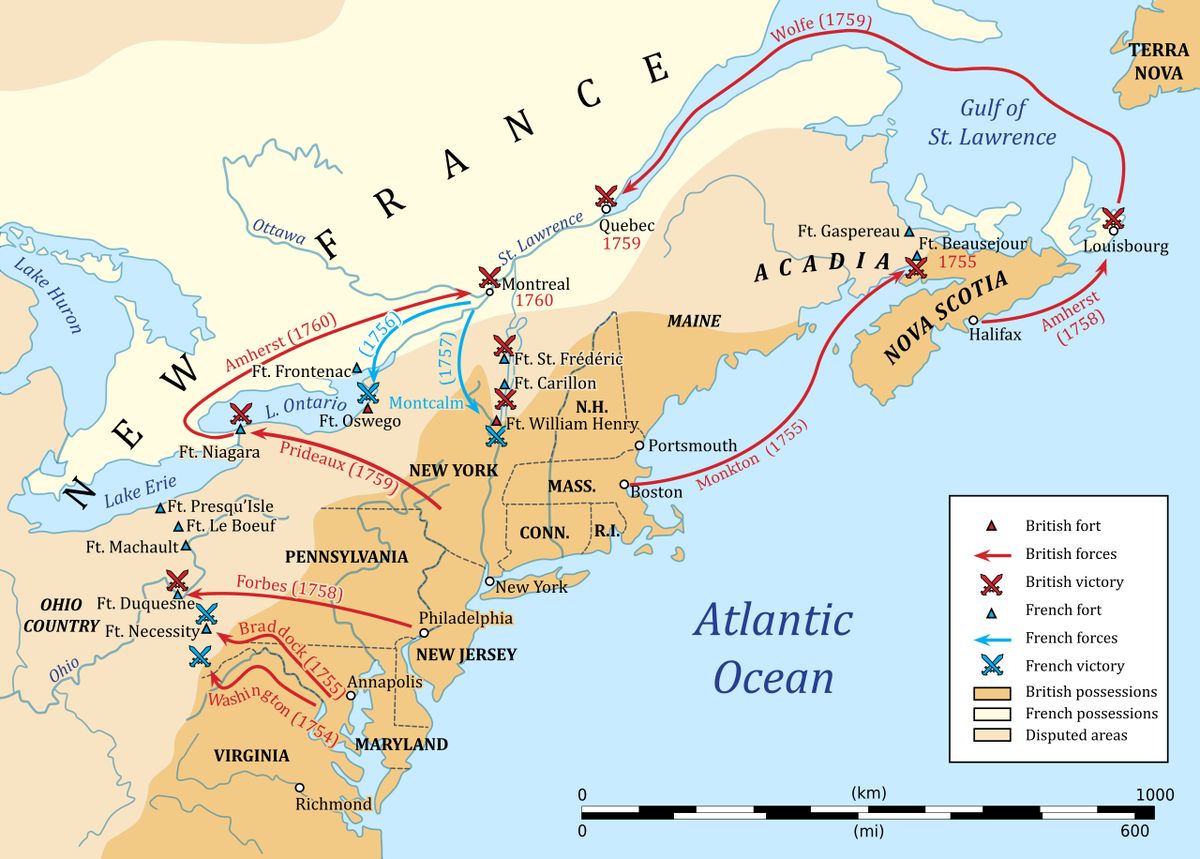
The population of Lower Canada was populated mainly by Canadiens, an ethnic group who trace their ancestry to French colonists who settled in Canada from the 17th century onward. The vast majority were Canadiens, a cohesive ethnic group defined by their French language, Catholic faith, and shared legal traditions. A smaller Anglophone community, concentrated in urban centres and the Eastern Townships, controlled much of the commerce and held most senior administrative positions. This demographic reality created a society where political and economic power was largely separated along ethnic lines. The colony's history is part of the longer continuum of French and British rule in the region, beginning with Jacques Cartier's arrival and the establishment of New France, through the British conquest in the Seven Years' War ending in 1763, and leading directly to the modern Canadian state. The Province of Quebec was established from conquered French lands from the French and Indian War, with the Quebec Act officially setting up governance.
Administration and Colonial Governance
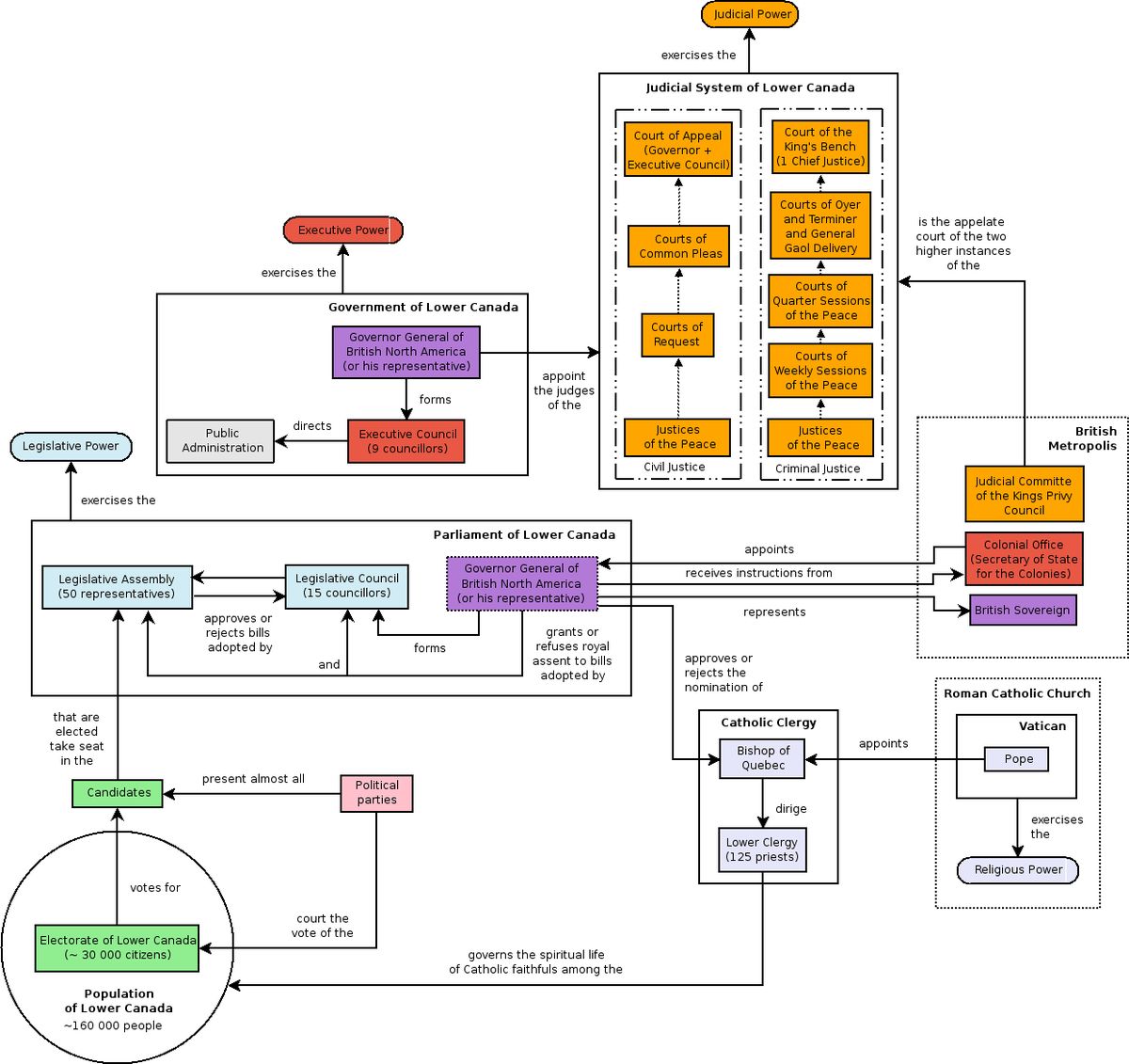
The governance of Lower Canada was a complex system established by the Constitutional Act. Executive power resided with a British-appointed Governor, supported by an Executive Council he selected. Legislative power was split between the elected Legislative Assembly and an appointed Legislative Council, whose members served for life. This structure meant the assembly could pass laws, but the council or governor could block them, and the assembly had little control over the colony's revenue or the civil service. The governor could also dissolve the assembly at will, as James Henry Craig did in 1810. This system concentrated power in the hands of the British-appointed officials and the Anglophone minority who supported them, frustrating the French-Canadian majority in the assembly. After the rebellion, this constitution was suspended and replaced by a Special Council from 1838 to 1841, which governed by decree. This period of direct rule was the final chapter of Lower Canada's separate administration before it was merged into the united Province of Canada. The Constitutional Act placed English Law in Upper Canada, and French Law and institutions in Lower Canada, with Catholics granted the ability to freely practise.
Questions about Lower Canada
What was Lower Canada?
Lower Canada was a British colony in North America that existed from 1791 to 1841. It was created when the Province of Quebec was split into two colonies by the Constitutional Act of 1791. It comprised the southern part of modern Quebec and was characterized by its French-speaking majority population and French civil law. The colony was united with Upper Canada in 1841 to form the Province of Canada.
Why was it called 'Lower' Canada?
The name refers to its geographical position relative to the flow of the St. Lawrence River. Lower Canada was located farther downriver from the headwaters of the St. Lawrence River than its contemporary Upper Canada. It was positioned downstream, closer to the river's mouth and the Gulf of Saint Lawrence. Upper Canada, in contrast, was situated upstream and corresponds to present-day southern Ontario. This naming convention was established when the colony was created by the Constitutional Act 1791.
What caused the Lower Canada Rebellion?
The rebellion was caused by long-standing political tensions between the elected French-Canadian majority and the appointed British executive. The immediate trigger was the British government's rejection of the Ninety-Two Resolutions for reform through the Russell Resolutions in 1837. This led to armed clashes between Patriote rebels and government forces. The three major divides were between the assembly and the executive, between Anglophone and Francophone elites, and between the state and the Catholic Church over education.
Who was Louis-Joseph Papineau?
Louis-Joseph Papineau was the principal political leader of French-Canadian reform efforts in Lower Canada. He served as Speaker of the Legislative Assembly and was the leader of the Parti canadien, later known as the Patriotes. Papineau was the author of the Ninety-Two Resolutions and a key figure in the movement for responsible government. He fled to the United States after the failure of the 1837 rebellion but later returned to political life in Canada East. He is a subject of historical works by authors like John Ralston Saul.
What happened to Lower Canada after the rebellion?
After the rebellion was suppressed, Britain suspended Lower Canada's constitution on 27 March 1838 and imposed martial law under a Special Council. The British Parliament passed the Act of Union in 1840. This act united Lower Canada and Upper Canada into the Province of Canada, which came into being in 1841. Lower Canada became known as Canada East within this new union, with equal representation in the legislature despite its larger population.
How is Lower Canada related to modern Quebec?
Lower Canada forms the historical and territorial core of the modern Canadian province of Quebec. The colony's boundaries are largely those of southern Quebec today. The preservation of French civil law, the Catholic Church's social role, and the French language during the British colonial period were crucial in shaping Quebec's distinct identity within Canada. The political struggles of Lower Canada are a direct precursor to Quebec's modern political movements.
Sources and further reading
- Lower Canada (Wikipedia)
- Significant Events in Canadian History (thecanadianencyclopedia.ca)
Checked by the Nosy Mag desk. Last updated 2026-10-22.