Nunavik
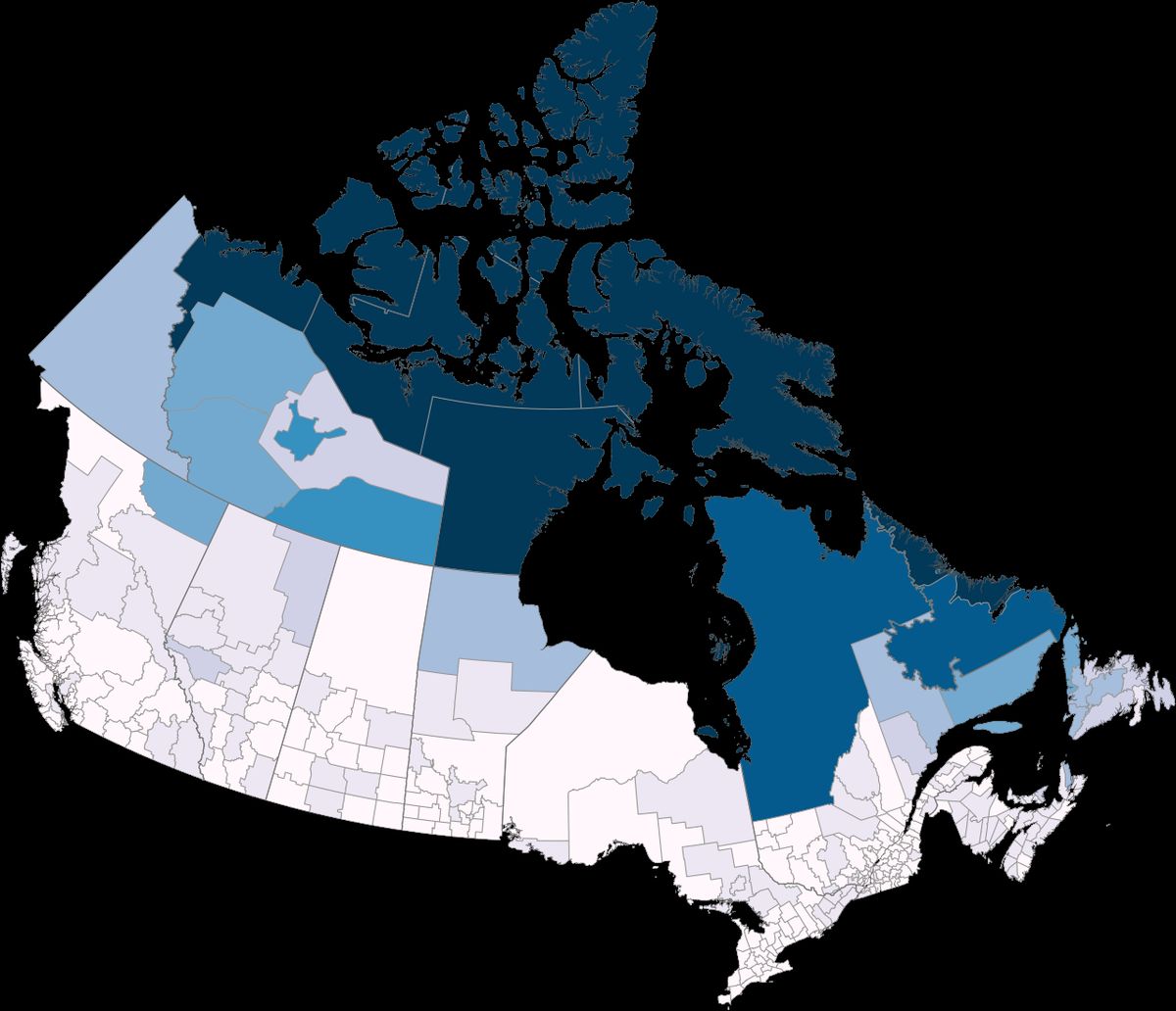
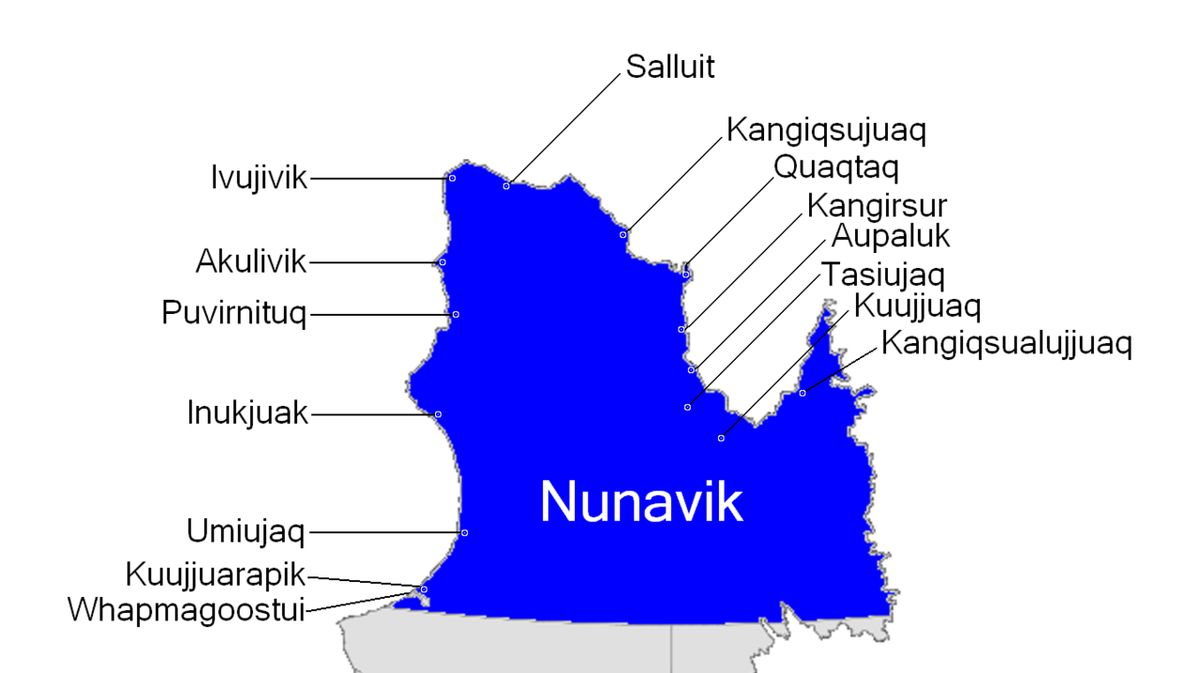
Nunavik is the homeland of the Inuit of Quebec, comprising the northern third of the province and forming a core part of the Inuit Nunangat. Covering a land area of 443,684.71 square kilometres north of the 55th parallel, it is the homeland of the Inuit of Quebec. Almost all of the 14,045 inhabitants of the region, of whom 90 percent are Inuit, live in fourteen northern villages on the coast of Nunavik and in the Cree reserved land of Whapmagoostui, near the northern village of Kuujjuarapik. Negotiations for regional autonomy and resolution of outstanding land claims took place in the 2000s. Negotiations on better empowering Inuit political rights in their land are still ongoing.
Geography and Physical Landscape
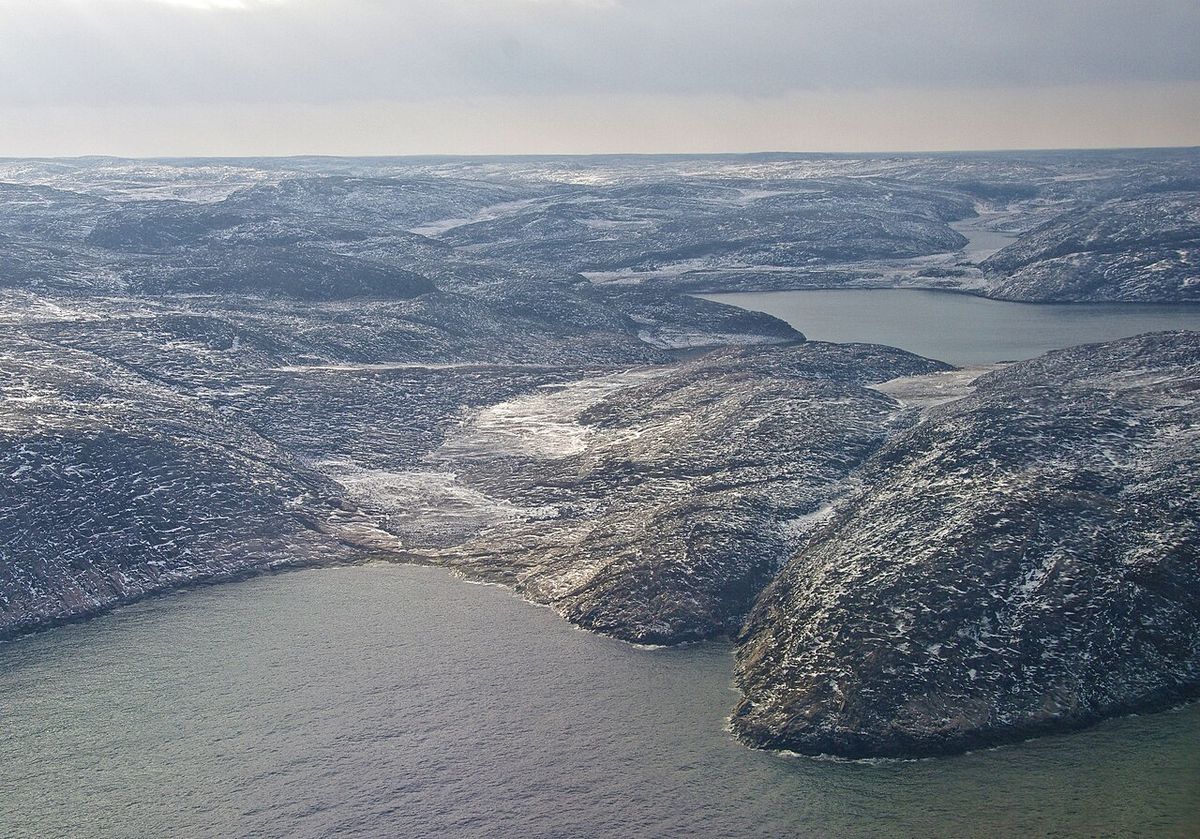
Nunavik occupies a massive territory in the northernmost part of Quebec, bounded by Hudson Bay to the west and Hudson Strait and Ungava Bay to the north. The Ungava Peninsula forms the northern two-thirds of the region, and it shares a border with the Côte-Nord region of Quebec and the Labrador region of Newfoundland and Labrador. The territory lies in both the Arctic and subarctic climate zones, dominated by tundra characterized by limited vegetation. There are no road links between Nunavik and southern Quebec, although the Trans-Taiga Road ends several hundred kilometres south of Kuujjuaq near the Caniapiscau Reservoir. Year-round air links and seasonal marine shipping are the primary transportation methods for the fourteen villages, and parts of the southern interior can be accessed via trails heading north from Schefferville. The region features notable geological formations, including five meteorite craters: the Pingualuit crater, the Lac Couture crater, the La Moinerie crater, and the two craters that form the Clearwater Lakes. The villages are located hundreds of kilometres apart on the shores of Hudson Bay, Hudson Strait, and Ungava Bay, with the principal administrative centre in Kuujjuaq on the southern shore of Ungava Bay.
Climate and Documented Environmental Changes
Nunavik's climate features long, cold winters as the surrounding seas freeze over, eliminating maritime moderation. Summers are also subdued due to the thawing sea, with Inukjuak averaging January highs of -21°C and summer highs of just 13°C, which is exceptionally cold for a sea-level settlement at its latitude. Areas less affected by summertime marine moderation have somewhat warmer temperatures and feature marginal taiga where summer mean temperatures exceed 10°C. Climate change studies employing community-based research and traditional ecological knowledge document significant shifts reported by Inuit communities, including shorter, warmer winters and observable changes in vegetation growth, precipitation, sea ice, permafrost, and water levels. Sea ice is thinning and decreasing in longevity through the winters, creating more risky conditions for ice-based transportation and hunting. Warmer temperatures have led to increased growth of trees and shrubs like Arctic Willow and Balsam Poplar, as well as berry plants including cloudberry, blueberry, crowberry, and cranberry. Lowering freshwater levels have been reported due to decreasing annual precipitation, and these environmental changes present direct health risks to communities.
Lowering water quality in Nunavik can be associated with gastrointestinal diseases, for example giardia. Cases of gastrointestinal diseases associated with natural sources were reported to increase in March when the sea ice begins breaking up, as well as in fall during the caribou migration period. Environmental levels of lead have also been changing in the Arctic with climatic shifts, presenting concerns for lead poisoning in northern communities. In Nunavik, lead concentrations in maternal blood were the highest in Canada at 50 micrograms per litre. Increasing levels of lead in the environment are also associated with the use of the lead shot in hunting, which was banned in 1999, although lead shots continue to be shipped to northern communities.
Historical Context from Territory Transfer to Land Claims
The region now known as Nunavik was part of the District of Ungava of the Northwest Territories from 1870 until it was transferred to Quebec in 1912 under the Quebec Boundaries Extension Act. The province undertook little development in the area until after the Quiet Revolution in the 1960s, a period that also saw the region named "Nouveau-Québec," the francization of place names, and the spread of French teaching in schools. In 1971, the Quebec government announced the James Bay hydroelectric project, described as the "project of the century," which would divert several major rivers and their watersheds without consulting the Inuit and Cree. The rights of the Inuit and Cree were ignored, leading a young Inuk named Charlie Watt to assemble the Northern Quebec Inuit Association (NQIA). The NQIA and the Quebec Association of Indians sought an injunction in the Quebec Superior Court in 1972 to stop the project, a ruling in their favour that was quickly overturned but which unleashed events leading to an out-of-court settlement. This settlement became the James Bay and Northern Quebec Agreement (JBNQA), signed in November 1975, the first major comprehensive land claims agreement in Northern Canada and the first comprehensive Inuit land claim in Canada.
A separate but traumatic event was the High Arctic relocation of the 1950s, where eight Inuit families from Inukjuak on the Ungava Peninsula were forcibly moved to Grise Fiord and Resolute to demonstrate Canadian sovereignty during the Cold War. They were promised homes and game to hunt, but discovered no buildings and very little familiar wildlife, and were later told the offer to return home after one year was withdrawn to protect Canada's sovereignty claims. The relocated Inuit eventually learned local beluga whale migration routes and survived by hunting over a range of 18,000 square kilometres each year. The Royal Commission on Aboriginal Peoples investigated the relocation in 1993, issuing a report entitled "The High Arctic Relocation: A Report on the 1953-55 Relocation" the following year. The government paid $10 million in compensation to survivors and their families, and the Prime Minister finally issued a formal apology in 2010. The JBNQA laid the legal groundwork for the creation of Nunavik within Quebec, and a subsequent agreement, the Nunavik Inuit Land Claims Agreement covering offshore areas and islands, came into effect in 2007 after a 14-year negotiation process between Makivik and the federal government.
Governance Structure and the Self-Determination Process
Nunavik's governance structure is derived from the James Bay and Northern Quebec Agreement. The Kativik Regional Government (KRG) is the main public administration for the fourteen northern villages, with a board made up of municipal representatives and all inhabitants, both Inuit and non-Inuit, eligible to vote in its elections. It holds jurisdiction in supramunicipal administration, economic development, transportation, telecommunications, and wildlife protection, with approximately 72 percent of its funding provided by the Quebec government, 18 percent from the federal government, and 10 percent from other revenue sources. The Makivik Corporation, headquartered in Kuujjuaq, represents the Inuit of Northern Quebec, manages the heritage funds from the JBNQA, and promotes economic and social development through business enterprises like air and sea transport. The Kativik Regional Police Force, established in 1996 to provide police services in the Kativik region, was renamed the Nunavik Police Service in mid-2021. A proposal to establish a Regional Government of Nunavik, which would have had an elected parliamentary-style council and rights to natural resource royalties, was rejected by about 66 percent of voters in a 2011 referendum.
Since the failed referendum, self-determination efforts have intensified through a distinct process led by the Makivik Corporation. The 2018 Nunavik Inuit Declaration, passed at a Nunavik All-Organizations Meeting, provided Makivik with the mandate to establish an Indigenous Government based on Inuit values, heritage, identity, culture and language. In 2019, Makivik appointed Mary Simon, a former president of Makivik, Inuit Circumpolar Council, and Inuit Tapiriit Kanatami, as well as Canada's first Ambassador to the Arctic, as Chief Negotiator for Nunavik Self-Determination and Inuit government. A Nunavik Constitutional Task Force was established to develop a Nunavik Constitution in consultation with the Nunavik Inuit. Negotiations with the federal government on a guiding Memorandum of Understanding began in October 2018, and these efforts are grounded in the recognition of the inherent right to self-government under Section 35 of the Constitution Act, 1982, and the UN Declaration on the Rights of Indigenous Peoples adopted by Canada in 2016. The proposed government would be territory-based, not ethnicity-based, and would fold existing structures like the KRG, Kativik School Board, and Nunavik Regional Board of Health and Social Services into a new entity with a public service responsible for delivering social services like education and health.
The James Bay and Northern Quebec Agreement of 1978 led to greater political autonomy for most of the Nunavik region with the founding of the Kativik Regional Government. All inhabitants of the 14 northern villages, both Inuit and non Inuit, vote in regional elections. The Makivik Corporation, headquartered in Kuujjuaq, represents the Inuit of Northern Quebec in their relations with the governments of Quebec and Canada. The governments of Quebec, Canada, and Nunavik had negotiated a proposal to establish a Regional Government of Nunavik, but this proposal was rejected by about 66 percent of voters in a referendum in 2011.
- The Kativik Regional Government, established by the JBNQA in 1978.
- The Makivik Corporation, the land claims organization mandated to protect Inuit rights and interests.
- The Nunavik Police Service, providing police services since 1996.
- The James Bay and Northern Quebec Agreement (1975).
- The Nunavik Inuit Land Claims Agreement (2007).
- The Sanarrutik Agreement (2002), an economic partnership with Quebec on resources.
- The Sivunirmut Agreement (2004), consolidating program funding into a single envelope.
- The Naskapi Nation of Kawawachikamach, which owns a hunting area in southern Nunavik and is represented in the KRG.
Demographics, Distinct Population, and Community Life
The 2021 census recorded 14,045 inhabitants in Nunavik, with approximately 90 percent being Inuit, a population that has been growing in line with high growth rates in Indigenous communities. The population is distributed across fourteen remote villages on the shores of Hudson Bay, Hudson Strait, and Ungava Bay, with about 100 Inuit also living in the Cree village of Chisasibi in James Bay. The villages range in size from Kuujjuaq, the administrative centre with 2,375 people, to Aupaluk with 195 people, and the Cree reserved land of Whapmagoostui forms an enclave on the eastern shore of Hudson Bay near the northern village of Kuujjuarapik. Residents call themselves Nunavimmiut, and a 2019 genetic study by researchers from the Montreal Neurological Institute and Hospital of McGill University found the Nunavik Inuit to be genetically distinct from any other known population. They possess distinct genetic signatures in pathways linked to lipid metabolism, allowing them to adjust to higher-fat diets and the extreme cold of the Canadian Arctic, and their closest genetic relatives are the Paleo-Eskimos who inhabited the Arctic before the Inuit. The primary language is Inuktitut, and the challenge since the mid-20th century has been to maintain a balance between Inuit values, language, and culture and adaptation to the modern world.
Community life in the villages is supported by distinct Inuit-led institutions and faces significant social challenges. The Kativik School Board, known as Kativik Ilisarniliriniq, delivers education across the region, and as of 2025, no post-secondary education institution exists in Nunavik, though the board and John Abbott College have jointly established some post-secondary courses. The cooperative movement is strong through the Fédération des coopératives du Nouveau-Québec (FCNQ), which alongside Makivik is a main economic engine in retail, oil supply, and telecommunications. Nunavik faces persistent overcrowding and inadequate housing, a crisis highlighted in the National Inuit Action Plan on Missing and Murdered Inuit Women, Girls and 2SLGBTQQIA+ People, and in the 2025 to 2026 fiscal year, $51.6 million in federal funding was allocated to new and improved housing across Inuit Nunangat. Community connectivity and information sharing are maintained through media like Taqramiut Nipingat Incorporated (TNI) Radio, which broadcast the 2018 and 2019 Nunavik All-Organization Meetings live to the entire region and via the internet to Inuit living outside Nunavik.
| Village | Population (2011 Census) |
|---|---|
| Kuujjuaq | 2,375 |
| Aupaluk | 195 |
Economic Sectors, Resource Development, and Partnerships
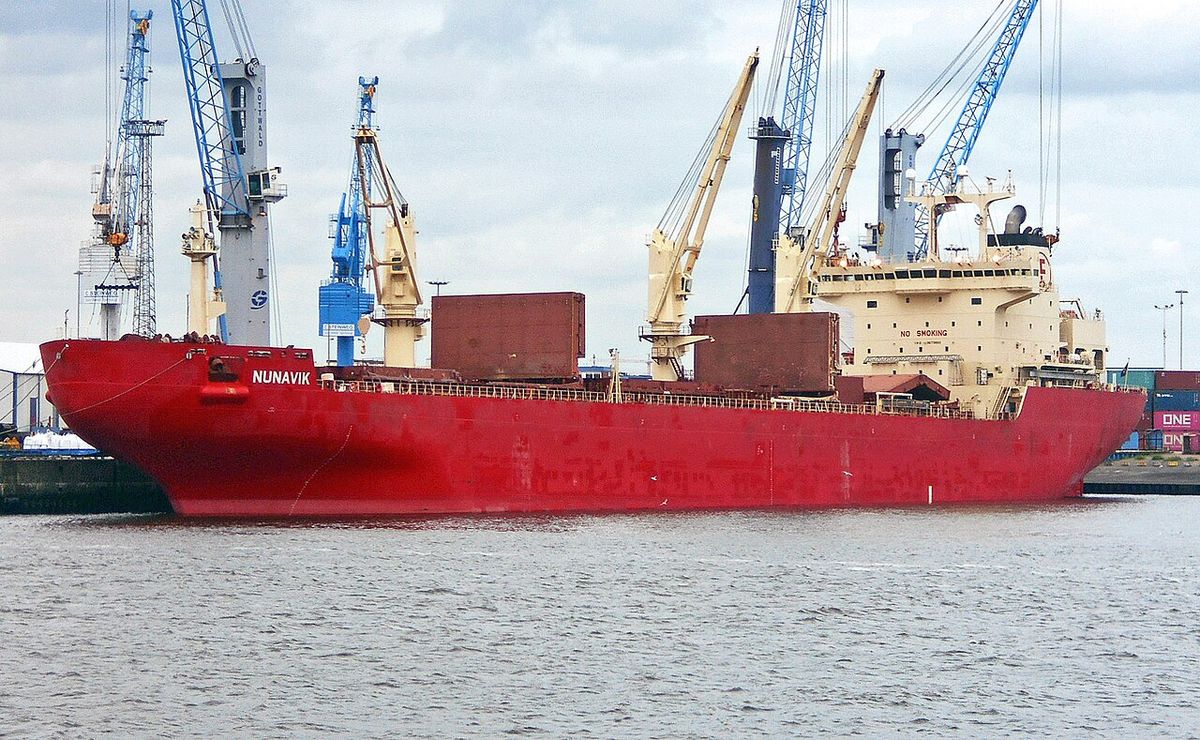
Nunavik's economy combines traditional subsistence hunting, public administration, and large-scale resource extraction. The region is rich in mineral deposits, most notably nickel at the Raglan Mine near Salluit, which is one of the largest mines in the region. Production began at the mine in 1997, and its current estimated mine life exceeds 30 years, with plans to increase production at a new mine in Raglan South. The mine site, situated in subarctic permafrost with an average annual temperature of -10°C and an average ambient temperature underground of -15°C, requires special construction and mining techniques to protect the fragile permafrost. It is linked by all-weather roads to Kattiniq/Donaldson Airport and to concentrate storage and ship-loading facilities at Deception Bay. Beyond mining, the cooperative movement is a major economic force through the Fédération des coopératives du Nouveau-Québec (FCNQ), which operates in the retail, oil supply, and telecommunications sectors, serving the fourteen villages. The Makivik Corporation is also a significant economic driver, owning and operating large profitable business enterprises in air and sea transportation, as well as food and fishing, generating jobs for Inuit and promoting social economic development.
Economic partnership agreements with the Quebec government have been instrumental in shaping development. The 2002 Sanarrutik Agreement contained provisions for hydroelectric resources, mining, and park development, aiming to accelerate the development of Nunavik. The 2004 Sivunirmut Agreement enhanced this by consolidating the funding of government programs into a single resource envelope, which simplified fund management and gave the Kativik Regional Government greater autonomy to establish its priorities for initiatives involving the northern villages. These agreements operate within the broader context of the James Bay and Northern Quebec Agreement, which enshrines harvesting rights and resource management regimes and establishes land categories of varying degrees of Indigenous and Crown control. The more recent Nunavik Inuit Land Claims Agreement of 2007, which covers the management of offshore areas and islands in Hudson and Ungava bays, also provides new opportunities for Nunavik to benefit from resource development, with over 30 years of land claims implementation experience guiding the use of new rights and compensation to improve economic and social well-being.
Cultural Practices, Arts, and Social Institutions
Inuit culture in Nunavik maintains a strong connection to the land and traditional activities like hunting caribou, seals, and marine mammals, though the early 20th century saw hunters abandon traditional weapons in favour of firearms. A distinctive cultural practice is katajjaq, or throat singing, called Kattajaq in Inuktitut, which involves a friendly contest between two women who face each other and imitate the sounds of nature such as wind, flowing river water, or animal cries. The arts scene has strong connections to Inuit culture and the natural environment, with Nunavimmiut carving sculptures from soapstone similar to their Nunavummiut neighbours, and the region has a proposed flag designed by artist Thomassie Mangiok during a 2013 Plan Nunavik consultation in Ivujivik. The Inuit language, Inuktitut, is actively promoted alongside the need to adapt to the modern world, a balance that has been a challenge since the second half of the 20th century. After World War II, Inuit society was significantly impacted by the introduction of the first federal government programs in education, health care, and housing, leading to permanent settlement and social structures that increasingly reflect those of southern Canadian societies.
Social institutions in Nunavik are largely Inuit-administered, stemming from the JBNQA. The Kativik School Board (Kativik Ilisarniliriniq) delivers education, and as of 1985, students from Nunavik formed groups in Montreal by concentrating around certain apartments when pursuing education outside the region. Health and social services are managed by the Nunavik Regional Board of Health and Social Services. The cooperative movement through the FCNQ plays a major role in economic and community life. Nunavik faces serious social challenges, including the crisis of missing and murdered Indigenous women, girls, and 2SLGBTQQIA+ people, which is addressed in the National Inuit Action Plan responding to the National Inquiry's Calls for Justice. The federal government's Federal Pathway to Address Missing and Murdered Indigenous Women, Girls and 2SLGBTQQIA+ People recognizes the unique challenges Inuit communities face, including economic insecurity and harms to language and cultural continuity. Community events and political meetings, such as the Makivik Annual General Meeting held in Aupaluk in March 2019 where the self-determination resolution was passed, are broadcast live via TNI Radio, ensuring widespread community engagement and information sharing across the vast territory.
Political Representation and Constitutional Foundations
Nunavik's political representation exists at multiple levels within the Canadian and Quebec political systems. Within Quebec, the region is part of the provincial riding of Ungava, with Nunavik residents making up just under half of the riding's total population. The Quebec government has expressed a desire to add a separate seat in the National Assembly to represent Nunavik, which would be the second least populous riding in the province, slightly more populous than Îles-de-la-Madeleine which exists under an exception to population distribution laws. On the national stage, Nunavik Inuit were key players during the constitutional negotiations in 1982 that affirmed Aboriginal and treaty rights in Section 35 of the Constitution Act, offering constitutional protection to comprehensive land claims agreements. Charlie Watt, founder of the Northern Quebec Inuit Association, served as a Canadian Senator for 34 years until his retirement in 2018, after which he was elected President of Makivik. Mary Simon, the Chief Negotiator for self-determination, is a former Canadian Ambassador to Denmark and the Arctic, contributed to the drafting of the UN Declaration on the Rights of Indigenous Peoples, and was instrumental in the creation of the Arctic Council in 1996.
The future political direction of Nunavik is firmly focused on the self-determination process grounded in these constitutional and international instruments. The process is explicitly based on the inherent right to self-government recognized as an existing Aboriginal right under Section 35 of the Constitution Act, 1982, and the UN Declaration on the Rights of Indigenous Peoples, which Canada adopted in 2016. The ongoing negotiations aim to establish a Nunavik Inuit government that would manage its own affairs based on Inuit values, heritage, identity, culture, and language, while ensuring all residents of the territory, regardless of ethnicity, can be full participants in the new governmental structure. This represents a continuation of the political distinctiveness of the region, which has a different language, culture, climate, and voting pattern from the rest of Quebec, and is part of the broader trend towards devolution in Canada's Arctic territories. While Quebec and Canada would maintain full jurisdiction, the successful establishment of such a government would mark a new chapter in the implementation of the "new beginning" envisioned by Makivik at the signing of the first land claim in 1975.
Questions about Nunavik
What does the name Nunavik mean?
The name Nunavik comes from the local dialect of Inuktitut and means "great land. This name reflects the vast territory and deep connection the Inuit people have with their homeland. The Inuit inhabitants of the region refer to themselves as Nunavimmiut. Nunavik is one of the four Inuit regions that together form Inuit Nunangat, the Inuit homeland in Canada.
Where is Nunavik located?
Nunavik comprises the northern third of the province of Quebec, Canada. It is located north of the 55th parallel and is nearly coterminous with the Kativik region. It is bordered by Hudson Bay to the west, Hudson Strait and Ungava Bay to the north, and shares boundaries with the Côte-Nord region of Quebec and Labrador. The Ungava Peninsula makes up the northern two-thirds of Nunavik.
What was the James Bay and Northern Quebec Agreement?
The James Bay and Northern Quebec Agreement was a landmark agreement. It led to greater political autonomy for most of the Nunavik region with the founding of the Kativik Regional Government. This agreement laid the initial legal groundwork for the creation of Nunavik within Quebec. It resulted in the first political organizing of Inuit in Canada in the Northern Quebec Inuit Association which fought for the eventual James Bay and Northern Quebec Agreement.
Who governs Nunavik?
Nunavik is governed through a structure established by the JBNQA. The Kativik Regional Government (KRG) is the main public administration for the fourteen northern villages. The Makivik Corporation, based in Kuujjuaq, represents Inuit rights and manages compensation funds and economic development. Policing is provided by the Nunavik Police Service. There is also an ongoing process toward greater self-determination, with negotiations led by Chief Negotiator Mary Simon to establish a Nunavik Inuit government.
What are the main economic activities in Nunavik?
The Nunavik economy includes traditional hunting, public sector employment, and resource development. Mining is significant, particularly the Raglan nickel mine near Salluit. The cooperative movement, through the Fédération des coopératives du Nouveau-Québec, is a major player in retail and supplies. The Makivik Corporation runs businesses in air and sea transportation. Economic partnerships with Quebec, like the Sanarrutik Agreement, also guide development in sectors like hydroelectricity and parks.
How is climate change affecting Nunavik?
Climate change is deeply affecting Nunavik, with communities reporting shorter, warmer winters. This leads to thinning sea ice, which poses risks for travel and hunting. Warmer temperatures are causing increased vegetation growth and permafrost thaw. Changes in precipitation affect freshwater levels and quality, linked to health issues like gastrointestinal diseases. Environmental lead levels are also a concern, with Nunavik having the highest maternal blood lead concentrations in Canada, a situation influenced by both historical hunting practices and climatic shifts.
Sources and further reading
- Nunavik (Wikipedia)
- Nunavik (indigenouspeoplesatlasofcanada.ca)
- Inuit (quebec.ca)
- Nunavik Inuit Pass Significant Self-Determination Resolution (makivvik.ca)
- 2025 to 2026 Highlight report: Inuit (rcaanc-cirnac.gc.ca)
Checked by the Nosy Mag desk. Last updated 2026-10-23.