French and Indian War
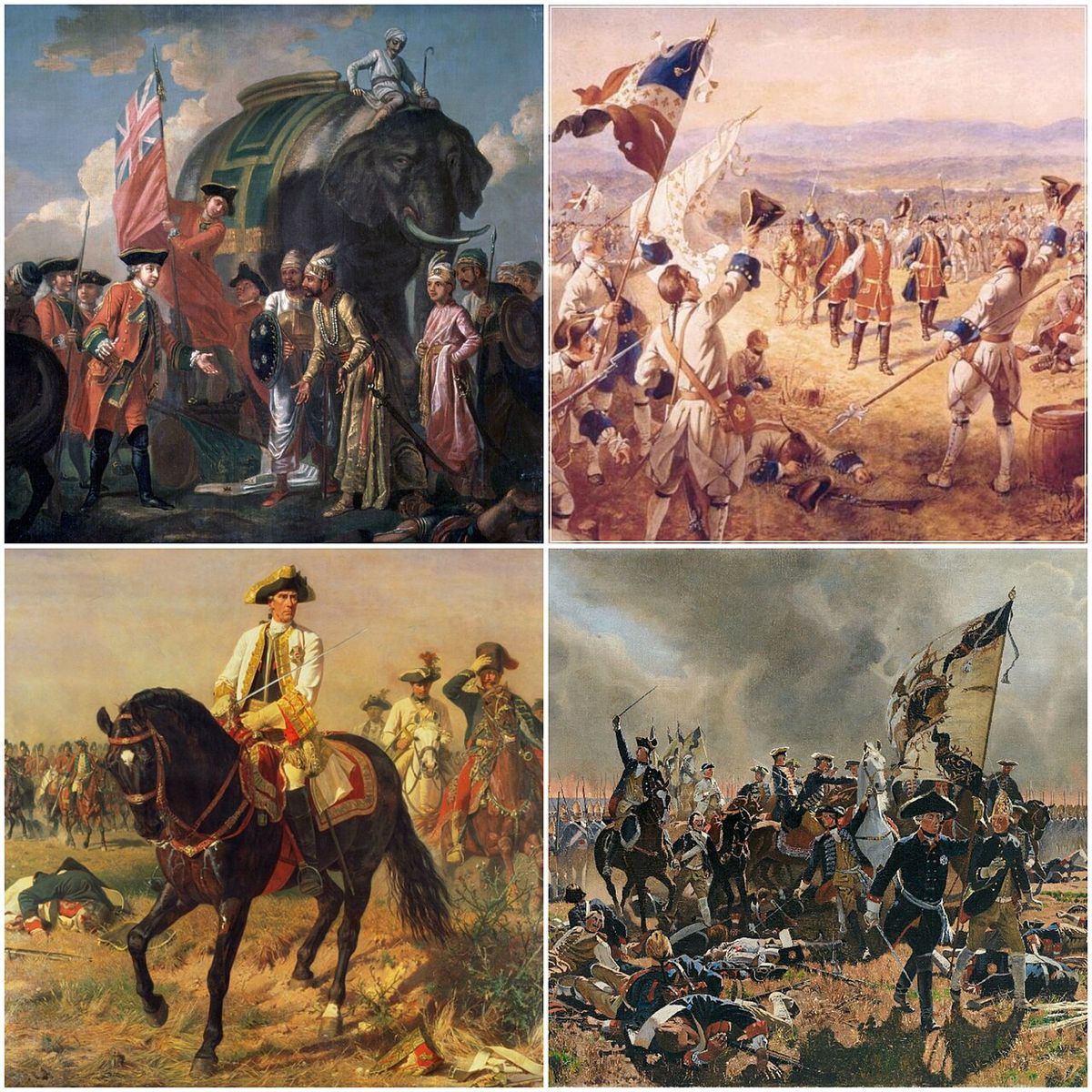
The French and Indian War (1754 to 1763) was the North American theatre of the global Seven Years' War, a decisive conflict between Great Britain and France for imperial supremacy on the continent. Fought across the colonial frontiers, the war involved British and French colonists alongside numerous Indigenous nations whose alliances were critical to both sides. For Canada, the war culminated in the Conquest of New France, fundamentally reshaping the political and cultural landscape by transferring sovereignty over French Canada to Britain. The Treaty of Paris in 1763 confirmed British territorial gains, setting the stage for future colonial tensions that would eventually lead to the American Revolution.
Origins and Competing Claims
The roots of the French and Indian War lay in the overlapping imperial ambitions of Britain and France in North America. New France, with a population of only about 75,000, was centred on the St. Lawrence River valley but its claims, based on earlier exploration, encompassed the Great Lakes and the entire Mississippi River watershed. The vast, ill-defined frontier between these empires, particularly the fertile Ohio Country, became a primary flashpoint. Both nations sought to secure the allegiance and trade of the numerous Indigenous nations who controlled these interior territories, including the Iroquois Confederacy, the Algonquian-speaking tribes, and the Cherokee. The 1748 Treaty of Aix-la-Chapelle ended war in Europe but left these North American tensions unresolved, delegating them to a commission that failed to reach a decision.
French authorities, alarmed by the incursion of British traders like George Croghan into the Ohio Valley, took proactive measures to assert control. In 1749, Pierre-Joseph Céloron led an expedition through the region to bury lead plates claiming the land for France and order British traders to leave. His report concluded that the local Indigenous peoples were entirely devoted to the English. In response, the British government granted land in the Ohio Country to the Ohio Company of Virginia in 1749, requiring it to build a fort and settle families. This grant directly conflicted with French claims and also with claims from the colony of Pennsylvania, setting the stage for confrontation. The competition was not merely about land but also about the lucrative fur trade and strategic influence over the continent's interior waterways.
Escalation and Opening Hostilities
Hostilities began with a series of escalating actions in the Ohio Country. In 1752, a French and Ottawa war party under Charles Michel de Langlade attacked the Miami village of Pickawillany, killing Chief Old Briton and capturing British traders to punish trade with the British. The French then moved to solidify their physical claim. In 1753, Paul Marin de la Malgue began constructing a chain of forts, including Fort Presque Isle and Fort Le Boeuf, to control the passage from Lake Erie to the Ohio River. This military build-up alarmed both the British colonists and the Iroquois. Mingo chief Tanaghrisson, who deeply distrusted the French, travelled to Fort Le Boeuf to protest but was dismissed contemptuously by Marin.
The colony of Virginia, whose Ohio Company investors stood to lose heavily from French control, responded forcefully. Governor Robert Dinwiddie dispatched a young Major George Washington in October 1753 to deliver a demand for the French to vacate the territory. Washington met with the French commander, Jacques Legardeur de Saint-Pierre, at Fort Le Boeuf in December. Saint-Pierre politely but firmly refused, stating France's claim based on La Salle's exploration was superior and he was not obliged to obey. Washington's return with this refusal made armed conflict seem inevitable. In the spring of 1754, Washington was sent back with a Virginia militia force to assert the British claim, leading directly to the skirmish that ignited the wider war.
The War Unfolds: Early British Defeats
The war's opening battle occurred in May 1754 at Jumonville Glen, where Washington's militia, accompanied by Tanaghrisson, ambushed a small French patrol led by Ensign Joseph Coulon de Villiers de Jumonville. The brief fight left Jumonville and several of his men dead, an event the French denounced as an assassination. Washington then fell back and hastily constructed Fort Necessity, only to be surrounded and forced to surrender in July by a larger French and Indigenous force. These early encounters demonstrated the unpreparedness of the British colonies for a coordinated war. In 1755, the British government sent General Edward Braddock as commander-in-chief with a plan for a four-pronged attack against French forts.
The Braddock Expedition aimed to capture the strategic French Fort Duquesne at the Forks of the Ohio. Braddock's force of British regulars and colonial militia was ambushed and decisively defeated on July 9, 1755, at the Battle of the Monongahela. Braddock was mortally wounded and died days later. The other British offensives that year also largely failed. From 1755 to 1757, the war trended in France's favour, with notable French and Indigenous victories such as the siege and surrender of Fort William Henry in 1757, an event later dramatized in literature. The only significant British success during this period was the 1755 capture of Fort Beauséjour in Acadia, which led to the brutal expulsion of the Acadian population.
The British Turnaround and the Conquest of Canada
The global conflict, known as the Seven Years' War, was formally declared in Europe in 1756, two years after fighting began in America. After a series of setbacks, a change in British leadership proved decisive. William Pitt the Elder, who became the effective head of the British government in 1757, committed massive resources to the North American campaign, believing victory there was the key to global supremacy. Pitt subsidized Prussia's fight in Europe to tie down French forces while bankrolling a major offensive in America. This strategy coincided with France's struggle to support its colonies while focused on the European theatre. From 1758, the tide of war turned dramatically.
A renewed, well-supported British campaign began to capture key French strongholds. In 1758, Fort Louisbourg on Île Royale (Cape Breton Island) fell, opening the St. Lawrence River to British naval forces. That same year, the British took Fort Frontenac on Lake Ontario, severing French supply lines to the west. The critical breakthrough came in 1759 with the siege of Quebec. British General James Wolfe's army scaled the cliffs at the Plains of Abraham and defeated the French under the Marquis de Montcalm on September 13. Both commanders died from wounds sustained in the battle. Montreal surrendered the following year in 1760, effectively ending major military operations in North America and completing the British conquest of New France.
Indigenous Alliances and Diplomacy
Indigenous nations were not mere auxiliaries but central players whose alliances both sides courted assiduously. The French generally held stronger ties with Algonquian-speaking nations in the Great Lakes and Ohio regions, such as the Ottawa, Ojibwa, and Wyandot, who were key trading partners and military allies. The British relationship with the powerful Iroquois Confederacy (Six Nations) was complex. The Iroquois initially sought to maintain neutrality to preserve their trade and political power, but the Covenant Chain alliance with Britain was strained by colonial land encroachment. At the 1754 Albany Congress, Iroquois speaker Hendrick accused the British of breaking the chain.
As the war progressed, British diplomacy achieved significant gains. The 1758 Treaty of Easton, negotiated by Pennsylvania, secured promises of neutrality from several Ohio Country tribes in exchange for guarantees against colonial settlement west of the Alleghenies. This agreement helped isolate the French at Fort Duquesne. Meanwhile, the Cherokee, initially British allies, later fought against them in the Anglo-Cherokee War (1758 to 1761) after conflicts over frontier violence and trade. The shifting allegiances and independent power of Indigenous nations were constant factors that both European powers had to manage, and their influence shaped the war's course across the frontier.
Treaty of Paris and Immediate Consequences
The war concluded with the signing of the Treaty of Paris on February 10, 1763. France, facing defeat globally, made major territorial concessions. France ceded all of its possessions in mainland North America east of the Mississippi River to Great Britain, including Canada and the Ohio Country. To compensate its ally Spain for its losses, France secretly transferred the vast territory of Louisiana west of the Mississippi to Spanish control in the Treaty of Fontainebleau. France retained only the tiny islands of Saint Pierre and Miquelon off Newfoundland as fishing stations. This treaty marked the end of France as a major colonial power in mainland North America and confirmed Britain's position as the dominant imperial force.
The war's outcome had profound and immediate consequences. The British Empire now governed a large, predominantly French-speaking Catholic population in Quebec, leading to the 1763 Royal Proclamation which attempted to organize the new territories and regulate western settlement. The enormous cost of the war led Britain to impose new taxes on its American colonies, such as the Stamp Act, to help pay for their defence. These measures, combined with colonial resentment over the Proclamation's limits on westward expansion, sowed the seeds of discontent that would grow into the American Revolution. For the Indigenous nations of the interior, the removal of the French counterweight left them facing an expanding, and often less conciliatory, British colonial frontier.
Naming and Canadian Memory
The conflict is known by different names that reflect varying national perspectives. In the United States, it is traditionally called the French and Indian War, a name coined by British colonists who named it after their two principal opponents. In Europe, it is conflated into the broader Seven Years' War. In Canada, both the European and American conflicts are typically grouped together as the Seven Years' War (Guerre de Sept Ans). Francophone historians and communities, particularly in Quebec, also use the term War of the Conquest (Guerre de la Conquête), a name popularized by historians like Jacques Lacoursière and Denis Vaugeois.
This terminology underscores the war's deep significance in Canadian history as the event that determined the political fate of French Canada. It is viewed as the decisive moment when New France was conquered and incorporated into the British Empire, a major turning point for French Canadian identity and nationhood. The memory of the war is kept alive through historical sites, re-enactments, and educational curricula. Events like Siege Week at Fort William Henry, a historical re-enactment scheduled for August 3-9, 2026, demonstrate the ongoing public fascination with this formative period in North American history.
Questions about French and Indian War
What was the main cause of the French and Indian War?
The primary cause was the imperial rivalry between Britain and France over control of North America, specifically the Ohio Country. Both nations had overlapping territorial claims based on exploration and trade. The construction of French forts in the Ohio Valley and the British granting of the same land to the Ohio Company of Virginia created a direct confrontation. This escalated into open warfare after the clash at Jumonville Glen in 1754.
How did the French and Indian War lead to the American Revolution?
The war led to the American Revolution in two key ways. First, the enormous debt Britain incurred to fight the war led Parliament to impose new taxes on the American colonies, such as the Stamp Act, which sparked colonial protests over taxation without representation. Second, the British government's 1763 Royal Proclamation, which aimed to stabilize the frontier by restricting colonial settlement west of the Appalachian Mountains, angered colonists and land speculators eager to expand into the territories newly won from France. These postwar policies created deep resentment that fueled the revolutionary movement.
What role did Indigenous peoples play in the war?
Indigenous nations were essential allies and independent actors, not just supporting forces. The French relied heavily on alliances with nations like the Ottawa, Ojibwa, and Wyandot from the Great Lakes region. The British were supported by the Iroquois Confederacy, though their alliance was sometimes uneasy, and initially by the Cherokee. Indigenous warriors provided crucial knowledge of woodland warfare, conducted raids, and served as scouts. Their diplomatic choices, such as the neutrality promised by some Ohio tribes in the 1758 Treaty of Easton, significantly influenced the war's strategy and outcome.
Why is it called the 'French and Indian War' if Indigenous people fought on both sides?
The name French and Indian War originated with the British American colonists, who named the conflict after their two main opponents in the North American theatre. From their perspective, they were fighting against the French colonial forces and the Indigenous nations allied with them. The name is specific to the American context and has been criticized for oversimplifying the complex alliances, as many Indigenous groups, including the Iroquois and Cherokee, also fought alongside the British. In Canada and Europe, the conflict is more commonly integrated into the broader Seven Years' War.
Sources: Wikipedia and current public reporting, checked by the Nosy Mag desk. Last updated 2026-10-18.