Seven Years' War
Fought primarily between the coalitions of Great Britain and Prussia against France, Austria, and their allies, its battles spanned Europe, North America, the Caribbean, West Africa, and the Indian subcontinent. For Canada, the war is of foundational importance, as its North American theatre, known as the French and Indian War, concluded with France ceding its continental possessions to Britain. This transfer set the stage for British colonial rule in what would become Canada, fundamentally altering its cultural, political, and linguistic future. The war's conclusion with the Treaties of Paris and Hubertusburg in 1763 marked the rise of British imperial power and the emergence of Prussia as a major European force.
Origins and the Diplomatic Revolution
The roots of the Seven Years' War lay in unresolved tensions from the earlier War of the Austrian Succession (1740 to 1748). That conflict ended with Prussia seizing the rich province of Silesia from Austria, a loss that Empress Maria Theresa of Austria was determined to reverse. The peace established by the 1748 Treaty of Aix-la-Chapelle was widely seen as a temporary truce, leaving all major powers dissatisfied. In North America, competing British and French claims over the Ohio River Valley created a persistent flashpoint, leading to clashes like the 1754 skirmish at Jumonville Glen involving a young George Washington.
These colonial frictions intersected with a dramatic realignment of European alliances known as the Diplomatic Revolution. For centuries, France and Austria had been rivals, but Austrian statesman Wenzel Anton von Kaunitz sought a new partnership to help reclaim Silesia from Prussia. The shift was triggered by the Convention of Westminster, a January 1756 agreement where Britain, seeking to protect its German possession of Hanover, allied with Prussia. France, feeling betrayed by its traditional ally Prussia, and Russia, angered by Britain's move, turned toward Austria. In May 1756, France and Austria signed the First Treaty of Versailles, forming a defensive alliance. This reversal of long-standing enmities created two powerful and opposed coalitions, making a widespread war virtually inevitable.
The War in North America: The French and Indian War
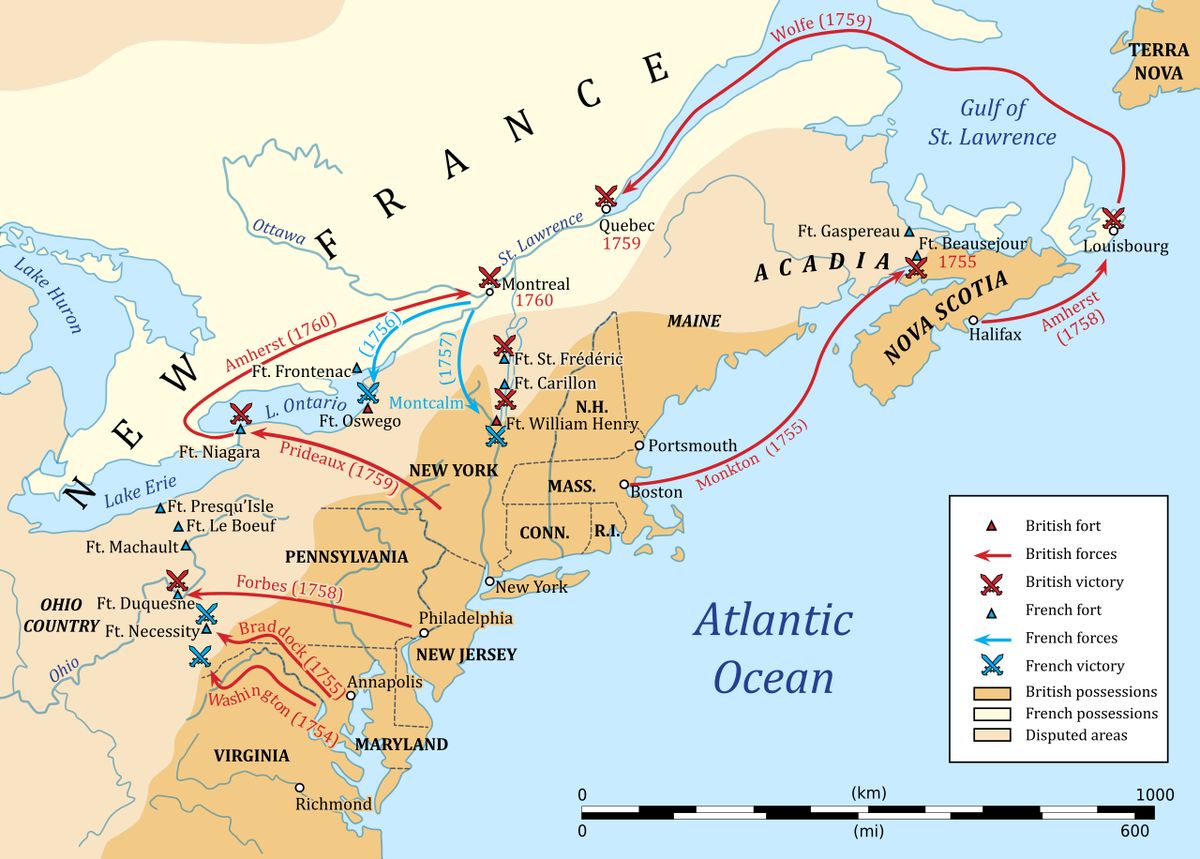
Fighting in North America, known as the French and Indian War, preceded the formal European declaration. The core issue was control of the continent's interior, particularly the Ohio Country. The French aimed to connect their holdings in Canada and Louisiana with a chain of forts, while British American colonists sought expansion westward. Early British efforts met with disaster, such as General Edward Braddock's defeat near Fort Duquesne in 1755. The war initially favoured France and its numerous Indigenous allies, including the Wabanaki Confederacy, who resisted British encroachment on their lands.
The tide turned after William Pitt the Elder took charge of British war policy in 1757. Pitt committed massive resources and troops to the American theatre, believing imperial conquest would secure Britain's global future. This strategy led to major British victories. In 1758, the crucial French fortress of Louisbourg on Cape Breton Island fell, opening the St. Lawrence River to invasion. The following year was decisive. British naval supremacy prevented France from reinforcing its colonies, sealing their fate.
The European and Global Theatres
In Europe, the war centred on Frederick the Great of Prussia defending his state against a powerful coalition of Austria, Russia, France, and Sweden. Frederick launched a pre-emptive invasion of Saxony in 1756, opening the continental war. Despite being surrounded and outnumbered, Prussia's highly disciplined army achieved spectacular victories at battles like Rossbach and Leuthen in 1757. However, the strain of a multi-front war nearly broke Prussia. The war in Germany became a brutal struggle of attrition, with armies living off the land and establishing winter quarters each year.
Beyond Europe and North America, the conflict raged across the world's oceans and colonies. In India, the Third Carnatic War saw British and French East India Companies, alongside their Indian allies, battle for supremacy. In the Caribbean, British forces captured lucrative French sugar islands like Guadeloupe and Martinique. The Spanish entry into the war in 1762 as a French ally backfired, leading to the British capture of Havana, Cuba, and Manila in the Philippines. These global campaigns demonstrated the war's truly worldwide scope, driven by commercial rivalry and competition for colonial resources.
Indigenous Nations and the Conflict
Indigenous nations were not mere bystanders but central, strategic participants in the North American war. Their alliances were sought after by both European powers, and they fought to advance their own political and territorial interests. The French generally had more extensive and successful alliance networks with peoples in the Great Lakes and Ohio Valley regions, such as the Odawa, Ojibwe, and Shawnee. These alliances were built on a history of trade, gift-giving, and comparatively less pressure for land seizure compared to the British colonies. French military operations, like the successful attacks on British frontier positions early in the war, heavily relied on Indigenous warriors and tactics.
British colonial expansion directly threatened Indigenous homelands, leading many nations to support France as the lesser of two evils. Some nations, like the Haudenosaunee (Iroquois Confederacy), experienced internal divisions, with most Mohawk siding with the British while other member nations remained neutral or supported the French. The British, under William Pitt, began to adopt more effective strategies for engaging Indigenous allies, including promising to address land grievances. The ultimate British victory created profound anxiety among Indigenous nations east of the Mississippi. They lost a European counterweight to British expansion, a fear that would soon be realized as settlers flooded into the Ohio Country, leading directly to the conflict known as Pontiac's War in 1763.
The Treaties of 1763 and Immediate Aftermath
The war concluded with two separate peace treaties in 1763. The Treaty of Paris, signed on 10 February, settled the conflicts between Britain, France, and Spain. France ceded all of its mainland North American territories to Britain. This included Canada (New France) and all lands east of the Mississippi River, except for New Orleans. France also surrendered several Caribbean islands and its claims in India, retaining only trading posts there. Spain, in return for gaining French Louisiana west of the Mississippi and New Orleans, ceded Florida to Britain. To recover its valuable sugar islands of Guadeloupe and Martinique, France gave up its claims to Canada, a decision debated in London at the time.
Prussia retained the province of Silesia, which had been the original flashpoint. This confirmation was a triumph for Frederick the Great, securing Prussia's position as a leading European power and a permanent rival to Austrian hegemony within the German lands. The war left all major European combatants with staggering national debts. Britain, though victorious, sought to raise revenue from its American colonies through new taxes like the Stamp Act, planting the seeds for the American Revolution. France, humiliated and seeking revenge, would later support the American rebels against Britain.
Military Logistics and the Nature of Warfare
Armies were built around regiments of infantry armed with smoothbore flintlock muskets and bayonets, supported by cavalry and artillery. Siege warfare, aimed at capturing key fortifications, was more common than decisive pitched battles. Campaigns were seasonal, with armies entering winter quarters during the cold months, resuming operations in the spring. This rhythm is evident in the North American theatre, where campaigns paused each winter.
Logistics were a critical, often decisive factor. Armies had grown too large to sustain themselves solely by foraging and plunder, requiring organized supply trains and pre-positioned magazines. The ability to project power across oceans, as Britain did so effectively, was a monumental logistical challenge. The British Royal Navy's dominance was not just tactical but logistical, allowing Britain to transport and supply troops across the Atlantic while blockading French ports and strangling French colonial trade. This global reach contrasted with the continental focus of France and Austria, whose strategies were constrained by the need to defend long land borders in Europe. The strain of financing global warfare led to innovations in public credit and administration, particularly in Britain.
Long-Term Consequences for Canada
The most direct and enduring consequence of the Seven Years' War for Canada was the transfer of sovereignty from France to Britain. The Royal Proclamation of 1763, issued by King George III later that year, established the new British Province of Quebec. This proclamation was a first attempt to govern a large French Catholic population under British law. It aimed to assimilate the Canadiens by introducing British institutions and restricting settlement to the existing colonies along the Atlantic coast, designating the vast interior as a reserve for Indigenous peoples. This plan was largely unsuccessful and unpopular with both the Canadien inhabitants and British merchants who desired expansion.
This act was a significant departure from British colonial policy, as it recognized French civil law, guaranteed the right to practise Roman Catholicism, and restored the Ohio territory to the Province of Quebec's administration. While it secured the loyalty of the Canadien elite during the impending American Revolution, it inflamed anti-British sentiment in the Thirteen Colonies, who saw it as a tyrannical act favouring popery and limiting their westward growth. The war's legacy thus created the unique dualistic character of Canadian society, with its French and English linguistic and legal traditions, and set the geopolitical boundaries that would define the nation's development. The displacement of French imperial power also irrevocably altered the relationship between Indigenous nations and the Crown, leading to a new era of treaty-making and conflict.
Questions about Seven Years' War
What were the main causes of the Seven Years' War?
The war had multiple intertwined causes. In Europe, the central issue was Austria's desire to reclaim the province of Silesia from Prussia, leading to a major alliance realignment called the Diplomatic Revolution. In North America, the cause was intense imperial rivalry between Britain and France over territorial claims in the Ohio Country and elsewhere. Global commercial competition between the two powers, especially in India and the West Indies, was another major factor. The 1756 alliances between Britain-Prussia and France-Austria transformed these regional tensions into a worldwide conflict.
What was the result of the Seven Years' War?
The war ended with two key treaties in 1763. The Treaty of Paris saw France cede Canada and all its territories east of the Mississippi to Britain, and it also surrendered its political influence in India, establishing British commercial dominance there. Spain ceded Florida to Britain. The Treaty of Hubertusburg confirmed Prussia's possession of Silesia, cementing its status as a great power. Britain emerged as the world's foremost colonial and naval power, but its massive war debt led to attempts to tax the American colonies, contributing to the American Revolution.
How did Indigenous peoples participate in the war?
Indigenous nations were vital military allies and independent actors with their own strategic goals. In North America, many nations, including those in the Wabanaki Confederacy and Great Lakes regions, allied with France to resist British colonial expansion. Some, like certain Haudenosaunee communities, allied with the British. Indigenous warriors were crucial for frontier raids, scouting, and wilderness combat. Their participation was based on protecting their lands and sovereignty. The British victory removed the French as a counterbalance, leading to increased encroachment on Indigenous territories and subsequent conflicts like Pontiac's War.
What were the long-term effects of the war?
The long-term effects were profound and global. It redrew the world map, making Britain the dominant colonial power and beginning the era of the First British Empire. The financial burdens of the war led Britain to impose taxes on its American colonies, a direct path to the American Revolution. France's desire for revenge led it to support the American rebels. In Europe, Prussia's survival as a great power set the stage for future German unification. For Canada, it created the conditions for a distinct society under British rule, while for Indigenous peoples, it began a new and more difficult era of relations with an expansive British Crown.
Sources: Wikipedia and current public reporting, checked by the Nosy Mag desk. Last updated 2026-10-18.