Act of Union 1840
The Act of Union 1840 was a piece of legislation passed by the British Parliament in July 1840 and proclaimed on February 10, 1841, in Montreal. It abolished the legislatures of Lower Canada and Upper Canada and established the Province of Canada. The act was a response to the political unrest and rebellions of 1837-38, aiming to impose stability and assimilate French Canadians. Its provisions, including equal representation for regions of unequal population and the official banishment of the French language, created a flawed union whose political deadlock helped pave the way for Canadian Confederation in 1867.
Origins in Rebellion and the Durham Report
The Act of Union was born from the political crises and armed rebellions that erupted in both Upper and Lower Canada in 1837 and 1838. In Lower Canada, tensions had been building for decades between the elected, French-Canadian dominated assembly and the appointed British executive. Led by Louis-Joseph Papineau and the Patriot Party, reformers issued the Ninety-Two Resolutions demanding control over colonial spending and the executive council. After these demands were ignored or rejected by successive governors general and the British Parliament, the Patriots organized two rebellions in November 1837 and November 1838. Both uprisings were quickly suppressed by British forces. In Upper Canada, a parallel but less violent rebellion led by William Lyon Mackenzie occurred in December 1837, demanding democratic reform and an end to the oligarchic rule of the Family Compact.
In response to this widespread unrest, the British government dispatched John George Lambton, the Earl of Durham, to investigate the causes and recommend solutions. His investigation, resulting in the Durham Report of 1839, identified a deep conflict between the French and English populations. Lord Durham's primary recommendations were the political union of the two Canadas and the introduction of responsible government. He believed union would ensure a loyal English-speaking majority in the new province, facilitate the assimilation of French Canadians, and address Upper Canada's severe financial problems by merging its debt with Lower Canada's healthier finances. The British government accepted the recommendation for union but initially rejected the proposal for responsible government.
Key Provisions of the 1840 Act
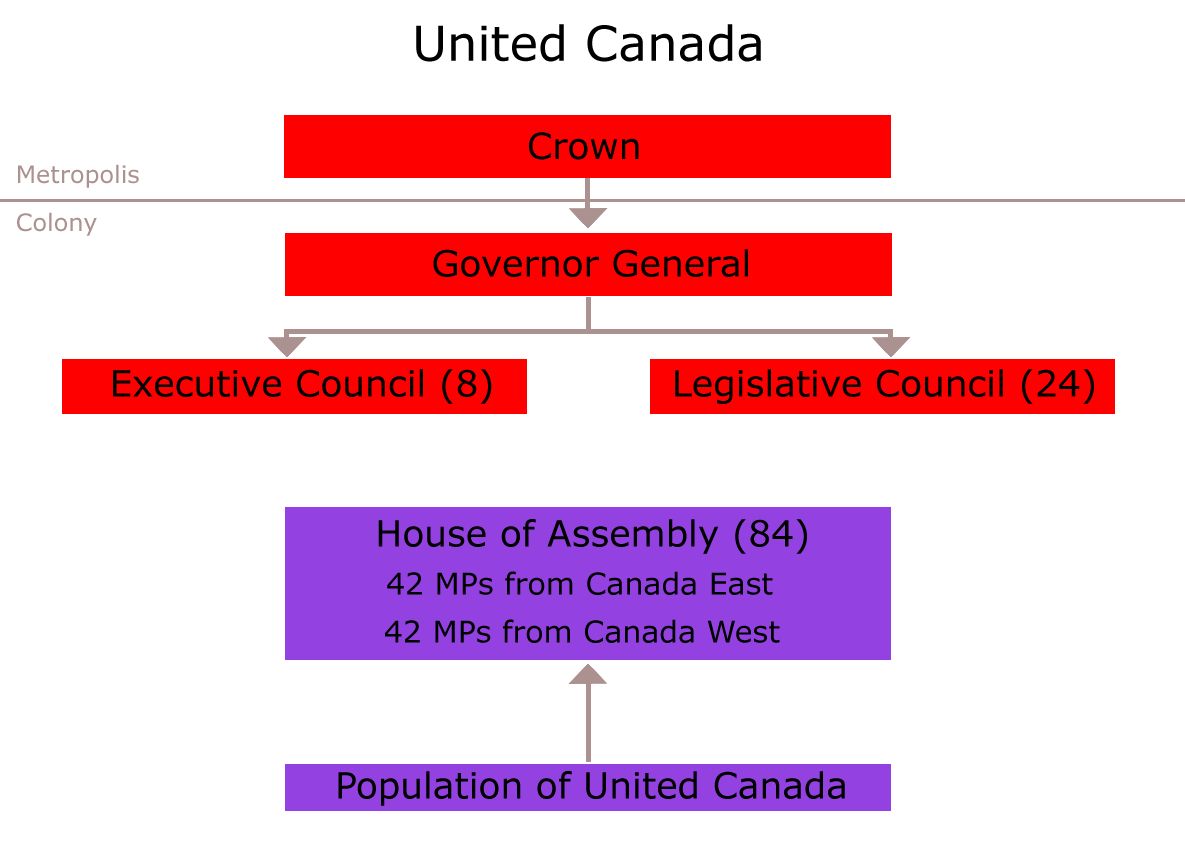
The Act of Union contained several specific and contentious provisions designed to reshape governance in British North America. The core of the act was the creation of a single parliament for the new Province of Canada, consisting of one Legislative Council and one Legislative Assembly. The territory was divided into two sections: Canada West (the former Upper Canada) and Canada East (the former Lower Canada). One of the most controversial measures mandated an equal number of seats in the assembly for each section, with 42 seats allotted to Canada West and 42 to Canada East. This was imposed despite Canada East having a significantly larger population of approximately 650,000 compared to Canada West's 450,000.
Other major financial and cultural provisions had lasting impacts. The debts of the two former colonies were consolidated into a single provincial debt. A permanent Civil List was established to govern official salaries. The act banished the French language from all official government use. Despite this forced political amalgamation, the distinct legal systems of the two regions were preserved, with Canada West retaining English common law and Canada East maintaining French civil law. British criminal law applied throughout the province.
- Single Parliament: Created one Legislative Council and Assembly for the Province of Canada.
- Equal Representation: Granted 42 legislative seats each to Canada East and Canada West, regardless of population.
- Debt Consolidation: Merged the separate debts of Upper and Lower Canada into one provincial debt.
- Civil List: Established a permanent list of government officials and their salaries.
- Language Ban: Officially prohibited the use of French in government proceedings and documents.
- Preserved Legal Systems: Maintained French civil law in Canada East and English common law in Canada West.
Implementation and Immediate Opposition
The path to implementing the Act of Union involved securing colonial consent before its passage in London. The legislation was first introduced in the British House of Commons in May 1839. To obtain the necessary approval from the Canadas, the British government sent Charles Poulett Thomson (later Lord Sydenham) as governor general. Through political manoeuvring, Thomson secured consent from the Special Council of Lower Canada in November 1839 and from the legislature of Upper Canada in December 1839. The act formally passed the British Parliament in July 1840 and received royal assent on July 23, 1840. It was proclaimed in force on February 10, 1841, in Montreal, with Kingston designated as the first capital of the united Province of Canada. The first united parliament convened in June 1841.
Opposition to the union was immediate and fierce from multiple quarters. In Upper Canada, the entrenched elite known as the Family Compact opposed the loss of their separate legislature. In Lower Canada, political and religious leaders universally condemned the act's anti-French measures. Louis-Joseph Papineau, upon entering the new parliament, immediately demanded representation by population and the recall of the union. The Catholic Church in Canada East, while fearful of assimilation, had supported British authorities during the rebellions and was consequently rewarded with continued influence. This cooperation helped mitigate some resistance, but the fundamental grievances regarding representation, debt, and language remained potent political forces.
Political Evolution and the Double Majority
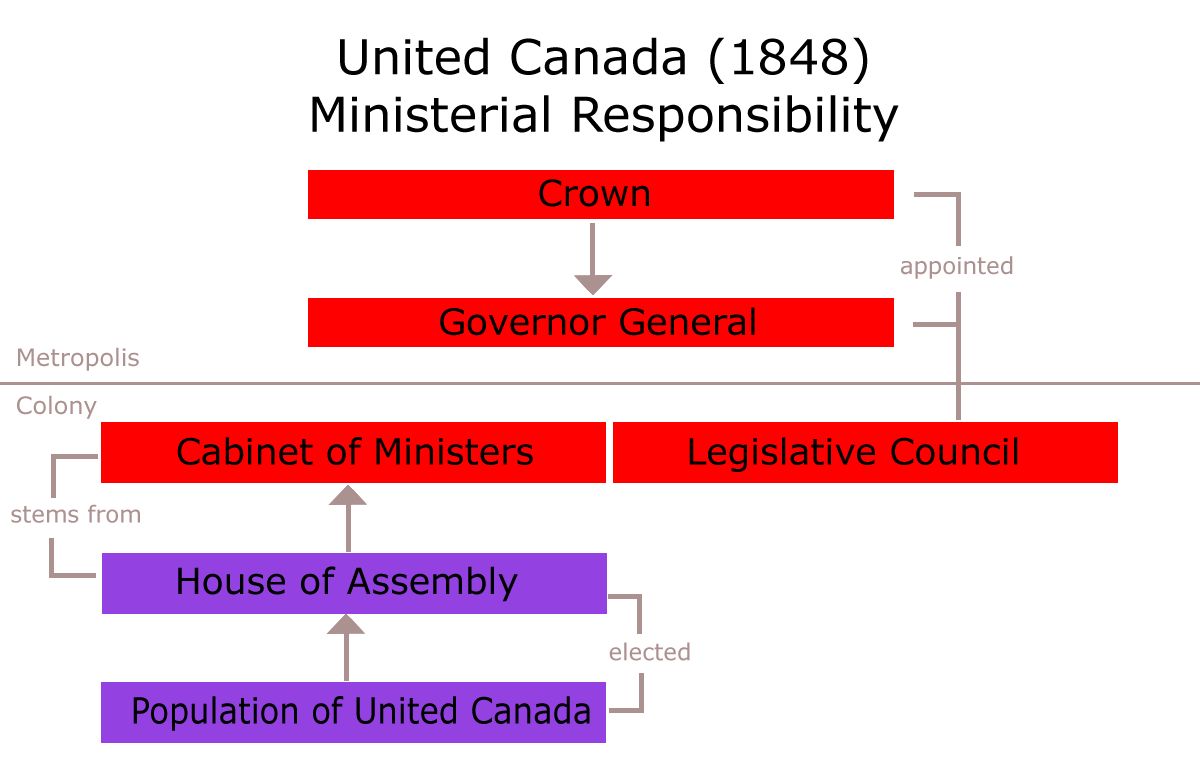
The political dynamics of the united province evolved significantly in the years following 1841, largely frustrating the assimilationist goals of the act's authors. The key development was the formation of a powerful political alliance between reformers from both sections. Robert Baldwin, leader of the reformers in Canada West, joined forces with Louis-Hippolyte La Fontaine of Canada East. La Fontaine agreed to the alliance on the condition that Baldwin's group accept French Canadian cultural identity and abandon assimilationist aims. This Baldwin-La Fontaine alliance won a majority in the legislative assembly in 1841. Their greatest achievement came in 1848 when the British government finally granted responsible government to the colony.
With responsible government in place, the Baldwin-La Fontaine ministry quickly moved to repeal some of the act's most offensive clauses, including the ban on the use of French in the assembly, courts, and civil administration. The political practice that emerged was known as the double majority principle. This unofficial convention held that for legislation affecting one section of the province to pass, it required support from a majority of legislators from that specific section, as well as an overall majority. This effectively meant the government needed support from both Canada East and Canada West. Because the francophone members from Canada East tended to vote as a unified bloc, while the anglophone members from Canada West were often divided into factions, the Canada East bloc held significant leverage. This principle created a system where the two Canadas were managed almost independently within the single parliament, but it also led to frequent legislative deadlock.
Demographic Shifts and the Push for Representation by Population
A major unforeseen consequence of the Act of Union was a dramatic demographic shift that undermined its original political calculus. The act's equal representation provision was based on the 1841 population figures, which favoured Canada East. However, the late 1840s and 1850s saw massive immigration from the British Isles, with most newcomers settling in Canada West. This influx rapidly changed the population balance between the two sections. By the late 1850s, Canada West's population had grown to surpass that of Canada East. This demographic reversal made the equal representation clause seem increasingly unjust to politicians in Canada West, who began to lobby for representation by population.
The demand for representation by population became a central and destabilizing political issue in the 1850s. Reformers like George Brown of Canada West argued it was undemocratic for his growing section to have the same number of seats as Canada East. Politicians in Canada East, particularly French Canadians, resisted this change fiercely, fearing it would drown out their voice and political influence within the union. This conflict over representation, combined with the inherent deadlock of the double majority system, created a political impasse. Government became increasingly difficult as ministries rose and fell with frequency. The resulting instability contributed to discussions for a broader federal union.
Failure and Legacy Leading to Confederation
The Act of Union did not succeed in assimilating French Canadians or stifling their political influence. Responsible government and the double majority principle had instead empowered a unified French-Canadian bloc in the assembly. The act also failed to provide stable governance, as the union was paralyzed by sectional conflict over representation, religion, and railways. The political deadlock became so severe that governments could barely function, leading statesmen from both Canada East and Canada West to seek a more fundamental constitutional change.
This pervasive dissatisfaction directly led to the discussions for a broader federal union. The resulting Confederation scheme, realized in the British North America Act of 1867, addressed the flaws of the Act of Union by creating a federal system. The new Dominion of Canada allowed the old Province of Canada to be divided into the provinces of Ontario and Quebec, each with control over local matters like education and civil law, while a central federal government handled common interests. Representation in the federal House of Commons was based on population, appeasing Canada West's demands, while a Senate with equal regional representation provided protection for smaller regions. Thus, the Act of Union's legacy is that of a flawed experiment whose breakdown made Confederation necessary for Canada's political future.
- Assimilation Failed: French Canadian political and cultural identity remained strong and influential.
- Political Deadlock: The double majority principle led to frequent and paralyzing legislative impasses.
- Catalyst for Change: The union's instability directly prompted the search for a new federal solution.
- Federal Model: Confederation in 1867 replaced the unitary union with a federal system, dividing the Province of Canada into Ontario and Quebec.
- Constitutional Evolution: The act remains a critical chapter in Canada's constitutional history.
Questions about Act of Union 1840
Why was the Act of Union considered unfair to Lower Canada (Canada East)?
The Act of Union was considered unfair to Lower Canada, renamed Canada East, for several specific reasons. First, it granted equal representation in the new assembly, 42 seats each, despite Canada East having a significantly larger population of about 650,000 compared to Canada West's 450,000. Second, it forced Canada East to assume responsibility for Canada West's substantial debt. Finally, it banned the official use of the French language in government, directly attacking the cultural identity of the majority in Canada East.
Did the Act of Union grant responsible government to Canada?
No, the Act of Union itself did not grant responsible government. Lord Durham had recommended responsible government, but the British government rejected this idea at the time of union. Responsible government was only achieved later, in 1848, following political pressure and reforms. The second Baldwin-La Fontaine ministry, appointed under the principles of responsible government, was then able to repeal some of the Act of Union's most discriminatory clauses, including the ban on the use of French.
What were Canada West and Canada East?
Canada West and Canada East were the two regions created by the Act of Union 1840 within the new Province of Canada. Canada West was the former colony of Upper Canada, comprising primarily English-speaking settlers and operating under English common law. Canada East was the former colony of Lower Canada, with a majority French-speaking, Catholic population and retaining its French civil law system. The act mandated that each region would have an equal number of seats in the provincial legislature, a source of major political conflict as their populations changed.
What was the 'double majority' principle?
The double majority was an unofficial political convention that developed in the Province of Canada. It held that for legislation affecting one of the two sections to pass, it needed the support of a majority of legislators from that specific section, in addition to an overall majority in the assembly. This practice emerged because French Canadian members from Canada East voted as a unified bloc, giving them leverage. While it allowed the two sections to be managed somewhat independently, the double majority principle often led to legislative deadlock and government instability.
How did the Act of Union lead to Canadian Confederation?
The Act of Union led to Canadian Confederation by creating a political system that ultimately proved unworkable. The equal representation clause became a major point of contention as Canada West's population grew, leading to demands for representation by population. This chronic instability convinced political leaders from both Canada East and Canada West that a new, broader form of government was necessary. Their search for a solution resulted in the Charlottetown and Quebec Conferences, which designed the federal system established by the British North America Act of 1867.
What was the main purpose of the Act of Union 1840?
The main purpose of the Act of Union 1840 was to resolve political instability and rebellion by uniting Upper and Lower Canada into the Province of Canada. This union was directly recommended in Lord Durham's report following the 1837-38 rebellions. The British government aimed to ensure a loyal English-speaking majority in British North America and to assimilate French Canadians. A further key purpose was to solve Upper Canada's severe debt crisis by merging its finances with the more solvent Lower Canada. The act was intended to create a more governable and economically stable colony under firm British control.
Sources and further reading
- Act of Union 1840 (Wikipedia)
- Act of Union (thecanadianencyclopedia.ca)
- Grade 7: History: The Act of Union and Responsible Government (vlc.ucdsb.ca)
- The Act of Union and Its Consequences | Secondaire (alloprof.qc.ca)
- Union Act, 1840 (UK) (primarydocuments.ca)
Checked by the Nosy Mag desk. Last updated 2026-10-23.