John Horgan
John Joseph Horgan (August 7, 1959, November 12, 2024) was a Canadian politician and diplomat who served as the 36th premier of British Columbia from 2017 to 2022 and as Canada's ambassador to Germany from 2023 to 2024. As leader of the British Columbia New Democratic Party from 2014 to 2022, he guided the party to power after 16 years in opposition, forming a historic minority government with the Green Party before winning a decisive majority in 2020. His premiership, which made him the province's first two-term NDP premier and its longest-serving NDP premier, was marked by significant policy initiatives on affordability, climate action, and public services. Horgan's career in public service, spanning roles as a political aide, Member of the Legislative Assembly, and finally a diplomat, ended with his death from thyroid cancer in November 2024.
Early Life and Formative Experiences
John Joseph Horgan was born on August 7, 1959, in Victoria, British Columbia, the son of Alice May (née Clutterbuck) and Pat Horgan. His father died when Horgan was 18 months old, leaving his mother to raise four children alone. The family's early years were difficult, relying on food hampers from their local church and support from relatives and neighbours, an experience Horgan said instilled in him a deep sense of gratitude and a duty to help others. He was raised in the Saanich district of Victoria and attended Reynolds Secondary School, where he struggled academically. A turning point came through his high school basketball coach, who mentored him and helped him secure a spot on the varsity basketball team at Trent University in Peterborough, Ontario, where he moved to continue his education.
At Trent University, Horgan earned a Bachelor of Arts degree in 1983 and met his future wife, Ellie. His political convictions were solidified during this period when he attended a rally by legendary NDP MP Tommy Douglas. After graduating, Horgan travelled to Australia to pursue a Master of Arts in history, which he earned from the University of Sydney in 1986. Before his graduate studies, he worked multiple jobs to save money, including at a pulp mill in Ocean Falls and waiting tables at the Keg restaurant in Victoria. Horgan and Ellie had two sons together, Nate and Evan. In 2008, he was diagnosed with bladder cancer but recovered after surgery and treatment. He was later diagnosed with throat cancer in 2021 and thyroid cancer in 2024.
Career as a Political Staffer and Policy Advisor
Returning to Canada from Australia, Horgan began his political career in the mailroom of his local MP, James Manly. He quickly advanced, becoming a legislative assistant to Manly and later to Victoria MP Lynn Hunter in 1988. In 1991, he returned to British Columbia to work within the provincial NDP government, starting as a ministerial assistant to Dave Zirnhelt. Over the next decade, Horgan held a series of increasingly senior positions within the public service, focusing on complex policy files, particularly in energy and natural resources. In 1993, he was named an analyst in the Policy Coordination Branch of the Ministry of Government Services, and by 1996 he had become a director at the Cabinet Policy and Communications Secretariat within the Ministry of Finance and Corporate Relations.
His specific responsibilities during the 1990s included serving as a lead negotiator for the Columbia Basin Trust and participating on negotiation teams for the Columbia River Treaty and various Land Use Plans. In 1998, he worked as a director in the Crown Corporations Secretariat before moving to Columbia Power as director of Corporate Affairs, where he focused on repowering the Keenleyside and Brilliant dams. His highest staff role came in 1999 when he was appointed chief of staff to Premier Dan Miller, having previously worked for premiers Mike Harcourt and Glen Clark. His final government role was at the associate deputy minister level in the Ministry of Finance, working on energy projects. Following the NDP's defeat in the 2001 provincial election, Horgan left government and co-founded a consulting company called IdeaWorks with former deputy minister Nancy Thompson and other former NDP officials.
- IdeaWorks developed a sophisticated campaign in 2003 that successfully convinced Vancouver City Council to lift a moratorium on slot machines.
- The firm focused on policy, management, research, and government liaison work for various clients.
- This period in the private sector lasted until his election to the Legislative Assembly in 2005.
Election to the Legislature and Opposition Critic Roles
Prompted by a challenge from one of his son's friends, Horgan ran for the BC Legislative Assembly in the 2005 provincial election. He won the NDP nomination in the riding of Malahat-Juan de Fuca, defeating Julie Thomas, and faced BC Liberal Cathy Basskin, Democratic Reform BC leader Tom Morino, Green candidate Steven Hurdle, and others in the general election. Horgan won the seat, though the NDP under Carole James formed the Official Opposition to a BC Liberal majority government. He was immediately appointed to the NDP front bench as the Opposition critic for education. In this role, he strongly criticized the government's 2005 Teachers' Collective Agreement Act, which legislated teachers into a contract, arguing it inflamed a volatile situation. The law was later overturned by the Supreme Court of Canada after 11 years of litigation.
In June 2006, Horgan was named the Opposition critic for energy and mines, a portfolio that matched his professional expertise. He called for greater transparency from the BC Oil and Gas Commission after reports showed a near-perfect compliance rating despite thousands of known infractions. In early 2007, he introduced the Retail Petroleum Consumer Protection Act as a private member's bill, seeking to place gasoline prices under the jurisdiction of the BC Utilities Commission, a move supported by an 18,000-signature petition. That same year, he accused Premier Gordon Campbell of a conflict of interest regarding his shares in Alcan during a power agreement negotiation. Horgan later introduced the Members' Conflict of Interest Amendment Act to require blind trusts for cabinet ministers. Also in 2007, following a legislative amendment that increased MLA salaries by 29 percent, Horgan joined all NDP MLAs in donating the increase to charities in their ridings for the remainder of the parliament.
Leadership Bids and Ascension to Party Leader
Horgan was re-elected in the 2009 election in the renamed riding of Juan de Fuca, defeating BC Liberal candidate and Colwood mayor Jody Twa. He continued as energy and mines critic in the 39th Parliament, consistently opposing the BC Liberal government's energy policies. He criticized the government for overturning BC Utilities Commission decisions on electricity from independent power producers and for exempting major projects like the Site C dam and the northwest transmission line from review. Following internal party criticism of leader Carole James and her subsequent resignation, Horgan entered the 2011 NDP leadership race. His campaign platform included a Fair Tax Commission to review taxation, expanding the carbon tax to cover large industrial emitters, building the Evergreen Line and light rail, and introducing an Endangered Species Act. He was endorsed by several MLAs including Robin Austin, Gary Coons, and Shane Simpson, but finished third behind winner Adrian Dix and Mike Farnworth.
After the NDP's unexpected loss in the 2013 election under Dix's leadership, the party leadership again became vacant. Horgan initially declined to run, encouraging a new generation like David Eby to step forward. By early 2014, with only Mike Farnworth declared, Horgan was urged to reconsider. He announced his candidacy on March 17, 2014, with the slogan "Real Leadership. For All BC," backed by Carole James, Maurine Karagianis, and Bill Routley. His campaign gained rapid endorsements, including from David Eby and Michelle Mungall who co-chaired it. When Farnworth withdrew in early April, Horgan was left as the sole candidate. He was acclaimed leader of the BC NDP on May 1, 2014, and officially became Leader of the Opposition on May 5. Upon becoming leader, he restructured the opposition front bench, appointing Farnworth as house leader and dividing the energy portfolio among critics Norm Macdonald, Bruce Ralston, and Adrian Dix, while giving significant files to younger MLAs like Rob Fleming and Spencer Chandra Herbert.
Policy Agenda as Opposition Leader and Path to Premier
As Leader of the Opposition from 2014 to 2017, Horgan used private member's bills to outline the NDP's policy direction. Just prior to becoming leader, he introduced the Standing Committee Reform Act and the Parliamentary Calendar Act to increase legislative transparency and regularity. After his acclamation, these bills were reintroduced by critic Gary Holman. In the 2015 and 2016 sessions, Horgan introduced several significant pieces of legislation that formed the core of his platform heading into the 2017 election. The Hydro Affordability Act sought to empower the Utilities Commission to mandate 'lifeline rates' for low-income households to address electricity costs. The Speculator Tracking and Housing Affordability Fund Act proposed allowing municipalities to levy a 2 percent property tax on vacant residential properties, with funds directed to affordable housing initiatives.
His most consistent focus was on campaign finance reform, an issue he had raised for years. The Campaign Finance Reform Act (2016) and the later Get Big Money Out of Politics Act (2017) aimed to ban all corporate and union donations to political campaigns, prohibit contributions from foreigners, and end the practice of premiers and ministers receiving second salaries. This legislative push directly targeted the fundraising practices of the governing BC Liberals and became a central theme in the 2017 election campaign. Horgan also spent this period travelling the province to endorse local candidates and engage in leaders' debates with Premier Christy Clark and Green Party leader Andrew Weaver, sharpening his party's message on affordability, public services, and political integrity.
The 2017 Election and Forming a Minority Government
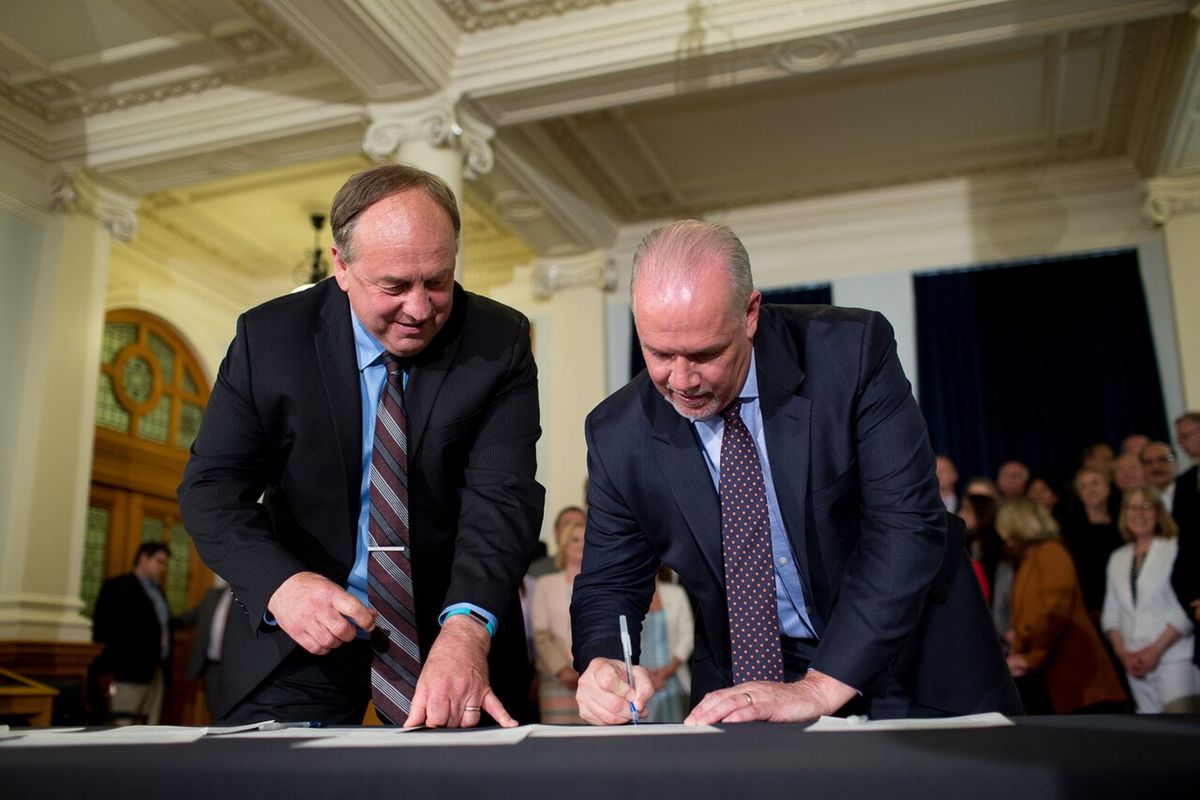
In the May 9, 2017, provincial election, Horgan was re-elected in his riding, now called Langford-Juan de Fuca, defeating BC Liberal Cathy Noel and others. The overall election result produced a hung parliament. Premier Christy Clark's BC Liberals were reduced to 43 seats, one short of a majority in the 87-seat legislature. The NDP won 41 seats and the BC Green Party won 3 seats. Despite not winning a plurality, Horgan moved swiftly to negotiate a governing arrangement. On May 29, 2017, he and Green Party leader Andrew Weaver announced a confidence and supply agreement, endorsed by both caucuses, in which the Greens would support an NDP minority government on confidence and budget matters for four years. This gave the combined NDP-Green bloc 44 seats, a one-seat advantage.
Clark initially refused to resign, recalling the legislature on June 22 to test its confidence. On June 28, Horgan introduced a motion of non-confidence as an amendment to the Speech from the Throne. The motion passed on June 29 by a vote of 44 to 42, with all NDP and Green MLAs in support. This marked the first time a BC government had been defeated on a confidence vote in the legislature. Clark then asked Lieutenant Governor Judith Guichon to dissolve parliament for a new election. Guichon declined the request and instead invited Horgan to form a government. He was sworn in as the 36th premier of British Columbia on July 18, 2017, ending 16 years of BC Liberal government and becoming the first NDP premier since Ujjal Dosanjh in 2001.
Premiership: First Term and Key Minority Government Actions
Leading a minority government dependent on Green support, Horgan's first term moved quickly to implement key promises. One of the earliest and most symbolic acts was the passage of legislation to ban corporate and union donations in provincial politics, fulfilling a long-standing pledge. His government also launched significant policy initiatives, including the CleanBC climate action plan developed in partnership with the Green Party. Other early moves included increasing investments in child care, beginning the elimination of Medical Services Plan premiums, and taking steps to address the housing affordability crisis. The government faced the ongoing challenge of managing the confidence and supply agreement, which required continuous negotiation and cooperation with the three Green MLAs to maintain a working majority on crucial votes. The partnership, while historic, was not without tension as the Green Party maintained its right to oppose government legislation outside the agreed-upon confidence and supply matters, leading to debates on specific policies. Nevertheless, the arrangement provided remarkable stability for a minority government, lasting the full intended four-year period without a collapse. His government's response to the pandemic, including public health orders and economic support measures, became a defining feature of the latter part of his first term and set the stage for his decision to call a snap election. The government's ability to manage these crises while maintaining its partnership with the Greens was a significant political achievement that contributed to its strong public standing heading into the 2020 election.
The 2020 Snap Election and Securing a Majority
On September 21, 2020, Horgan asked Lieutenant Governor Janet Austin for an early election, ending the NDP-Green confidence and supply agreement. The snap election was held on October 24, 2020. The result was a decisive victory for the BC NDP. When the final vote count was completed on November 8, the party had won 57 of 87 seats, securing a majority government for the first time since the 1996 general election. This victory made John Horgan British Columbia's first two-term NDP premier. During his second term, he also surpassed the tenure of all previous NDP premiers, becoming the longest-serving BC NDP premier in the province's history.
The 2020 mandate allowed Horgan to govern without the procedural constraints of the confidence and supply agreement. His second-term agenda included further expansion of the child care program, the introduction of the province's first anti-racism data act, and continued implementation of the CleanBC plan. The government also faced persistent challenges, including the ongoing pandemic response, the toxic drug crisis, wildfires, and pressures on the health care system. On March 3, 2021, Horgan introduced Bill 9, the Local Elections Statutes Amendment Act 2021, to regulate campaign financing in municipal elections. On September 16, 2021, he was selected to chair the Council of the Federation, a body of Canada's provincial and territorial premiers. Horgan's personal health also became a consideration, as he had been diagnosed with throat cancer in October 2021 and underwent surgery and radiation treatment.
Resignation, Diplomatic Posting, and Death
On June 28, 2022, Horgan announced he would step down as premier and NDP leader once a successor was chosen, citing his health and a desire to pass the torch after nearly five years as premier and eight as party leader. He asked the party to hold a leadership contest that fall. His long-time cabinet minister and former housing critic, David Eby, was acclaimed as the new party leader after the disqualification of a rival candidate. Horgan was succeeded by Eby on November 18, 2022. Horgan remained the MLA for Langford-Juan de Fuca until his resignation took effect on March 31, 2023, completing over 17 years of service in the legislature. A by-election held on June 24, 2023, was won by NDP candidate Ravi Parmar.
On November 1, 2023, Prime Minister Justin Trudeau announced Horgan's appointment as Canada's ambassador to Germany. The appointment leveraged Horgan's extensive experience in government and energy policy at a time when Germany was seeking new energy partnerships. Horgan presented his credentials to German President Frank-Walter Steinmeier in Berlin on December 8, 2023, formally beginning his diplomatic service. He went on leave from the position in June 2024 after being diagnosed with cancer for a third time. John Horgan died from thyroid cancer on November 12, 2024, at the Royal Jubilee Hospital in Victoria, British Columbia. His death prompted widespread tributes from political allies and opponents alike, recognizing his significant impact on British Columbia and his reputation as a pragmatic and relatable leader who reshaped the province's political landscape.
Questions about John Horgan
How did John Horgan become premier of British Columbia?
John Horgan became premier following the 2017 provincial election, which resulted in a hung parliament. His BC NDP won 41 seats, while the governing BC Liberals won 43, one short of a majority. Horgan negotiated a confidence and supply agreement with the three-member BC Green Party caucus. When the legislature reconvened, the combined NDP and Green votes passed a non-confidence motion against the Liberal government on June 29, 2017. Lieutenant Governor Judith Guichon then invited Horgan to form a minority government, which he did on July 18, 2017.
What kind of cancer did John Horgan have?
John Horgan was diagnosed with bladder cancer in 2008 and was later declared cancer-free. He was diagnosed with throat cancer in 2021 and underwent surgery and radiation treatment. He went on leave from his ambassadorial post in June 2024 after a third cancer diagnosis. He ultimately died from thyroid cancer on November 12, 2024.
What was John Horgan's biggest electoral achievement?
John Horgan's biggest electoral achievement was leading the BC NDP to a majority government victory in the 2020 snap election. The party won a record 57 seats and the highest share of the popular vote in its history. This made him British Columbia's first two-term NDP premier and, during his second term, its longest-serving NDP premier.
What did John Horgan do after being premier?
After stepping down as premier in November 2022 and resigning as an MLA in March 2023, John Horgan was appointed Canada's ambassador to Germany in November 2023. He presented his credentials on December 8, 2023, and served in the position until his death in November 2024.
What was the confidence and supply agreement with the BC Greens?
The confidence and supply agreement was a political deal announced on May 29, 2017, after the 2017 election. The BC Green Party agreed to support an NDP minority government on confidence and budget matters for four years. This gave the combined NDP-Green bloc 44 seats, one more than the BC Liberals' 43, allowing the NDP to form government after a non-confidence motion defeated Premier Christy Clark.
Where did John Horgan go to university and what did he study?
John Horgan attended Trent University in Peterborough, Ontario, where he graduated with a Bachelor of Arts degree in 1983. He then earned a Master of Arts in history from the University of Sydney in Australia in 1986.
Sources and further reading
- John Horgan (Wikipedia)
- BC NDP Leader John Horgan casts his ballot in advance poll (bcndp.ca)
- Meet the party leaders running in B.C.'s provincial election (cbc.ca)
- B.C. election 2026: What to know about the parties, leaders ... (theglobeandmail.com)
- John Horgan (thecanadianencyclopedia.ca)
Checked by the Nosy Mag desk. Last updated 2026-10-23.