Canadian constitutional law
Canadian constitutional law is the body of law governing the interpretation and application of the Constitution of Canada, the supreme law of the nation. It defines the powers of federal and provincial governments, establishes the structure of Canadian democracy, and protects fundamental rights and freedoms. This area of law is primarily enforced by the courts, which have the authority to review all legislation for constitutional compliance. The field encompasses both the written constitutional texts and unwritten principles developed through judicial interpretation, forming the bedrock of Canada's legal and political order.
Constitutional Supremacy and Judicial Review
The foundational principle of Canadian constitutional law is the supremacy of the Constitution, as entrenched in section 52(1) of the Constitution Act, 1982. This provision states that any law inconsistent with the Constitution is of no force or effect, granting courts a broad mandate for judicial review. Constitutional issues reach the courts through traditional litigation between parties or through reference questions, where governments ask courts for advisory opinions on legal matters. The courts have rejected a strict 'political questions' doctrine akin to that in the United States, meaning a political dimension to an issue does not automatically bar judicial consideration. Courts exercise caution with reference questions, ensuring they answer only legal questions that are not speculative, purely political, or unripe for adjudication.
To bring a constitutional challenge, a party must have legal standing, typically by being directly affected by the impugned law or by being a rights-holder whose rights are limited. Public interest groups may also gain standing by meeting the criteria from the Borowski test, which requires demonstrating a serious constitutional issue, a genuine interest in the matter, and the absence of another reasonable way to bring the issue before the court. This framework ensures that constitutional review is accessible while maintaining the courts' proper role within the constitutional framework. The Supreme Court of Canada is the ultimate arbiter of constitutional disputes, and it is expected to hear between 30 and 50 cases in its 2026 docket.
The Written and Unwritten Constitution
The written Constitution of Canada is comprised primarily of the Constitution Act, 1867, and the Constitution Act, 1982, the latter of which includes the Canadian Charter of Rights and Freedoms. These documents outline the division of powers between federal and provincial governments, the structure of government institutions, and protected rights. However, Canadian constitutional law also recognizes significant unwritten principles that inform the Constitution's interpretation. In the Reference re Secession of Quebec, the Supreme Court characterized four fundamental and organizing principles: federalism, democracy, constitutionalism and the rule of law, and the protection of minorities. These principles are not explicitly enumerated in the text but are inferred from the constitutional architecture as a whole.
Courts have developed other substantive unwritten rules. In Hunt v T&N plc, the Court found that the 'integrating character' of Canada's constitutional arrangements required provinces to give 'full faith and credit' to judgments from other provinces, despite the absence of an express constitutional clause. In the Provincial Judges Reference, the Court identified an unwritten principle protecting the right of provincial court judges to independent salary commissions. The Constitution also reaffirms Canada's dual legal system and includes Aboriginal rights and treaty rights under section 35 of the Constitution Act, 1982, which are central to the nation's legal fabric.
Core Principles of Interpretation
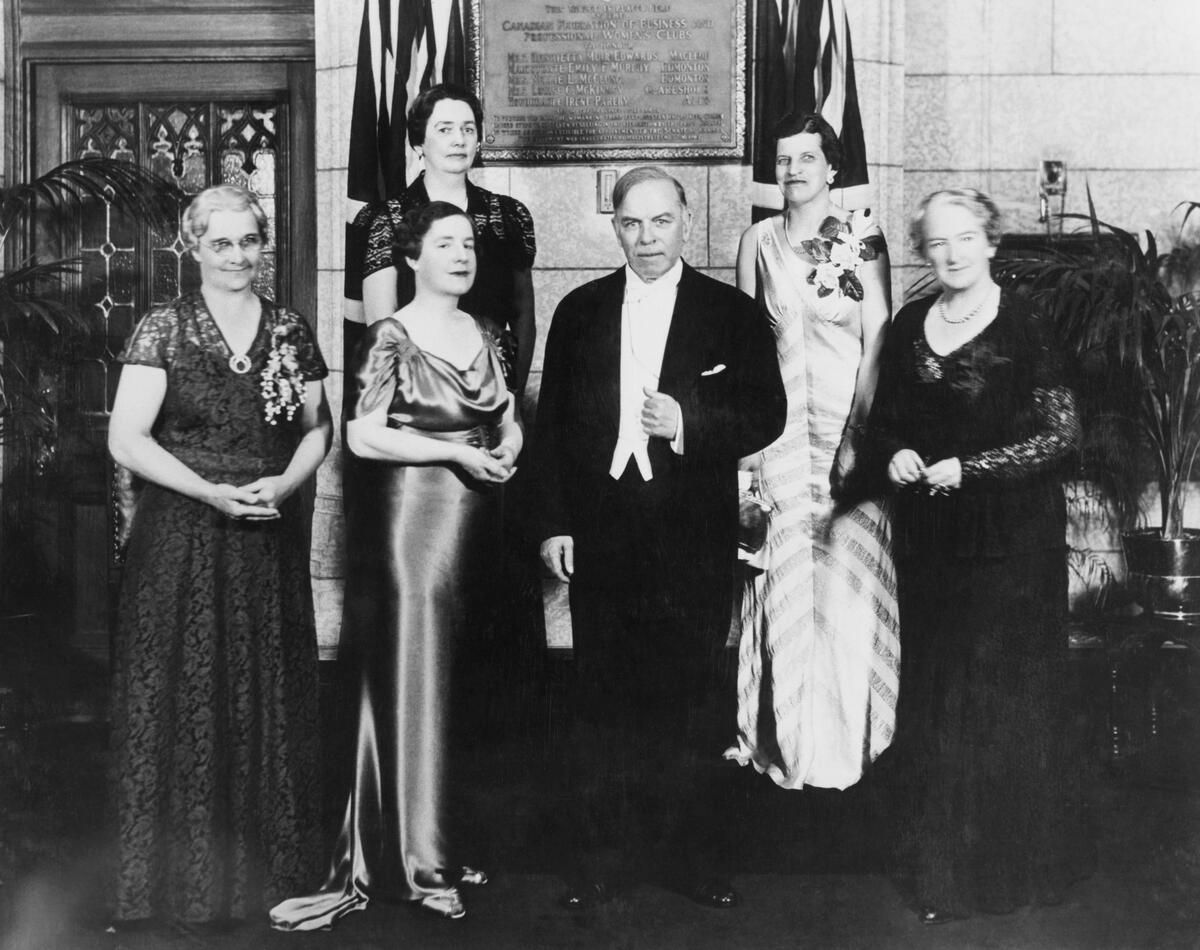
Canadian courts employ distinct methodologies to interpret constitutional and statutory texts, ensuring the law remains responsive to societal evolution. The most famous is the 'living tree' doctrine, established in the 1929 Persons Case, Edwards v Canada (AG). This doctrine holds that the Constitution is an organic instrument capable of growth and expansion within its natural limits, allowing its interpretation to adapt to changing social contexts. Alongside this, courts use a purposive approach, reading the words of an Act in their entire context and ordinary sense harmoniously with the scheme and object of the Act and the intention of Parliament. This approach rejects overly technical readings in favour of understanding the law's purpose.
In Charter jurisprudence, the 'dialogue principle' has emerged, conceptualizing judicial review as part of a conversation between legislatures and courts. Governments may draft new legislation in response to court rulings, and courts, in turn, assess these legislative responses when challenged. This principle acknowledges the collaborative nature of constitutional development in a parliamentary democracy. These interpretive techniques ensure that constitutional law is both stable and flexible, capable of addressing contemporary challenges while respecting its foundational purposes.
The Charter of Rights and Freedoms
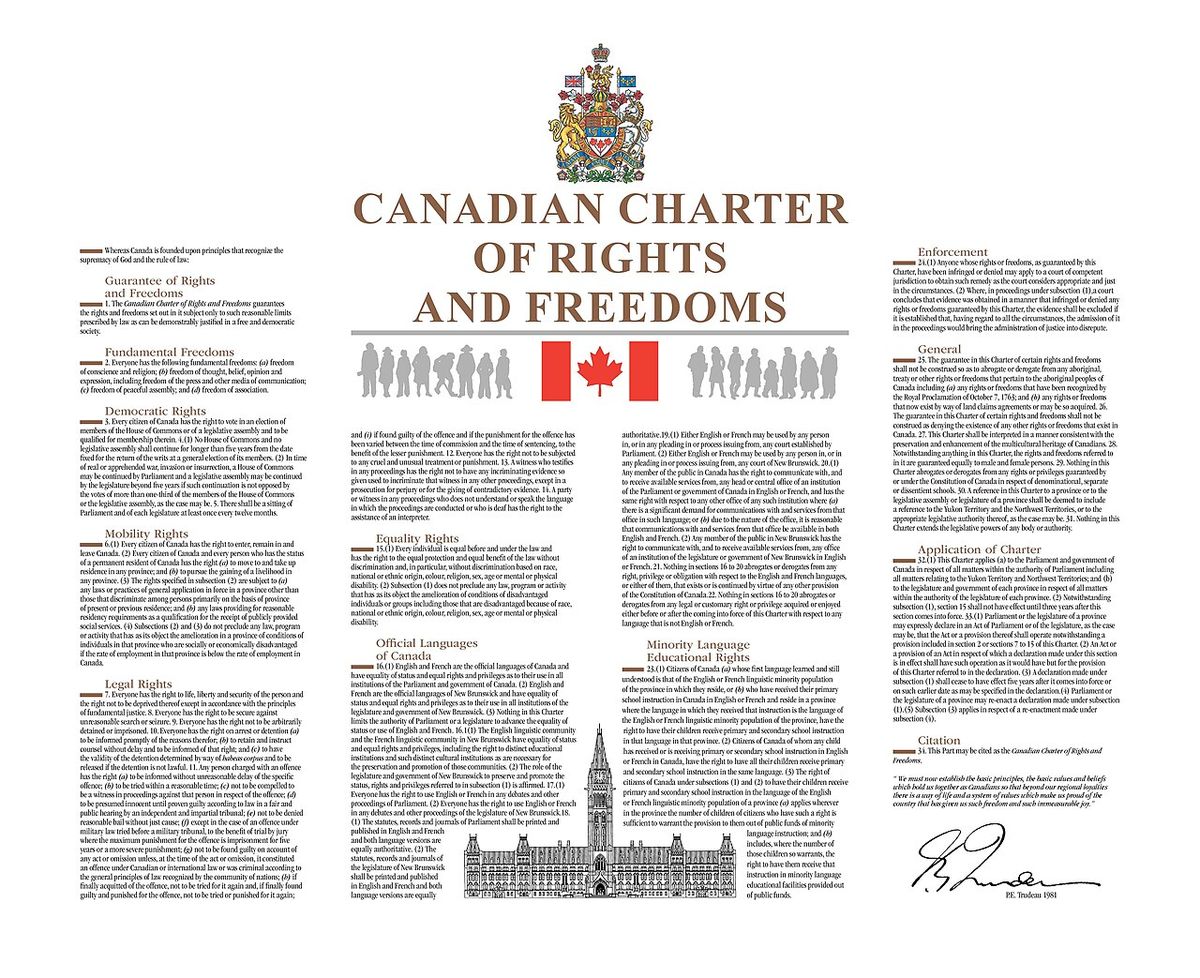
The Canadian Charter of Rights and Freedoms, enacted in 1982, forms a central pillar of modern constitutional law. It guarantees fundamental freedoms, democratic rights, mobility rights, legal rights, equality rights, and language rights. Section 32 states that the Charter applies to both the Parliament and government of Canada and to the legislatures and governments of each province, thereby limiting the powers of both levels of government. The relationship between the Charter and federalism is clarified in section 31, which states that neither level of government gains new powers under the Charter. A law whose purpose is found to violate a Charter right cannot be saved even if its effects are inoffensive, as established in R v Big M Drug Mart Ltd.
Not all Charter violations are fatal. Section 1 allows rights to be subject to reasonable limits prescribed by law that can be demonstrably justified in a free and democratic society. The test for justifying a limit, first set out in R v Oakes, involves a multi-step proportionality analysis. The government must show the law addresses a pressing and substantial objective, that the means are rationally connected to the objective, that the law minimally impairs the right, and that the law's deleterious effects are proportionate to the objective's importance. While modified in later cases, the Oakes test remains a fundamental component of Charter analysis. Certain areas, however, are shielded from Charter review. For example, the provincial education power under section 93 of the Constitution Act, 1867, regarding the funding of Roman Catholic separate schools and public schools, is plenary and not subject to Charter attack so long as it stays within that mandate.
Division of Powers and Key Doctrines
To rationalize how far each jurisdiction may use its authority, the courts have devised several key doctrines. The primary analytical tool is the 'pith and substance' doctrine, which seeks to identify the true character or dominant purpose of a law. If that dominant purpose falls within the legislature's jurisdiction, the law is intra vires (within its power), even if it has incidental effects on matters outside its jurisdiction. The 'double aspect' doctrine recognizes that some matters, by their nature, can be regulated by both levels of government from different perspectives, allowing for concurrent valid legislation.
When federal and provincial laws conflict, the doctrine of 'paramountcy' holds that valid federal law prevails. However, as established in Multiple Access Ltd v McCutcheon, paramountcy is invoked only where there is a true conflict, such as where it is impossible to comply with both laws or where the provincial law frustrates the purpose of the federal law. The doctrine of 'interjurisdictional immunity' protects the core of an exclusive federal or provincial power from being impaired by the other level's laws, though the Supreme Court has expressed caution in applying this narrow doctrine, as seen in Canada (AG) v PHS Community Services Society, noting its tension with cooperative federalism. Other relevant doctrines include Crown immunity and the concept of 'colourability,' where a law is struck down if its stated purpose masks an unconstitutional true purpose, as occurred in Re Upper Churchill Water Rights Reversion Act.
- Pith and Substance: Identifies a law's dominant purpose to assess jurisdiction.
- Double Aspect: Allows both federal and provincial laws on the same subject from different perspectives.
- Paramountcy: Federal law prevails over conflicting provincial law.
- Interjurisdictional Immunity: Protects the core of exclusive powers from impairment.
- Ancillary Powers: Allows incidental provisions if integrated with a valid legislative scheme.
- Colourability: Strikes down laws that disguise an unconstitutional purpose.
Modern Analytical Framework and Current Issues
The modern approach to division of powers disputes was summarized by the Supreme Court in Canadian Western Bank v Alberta. This framework involves a structured analysis. First, the pith and substance of both the provincial and federal laws are examined to confirm each is validly enacted. Second, if a provincial law is alleged to affect a federal matter, the doctrine of interjurisdictional immunity is considered. Third, only if both laws are valid and applicable is the doctrine of paramountcy examined for a conflict. The burden of proving paramountcy lies on the party alleging it, requiring a demonstration of impossibility of dual compliance or frustration of federal purpose. This approach emphasizes concurrent operation and cooperative federalism where possible.
Recent and upcoming cases continue to shape the field. The Supreme Court of Canada will hear the federal government's appeal in 2026 regarding the invocation of the Emergencies Act against the 2022 Freedom Convoy protesters, a case in which the Canadian Constitution Foundation (CCF) is an intervener. The CCF, a charity dedicated to defending constitutional rights, frequently litigates such cases and has expanded its legal team in 2026 with the addition of former Saskatchewan Justice Minister Bronwyn Eyre. Other persistent tensions include federal environmental regulations like the 'No More Pipelines' law, which the Alberta Court of Appeal has twice found unconstitutional, and disputes over the scope of the federal criminal law power versus provincial authority over property and civil rights, as seen in references on assisted human reproduction and securities regulation. These conflicts illustrate the ongoing vitality and complexity of Canadian federalism.
Institutions and Advocacy
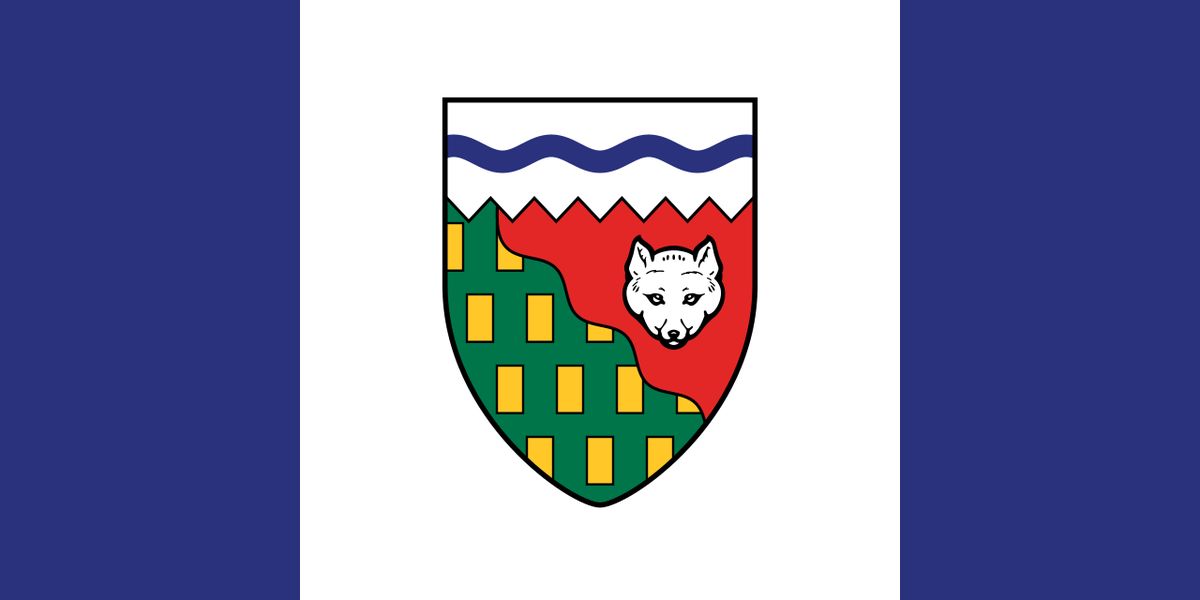
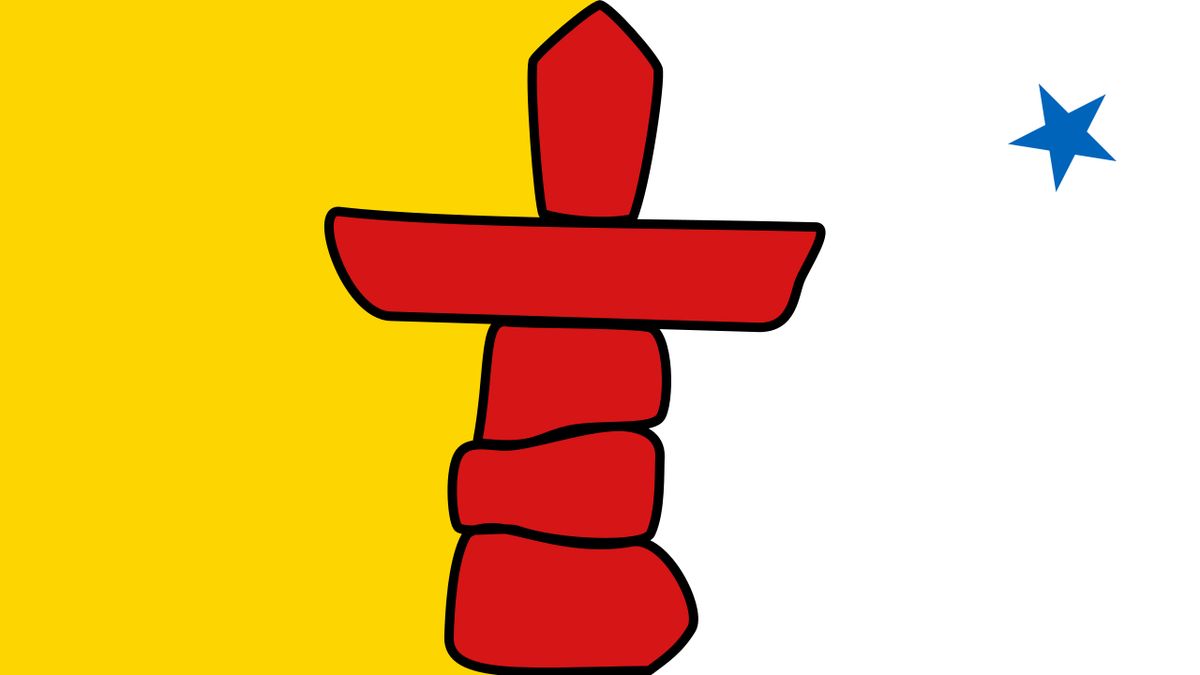
The interpretation and defence of constitutional law involve key public institutions and private organizations. The Supreme Court of Canada, established under the authority of the Constitution Act, 1867, is the general court of appeal and final arbiter of constitutional questions. The federal Minister of Justice and Attorney General oversees the Department of Justice Canada, which drafts laws and provides legal advice to the government. Parliament deals with matters concerning Canada as a whole like national defence and criminal law, while provincial legislatures govern areas like education, property, and civil rights. The three federal territories, Yukon, the Northwest Territories, and Nunavut, have councils with powers delegated by federal law.
Outside government, organizations like the Canadian Constitution Foundation play a significant advocacy and litigation role. The CCF, a registered charity, litigates cases against government action it deems unconstitutional, provides educational resources, and raises public awareness. Its work in 2026 includes intervening at the Supreme Court in the Emergencies Act appeal and other cases. Academic institutions also contribute through research and public engagement, such as the UBC Research Group for Constitutional Law hosting the annual UBC Constitutional Lecture. The 2026 lecture featured former Supreme Court Justice Russell Brown discussing the separation of powers and judicial review, reflecting the ongoing public and scholarly discourse on the Constitution's role in Canadian society.
| Institution | Primary Constitutional Role |
|---|---|
| Supreme Court of Canada | Final interpreter of the Constitution |
| Parliament of Canada | Enacts federal laws within its jurisdiction |
| Provincial Legislatures | Enact laws on provincial matters (e.g., education, property) |
| Department of Justice Canada | Provides legal advice and drafts federal laws |
| Canadian Constitution Foundation (CCF) | Litigates and educates on constitutional rights |
Questions about Canadian constitutional law
What is the supreme law of Canada?
The supreme law of Canada is the Constitution of Canada. It includes the Constitution Act, 1867, and the Constitution Act, 1982, which contains the Canadian Charter of Rights and Freedoms. This Constitution outlines the structure of government, divides powers between federal and provincial levels, and guarantees fundamental rights. All other laws in Canada must conform to it, and any law found to be inconsistent with the Constitution is of no force or effect.
What are the unwritten principles of the Canadian Constitution?
The Supreme Court of Canada has identified four fundamental unwritten principles that underlie the Constitution. These principles are federalism, democracy, constitutionalism and the rule of law, and the protection of minorities. They were articulated in the Reference re Secession of Quebec. In other cases, such as Hunt v T&N plc and the Provincial Judges Reference, the Court has found other unwritten constitutional rules. These rules are not expressly set out in constitutional texts but are implied by a number of different principles.
How does the Charter of Rights and Freedoms work?
The Canadian Charter of Rights and Freedoms, part of the Constitution Act, 1982, applies to all government actions at the federal and provincial levels. It guarantees rights such as freedom of expression, legal rights, and equality rights. If a law violates a Charter right, a court can strike it down. However, section 1 of the Charter allows the government to justify a rights violation as a reasonable limit in a free and democratic society, using the proportionality test established in the Oakes case. The Charter does not grant new powers to governments, as clarified in section 31.
What is the 'living tree' doctrine?
The 'living tree' doctrine is a principle of constitutional interpretation established in the 1929 Edwards v Canada (AG) case. It holds that the Constitution is an organic instrument capable of growth and expansion over time to meet new social realities. This approach allows courts to interpret constitutional provisions in a broad and progressive manner, rather than being confined to their original historical meaning. It has been instrumental in evolving interpretations of federal powers, the definition of 'persons,' and the scope of Charter rights.
What happens when federal and provincial laws conflict?
When valid federal and provincial laws genuinely conflict, the doctrine of paramountcy applies, meaning the federal law prevails and the provincial law is inoperative to the extent of the conflict. A conflict exists only where it is impossible to comply with both laws simultaneously or where the provincial law frustrates the purpose of the federal law. If there is no such conflict, both laws can operate concurrently, as per the double aspect doctrine. The burden of proving a conflict lies with the party alleging it.
Who can challenge a law as unconstitutional?
A party with legal standing (locus standi) can challenge a law's constitutionality. This includes individuals directly affected by the law or whose Charter rights are limited by it. Public interest groups may also gain standing by meeting the Borowski test, which requires showing a serious constitutional issue, a genuine interest in the matter, and no other reasonable way to bring the issue to court. Challenges are heard by the courts, with the Supreme Court of Canada serving as the final court of appeal on constitutional matters.
Sources and further reading
- Canadian constitutional law (Wikipedia)
- Public and Constitutional Law | Queen's Certificate in Law (certificate.queenslaw.ca)
- Canadian Constitution Foundation: Home (theccf.ca)
- The Canadian Constitution, About Canada's System of ... (justice.gc.ca)
Checked by the Nosy Mag desk. Last updated 2026-11-04.