Edwards v Canada
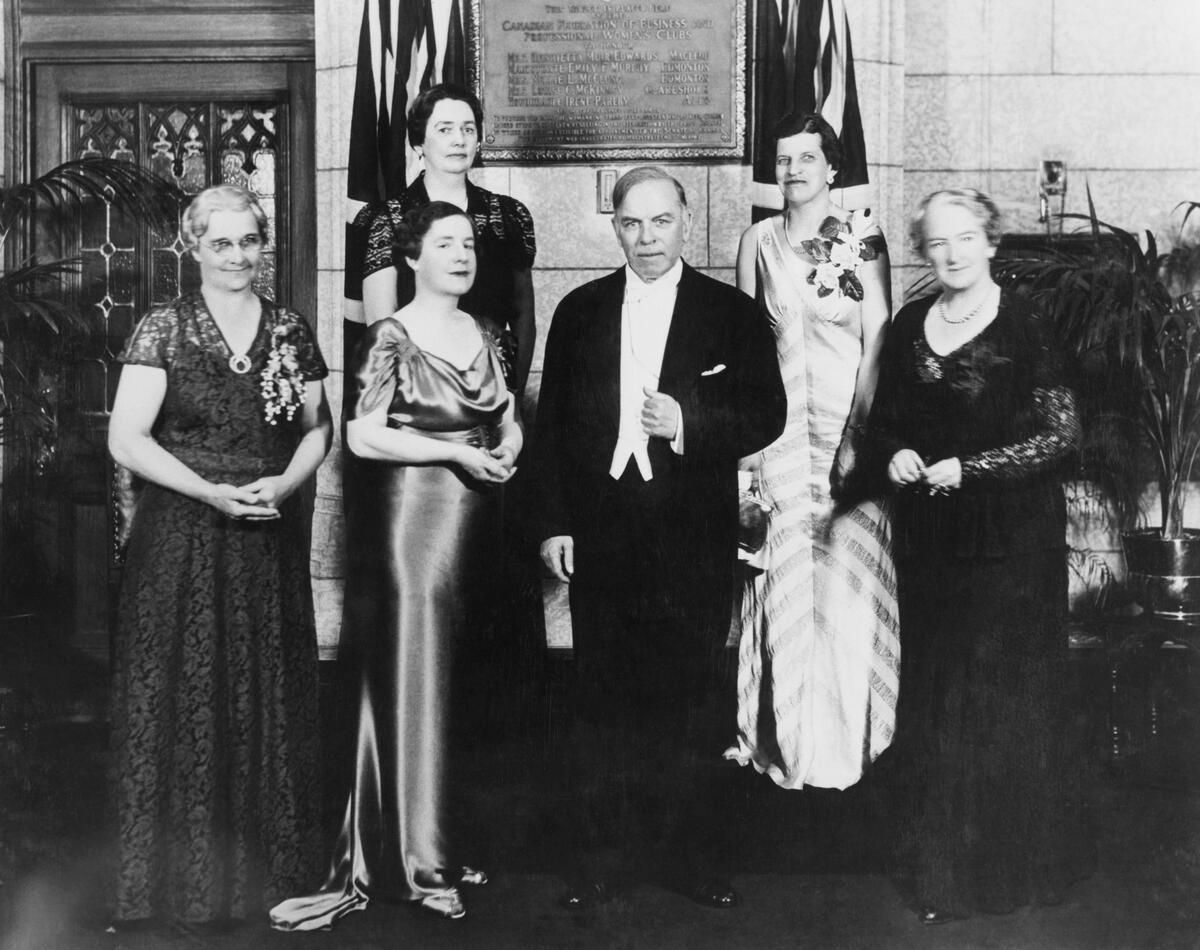
Edwards v Canada (AG), commonly known as the Persons Case, is a foundational Canadian constitutional ruling. Decided on October 18, 1929, by the Judicial Committee of the Privy Council in London, the case established that women were legally 'persons' and thus eligible for appointment to the Senate of Canada. The case was initiated by a petition from five prominent Alberta women, Emily Murphy, Nellie McClung, Louise McKinney, Irene Parlby, and Henrietta Muir Edwards, collectively known as the Famous Five. The ruling introduced the 'living tree' doctrine, a principle of constitutional interpretation that has shaped Canadian law by allowing the constitution to adapt to societal change.
Origins and the Petition
The Persons Case originated from the efforts of Emily Murphy, a magistrate and women's rights activist from Alberta. In 1916, Murphy attempted to attend a trial of Alberta women accused of prostitution but was ejected on the grounds that the testimony was not fit for mixed company. She appealed to Attorney General Charles Wilson Cross, who agreed to set up a special court and appointed her as a magistrate. On her first day, a lawyer challenged her authority on the basis that women were not considered 'persons' under the British North America Act. In 1917, the Supreme Court of Alberta ruled that women were persons. Murphy later tested the issue at the federal level by allowing her name to be put forward to Prime Minister Robert Borden as a candidate for senator. Borden rejected her, citing an 1876 British common law ruling that women were eligible for pains and penalties but not rights and privileges. A petition signed by nearly 500,000 Canadians supported her appointment.
On August 27, 1927, Murphy invited four other prominent Albertan women to her home in Edmonton to discuss a legal strategy. The group, which included Irene Parlby, Nellie McClung, Louise McKinney, and Henrietta Muir Edwards, became known as the Famous Five. Together, they signed a formal petition to the federal government asking it to refer two questions to the Supreme Court of Canada regarding women's eligibility for the Senate. The petition asked whether the Governor General or Parliament had the power to appoint a female senator and whether Parliament could make constitutional provision for such an appointment. This collaborative act marked the formal beginning of the constitutional challenge.
The Supreme Court of Canada Reference
Ernest Lapointe, the Minister of Justice in the government of William Lyon Mackenzie King, reviewed the petition from the Famous Five. He recommended to the federal Cabinet that the two original questions be narrowed down to a single question. On October 19, 1927, the Cabinet submitted this question to the Supreme Court of Canada. The question asked whether the word 'Persons' in section 24 of the British North America Act, 1867, included female persons. Emily Murphy originally objected to this change in wording on behalf of the petitioners. After further correspondence and consultation with their lawyer, the Famous Five accepted the single question posed by the Cabinet.
The Supreme Court heard the case on March 14, 1928. Chief Justice Francis Alexander Anglin wrote the majority judgment, with Justices Lamont and Smith concurring. Justices Mignault and Duff wrote separate concurring reasons. Justice Edmund Leslie Newcombe recused himself due to prior involvement on the issue. The Court's analysis centred on Section 24 of the Constitution Act, 1867, which authorizes the Governor General to summon 'qualified persons' to the Senate, and Section 23, which sets qualifications using the pronoun 'He.' On April 24, 1928, the Court issued a unanimous decision, answering the rephrased question, 'Are women eligible for appointment to the Senate of Canada?', in the negative. The Court held that the common law incapacity of women to exercise public functions, as understood in 1867, excluded them from being 'qualified persons' under the constitution.
Appeal to the Judicial Committee of the Privy Council
The five women appealed the Supreme Court's decision to the Judicial Committee of the Privy Council in London. At that time, this was the court of last resort for Canada within the British Empire and Commonwealth. The case name lists Edwards as the lead appellant because her name came first alphabetically. This led to the case being entered as Edwards v Canada (Attorney General). On October 18, 1929, Lord Chancellor Lord Sankey delivered the committee's landmark ruling. The Privy Council unanimously overturned the Supreme Court of Canada's decision, holding that the word 'persons' in Section 24 did indeed include women. Lord Sankey's judgment stated, 'The exclusion of women from all public offices is a relic of days more barbarous than ours.' He concluded that women were therefore eligible to be summoned and become members of the Senate of Canada. The ruling was immediately effective, removing the legal barrier that had prevented women from serving in the upper house of Parliament.
The Living Tree Doctrine
The Persons Case established a new approach to constitutional interpretation known as the living tree doctrine. In his ruling, Lord Sankey wrote that the British North America Act planted in Canada a living tree capable of growth and expansion within its natural limits. He stated that the Act was subject to development through usage and convention. Sankey argued it was not the duty of the Board to cut down the provisions of the Act by a narrow and technical construction. Instead, he said the constitution should be given a large and liberal interpretation. The living tree doctrine is a doctrine of constitutional interpretation that says a constitution is organic. It must be read in a broad and liberal manner so as to adapt it to changing times. This approach has become one of the core principles of constitutional law in Canada.
Immediate Aftermath and Appointments
The Privy Council's ruling was a legal victory, but it did not result in the immediate appointment of Emily Murphy or any of the other petitioners to the Senate. The first woman appointed to the Senate was Cairine Reay Wilson, who was summoned by Prime Minister Mackenzie King on February 15, 1930. Wilson's appointment, nearly a year after the ruling, demonstrated that while the legal barrier had fallen, political will was required to enact the change. Her career in the Senate, where she served for over three decades, paved the way for many women who have followed. Prior to the Persons Case, women had gained the right to vote in federal elections in 1918 and the right to stand for the House of Commons in 1919. Agnes Macphail became the first woman elected to the House of Commons in 1921. The Persons Case completed the picture by securing access to the appointed upper chamber. These rights initially applied primarily to white women, with Indigenous, Black, and Asian Canadians facing additional legal and systemic barriers for many more decades.
Commemoration and Legacy
The Persons Case and the Famous Five are commemorated across Canada through various awards, monuments, and educational initiatives. In 1979, the Governor General's Awards in Commemoration of the Persons Case were established. These annual awards are presented to five individuals who have made distinguished contributions to advancing gender equality in Canada. Physical monuments honour the group's achievement, including a statue by artist Barbara Paterson unveiled in Calgary in 1999. A replica of this statue was placed on Parliament Hill in Ottawa in 2000, depicting the five women celebrating their victory. In October 2009, the Senate voted to name the Famous Five posthumously as Canada's first honorary senators. The fifty-dollar note in the Canadian Journey Series, first issued in 2004, featured the statue of the Famous Five. Emily Murphy's house where the tea party occurred is now on the campus of the University of Alberta.
- Governor General's Awards in Commemoration of the Persons Case: Established in 1979, awarded annually to five recipients.
- Statue on Parliament Hill: A bronze monument unveiled in 2000, featuring the Famous Five.
- Canadian fifty-dollar note (2004 series): Featured the Famous Five statue on the reverse.
- Honorary senators: The Famous Five were posthumously named honorary senators by the Senate in 2009.
- Persons Day: October 18 is observed annually to commemorate the 1929 decision.
- Emily Murphy's house: The Edmonton location of the 1927 meeting is preserved on the University of Alberta campus.
Historical Context of Women's Rights
The Persons Case was part of a broader struggle for women's rights in Canada. Manitoba, Saskatchewan, and Alberta were pioneers, granting women the right to vote and hold provincial office in 1916. Most other provinces followed suit over the next several years, though Quebec women did not gain provincial voting rights until 1940. Federally, most women over 21 gained the right to vote in 1918 and the right to stand for the House of Commons in 1919. It is critical to acknowledge that these rights were not extended equally to all women. Racial and colonial policies systematically disenfranchised many. For instance, most Indigenous women and men were denied the federal vote until 1960. Inuit people were excluded until the 1950s. Black women, while legally eligible, faced poverty and systemic racism that acted as barriers.
| Jurisdiction | Year Women Gained Provincial Vote | Year Women Gained Right to Hold Office |
|---|---|---|
| Manitoba | 1916 | 1916 |
| Saskatchewan | 1916 | 1916 |
| Alberta | 1916 | 1916 |
| British Columbia | 1917 | 1917 |
| Ontario | 1917 | 1919 |
| Nova Scotia | 1918 | 1918 |
| New Brunswick | 1919 | 1934 |
| Prince Edward Island | 1922 | 1922 |
| Quebec | 1940 | 1940 |
| Newfoundland (pre-Confederation) | 1925 | 1925 |
Questions about Edwards v Canada
What was the Persons Case?
The Persons Case, officially Edwards v Canada (Attorney General), was a 1929 constitutional ruling by the Judicial Committee of the Privy Council in London. It determined that women were included in the term 'persons' under Section 24 of the Constitution Act, 1867, making them eligible for appointment to the Senate of Canada. The case overturned a 1928 ruling by the Supreme Court of Canada which had held that women were not 'qualified persons' for Senate appointment.
Who were the Famous Five?
The Famous Five were the group of women who petitioned the government on the issue of women's status. They were Henrietta Muir Edwards, Nellie McClung, Louise McKinney, Emily Murphy and Irene Parlby. On August 27, 1927, the four other women joined Emily Murphy for tea at her house in Edmonton. All five women signed the petition asking the federal government to refer questions relating to women's status to the Supreme Court of Canada.
What is the living tree doctrine?
The living tree doctrine is a principle of constitutional interpretation established in the Persons Case by Lord Sankey. It holds that a constitution is an organic document, 'capable of growth and expansion,' and should be interpreted in a 'large and liberal' manner to adapt to changing times and societal needs. This doctrine rejected a narrow, originalist reading of the constitution focused solely on the framers' intent in 1867.
Why is October 18 significant in Canada?
October 18 is recognized as Persons Day in Canada, marking the anniversary of the 1929 Privy Council decision in the Persons Case. The day commemorates the legal recognition of women as persons under Canadian law and their eligibility for the Senate. It is often used as a day to celebrate advancements in gender equality and to reflect on the ongoing work needed to achieve full equality for all women in Canada.
How is the Persons Case commemorated today?
The Persons Case is commemorated through several enduring tributes. Since 1979, the Governor General's Awards in Commemoration of the Persons Case have been awarded annually to five individuals advancing gender equality. A statue of the Famous Five, unveiled on Parliament Hill in 2000, is a prominent national monument. The group was also posthumously named honorary senators in 2009.
When was the first woman appointed to the Senate?
The first woman appointed to the Senate of Canada was Cairine Reay Wilson on February 15, 1930. This appointment occurred nearly a year after the Judicial Committee of the Privy Council's landmark ruling on October 18, 1929. Prime Minister William Lyon Mackenzie King summoned Wilson to the Senate. Her appointment established the practical precedent for women serving in Canada's upper house.
Sources and further reading
- Edwards v Canada (Wikipedia)
- Why the Persons Case Matters (sencanada.ca)
- Persons Case (thecanadianencyclopedia.ca)
- The Persons Case (niagaralaw.ca)
Checked by the Nosy Mag desk. Last updated 2026-10-23.