Constitution Act, 1867
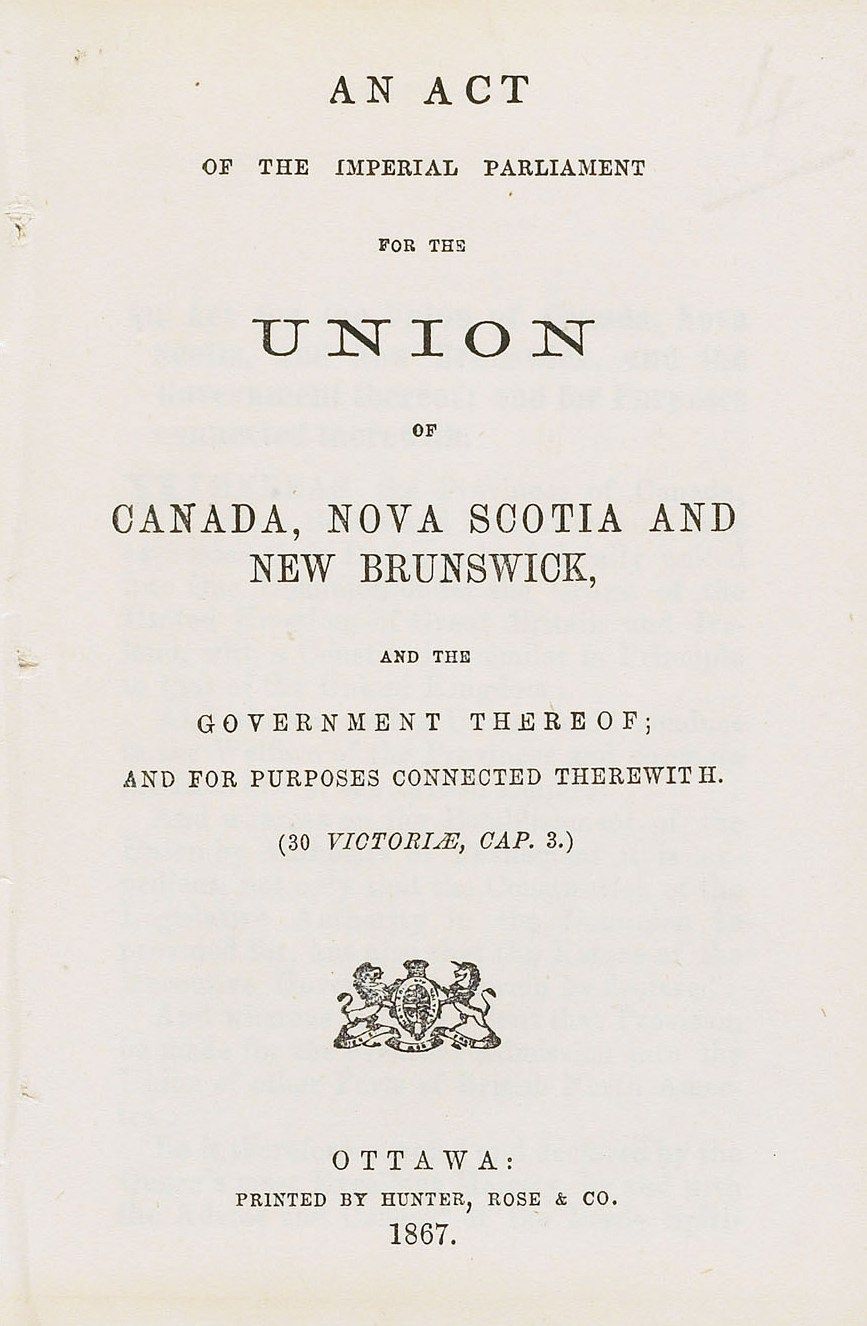
The Constitution Act, 1867 is the foundational statute of the Constitution of Canada. Originally enacted by the British Parliament as the British North America Act, 1867, it created the Dominion of Canada on July 1, 1867, by uniting the colonies of the Province of Canada, New Brunswick, and Nova Scotia. The act establishes the basic structure of the Canadian government, including the Parliament of Canada, the executive, and the division of powers between the federal and provincial governments. It was renamed the Constitution Act, 1867 during the patriation of the Constitution in 1982.
Historical Context and Legislative Passage
Delegates from the Province of Canada, Nova Scotia, and New Brunswick sought a federal union to address economic, defensive, and political challenges. The act was drafted as a British statute, the British North America Act, 1867, and passed by the Parliament of the United Kingdom on March 29, 1867. It received royal assent and was proclaimed to come into force on July 1, 1867. The preamble states the desire of the provinces to be united into one Dominion with a Constitution similar in principle to that of the United Kingdom. This reference to British principles has had interpretive significance for Canadian courts, including in cases on parliamentary privilege and judicial independence.
Framework of Federal Institutions
The act provides a detailed blueprint for Canada's central government. Section 9 vests executive authority in the monarch, with Section 10 specifying that the Governor General carries on the government on the monarch's behalf. Section 11 creates the King's Privy Council for Canada to aid and advise, while Section 16 establishes Ottawa as the seat of government. The legislative branch, Parliament, is constituted by Section 17 and consists of the monarch, the Senate, and the House of Commons. Section 18 grants Parliament privileges no greater than those of the British Parliament. The act required the first session of Parliament to begin within six months of its passage. Specific provisions govern the summoning of the House of Commons, the election of its Speaker, and the requirement for a session at least once every year. The Governor General's powers regarding royal assent, reservation of bills, and the federal power of disallowance over provincial acts are also defined within the act's text.
Composition of Parliament: Senate and Commons
The act establishes distinct rules for the two houses of Parliament. The Senate, detailed in sections 21 to 36, has 105 members appointed by the Governor General under Section 24. The act divides senatorial representation among four regional divisions: Ontario, Quebec, the Maritime provinces, and the Western provinces. Section 23 outlines qualifications for senators, including a property requirement and a minimum age of 30. Section 26 allows for the extraordinary addition of four or eight senators at one time, with the total number not to exceed 113 under Section 28. Since 1965, senators must retire at age 75. The House of Commons, defined in sections 37 to 52, is based on representation by population. Section 37 originally outlined the composition, which has been updated over time. The act now references a formula in Section 51 for readjusting the number of seats following each decennial census mandated by Section 8. The maximum duration of a Commons is five years under Section 50, and money bills must originate there under Section 53.
- Senate Divisions: Ontario, Quebec, the Maritime Provinces, the Western Provinces.
- House of Commons Readjustment: Seats are redistributed every 10 years after a census (S.51).
- Money Bills: Must originate in the House of Commons (S.53) and be recommended by the Governor General (S.54).
Division of Legislative Powers
Sections 91 to 95 of the act allocate law-making authority between the federal Parliament and the provincial legislatures, forming the basis of Canadian federalism. Section 91 lists 29 classes of subjects under exclusive federal jurisdiction, including the residual power to make laws for the peace, order, and good government of Canada. Key federal powers listed in Section 91 include regulation of trade and commerce, taxation, military and naval service, currency, banking, patents, copyrights, criminal law, and fisheries. Section 91(24) grants Parliament power over Indians and lands reserved for the Indians. Section 92 enumerates 16 classes of subjects for exclusive provincial jurisdiction, such as direct taxation, management of public lands, local works, property and civil rights, and the administration of justice. Section 92A, added in 1982, explicitly affirms provincial authority over non-renewable natural resources, forestry, and electrical energy. Sections 94A and 95 establish concurrent jurisdictions for old age pensions and for agriculture and immigration respectively, with rules stating which level of government's laws prevail in case of conflict.
| Jurisdiction | Section | Key Subject Areas |
|---|---|---|
| Federal | 91 | Trade, criminal law, banking, Indigenous peoples, peace/order/good government. |
| Provincial | 92 | Property/civil rights, municipal institutions, local works, administration of justice. |
| Concurrent | 95 | Agriculture and immigration (federal law prevails). |
| Concurrent | 94A | Old age pensions (provincial law prevails). |
| Provincial | 92A | Non-renewable natural resources, forestry, electrical energy. |
Provincial Government Structures
Part V of the act sets out the constitutions for the original provinces and the model for later ones. Section 58 provides for a lieutenant governor in each province, appointed by the Governor General under Section 59. The lieutenant governor's salary is paid by the federal Parliament under Section 60. Provincial executive power is exercised by the lieutenant governor, either alone or by and with the advice of the executive council, as outlined in Sections 63, 64, and 65. For Ontario, Section 69 establishes a legislature consisting of the lieutenant governor and the Legislative Assembly. For Quebec, Section 71 originally established a parliament with a Legislative Council and a Legislative Assembly. The Council was later abolished. Sections 69 to 87 detail provisions for these two provinces regarding legislative summoning, the disqualification of certain officeholders from sitting, the maximum four-year life of an assembly, and rules for speakers and quorum. Section 88 simply continues the pre-Confederation constitutions of Nova Scotia and New Brunswick. The act also extends the federal powers of reservation and disallowance to apply to provincial legislation through Section 90.
Patriation and Modern Amendment Process
The act's status as a British statute meant amendments required an address from the Canadian Parliament to the UK Parliament until 1982. The Statute of Westminster, 1931, granted Canada full legislative autonomy but explicitly excluded amendments to the British North America Acts. Decades of federal-provincial negotiation failed to produce an agreed-upon domestic amending formula. This changed with the patriation package of 1982, which included the Constitution Act, 1982. That act renamed the British North America Act, 1867 as the Constitution Act, 1867 and entrenched it as part of the supreme law of Canada. It also introduced several amending formulas. One formula, in section 45 of the Constitution Act, 1982, allows a provincial legislature to unilaterally amend its own constitution. Quebec used this procedure twice in 2022: first to entrench French as the only official language of Quebec via Bill 96, adding section 90Q, and second to remove the oath of allegiance to the monarch for members of the National Assembly, adding section 128Q. Saskatchewan used it in 2023 with the Saskatchewan First Act, adding section 90S to assert provincial autonomy over natural resources.
- 1982 Renaming: The British North America Act, 1867 became the Constitution Act, 1867.
- Unilateral Provincial Amendment (S.45): Allows provinces to amend their own constitution.
- Quebec Amendment (2022): Bill 96 added section 90Q on French language.
- Quebec Amendment (2022): Removed oath to monarch, adding section 128Q.
- Saskatchewan Amendment (2023): Saskatchewan First Act added section 90S.
Judicial Interpretation and Key Legal Doctrines
Courts have played a central role in applying and defining the act's provisions. From 1867 until 1949 for civil cases, the final court of appeal was the Judicial Committee of the Privy Council in London, whose rulings often emphasized provincial autonomy under Section 92. The JCPC interpreted the federal peace, order, and good government power narrowly, confining it to emergencies or distinct matters of national concern. After the Supreme Court of Canada became the final court in 1949, its interpretations continued to shape federalism. In the 1976 Anti-Inflation Act Reference, the court recognized a peacetime emergency power under peace, order, and good government. The preamble's reference to a constitution similar to the UK's has been used to import unwritten principles, such as parliamentary privilege in the 1993 New Brunswick Broadcasting case and judicial independence in the 1997 Provincial Judges Reference. Recent litigation, such as the 2019 Saskatchewan Court of Appeal decision on the federal Greenhouse Gas Pollution Pricing Act, shows ongoing judicial delineation of federal and provincial powers, particularly regarding national concerns like climate change.
Specific Powers and Their Societal Impact
Individual clauses within the division of powers have had specific effects on Canadian life. Section 91(27), granting Parliament exclusive authority over criminal law, allowed for the creation of a uniform national Criminal Code. However, Section 92(14) gives provinces power over the administration of justice, leading to provincially constituted courts and police forces like the Ontario Provincial Police. Section 91(26) gives the federal government power over marriage and divorce, while Section 92(12) gives provinces power over the solemnization of marriage, creating a jurisdictional overlap. Section 92(13) on property and civil rights is interpreted broadly, forming the basis for provincial regulation of labour relations, consumer protection, and professional licensing. The federal power over Indians and lands reserved for the Indians under Section 91(24) established the constitutional basis for the Indian Act and federal administration of Indigenous affairs, a relationship later modified by the recognition of treaty rights in 1982. The act's provisions for a decennial census and seat redistribution ensure the House of Commons reflects demographic changes over time. Section 133 establishes English and French as the official languages of the Parliament of Canada and the Legislature of Quebec.
Questions about Constitution Act, 1867
What is the difference between the British North America Act and the Constitution Act, 1867?
They are the same document. The law was originally passed by the British Parliament in 1867 under the title British North America Act, 1867. When the Constitution was patriated in 1982, this and other foundational British statutes were renamed as Constitution Acts. Therefore, the Constitution Act, 1867 is the modern Canadian name for what was historically known as the BNA Act.
What did the Constitution Act, 1867 actually do?
The act created the Dominion of Canada, effective July 1, 1867. It united the colonies of the Province of Canada, New Brunswick, and Nova Scotia into a federal union. The act established the basic structure of the Canadian government, including the Parliament, the executive branch, and the court system. Crucially, it divided powers between the new federal government and the provincial governments, a framework that still governs Canada today. It also created two new provinces, Ontario and Quebec, from the former Province of Canada.
Can the Constitution Act, 1867 be changed?
Yes, but the process depends on the nature of the change. Since 1982, amendments to the Constitution of Canada, including the Constitution Act, 1867, are made using the domestic amending formulas set out in the Constitution Act, 1982. Some changes require the agreement of the federal Parliament and two-thirds of the provinces representing a majority of the population. For matters affecting only one province, that province's legislature can make unilateral amendments under section 45, as Quebec and Saskatchewan have done in recent years.
Why was the Constitution not fully Canadian until 1982?
Although Canada gained increasing autonomy through events like the Statute of Westminster in 1931, the British North America Act remained an act of the British Parliament. This meant Canada lacked the full legal authority to amend its own constitution without requesting changes from Britain. Decades of negotiation between the federal and provincial governments were needed to agree on an amending formula. This process, called patriation, was finally completed in 1982, bringing the constitution fully under Canadian control and renaming the core document the Constitution Act, 1867.
What are 'peace, order, and good government' powers?
The 'peace, order, and good government' powers are found in the opening of section 91 of the Constitution Act, 1867. This clause authorizes the federal Parliament to make laws for the peace, order, and good government of Canada regarding matters not exclusively assigned to the provinces. Judicial interpretation has defined it as a delimited federal competency, applicable to matters of national concern and emergencies. This provision is a foundational part of the division of powers between the federal and provincial governments.
How does the act affect Indigenous peoples in Canada?
The act affects Indigenous peoples primarily through section 91(24), which provides that the federal government has legislative jurisdiction over 'Indians and lands reserved for the Indians'. This constitutional provision empowered the federal government to enact laws like the Indian Act. Treaty rights were later incorporated into the Constitution in 1982. The federal department now known as Crown Indigenous Relations and Northern Affairs Canada historically exercised authority under this section.
Sources and further reading
- Constitution Act, 1867 (Wikipedia)
- Constitution Act, 1867 (thecanadianencyclopedia.ca)
- The Evolution of the Canadian Constitution (leg.bc.ca)
- Canada, Constitutional history of (constitutionnet.org)
- Constitution Act, 1867 (primarydocuments.ca)
Checked by the Nosy Mag desk. Last updated 2026-10-27.