Bob Rae
Bob Rae is a Canadian politician and diplomat whose career has spanned over five decades and crossed party lines. He served as the 21st premier of Ontario from 1990 to 1995, leading the province's first and only New Democratic Party government. Rae later served as interim leader of the federal Liberal Party from 2011 to 2013 and concluded his formal public service as Canada's Ambassador to the United Nations from 2020 to 2025. Since December 2025, he has been serving as the Visitor of Massey College.
Early life and education
Bob Rae was born in Ottawa in 1948 into a family deeply connected to public service and diplomacy. His father, Saul Rae, was a distinguished Canadian career diplomat who had postings in Washington, D.C., Geneva, New York, Mexico, and The Hague. Rae attended Crichton Street Public School in Ottawa, Horace Mann Public School and Gordon Junior High School in Washington, D.C., and the International School of Geneva. His first job was a paper route delivering the Washington's Evening Star newspaper. His customers included future U.S. President Richard Nixon and Senator Estes Kefauver. Rae graduated with honours from University College, University of Toronto, where his roommate for a time was future political rival Michael Ignatieff. He was awarded a Rhodes Scholarship to the University of Oxford, where he studied at Balliol College under philosopher Isaiah Berlin and earned a Master of Philosophy in politics. His thesis critiqued the cultural imperialism of early British Fabian socialists like Sidney and Beatrice Webb. Upon returning to Canada in 1974, Rae completed his law degree at the University of Toronto Faculty of Law in 1977. During his time in Britain he became involved with social work, helping squatters find rental accommodation in London.
Entry into politics and federal NDP career
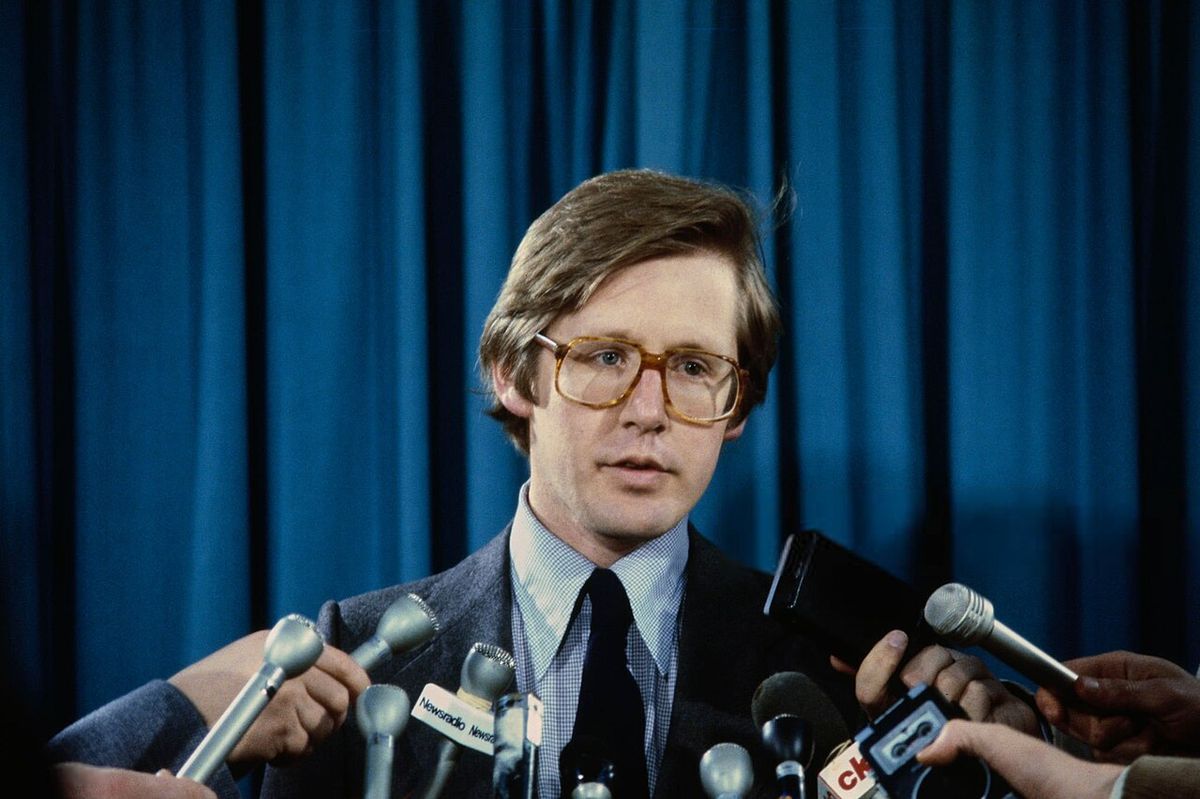
Rae first became involved in politics by volunteering on Pierre Trudeau's 1968 Liberal leadership campaign, and later worked on Liberal Charles Caccia's campaign in the 1968 federal election. However, his ideological shift toward social democracy led him to join the New Democratic Party in 1974. He was first elected to the House of Commons in a 1978 by-election in the Toronto riding of Broadview, defeating Progressive Conservative Tom Clifford by 420 votes after winning the NDP nomination over former MP John Paul Harney and activist Kay Macpherson. Rae was re-elected in the 1979 and 1980 federal elections from the riding of Broadview, Greenwood. He quickly gained a national profile as the NDP's finance critic. In December 1979, Rae moved the subamendment stating the House of Commons did not approve of Joe Clark's budget, a motion whose passage toppled the short-lived Progressive Conservative government after only eight months. In caucus, he supported party leader Ed Broadbent on the patriation of the Canadian Constitution with a Charter of Rights and Freedoms. Rae also articulated NDP policy on the Canadian Bank Act and criticized the Bank of Canada's high interest rate policy. He married Arlene Perly just days after his 1980 election victory.
Ontario NDP leadership and path to premier
In 1982, Rae was drafted to lead the Ontario New Democratic Party following Michael Cassidy's resignation after a poor performance in the 1981 provincial election. A delegation led by MPP Dave Cooke initially asked Rae to run, and after further encouragement from figures like former leader Stephen Lewis, he agreed. He won the leadership convention easily, defeating Richard Johnston and Jim Foulds, with the support of eleven of the party's 21 MPPs and much of the labour movement. After a by-election victory in York South in November 1982, where he defeated Liberal candidate John Nunziata, he entered the Ontario legislature. For the next several years, Rae worked to rebuild the party, often competing directly with Liberal leader David Peterson for opposition prominence. In a 1985 speech, he famously described the long-governing Progressive Conservative Ontario as 'Toryland', a 'country club' unwelcoming to women and people of colour. The turning point came after the 1985 provincial election, which resulted in a minority parliament where the PCs held a slim plurality. Rae negotiated and signed a historic Liberal-NDP Accord, agreeing to support a Peterson-led minority government for two years in exchange for progressive policy commitments. This accord ended 42 years of Progressive Conservative rule in Ontario, with Rae himself moving the non-confidence motion that defeated Premier Frank Miller's government on June 18, 1985. Rae served as Leader of the Opposition after the Liberals won a majority in 1987, a campaign where he nearly lost his own seat to Liberal Alan Tonks, winning by only 333 votes. Against all expectations, Peterson's government collapsed in popularity, and in the snap 1990 election, Rae led the NDP to a surprise majority victory with 74 seats, becoming premier on October 1, 1990.
- 1982: Elected leader of the Ontario NDP and wins by-election in York South.
- May 1985: NDP wins 25 seats in provincial election, leading to a minority parliament.
- June 1985: Negotiates the Liberal-NDP Accord, making David Peterson premier.
- September 1989: Participates in a protest for Temagami First Nation land claims, escorted by police but not charged.
- 1990: Serves as an international observer for Lithuania's first multi-party elections.
- September 1990: Leads NDP to a majority victory with 74 seats, defeating Premier David Peterson.
Premier of Ontario (1990 to 1995)
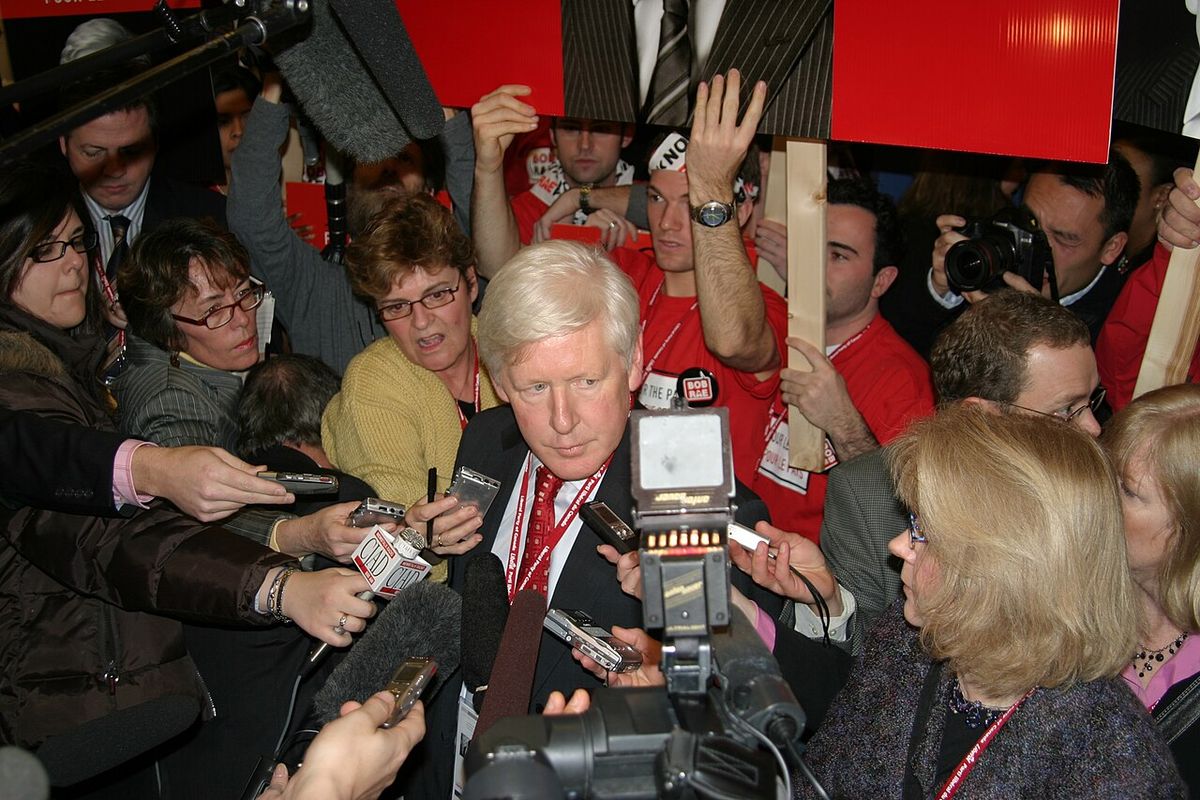
Rae's government took office during the early stages of a severe recession, which dramatically constrained its policy options and defined its tenure. His administration initiated several significant social programs, including the expansion of public daycare and the introduction of the first province-wide employment equity legislation. The government also brought an end to extra-billing by doctors, implemented pay equity measures, and established campaign spending limits, building on policies from the earlier Liberal-NDP accord. However, the government's most controversial move was the 1993 Social Contract Act, legislation aimed at reducing the provincial deficit through an agreement with public sector unions for unpaid leave days, known as 'Rae Days'. This policy, along with a move away from traditional NDP economic positions, alienated many in the party's base and the labour movement. The government also faced challenges with auto insurance reform and struggled to manage the economic downturn. In 1986, while in opposition, Rae had been a forceful critic of corporate pension fund abuses, specifically targeting Conrad Black for withdrawing $62 million from Dominion Stores Ltd. while laid-off workers went unpaid. The government saved jobs in northern Ontario through a bailout of Algoma Steel and negotiated a contract for paper mill workers in Kapuskasing. It also approved casino gambling for the province, providing a steady source of revenue. By the 1995 election, public dissatisfaction had grown, and the NDP was heavily defeated, winning only 17 seats. Rae resigned as party leader in 1996 and subsequently left the NDP in 1998, disagreeing with its leftward shift. His premiership remains the only NDP government in Ontario's history and the first NDP government east of Manitoba.
Return to federal politics as a Liberal
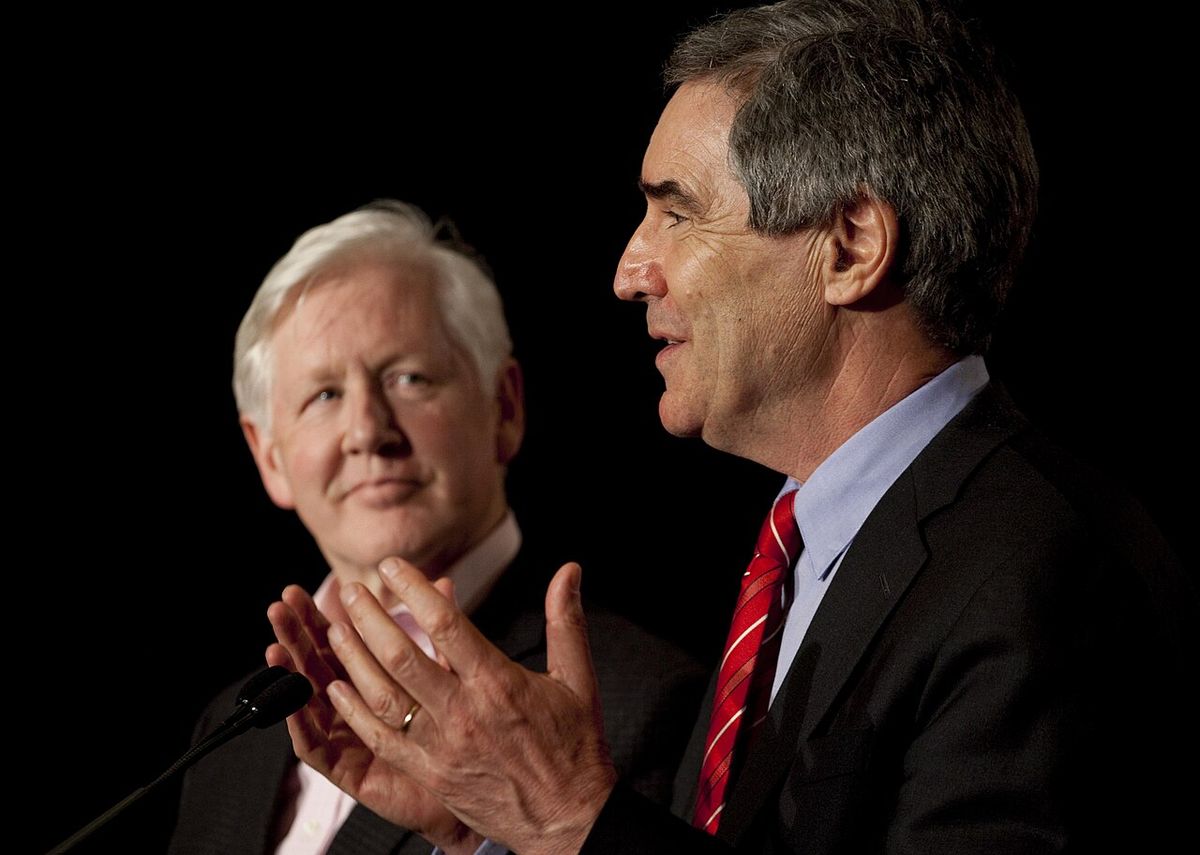
After leaving the NDP, Rae practised law and engaged in academic work before rejoining the Liberal Party of Canada in 2006, a party he had been associated with in his youth. He immediately contested the party leadership that year, placing third on the third ballot. Rae returned to the House of Commons in March 2008, winning a by-election in Toronto Centre as a Liberal. He was re-elected in the 2008 and 2011 general elections. Following Michael Ignatieff's resignation after the 2011 election defeat, Rae was chosen as the party's interim leader in May 2011. He served in that role for nearly two years, until Justin Trudeau was elected permanent leader in April 2013. Rae announced his resignation from Parliament in June 2013 to become chief negotiator for James Bay area First Nations in their talks with the Ontario government, with his resignation taking effect in July. During his federal Liberal tenure, he also served as the party's foreign affairs critic. He had previously run for the Liberal leadership again in 2009 but withdrew from that race in December 2008. In the 2008 by-election, Rae finished almost 11,000 votes ahead of his closest opponent.
| Year | Riding | Party | Result |
|---|---|---|---|
| 1978 (by) | Broadview | NDP | Elected |
| 1979 | Broadview, Greenwood | NDP | Elected |
| 1980 | Broadview, Greenwood | NDP | Elected |
| 2008 (by) | Toronto Centre | Liberal | Elected |
| 2008 | Toronto Centre | Liberal | Elected |
| 2011 | Toronto Centre | Liberal | Elected |
Diplomatic and post-political career
Following his departure from electoral politics, Rae's expertise was sought in diplomacy, law, and academia. He joined the law firm Olthuis Kleer Townshend LLP as a partner in 2014, focusing on representing Indigenous clients. He served as Canada's special envoy to Myanmar from October 2017 to April 2018, authoring a seminal report on the Rohingya crisis titled 'Tell Them We Are Human'. His role later expanded to become the prime minister's special envoy for humanitarian and refugee issues globally. In July 2020, Prime Minister Justin Trudeau appointed Rae as Canada's Ambassador and Permanent Representative to the United Nations in New York, a position he held from August 1, 2020, until November 17, 2025. At the UN, he was an outspoken advocate for deep reform of the institution. He served as President of the Economic and Social Council for the 2025 session, one of only three Canadians elected in their personal capacity to preside over a UN Charter body since 1945. Concurrently, Rae maintained a strong academic presence as a distinguished fellow at the University of Toronto's Munk School of Global Affairs and Public Policy, as a Matthews Fellow at Queen's University's School of Policy Studies, and previously as the Wilson Professor of Public Policy at Victoria University. In December 2025, he was appointed Visitor of Massey College at the University of Toronto. In 2026, he was named the Power Corporation Fellow at the Glendon School of Public and International Affairs for the 2026 to 2027 term and became chair of the advisory board for the Université de Montréal's Centre for International Studies (CÉRIUM). He also serves as an advisor to Canada's Ecofiscal Commission and is a Senior Fellow at the Raoul Wallenberg Centre for Human Rights.
Policy work, writings, and institutional leadership
Beyond elected office and diplomacy, Bob Rae has authored influential reports and provided leadership to major Canadian institutions. In 2005, he wrote a report on post-secondary education for the Ontario Liberal government, commonly referred to as the Rae Report. The report called for increased government funding to colleges and universities and enhanced student aid for low-income students. Rae was appointed to the Security and Intelligence Review Committee by Prime Minister Jean Chrétien. He has led the restructuring of several prominent national organizations, serving as chair of the board for the Royal Conservatory of Music and helping to reorganize the Canadian Red Cross and the Toronto Symphony Orchestra. His most recent publication is an edited collection of essays titled 'Reclaiming Canadian Sovereignty in a Ruptured World'. Rae has written nine books and reports on politics and public policy, including 'From Protest to Power: Personal Reflections on a Life in Politics' (1996) and 'What's Happened to Politics?' (2016). He was the national spokesperson for the Leukemia Research Foundation and helped oversee constitutional discussions between the government of Sri Lanka and Tamil Tiger rebels in 2002 and 2003 as chair of the Forum of Federations.
Personal life, family, and honours
Bob Rae married journalist and author Arlene Perly in 1980, and the couple raised their three daughters in the Jewish faith, with Rae becoming a member of Toronto's Reform Jewish congregation, Holy Blossom Temple. He learned of his own paternal Jewish heritage, from a family of Lithuanian immigrants to Scotland, in 1968, which had a deep impact on his personal identity and exploration of Jewish culture. Rae's elder brother, John A. Rae, was a senior executive and director of Power Corporation and a key adviser to Prime Minister Jean Chrétien from 1993 to 2003. His younger brother, David, died of leukemia in 1989 at age 32 despite a bone marrow transplant from Bob. His uncle was entertainer Jackie Rae, a former host of The Jackie Rae Show on CBC. Rae's extensive service has been recognized with numerous honours. He was made an Officer of the Order of Canada in 2000 and was appointed to the Order of Ontario in 2004. He was sworn to the Queen's Privy Council for Canada upon becoming premier in 1990. Rae holds numerous honorary degrees from universities across the country. He was installed as the sixth chancellor of Wilfrid Laurier University in October 2003.
- Companion of the Order of Canada
- Member of the Order of Ontario
- Honorary degrees from multiple Canadian universities
- Privy Councillor (1990)
- Chancellor of Wilfrid Laurier University (2003-2008)
Questions about Bob Rae
What is Bob Rae doing now in 2026?
As of 2026, Bob Rae holds several academic and advisory roles following the end of his term as UN Ambassador. He was appointed Visitor of Massey College at the University of Toronto in December 2025. In 2026, he was named the Power Corporation Fellow at York University's Glendon School of Public and International Affairs for the 2026 to 2027 academic year. He also became the chair of the advisory board for the Centre for International Studies (CÉRIUM) at the Université de Montréal in May 2026. Rae continues to write, speak publicly on global affairs, and serve as a distinguished fellow at the University of Toronto's Munk School of Global Affairs and Public Policy.
How long was Bob Rae Canada's Ambassador to the UN?
Bob Rae served as Canada's Ambassador and Permanent Representative to the United Nations for just over five years. His appointment was announced in July 2020, and his term officially began on August 1, 2020. He served until November 17, 2025. During his tenure, he was a vocal advocate for UN reform and refugee rights, and he served as President of the UN's Economic and Social Council for the 2025 session.
Why did Bob Rae switch from the NDP to the Liberals?
Bob Rae left the New Democratic Party in 1998 following his appointment to the Security Intelligence Review Committee, after resigning as Ontario NDP leader in 1996. His departure was driven by a fundamental disagreement with the party's leftward direction, particularly following the policies of his own government, such as the Social Contract, which had alienated traditional NDP supporters. Rae had actually been involved with the Liberal Party in his youth, volunteering for Pierre Trudeau in 1968. He formally rejoined the Liberals in 2006, citing a belief that the party was the best vehicle for progressive change in Canada at that time, and he ran for its leadership that same year.
What were 'Rae Days'?
'Rae Days' was the popular term for a key element of the Social Contract Act introduced by Premier Bob Rae's Ontario government in 1993. Facing a major recession and a large budget deficit, the legislation aimed to cut public sector spending without layoffs. It required unionized public sector workers to take up to twelve unpaid leave days per year. The policy was deeply unpopular with the NDP's traditional labour allies and is often cited as a major factor in the government's loss of support and its decisive defeat in the 1995 provincial election, where the NDP was reduced to 17 seats.
What is Bob Rae's connection to the Rohingya crisis?
Bob Rae served as Canada's special envoy to Myanmar from October 2017 to April 2018, appointed by Prime Minister Justin Trudeau to address the Rohingya humanitarian crisis. In this role, he visited refugee camps in Bangladesh and authored a detailed report titled 'Tell Them We Are Human', which documented atrocities and made recommendations for Canadian and international action. His work focused on humanitarian assistance, accountability, and advocating for the rights of the stateless Rohingya people. This role later expanded into a broader mandate as special envoy for humanitarian and refugee issues.
How many times was Bob Rae elected?
Bob Rae was elected 11 times to federal and provincial parliaments between 1978 and 2013. His electoral career began with a 1978 federal by-election win as a New Democratic Party MP in Broadview. He was re elected in the 1979 and 1980 federal elections. After moving to provincial politics, he won a 1982 by election in York South to enter the Ontario legislature and led the Ontario NDP to victory in the 1990 provincial election, serving as premier. Following his switch to the Liberal Party, he returned to the House of Commons via a 2008 by election and was re elected in the 2008 and 2011 federal elections.
Sources and further reading
- Bob Rae (Wikipedia)
- Bob Rae on What Direction for Canada after Davos? (group78.org)
- Bob Rae to chair the CÉRIUM advisory board, UdeMnouvelles (nouvelles.umontreal.ca)
- Rae, Bob | School of Policy Studies (queensu.ca)
Checked by the Nosy Mag desk. Last updated 2026-10-23.