Thule people
The Thule people, also known as proto-Inuit, were the direct prehistoric ancestors of all modern Inuit and Yupik peoples. They developed in coastal Alaska by 1000 CE and undertook a rapid eastward expansion across the Canadian Arctic, reaching Greenland by the 13th century. In Canada, they replaced the earlier Dorset culture. Their sophisticated adaptation to the Arctic environment, based on whaling and advanced transportation, laid the foundations for Inuit societies that persist today.
Origins and Development in Alaska
The cultural foundations of the Thule people were established in the Bering Strait region through a series of developmental stages over more than a millennium. Archaeological research identifies the Old Bering Sea stage, dating from approximately 200 BCE to 500 CE, as an early precursor. This stage is characterized by a strong maritime adaptation, with the first archaeological appearances of both kayaks and large skin boats called umiaks. The tool kits from this period are dominated by polished-slate artifacts, including lanceolate knives and ulu transverse-bladed knives, alongside crude pottery and extensive use of bone and antler for harpoon heads and other implements. Artistic decoration on tools from this period features distinctive curvilinear dots, circles, and short lines. The chronological relationship between the closely related Okvik and Old Bering Sea cultures remains a subject of debate, with some considering them distinct and others viewing them as roughly contemporaneous regional variants.
The Punuk stage, a development from the Old Bering Sea culture, flourished from around 800 CE along the Bering Strait islands and the Chukchi Peninsula. Punuk settlements were larger and more common than earlier villages, featuring subterranean, square or rectangular dwellings with wooden floors supported by whale jawbones and covered with skins, sod, and snow. Whaling took on greater emphasis during this stage, requiring skilled leadership and the cooperation of several umiak crews, a role known as the umialik that remains prominent in Alaskan Arctic communities today. Technological changes included the replacement of chipped stone tools with ground slate, the use of ivory-winged tridents and iron-tipped engraving tools, and the development of bone armour and the bow and arrow. Punuk art became simpler and more standardized compared to the earlier Old Bering Sea style.
The Birnirk culture, known from coastal northern and western Alaska and spanning several phases, is considered a direct ancestral population to the later Thule who migrated east. Birnirk harpoon heads were more often made of antler rather than ivory, with spur styles changing from trifurcated in the Early phase to single-laterally-placed in the Late phase. The Birnirk people used similar hunting technology to the Punuk but produced very little art, with decoration limited mainly to spiral and concentric motifs on clay pots. They were sea-mammal hunters and fishers who used sledges of a basic design later used with dog teams. Their houses were square, built with horizontal log walls and corner posts, with sleeping areas at the rear and evidence of open fires from fire-blackened pottery fragments. A 2019 genetic analysis concluded that the ancestors of the Thule emerged in Alaska through admixture between Paleo-Eskimo and Ocean Bay Tradition peoples between 2,700 and 4,900 years ago.
Eastward Expansion into the Canadian Arctic
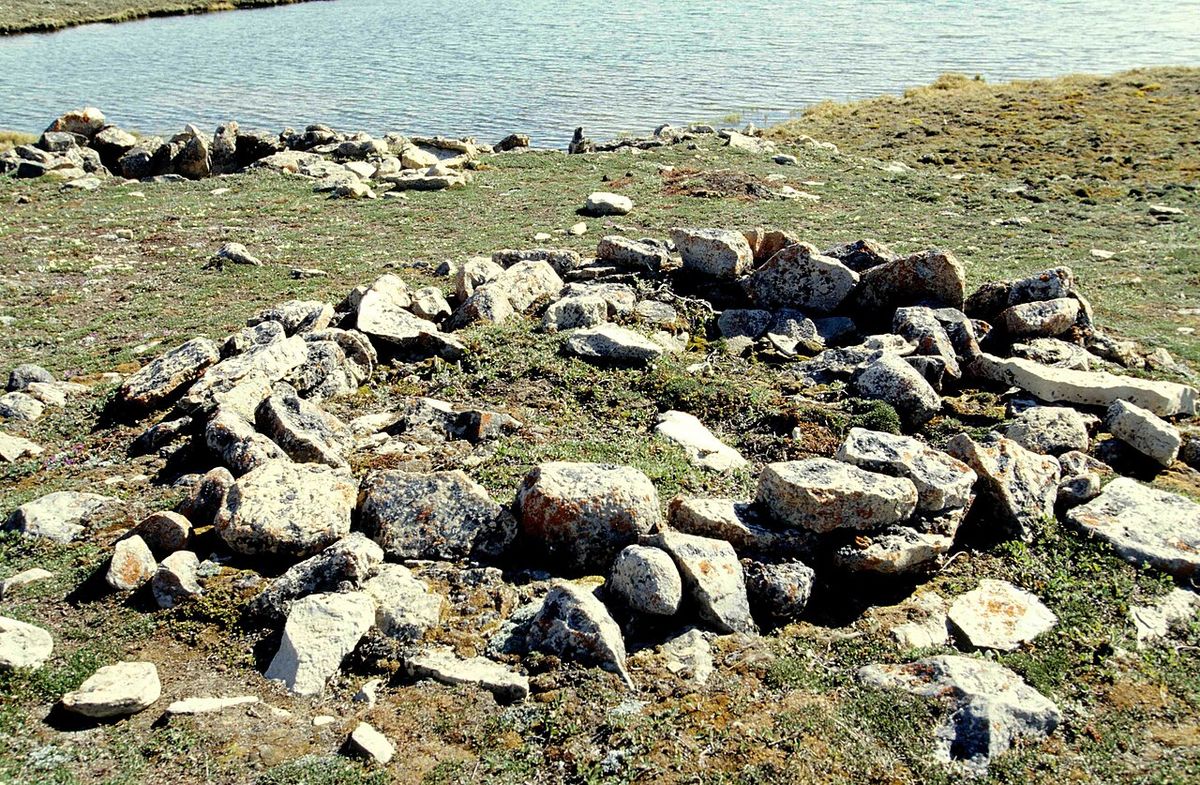
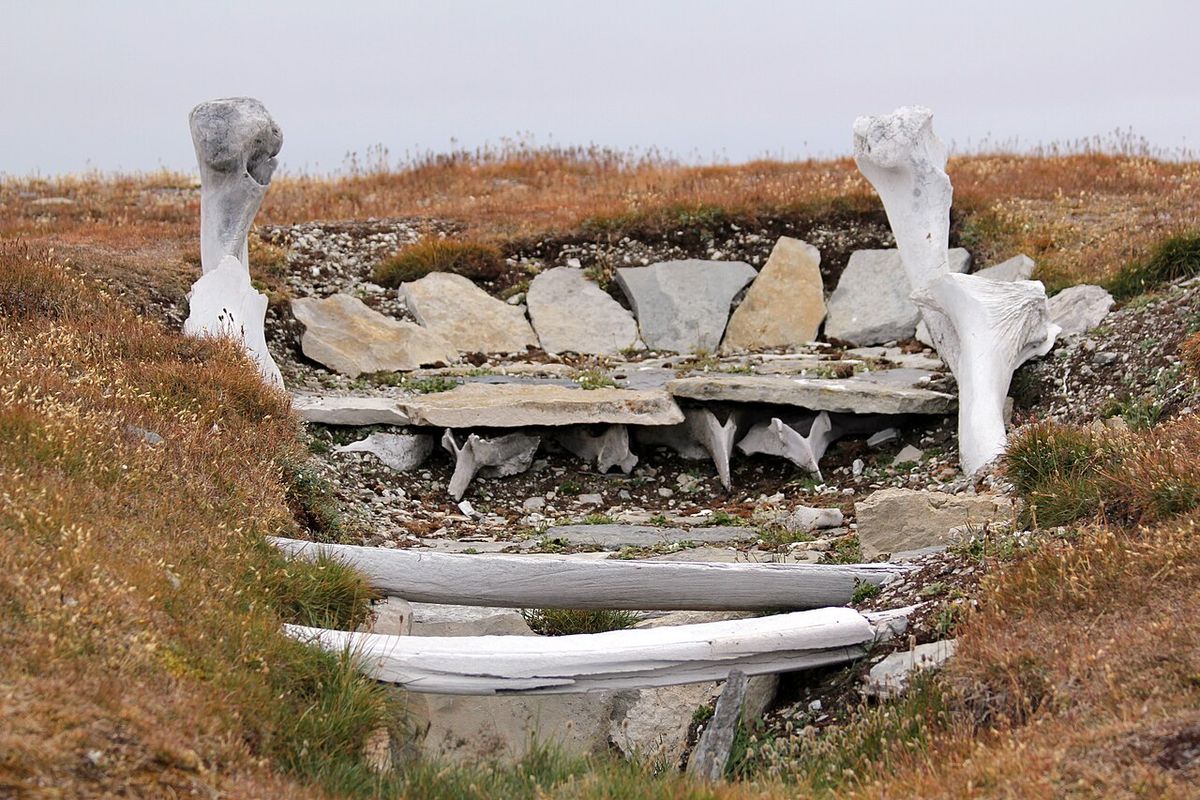
Between 900 and 1100 CE, Thule groups began a rapid migration eastward from Alaska across northern Canada, a movement that would see them occupy the entire North American Arctic within a few centuries. This expansion was facilitated by their efficient transportation technology, including dog sleds, umiaks, and kayaks, which allowed hunters to travel great distances and follow migratory game. The practice of using polished slate for tools spread westward to the Aleutian Islands, while Thule pottery-making methods replaced the earlier Norton tradition in southern Alaska. As they moved east, regional variations emerged, with eastern populations developing a preference for soapstone domestic items over pottery and refining the use of dogs to pull sleds. Eastern house styles became more above-ground and rounded, often using stone sleeping platforms and whale bones for structural support.
The Thule migration displaced the existing Dorset culture inhabitants of the central and eastern Canadian Arctic, though the nature of this succession remains poorly understood due to scarce evidence of contact. The Thule culture was first identified in the Eastern Arctic by Danish scholars, notably archaeologist Therkel Mathiassen following the Fifth Danish Thule Expedition (1921 to 1924). Mathiassen correctly hypothesized an Alaskan origin and mapped the Thule migration and their interactions in Greenland. Several theories attempt to explain the impetus for this eastward movement. One prominent cultural-ecological model suggests that Thule families followed bowhead whales, a vital source of food and materials, as a warming climatic episode between 900 and 1200 CE lengthened the open-water season and expanded the whales' summer range eastward into the Beaufort Sea and Arctic Archipelago. Other theories propose that warfare in Alaska or a desire to seek new sources of iron for tools may have encouraged migration.
- Primary Routes: Archaeologists have used the distribution of early Alaskan-style harpoon heads to trace two main migration routes into the Canadian Arctic.
- Northern Route: This path followed the Beaufort Sea coast and Amundsen Gulf, entering the High Arctic via Parry Channel and Smith Sound.
- Southern Route: This alternative led south, along the western coast of Hudson Bay.
- Timeline: Thule groups migrated east from Alaska around 1000 CE, reaching Greenland by the 13th century. By about 1300 CE, they had largely replaced Dorset populations in northern Canada and Greenland.
Recent research has suggested that the Thule Inuit arrived in Canada's High Arctic earlier than previously thought. By the 15th century CE, early Inuit groups lived throughout the Eastern Arctic, representing the direct ancestors of Inuit today. In regions like Auyuittuq National Park on Baffin Island, the earliest remains of human occupation are generally from the Thule culture, with some Dorset evidence also present. By approximately 1200 CE, the Thule culture had become predominant across the eastern Arctic.
Classic Thule Culture and Lifeways
The period from approximately 1100 to 1400 CE is known as the Classic Thule stage, when eastern Thule populations were established throughout the High Arctic and into southern regions. They lived along the coasts of the Hudson Strait, Hudson Bay, Foxe Basin, and the Canadian mainland from the Mackenzie Delta to the Melville Peninsula. Their society was fundamentally shaped by the hunting of bowhead whales, which provided food, fuel, building materials, and raw materials for tools. Access to bowhead whales enabled some Thule communities to grow into the largest settlements of the prehistoric Arctic, with villages typically containing between fifteen and twenty houses, and at least one site containing sixty. Whaling was a cooperative endeavour requiring multiple umiak crews and skilled leadership from an umialik.
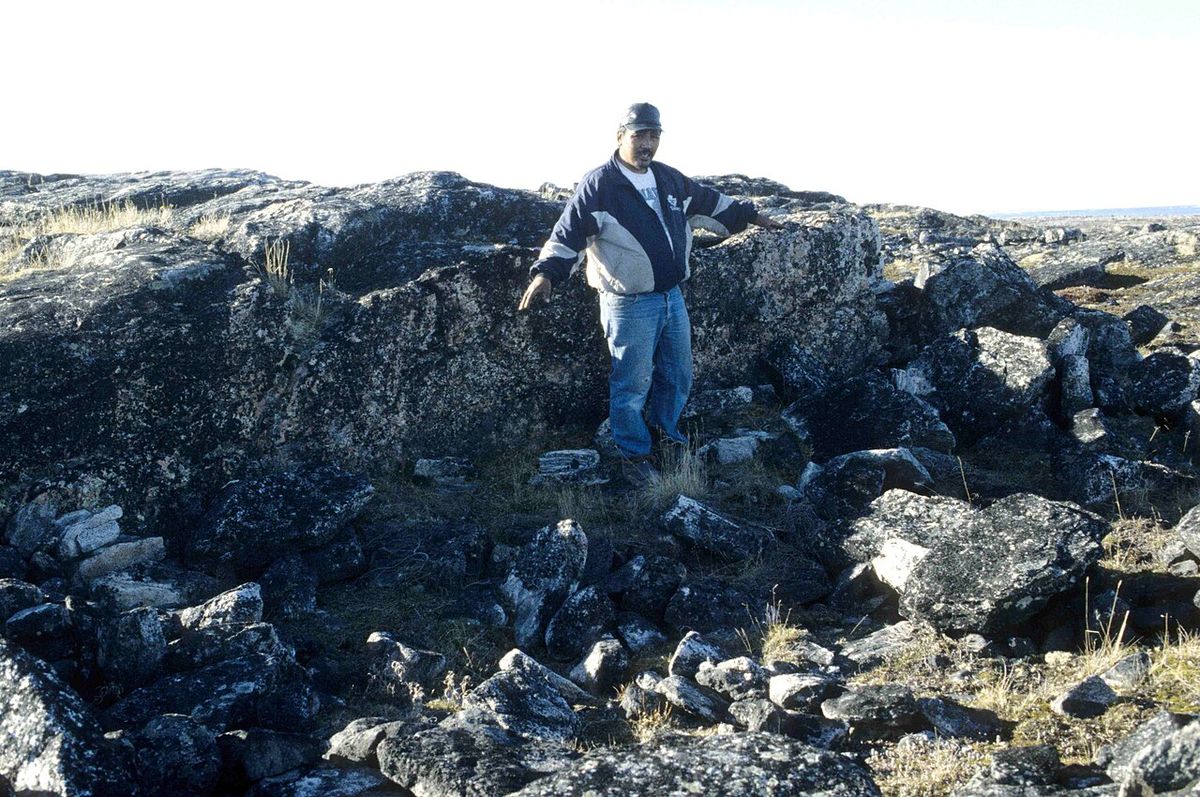
Thule winter houses were semi-subterranean, often built in clusters that may have housed extended family groups, with some communal structures identified for ceremonial activities. Variations in house size, form, and contents, including whaling equipment and non-local goods, suggest differences in wealth or social standing, which some researchers interpret as evidence of hierarchical social structures. In summer, communities moved into skin tents held down by circles of stone. The Thule were using iron long before sustained European contact, sourcing it from meteoric deposits like the Cape York meteorite in Greenland and through trade, possibly with the Norse. This iron, along with native copper from the western Arctic, was worked into tools for carving and engraving, enhancing their ability to work wood and bone.
Their hunting technology was highly sophisticated. The toggling harpoon was a key innovation, comprising a two-part point designed to lodge securely under an animal's skin and blubber. These harpoons were often fitted with inflated floats made from seal skin to create drag and tire out large prey like whales. Other equipment included bows and arrows, bird bolas, net sinkers, reinforced bows, and bone wrist guards. Archaeological evidence indicates that most bowhead remains at Thule sites came from actively hunted whales rather than scavenged carcasses. Outside major whaling areas, subsistence relied more heavily on seals, walrus, caribou, and fish. Thule art during this classic period emphasized practicality, with simple, linear designs featuring people without appendages, animals, or non-religious symbols appearing on household items like combs.
Post-Classic Transition and the Little Ice Age
From about 1400 CE up to the period of European contact, the Thule tradition entered a Post-Classic stage, characterized by significant adaptation to climatic and environmental change. The onset of the Little Ice Age, a period of cooling that lasted from approximately 1400 to 1600 CE, had a deep impact on Thule societies. The colder climate increased sea ice, shortened the open-water season for whaling, and limited the range of bowhead whales. By the 16th century, umiak and kayak whale hunting had ceased in the High Arctic, and by 1600, many areas were abandoned due to the severe conditions. This climatic pressure forced a redistribution of populations and a shift in subsistence strategies.
In regions where whales became less prevalent, there is increased archaeological evidence of a broader subsistence base focusing on caribou, seal, and fish. Settlements became smaller and more dispersed, reflecting a more nomadic lifestyle. Thule groups that lived nearer to persistent open water were less affected and could continue some whaling activities. This period of adaptation and diversification led to the emergence of the distinct historic Inuit groups recognized today. The Copper Inuit, Netsilik, and Iglulingmiut (from the Igloolik area) all trace their origins to this Post-Classic Thule period. The transition from the Thule culture to the historic Inuit culture is generally placed between 1600 and 1850, coinciding with the end of the Little Ice Age and the beginning of sustained European contact. The Thule cultural sequence demonstrates a remarkable resilience in the face of environmental change. Their ability to modify their hunting practices, settlement patterns, and tool technologies allowed them to persist and ultimately become the direct ancestors of modern Inuit. The archaeological record from this time shows a gradual settlement of areas with fewer whales and an increase in the use of terrestrial resources, illustrating a flexible and sophisticated approach to survival in the Arctic.
Technology and Material Culture
Thule technology represented a significant advancement in Arctic adaptation, differing markedly from the earlier Dorset culture. Their toolkit was highly specialized for a maritime-focused life, enabling their rapid expansion and efficient exploitation of Arctic resources. A defining feature of Thule technology was the use of ground slate for cutting tools, which largely replaced the flaked-stone tools of earlier periods. They manufactured slate ulus (women's knives), lanceolate knives, and projectile points, which held a sharper edge for longer. The Thule were also proficient metalworkers within the constraints of available materials. They used native copper gathered from the Coppermine River area and Victoria Island, and meteoritic iron from sources like the Cape York strewn field in Greenland. This metal was cold-hammered into tools for engraving and carving, and some evidence suggests they may have obtained small amounts of smelted iron through trade with the Greenlandic Norse.
Transportation technology was foundational to Thule success. The umiak, a large open skin boat, was essential for whaling expeditions and moving families and goods. The kayak, a covered single-person craft, was used for hunting and travel. The dog sled, pulled by teams of dogs, allowed for extensive overland travel and transport of heavy loads across sea ice and tundra, vastly expanding their effective hunting territory. Hunting technology was equally sophisticated. The toggling harpoon, often made of antler, bone, or ivory, was a complex, two-part weapon designed to securely lodge in large sea mammals. Hunters used inflated sealskin floats attached to harpoon lines to tire out whales and prevent them from sinking. Other specialized tools included bird bolas (weights on strings thrown to entangle birds), heavy ivory net sinkers, reinforced bows, and bone plated wrist guards.
| Tool/Technology | Primary Material | Primary Use |
|---|---|---|
| Toggling Harpoon | Antler, Bone, Ivory | Hunting whales and large sea mammals |
| Ulu | Slate | Cutting and scraping (multi-purpose knife) |
| Umiak | Wood frame, Walrus/Seal skin | Transport, whaling expeditions |
| Kayak | Wood frame, Seal skin | Individual hunting and travel |
| Dog Sled | Wood, Bone, Leather | Overland transportation |
| Bow and Arrow | Wood, Bone, Sinew | Hunting caribou and other game |
Domestic technology included pottery, initially made from Alaskan clays even in eastern sites, though this was later replaced by locally available soapstone pots in the Eastern Arctic. Thule winter houses were ingeniously constructed using available materials. Early houses were semi-subterranean, with frames of whale bone (especially jawbones and ribs) or wood, covered with skins, sod, and snow for insulation. They featured a sunken floor, a long entrance tunnel, and sleeping platforms at the rear. The artistry on tools and personal items, while often practical, displayed regional styles and simple linear designs depicting people and animals.
Social Organization and Trade Networks
Thule social organization was influenced by their subsistence economy, particularly in communities focused on large-scale whaling. The cooperative nature of whaling, which required the coordinated effort of multiple umiak crews, likely fostered social structures with defined leadership roles. The umialik, or whaling boat captain, was a position of prominence and responsibility, a role that persists in altered forms in modern Alaskan Inupiat communities. The umialik would organize the hunt, direct the crews, and oversee the distribution of the whale after a successful catch. Archaeological evidence suggests some social stratification within Thule communities. Differences in the size, construction quality, and contents of houses, including the presence of whaling gear and valuable non-local trade items, indicate variations in wealth and status between households.
Communities were often composed of extended family groups, with houses built in clusters. Some sites contain larger communal structures, possibly used for ceremonial gatherings, feasts, or decision-making. Trade was a vital component of Thule society, connecting communities across vast distances and facilitating the flow of essential and prestige goods. Extensive trade networks circulated raw materials throughout the Arctic. Native copper from the Coppermine River region and Victoria Island was traded eastward. Meteoritic iron from the Cape York area of Greenland was a highly valued commodity that moved westward. Other trade items likely included soapstone, amber, and distinctive lithic materials for toolmaking.
- Key Trade Items: Native copper, meteoritic iron, soapstone, amber, distinctive tool-making stones.
- Social Role: The umialik (whaling captain) held a leadership position, organizing hunts and distributing resources.
- Community Structure: Settlements often consisted of clusters of houses occupied by extended families.
- Evidence of Stratification: Archaeological finds show variation in house size and contents, suggesting differences in wealth or status.
These exchange networks provided access to materials unavailable locally, such as native copper from the western Arctic and meteoric iron from northwestern Greenland. The presence of these trade goods in sites far from their source demonstrates the mobility of Thule peoples across the Arctic. This capacity for long-distance travel and communication, facilitated by dog sleds and boats, was a key factor in their ability to rapidly colonize new territories. It also helped them maintain a cohesive cultural tradition across thousands of kilometres from Alaska to Greenland.
Genetic Heritage and Relation to Modern Inuit
Genetic research has provided conclusive evidence linking the Thule people directly to modern Inuit and Yupik populations. A major genetic study published in the journal Science in August 2014 examined the remains of Thule individuals buried between approximately 1050 and 1600 CE across the Arctic. The findings confirmed that the Thule people descended from populations associated with the Birnirk culture of northwestern Alaska, whose own genetic roots lay in northeastern Siberia across the Bering Strait. As Thule communities expanded eastward from Alaska after about 1000 CE, they remained genetically distinct from the earlier Dorset people they encountered and eventually replaced. This supports the archaeological model of a rapid migration and population replacement rather than a gradual cultural transformation or significant admixture with Dorset groups. The study found no evidence of genetic admixture between the Thule and the Greenlandic Norse.
The study's results affirm that the Thule are the direct prehistoric ancestors of all contemporary Inuit and Yupik peoples. This genetic continuity shows the deep historical roots of modern Indigenous communities in the North American Arctic. The term "Thule" itself, however, has a complex history. Some archaeologists have argued that using this term is inappropriate due to its prior use by Ancient Greek geographers and, more problematically, its association with the unrelated German "Thule Society," a precursor to the Nazi party. Consequently, many scholars and Inuit knowledge keepers prefer terms like "Early Inuit," "proto-Inuit," or the Inuktitut term "Taissumanialungmiut" (the people of a very long time ago).
Modern Inuit are recognized as the direct descendants of the Thule people. In Greenland, Inuit represent around 90 percent of the population. Across the Canadian Arctic, from the Inuvialuit Settlement Region to Nunavut, Nunavik, and Nunatsiavut, Inuit trace their lineage back to the Thule migrants. Despite these changes, a deep continuity exists in language, worldviews, and many adaptive strategies, demonstrating the lasting influence of Thule innovation and resilience in the face of Arctic challenges.
Questions about Thule people
Who were the Thule people?
The Thule people were the direct prehistoric ancestors of all modern Inuit and Yupik peoples, also known as proto-Inuit. They developed in coastal Alaska by 1000 CE and then undertook a rapid eastward migration across the Canadian Arctic, reaching Greenland by the 13th century. They are distinguished from the earlier Dorset culture by their sophisticated maritime technology, including umiaks, kayaks, dog sleds, and advanced whaling techniques. Their archaeological remains were first found at Comer's Midden in northwest Greenland, a location historically known as Thule.
When did the Thule people arrive in Canada?
Thule people began migrating into the Canadian Arctic from Alaska around 1000 CE. Their expansion was remarkably swift, with groups moving across what is now the Northwest Territories, Nunavut, and Greenland within a few centuries. By about 1300 CE, they had largely replaced the Dorset culture that previously inhabited the region. One migration route followed the Beaufort Sea coast and Amundsen Gulf, entering the High Arctic via Parry Channel and Smith Sound.
What was the main source of food for the Thule?
During the Classic Thule period (c. 1100 to 1400 CE), the bowhead whale was the central resource for many communities. A single whale provided massive quantities of meat, blubber for oil and fuel, and bones for tools and house construction. Whaling required cooperative hunting from umiak crews. In areas less suited to whaling or during the Post-Classic period after 1400 CE, subsistence broadened to include a heavier reliance on seals, walrus, caribou, and fish.
What happened to the Thule people?
The Thule people did not disappear but gradually evolved into the historic and modern Inuit. This transition occurred between about 1600 and 1850 CE, influenced by two major factors. First, the Little Ice Age (c. 1400 to 1600) caused climatic cooling that disrupted whaling patterns, forced population movements, and led to more diversified subsistence strategies. Second, intensified contact with Europeans in the 18th century further contributed to cultural change.
What is the difference between Dorset and Thule cultures?
The Dorset and Thule were distinct cultures with different origins and technologies. The Dorset, a Paleo-Eskimo culture, inhabited the Arctic before the Thule and had different toolkits, lacking bows and arrows, dog sleds, and the large skin boats (umiaks) central to Thule life. The Thule had a more maritime-focused economy centred on open-water whaling, whereas the Dorset relied more on hunting seals at breathing holes. Genetic evidence shows little mixing between the two populations.
Are modern Inuit related to the Thule?
Yes, modern Inuit are the direct descendants of the Thule people. A genetic study published in Science in 2014 confirmed that the Thule descended from Birnirk culture populations in Alaska and are the ancestors of all contemporary Inuit and Yupik peoples. The study examined Thule individuals buried between about 1050 and 1600 CE across the Arctic. It found they remained genetically distinct from the earlier Dorset people and showed no evidence of admixture with the Greenlandic Norse.
Sources and further reading
- Thule people (Wikipedia)
- Thule Culture | Museum | Museum of the North (uaf.edu)
- Culture and history, Auyuittuq National Park, Parks Canada (parks.canada.ca)
- Early Inuit (Thule Culture) (thecanadianencyclopedia.ca)
- The Legacy of the Thule Culture, Legend of the Norse, ... (oceanwide-expeditions.com)
Checked by the Nosy Mag desk. Last updated 2026-10-21.