Mississaugas of the Credit First Nation
The Mississaugas of the Credit First Nation (MCFN) is a Mississauga (Anishinaabe/Ojibwe) First Nation with its primary reserve, New Credit 40A, located near Hagersville in southwestern Ontario. As the sole and rightful Treaty holder for a vast territory encompassing much of the Greater Toronto Area and the Golden Horseshoe, the Nation's history is central to the development of Southern Ontario. The community, which had a registered population of 3,019 as of September 2026, continues to assert its rights and negotiate land claims while building a thriving modern community. Its leadership and members have made significant contributions to Canadian law, politics, and the ongoing journey of truth and reconciliation.
Historical Territory and Traditional Life
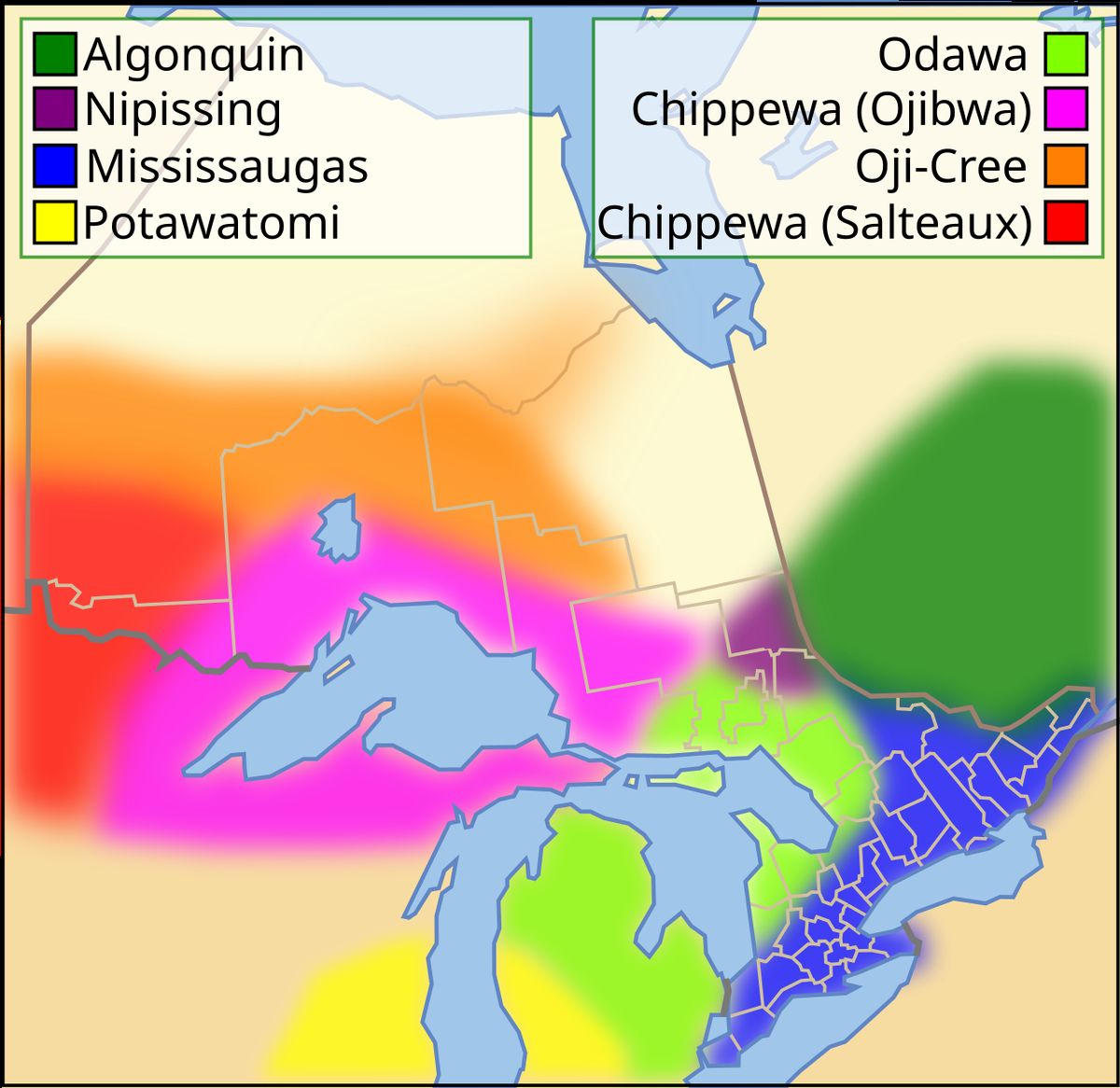
The traditional territory of the Mississaugas of the Credit once encompassed approximately 3.9 million acres of lands, waters, and resources in Southern Ontario. This vast area stretched from the Rouge River Valley in the east, westward to the headwaters of the Thames River, south to Long Point on Lake Erie, and then followed the shoreline of Lake Erie, the Niagara River, and Lake Ontario back to the Rouge River. One group within this Nation claimed the area at the western end of Lake Ontario, with the Credit River as their principal home. The Mississaugas lived a seasonal, mobile lifestyle, moving throughout their territory to hunt, fish, and gather resources as they became available. They were active participants in the trans-Atlantic fur trade, establishing economic relationships first with the French and later with the British. By the close of the 17th-century Beaver Wars, the Mississaugas had displaced the Haudenosaunee from Southern Ontario and established their homes on the flats of rivers and creeks flowing into Lake Ontario.
Treaty Era and Dispossession
Following the American Revolution, the British Crown sought land to resettle Loyalists, leading to a series of treaties with the Mississaugas of the Credit between 1781 and 1820. The eight treaties negotiated were the Mississaugas Treaty at Niagara, No. 381 (1781). The Between the Lakes Treaty, No. 3 (1792). The Brant Tract Treaty, No. 8 (1797). The Toronto Purchase, No. 13 (1805). The Head of the Lake Treaty, No. 14 (1806). The Ajetance Treaty, No. 19 (1818). Treaty 22 (1820). And Treaty 23 (1820). The Mississaugas entered these agreements, including the Toronto Purchase of 1805, under the belief they were agreeing to share the land with newcomers. They soon discovered the Crown interpreted the treaties as outright land purchases. The influx of settlers, including 2,000 Haudenosaunee Loyalists, rapidly diminished the Mississauga land base and traditional economy. Settler farms and villages hindered seasonal movements, while unfamiliar diseases and the depletion of fish and game stocks had a devastating impact. By the 1820s, when the last treaties were concluded, the population of the Mississaugas of the Credit had been reduced by an estimated 60 percent, from about 500 to 200 people. Their territory had been catastrophically reduced from 4 million acres to just 200 acres, threatening the very survival of the Nation.
The Credit Mission and Relocation to New Credit
The survival of the Nation seemed in doubt until the leadership of Kahkewāquonāby (Reverend Peter Jones) helped the community adopt a Christian, agrarian lifestyle at the Credit Mission Village, established in 1826 near the Credit River. The village was located where the Mississauga Golf & Country Club now stands, near the point where the Queen Elizabeth Way crosses the river. The settlement became a successful agricultural community with a hospital, school, church, mechanic shops, and log-cabin style homes. The Mississaugas were the major shareholders of the Credit River Harbour Company, whose employees built piers in the lake and charged tolls for handling goods like lumber. The community eventually built its own schooner to ship goods on Lake Ontario. However, continuous settler encroachment, resource depletion, and the inability to gain title to their land made their position untenable. Unable to secure a land title from the provincial government, the Mississaugas accepted an offer in 1848 from the Six Nations Confederacy to settle on a portion of their reserve. This 1,900-hectare parcel was offered in recognition of the Mississaugas' earlier authorization for the British purchase of land for the Six Nations Reserve in 1784, which had been granted via the Haldimand Proclamation. This land became the New Credit 40A Indian Reserve, formally consisting of lots 1 to 12 in the first and second concessions in the Townships of Tuscarora and Oneida in Brant County. The reserve was expanded with a 24-hectare purchase bordering Highway 6 in Hagersville in 1997.
Modern Community and Governance
Today, the Mississaugas of the Credit First Nation is a thriving community governed from the New Credit 40A reserve, which straddles Brant and Haldimand Counties adjacent to the Six Nations of the Grand River. The community operates various programs and services for its members, including a Seniors & HCC Lawn Maintenance Program which runs seasonally and community events like a Halloween Trunk or Treat. The Nation is led by a Chief and Council, with Chief Margaret Sault serving as the community's leader as of 2026. The First Nation actively works to revitalize its language and culture, offering workshops and events focused on traditional crafts and the Michi Saagiig language.
Land Claims and Financial Settlements
The Mississaugas of the Credit have persistently pursued claims regarding the historic alienation of their territory. A major settlement was reached in 2010 concerning the disputed Toronto Purchase of 1787. Canada agreed to pay $145 million for the lands, based on the historic value extrapolated to 2010 dollars. The funds were distributed with each of the then 1,700 registered members receiving $20,000, and the remainder placed in trust for future generations. The First Nation placed a controversial hold on new membership during this period to preserve the financial settlement for existing members, meaning the multi-million dollar settlement was only given to previously registered members. More recently, significant developments have occurred on other claims. In March 2025, Canada provided a $30 million advance payment toward settling a specific claim under Treaties 22 and 23 from 1820, involving the surrender and sale of approximately 4,427 hectares of reserve land. Negotiations for this claim began in 2015.
Notable Members and Contributions
Throughout its history, the Mississaugas of the Credit First Nation has been home to individuals who have made significant impacts within and beyond their community. Kahkewāquonāby (Reverend Peter Jones) was a Mississauga chief and Methodist minister who played a central role in the community's adaptation and survival during the 19th century, helping establish the Credit Mission. Wabakinine was a Mississauga chief and warrior who died in 1796 protecting his sister from an assault by a Queen's York Rangers soldier, Charles McEwan, en route from York, Upper Canada. Harry LaForme is a member of MCFN who served as a justice of the Court of Appeal for Ontario and was the first chair of the Truth and Reconciliation Commission of Canada. Walt Secord is an Australian politician of Canadian Indigenous descent who is a registered member of the Mississaugas of the Credit First Nation. The community's influence continues through modern partnerships, such as the 2026 Memorandum of Understanding with York University to support Indigenous learners and co-create academic spaces.
Recent Partnerships and Cultural Revitalization
The First Nation actively builds relationships to advance education, economic development, and cultural recognition. A landmark agreement was signed with York University on March 4, 2026. The Memorandum of Understanding includes a tuition waiver for eligible MCFN community members in undergraduate programs and commits to collaborative work on language revitalization and course creation. York University also adopted an Indigenous-led land acknowledgement for its Keele and Glendon Campuses developed in consultation with MCFN, and a different one for its Markham Campus, reflecting how the community wishes to be represented. Through the Moccasin Identifier project, moccasin engravings will be installed on pathways at York's Keele Campus to foster public awareness of treaties and Indigenous culture. The community also participates in public cultural exhibitions, such as its exhibit at the Canadian National Exhibition in 2026, sharing its deep-rooted history with a wider audience. These initiatives reflect the Nation's ongoing work to ensure its history, voices, and perspectives are meaningfully recognized in contemporary Canadian society.
Population and Demographics
| Category | Population Count |
|---|---|
| Total Registered Population | 3,019 |
| On-Reserve Population | 1,035 |
| Off-Reserve Population | 1,968 |
This data indicates a community where approximately two-thirds of the membership lives off the primary reserve. The total registered population has increased from the 2,330 members reported in April 2015, demonstrating the community's growth. The on-reserve population has also increased from the 850 residents noted in 2015 to over one thousand, reflecting ongoing development at New Credit. The Mississaugas of the Credit are the only First Nation in the Canadian system to have a subsection reserve within another First Nation's territory, a unique status resulting from their 1848 agreement with the Six Nations Confederacy.
Community Programs and Public Engagement
The Mississaugas of the Credit First Nation maintains an active schedule of community programs and public engagement initiatives that reflect its priorities and cultural values. The community organizes seasonal activities such as the Seniors & HCC Lawn Maintenance Program, which concluded its seasonal cutting on October 13, 2026. Cultural and skill-building workshops are regularly offered, including crafting events that often reach full capacity, demonstrating high community interest. The First Nation also hosts public celebrations like its exhibit at the Canadian National Exhibition (CNE) and participates in National Indigenous Peoples Day events at locations like Celebration Square in Mississauga, featuring Indigenous culture, creativity, and community. The Nation's official Facebook page serves as a welcoming space for community members and staff to connect and share information. This ongoing public engagement helps to educate the wider public about the Nation's history as caretakers of a territory that became some of the most heavily populated and industrialized land in Canada.
Questions about Mississaugas of the Credit First Nation
Where is the Mississaugas of the Credit First Nation located?
The Mississaugas of the Credit First Nation is based in south-central Ontario. Its primary reserve is the New Credit 40A Indian Reserve, a 2,392.6-hectare parcel also known as Reserve 40B near Hagersville, Ontario. This reserve straddles Brant and Haldimand Counties and sits adjacent to the Six Nations of the Grand River reserve. Historically, the Nation's territory encompassed approximately 3.9 million acres across Southern Ontario, from the Rouge River Valley to the headwaters of the Thames River.
What was the Toronto Purchase and its settlement?
The Toronto Purchase refers to Treaty 13, negotiated in 1805, through which the British Crown acquired a large tract of land at the mouth of the Credit River, including the site of present-day Toronto. The Mississaugas of the Credit long disputed the terms and fairness of this transaction. In 2010, the Government of Canada agreed to a settlement of $145 million to resolve this specific claim. The funds were distributed to the then 1,700 registered members, with each receiving $20,000 and the remainder placed in a trust for future generations of the First Nation.
What recent partnership has the First Nation established with a university?
On March 4, 2026, the Mississaugas of the Credit First Nation signed a Memorandum of Understanding with York University. This partnership includes a tuition waiver for eligible MCFN community members enrolled in York undergraduate degree programs. The agreement commits both parties to collaborate on revitalizing the Michi Saagiig language and culture through research and learning. It also involves a MCFN councillor sitting on York’s School of Medicine Indigenous Health Advisory Committee and the co-creation of a Faculty of Health course.
Who is the current Chief of the Mississaugas of the Credit?
The current Chief of the Mississaugas of the Credit First Nation is Margaret Sault. Chief Sault represented the community in the signing of a Memorandum of Understanding with York University in March 2026. In her statement, she emphasized a shared commitment to relationship building grounded in respect, responsibility, and reciprocity. She also highlighted the goal of strengthening pathways for Indigenous learners and ensuring their histories and perspectives are reflected in academic spaces. This partnership includes a tuition waiver for eligible community members enrolled in undergraduate programs at York.
How many people are members of the Mississaugas of the Credit First Nation?
The Mississaugas of the Credit First Nation had a total registered population of 3,019 members as of September 2026. This population figure includes 1,035 members who lived on the New Credit reserve and 1,968 members who lived off reserve. This represents significant growth from an earlier reported enrolled population of 2,330 people in April 2015. The First Nation is based on a reserve of just under 6,000 acres adjacent to the Six Nations of the Grand River reserve in southwestern Ontario.
What is the Rouge River Valley Tract claim?
Negotiations for this claim began in 2015 between the Mississaugas of the Credit, Canada, and the Province of Ontario. In March 2025, a proposed settlement totaling $183.4 million was announced to resolve this claim. This claim is separate from other settlements, such as the 2010 Toronto Purchase agreement. The tract is part of the vast traditional territory the Mississaugas once occupied and stewarded.
Sources and further reading
- Mississaugas of the Credit First Nation (Wikipedia)
- Mississaugas of the Credit First Nation (mncfn.ca)
- Mississaugas of the Credit First Nation (thecanadianencyclopedia.ca)
- York and the Mississaugas of the Credit First Nation sign ... (yorku.ca)
Checked by the Nosy Mag desk. Last updated 2026-10-24.