Immigration to Canada
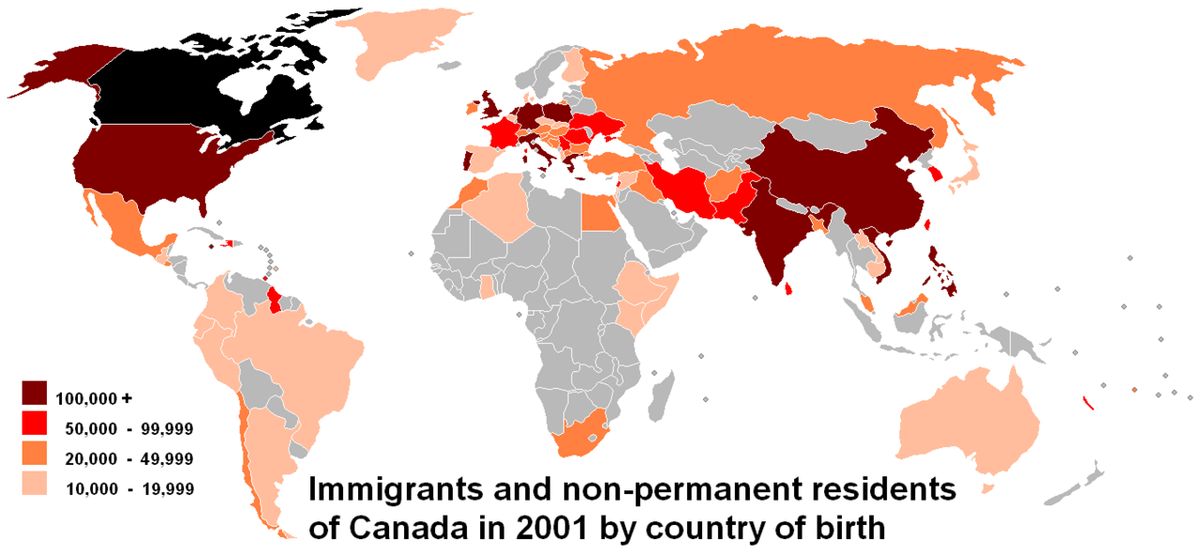
Immigration to Canada is the process by which people move to Canada to reside there, with the vast majority seeking permanent resident status. It is a central pillar of Canadian population growth and economic policy, with immigrants representing approximately 23 percent of the country's total population as of the 2021 census. The federal government, through Immigration, Refugees and Citizenship Canada (IRCC), manages a complex system of laws, quotas, and programs designed to attract skilled workers, reunite families, and provide refuge. Contemporary policy, as outlined in the 2026 to 2028 Immigration Levels Plan, aims to stabilize annual permanent resident admissions at 380,000 while reducing the share of temporary residents in the population.
Historical Waves of Immigration
Canada's history of non-Aboriginal immigration is characterized by several distinct waves. The first significant wave occurred before 1815, featuring slow French settlement and the influx of 46,000 to 50,000 British Loyalists fleeing the American Revolution into the Maritimes and Southern Ontario. This movement helped boost Canada's population from about 500,000 in 1812 to 2.5 million by 1851, shifting the demographic balance to an Anglophone majority. The second wave, known as the Great Migration, saw at least 800,000 people arrive between 1815 and 1850, 60 percent of whom were British. In 1896, Interior Minister Clifford Sifton launched a program of settlement with offices and advertising in the United Kingdom and continental Europe, leading to Canada's third wave of immigration. This wave peaked before World War I from 1911 to 1913, with over 400,000 migrants in 1912. Many of these migrants were from Eastern and Southern Europe. This immigration wave created farms, towns, and cities across the Prairie Provinces. The fourth wave came from Europe following World War II, and peaked at 282,000 in 1957. With many of these migrants coming from Italy and Portugal, Pier 21 in Halifax, Nova Scotia proved to be an influential port for European immigration. Canada is currently undergoing its fifth wave of immigration, which has been mostly from Asia since the 1970s.

Evolution of Immigration Policy and Law
Canadian immigration policy has evolved from openly discriminatory practices to a points-based system focused on skills and economic contribution. For much of its early history, policy explicitly favoured immigrants of European and Christian backgrounds while excluding others, such as through the 1885 Chinese Immigration Act which imposed a head tax and the 1908 continuous journey regulation aimed at South Asians. The 1923 Chinese Immigration Act barred Chinese entry altogether until 1947, and the government issued an official apology for this discrimination in 2006. The post-World War II period initiated change, culminating in the landmark Immigration Act of 1976, which established nine selection categories including education, occupation, and language ability. A major reform was the introduction of the points system in 1967, which removed overt racial criteria and assessed applicants on factors like language, age, education, and arranged employment.
The current legal framework is the Immigration and Refugee Protection Act (IRPA), which came into force in 2002. Another significant development was the 1978 Canada-Quebec Accord, which granted Quebec substantial authority to select its own immigrants. The modern system is managed through programs like Express Entry for skilled workers, the Provincial Nominee Program (PNP), and family sponsorship streams, all designed to meet detailed annual targets set by the federal government. In 2015, Canada introduced the Express Entry system, providing a streamlined application process for many economic immigrants.
Contemporary Immigration System and Programs
Canada's contemporary immigration system is a multi-faceted structure designed to meet economic, social, and humanitarian objectives. The federal department of Immigration, Refugees and Citizenship Canada (IRCC) administers the system and publishes a multi-year Immigration Levels Plan to guide operations. The central mechanism for economic immigration is the Express Entry system, which manages applications for the Federal Skilled Worker Program, the Federal Skilled Trades Program, and the Canadian Experience Class. Candidates are ranked in a pool based on a Comprehensive Ranking System score, with the highest-ranked candidates receiving Invitations to Apply for permanent residence.
Other major programs include the Provincial Nominee Program (PNP), which allows provinces and territories to nominate candidates who meet local economic needs, and the Atlantic Immigration Program (AIP). Family class immigration enables Canadian citizens and permanent residents to sponsor spouses, partners, children, parents, and grandparents. Canada also maintains strong refugee and humanitarian programs, resettling government-assisted and privately sponsored refugees from abroad and offering protection to asylum claimants in Canada. The system is continuously adjusted, with new category-based selection draws in Express Entry targeting specific occupations like healthcare and skilled trades.
- Express Entry: Manages skilled worker applications through periodic draws.
- Provincial Nominee Program (PNP): Allows provinces to nominate candidates for permanent residence.
- Family Sponsorship: Reunites families through spousal, partner, and parent/grandparent programs.
- Refugees and Protected Persons: Includes resettlement programs and in-Canada asylum.
- Atlantic Immigration Program (AIP): Employer-driven program for Atlantic Canada.
- Caregiver Pilots: Pathways for in-home childcare and support workers.
- Start-up Visa Program: For entrepreneurs to launch innovative businesses in Canada.
- Agri-Food Pilot: Addresses labour needs in the farming and food processing sectors.
The 2026 to 2028 Immigration Levels Plan
Released in November 2025, the 2026 to 2028 Immigration Levels Plan (ILP) outlines the federal government's targets for permanent and temporary resident admissions. The plan stabilizes annual permanent resident admissions at 380,000 for each year from 2026 through 2028. However, this headline figure is augmented by two one-time initiatives designed to transition current non-permanent residents to permanent status. These initiatives aim to admit 148,000 individuals over 2026 and 2027, bringing the true admissions target for 2026 to 446,000. The plan also reiterates a commitment to reduce the non-permanent resident population to less than 5 percent of Canada's total population by the end of 2027.
The ILP significantly lowers targets for new temporary resident arrivals, particularly for international students, to 385,000 in 2026, 370,000 in 2027, and 370,000 in 2028. This represents a strategic shift to manage population growth pressures on housing and infrastructure. The plan maintains specific targets for French-speaking permanent residents outside Quebec, aiming for 9 percent of such admissions in 2026. Mid-year data for 2026 indicated admissions were behind the annual pace, with 155,800 permanent residents admitted in the first six months against the 380,000 target, highlighting the operational challenges in meeting these planned levels.
Demographic and Economic Impact
Immigration is the primary driver of Canada's population growth, a role that has intensified as the natural increase from births minus deaths has dwindled due to an aging population and low fertility rates. Statistics Canada projects that immigrants could represent between 29.1 and 34.0 percent of the population by 2041, up from 23.0 percent in 2021. The economic impact of immigration is a subject of ongoing debate. Proponents, including the federal Liberal government, argue that higher immigration increases the size of the economy (GDP), expands the tax base to support social services like healthcare, and addresses labour shortages as baby boomers retire.
Critics, including the Conservative Party under Pierre Poilievre, argue that high immigration can decrease per capita living standards and strain housing, infrastructure, and public services. In 2023, Statistics Canada released a report indicating that the longstanding concern regarding labour shortages had ceased to be a predicament. Economists at banking institutions contend that the labour market cannot feasibly accommodate the continued influx of newcomers. A 2011 report by the Fraser Institute suggested immigrants could represent a fiscal burden of up to $23 billion annually.
Recent Trends and Mid-2026 Admissions Data
Recent immigration trends show a marked shift from the record-high growth experienced in 2023. Government measures introduced in 2024, such as a cap on study permits and stricter rules for temporary foreign workers, successfully began reducing the non-permanent resident population. By October 2025, this group had fallen to 6.8 percent of the population from a peak of 7.6 percent in late 2024. Data for the first half of 2026 provides a snapshot of the system's performance against its ambitious targets. From January to June 2026, Canada admitted 155,800 new permanent residents, which was only 41 percent of the annual 380,000 target and 34,200 behind the mid-year pace needed to reach it.
The economic class saw 89,200 admissions against a 2026 target of 239,800, putting it 30,700 behind schedule. The family class performed better, with 45,100 admissions pacing slightly ahead of its 84,000 target. The refugees and protected persons category admitted 17,900 people, behind its 49,300 target. When including the one-time initiatives for in-Canada workers and protected persons, total admissions by mid-2026 reached 182,100, representing 40.8 percent of the true composite target of 446,000. This data shows the significant gap between planned admissions and actual processing outcomes in the current period.
| Immigration Category | 2026 Annual Target | Admissions (Jan-Jun 2026) | Status vs. Pace |
|---|---|---|---|
| Economic Class | 239,800 | 89,200 | 30,700 behind |
| Family Class | 84,000 | 45,100 | 3,100 ahead |
| Refugees & Protected Persons | 49,300 | 17,900 | 6,750 behind |
| Humanitarian & Other | 6,900 | 3,600 | 150 ahead |
Settlement Patterns and Provincial Roles
New immigrants to Canada predominantly settle in major urban areas, with Toronto, Montreal, and Vancouver being the primary destinations. This concentration has significant implications for housing markets, transit systems, and service delivery in these cities. To promote a more geographically balanced distribution, the Provincial Nominee Program (PNP) is a critical tool, allowing provinces and territories to nominate immigrants who intend to settle in a specific region and fill local labour market needs. Quebec exercises the most autonomy through its unique selection authority derived from the 1978 Canada-Quebec Accord, allowing it to choose immigrants based on its own criteria, particularly emphasizing French-language ability.
Other regions have developed targeted streams, such as the Atlantic Immigration Program (AIP), which is employer-driven and designed to support population growth in Canada's eastern provinces. Rural and northern communities also benefit from immigration pilots, like the Rural and Northern Immigration Pilot, which creates pathways to permanent residence for skilled workers who want to live and work in smaller communities. The federal government's one-time In-Canada Workers Initiative for 2026 to 2027 specifically targets skilled workers who have been living in rural communities for at least two years, further incentivizing settlement outside major metropolitan centres. Historically, settlement was promoted through land policies like the Dominion Lands Act of 1872, which offered free land to encourage farming in the west.
Questions about Immigration to Canada
What is the Express Entry system?
Express Entry is the Canadian government's online application management system for three key economic immigration programs: the Federal Skilled Worker Program, the Federal Skilled Trades Program, and the Canadian Experience Class. Candidates create an online profile and are ranked against others in a pool using a points-based system called the Comprehensive Ranking System. The government holds regular draws, inviting the highest-ranked candidates to apply for permanent residence. The system was introduced in 2015 to provide a streamlined process. In 2026, new category-based selection draws are targeting candidates with specific work experience, such as in healthcare or skilled trades.
How has Canadian immigration policy changed historically?
Canadian immigration policy has evolved from openly discriminatory practices to a merit-based system. Early policies, like the 1885 Chinese Head Tax and the 1923 Chinese Immigration Act, explicitly excluded certain groups. The major shift occurred in 1967 with the introduction of a points system that assessed applicants on factors like education and language rather than race or nationality. The Immigration Act of 1976 further formalized categories for selection, and the current Immigration and Refugee Protection Act (2002) governs the modern system focused on economic contribution, family reunification, and refugee protection. In 2006, the government issued an official apology for the Chinese Immigration Act.
What are the main arguments for and against high immigration levels?
Proponents, including the federal government, argue high immigration is necessary to grow the economy, expand the tax base to support an aging population, and address labour shortages. Critics raise concerns that rapid population growth can strain housing, infrastructure, and public services like healthcare, potentially lowering per-capita living standards. They also question whether the labour market can effectively absorb large numbers of newcomers and point to challenges in foreign credential recognition. A 2011 Fraser Institute report suggested immigrants could be a fiscal burden, while a 2023 Statistics Canada report noted labour shortages were no longer a primary concern.
How many immigrants does Canada plan to accept in 2026?
Canada's official Immigration Levels Plan for 2026 targets 380,000 new permanent residents. This is part of a multi-year plan that also includes targets of 395,000 in 2025 and 365,000 in 2027. The plan also includes targets for new temporary resident arrivals, set at 385,000 in 2026. These numbers are part of a broader effort to manage population growth while considering the capacity of healthcare, housing, and social services. The government has also committed to reducing the temporary resident population to less than 5% of the total population by the end of 2027.
Can provinces choose their own immigrants?
Yes, Canadian provinces have significant authority to select immigrants. Quebec possesses the most autonomy under the 1978 Canada-Quebec Accord with the federal government, allowing it to independently choose immigrants who must then be approved by Ottawa. Other provinces participate in the Provincial Nominee Program (PNP), which allows them to nominate candidates based on regional economic needs. This shift supports settlement in areas with specific labour market demands beyond major urban centres like Toronto, Montreal, and Vancouver.
What percentage of Canada's population are immigrants?
Immigrants make up approximately 23 percent of Canada's total population, numbering 8.3 million persons according to the 2021 census. This represents one of the highest immigrant population ratios for industrialized Western countries. Statistics Canada projects this proportion will increase significantly, with immigrants representing between 29.1 percent and 34.0 percent of the population by 2041. The population with at least one foreign born parent could rise to between 49.8 percent and 54.3 percent. Immigration is the main driver of Canadian population growth.
Sources and further reading
- Immigration to Canada (Wikipedia)
- Demographic Implications of the 2026 to 2028 Immigration ... (pbo-dpb.ca)
- Canada on track to admit fewer permanent residents than ... (cicnews.com)
- Canada's Immigration Levels Plan 2024 to 2026 (canadavisa.com)
- Canada Introduces New Express Entry Categories for 2026 ... (newlandchase.com)
Checked by the Nosy Mag desk. Last updated 2026-10-22.