Dominion Lands Act
The Dominion Lands Act was a federal law that received royal assent in April 1872. It was designed to encourage the agricultural settlement of the Canadian Prairies, a region newly acquired by the Dominion of Canada, and to help prevent the area being claimed by the United States. Modelled closely on the United States Homestead Act of 1862, the law offered individuals ownership of 160 acres of land for a small fee, provided they lived on and improved the property. The act facilitated a massive demographic transformation of western Canada, shaping its land use patterns, agricultural economy, and cultural composition for generations, though its implementation came at a deep cost to Indigenous and Métis peoples whose traditional territories were opened for settlement.
Historical and Political Context
The Dominion Lands Act was a central pillar of Prime Minister Sir John A. Macdonald's National Policy, a nation-building strategy focused on western expansion, railway construction, and protective tariffs. Its creation followed Canada's acquisition of Rupert's Land and the North-Western Territory from the Hudson's Bay Company in 1870, a transaction conducted without the consent of the Indigenous inhabitants. To clear the legal path for settlement, the federal government began negotiating the Numbered Treaties with First Nations in 1871, starting with Treaties 1 and 2. Lieutenant Governor Adams G. Archibald informed Indigenous leaders that settlers would arrive whether they wished it or not, and the treaties were presented as a means to secure reserves and annuities in exchange for ceding vast tracts of land. The optimistic 1872 agricultural survey by civil servant John Macoun, which contradicted earlier pessimistic reports by explorer John Palliser, provided the justification needed to promote the prairie region as ideal for farming and to pass the homestead legislation. The act was passed by the Parliament of Canada and was closely based on the American model, setting the conditions for the settlement and resource development of the western lands.
Key Provisions and the Homesteading Process
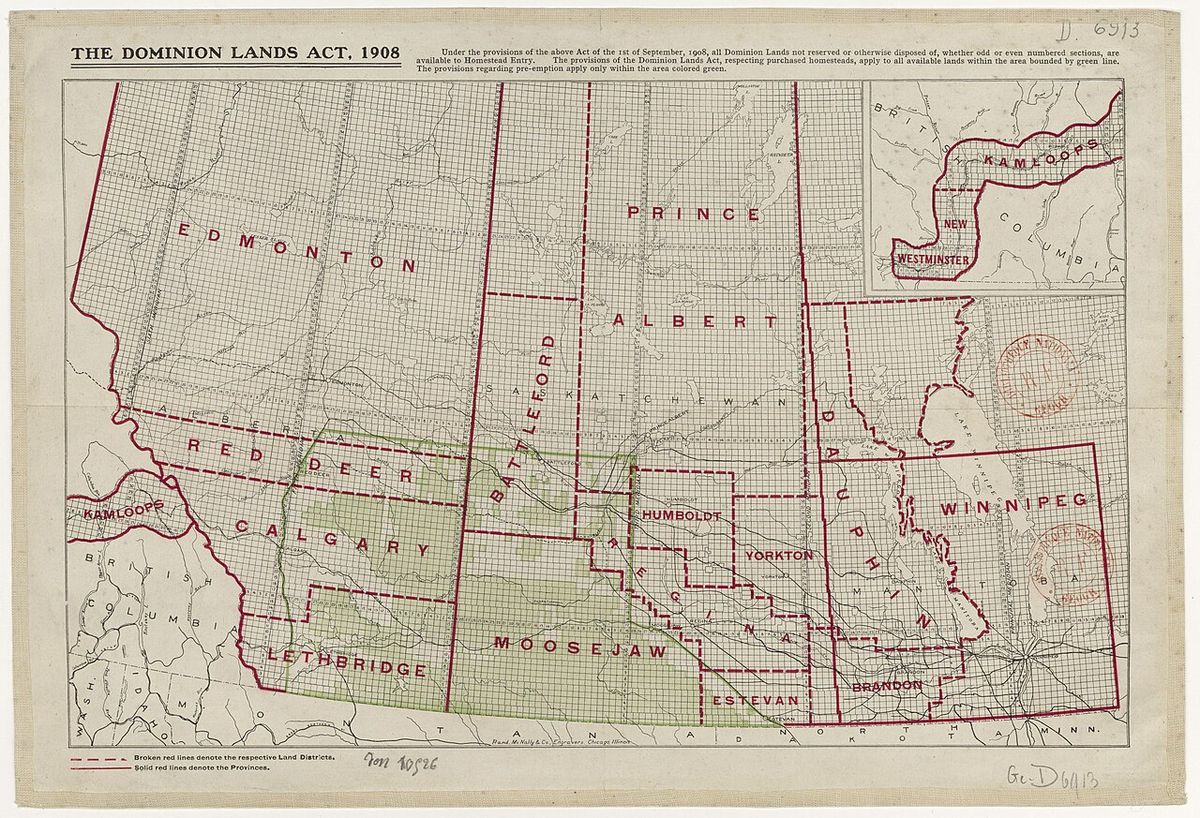
The core mechanism of the act was the homestead grant. A claimant could obtain a quarter-section of 160 acres (65 hectares) by paying a $10 administration fee. To eventually receive full title, known as a patent or letters patent, the homesteader was required to fulfil specific obligations over a three-year period, a process known as "proving up." These requirements were designed to discourage land speculation and ensure genuine agricultural development. The homesteader had to reside on the land for at least six months each year, build a habitable dwelling such as a sod house, and cultivate a portion of the land, originally set at 40 acres. Authorities from the Dominion Lands Branch, established in 1871, would assess the improvements through a Dominion Lands Board, and if satisfactory, grant the patent. A critical and successful feature unique to the Canadian system allowed a farmer, after proving up the original homestead, to purchase an adjacent quarter-section for an additional $10 registration fee. This provision was vital in the arid Palliser's Triangle region, where a 320-acre farm was often necessary for viability, making Canadian agriculture more successful than American efforts in similar arid conditions. The act also established the Dominion Lands Survey, which imposed the grid system of townships, ranges, and sections that still defines the prairie provinces to this day.
The regulations governing eligibility and process were amended frequently over the act's approximate 58-year lifespan. The initial act allowed any male over 21 or any woman heading a household to apply, and they did not need to be British subjects. This changed significantly through subsequent amendments that frequently altered the requirements. The 1873 amendment lowered the eligible age for male homesteaders from 21 to 18, making it easier for young families to start a claim. The 1876 amendment restricted homestead claims by single women, allowing only those classified as the head of a household, such as widows with dependent children, which contrasted with the United States where single women were permitted to homestead. Numerous revisions starting in 1908 required applicants to be British subjects, either at the time of entry or at the granting of title, or both. In 1919, widows of war veterans were made eligible to receive land patents, expanding access for a specific group of women. Section 37 of the Dominion Lands Act encouraged bloc settlements by allowing associations of ten or more settlers to group their houses together to form a hamlet. This allowed them to fulfil their cultivation obligations on their own homestead while residing in the settlement. This provision supported the establishment of distinct ethnic communities across the prairies.
Land Allocation, Exclusion Zones, and Competing Interests
Contrary to the popular image of freely available land, less than half of the arable land in the West was ever open to homesteading under the act. Large tracts were allocated for other purposes, creating a complex patchwork of ownership and control that persisted for decades. The Hudson's Bay Company retained title to five percent of the land in the prairie region as part of the terms of surrendering its charter, and both the HBC and the railway companies sold land to land companies and farmers on the open market. The federal government also set aside lands for schools and government buildings, typically sections 11 and 29 in every township, which were to be sold at auction to raise money. Through an 1883 amendment, lands were also set aside for the creation of National Parks. Initially, to protect railway company interests and the value of their adjacent land grants, the act established a major exclusion zone, banning homesteads within 20 miles (32 km) of any railway line. This was a significant disincentive, as transporting grain by wagon beyond that distance was economically impractical, though farmers could buy land within the zone at a higher price of $2.50 per acre. The zone was reduced to 10 miles (16 km) in 1879 and eliminated entirely in 1882, which significantly opened up accessible land for settlement and was a key factor in increasing the act's success.
Impact on Indigenous and Métis Communities and Title
The Dominion Lands Act was an instrument for implementing the colonial policy of displacing Indigenous peoples to make way for agricultural settlers. The Numbered Treaties, negotiated from 1871 onwards, were intended to extinguish Aboriginal title to the land, though First Nations assert they were not fairly compensated and that only lands taken up for immigration and settlement were covered, leaving other lands and natural resources outside the treaties. The act itself acknowledged Indigenous title in its 1879 amendments. Section 42 indicated recognition and protection of Aboriginal rights, limiting settlement by homesteaders until title was extinguished. For the Métis, the federal government used a different mechanism called scrip, issued after 1885 during the negotiations of Treaties 5, 8, and 10. Métis families were offered scrip that could be exchanged for a quarter-section of land (65 ha), a 97-hectare plot, or a cash value such as $160 or $240, in exchange for relinquishing their land title. The scrip process was often rife with fraud and exploitation. Many Métis were entered into the arrangement unscrupulously, with agents forging signatures, and others were pressured into selling their scrip for less than face value to land speculators who would later sell it to homesteaders at a profit. This system, alongside the treaty process, effectively removed Métis and First Nations title to their traditional lands, facilitating the wave of immigrant settlement encouraged by the act.
Results, Settlement Patterns, and Demographic Transformation
Between 1870 and 1930, the government issued roughly 625,000 land patents to homesteaders. Settlement was initially slow, hampered by economic conditions, the earlier railway exclusion zones, and the challenging reality of prairie farming. Promotional campaigns, including the famous "Last Best West" advertising, eventually drew hundreds of thousands of immigrants from Eastern Canada, the United States, the United Kingdom, and Europe. This influx dramatically transformed the demographic and cultural makeup of the region, leading to the creation of the provinces of Saskatchewan and Alberta in 1905. The settlement pattern, dictated by the Dominion Lands Survey grid and the bloc settlement provision, created a distinctive agricultural pattern of family farms and ethnically concentrated communities. The success of this settlement established the Prairie provinces as a global breadbasket, fundamentally shaping Canada's economic identity. The act's requirement that land be located through cadastral surveys and that individuals show improvement by constructing a dwelling or cultivating the land created a standardized process for validating applications and issuing patents across the region.
Administration, Provincial Control, and Repeal
The federal Dominion Lands Branch, established in 1871, was responsible for administering the act, surveying land, receiving applications, and overseeing the "proving up" process. This branch was later absorbed by the Lands, Northwest Territories administration. This centralized federal control over western lands and natural resources became a growing source of tension with the prairie provinces, which argued they were treated differently from other provinces that owned their own resources. This dispute was resolved in 1930 through a series of Natural Resources Acts, which transferred control over public lands and natural resources to the governments of Manitoba, Saskatchewan, and Alberta. From that point, the Dominion Lands Act only applied to public lands in the Northwest Territories. Its homesteading provisions, designed for prairie agriculture, were ill-suited to the northern territories and had little application there. Parliament formally repealed the act in 1950, replacing it with the Territorial Lands Act, which contained no homesteading clauses and was better adapted to conditions in the Territories, marking the end of this historic policy era.
Statistical Overview and Legacy of Land Disposition
The disposition of western lands under the Dominion Lands Act and related policies involved multiple entities and purposes, with the homestead system being just one part of a broader strategy of resource allocation and economic development. The following table illustrates the approximate scale of land allocation, drawing from the figures and categories noted in the historical record. The total land disposed under the act amounted to 478,000 square kilometres, but this was distributed among homesteaders, railways, the Hudson's Bay Company, and reserves for schools and government use. The homestead grants themselves resulted in about 625,000 patents, but this represented access to less than half of the region's total arable land, as significant portions were reserved or sold for other purposes.
| Category of Land | Approximate Scale / Note |
|---|---|
| Homestead Patents Issued (1870 to 1930) | ~625,000 patents |
| Land Retained by Hudson's Bay Company | 5% of prairie lands |
| Land Granted to Railway Companies | Massive grants for construction subsidies |
| Land for Schools & Reserves | Sections 11 and 29 in every township set aside |
| Land for National Parks | Set aside via 1883 amendment to the Act |
| Total Land Disposed by Government | 478,000 square kilometres |
The "free land" of homesteading was only one part of a larger land distribution system. Less than half of the arable land in the West was ever open to farmers for homesteading under the act. Significant areas were granted to the Hudson's Bay Company and the railways, who sold land on the open market. The legacy of the act includes populating the prairies and building an agricultural economy. It also played a role in the colonial dispossession of Indigenous peoples through the Numbered Treaties. The framework of the Dominion Lands Survey remains visibly embedded in the organization of the Prairie provinces today.
Questions about Dominion Lands Act
What was the main purpose of the Dominion Lands Act?
The primary purpose of the Dominion Lands Act of 1872 was to encourage the agricultural settlement of the Canadian Prairies. This served dual goals of national development, by populating the region with farmers to boost the economy, and national sovereignty, by helping prevent the area being claimed by the United States. It was a key component of Prime Minister Macdonald's National Policy, which also included railway construction and protective tariffs. The act was modelled on the U.S. Homestead Act.
How much land could a settler get under the act and what did it cost?
A settler could obtain a homestead grant of 160 acres, which is a quarter-section of land or about 65 hectares. The only direct monetary cost was a $10 administration fee paid upon application. To secure full ownership, the homesteader then had to fulfil residency and improvement requirements over three years, including building a dwelling and cultivating 40 acres of the land. After proving up the original homestead, a settler could also purchase an adjacent 160-acre quarter-section for an additional $10 fee, allowing many farmsteads to double to 320 acres.
Could women claim land under the Dominion Lands Act?
Eligibility for women changed over time due to amendments. Initially, the act allowed any woman heading a household to claim a homestead. However, an 1876 amendment prohibited single women from claiming land unless they were classified as the head of a household, which in practice limited female participation largely to widows with dependent children. This contrasted with the United States, where single women were permitted to homestead. In 1919, the widows of war veterans were also made eligible to receive land patents.
How did the Dominion Lands Act affect Indigenous peoples?
The Dominion Lands Act was predicated on the prior extinguishment of Indigenous land title through the Numbered Treaties. The Government of Canada negotiated these treaties with First Nations beginning in 1871 to obtain lands for immigration and settlement. First Nations assert they were not fairly compensated and that the treaties only covered lands taken up for those specific purposes. For the Métis, the government used a separate scrip system after 1885 to extinguish land title, a process often marked by fraud and exploitation.
What was the 'quarter-section plus' provision and why was it important?
A distinctive feature was the pre-emptive right allowing a homesteader to purchase an adjacent 160-acre quarter-section for an additional $10 fee after proving up their original homestead. This allowed most farmsteads to quickly double in size to 320 acres. This provision was crucial in the arid southern Palliser's Triangle area where a functional farm on only 160 acres was nearly impossible. Canadian agriculture was consequently more successful than U.S. agriculture in this region due to this system.
When and why did the Dominion Lands Act end?
The homesteading provisions of the Dominion Lands Act effectively ended in 1930 when the federal government transferred control over public lands and natural resources to the prairie provinces through the Natural Resources Acts. This transfer meant the act no longer applied in Manitoba, Saskatchewan, and Alberta. From 1930 onwards, the act only applied to public lands in the Northwest Territories. Parliament formally repealed the act in 1950, replacing it with the Territorial Lands Act, which did not contain any homesteading provisions.
Sources and further reading
- Dominion Lands Act (Wikipedia)
- Dominion Lands Act (thecanadianencyclopedia.ca)
- Dominion Lands Act | History | Research Starters (ebsco.com)
- Dominion Lands Act / Homestead Act (teaching.usask.ca)
Checked by the Nosy Mag desk. Last updated 2026-10-25.