Klondike
Klondike is the definitive single-player card game of the solitaire family, renowned globally as the classic version of Patience. In Canada and the United States, the term "solitaire" alone typically refers to Klondike, a sign of its cultural ubiquity. The game is played with a standard 52-card deck, challenging players to sort all cards into four foundation piles by suit, from Ace to King. Its inclusion in Microsoft Windows in 1990 catapulted it to unprecedented popularity, making it a daily pastime for millions and a foundational introduction to personal computing. The name Klondike is widely believed to be derived from the Klondike Gold Rush in Canada's Yukon Territory, linking the game to a key chapter in Canadian history.
Game Rules and Objective
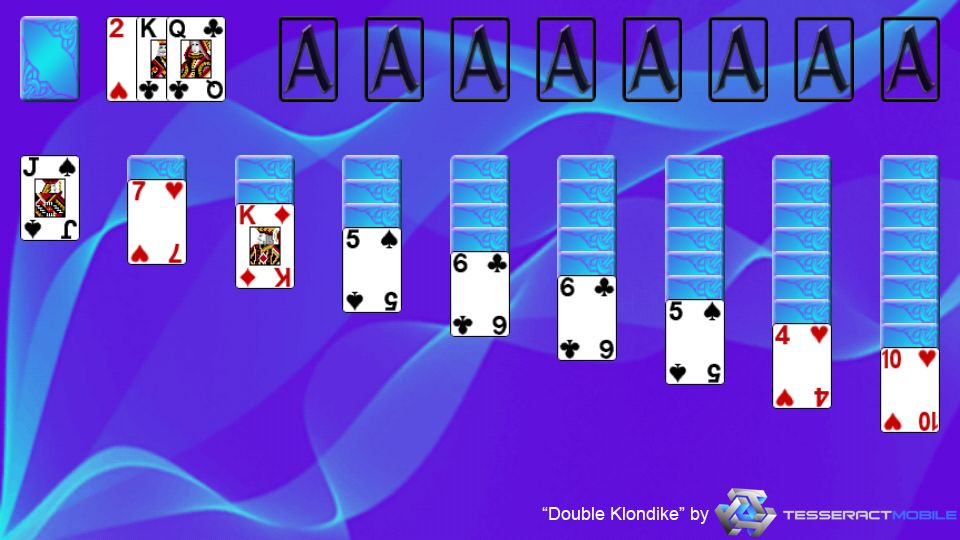
Klondike is played with a standard 52-card deck without jokers. The primary objective is to build all four suits, spades, hearts, clubs, and diamonds, onto separate foundation piles, beginning with the Ace and ascending sequentially to the King. The game begins by dealing a tableau of seven fanned piles from left to right. The leftmost pile contains a single face-up card, the second pile contains two cards (one face-down, one face-up on top), and so on until the seventh pile contains seven cards with only the top card face-up. The remaining 24 cards form the stock pile, placed face-down in the upper-left corner of the layout. The four empty foundation spaces are positioned in the upper-right corner.
During play, cards are moved according to specific building rules. Within the tableau, cards can be built downward in sequence, but must alternate in colour. For example, a black 10 can be placed on a red Jack. Any face-up card in a pile, or an entire sequence built correctly, can be moved as a unit to another tableau pile. An empty tableau column may only be filled by a King or by a sequence of cards starting with a King. Cards are revealed from the stock pile to a waste pile according to the chosen variant, most commonly by turning one card (Turn 1) or three cards (Turn 3) at a time. Cards from the waste pile or the tableau can be moved to the foundations when they become available. The game is won when all 52 cards are successfully moved to the four foundation piles in correct order.
Popular Variations and House Rules
While the core objective remains constant, numerous rule variations affect Klondike's difficulty and style of play. The most significant variation involves how cards are dealt from the stock. In the Turn 1 variant, cards are revealed one at a time from the stock to the waste, with each card immediately available for play. This version is considered easier, with a higher practical win rate. The Turn 3 variant, famously used in Microsoft Solitaire, reveals three cards at a time to the waste. Typically, only the top card of the three is available, and players must work through the batch to access cards beneath it. This creates a more challenging game with more limited options. Some players also impose limits on how many times they can recycle the waste pile back into the stock, with common limits being one, three, or an unlimited number of passes.
Beyond the standard rules, several distinct single-deck variants of Klondike have been documented. These variants alter the tableau layout, building rules, or card visibility. Examples of these single-pack variants include Agnes, Easthaven, Nine Across, Somerset or Usk, Thumb and Pouch, Whitehead, Westcliff, and Kuipers. For instance, in the variant called Whitehead, all cards are dealt face up and building is by color. Another variant, Thumb and Pouch, allows a card in the tableau to be built upon another that is any suit other than its own.
- Whitehead: All cards are dealt face-up, building is by colour (red on red, black on black), and any card or sequence can fill an empty column.
- Thumb and Pouch: Tableau building is by any suit other than its own (e.g., spades cannot be on spades), and any card can fill a space.
- Easthaven (Aces Up): Twenty-one cards are dealt into seven piles of three, with two face-down and one face-up. New cards are dealt to the tableau when play stalls.
- Westcliff: A US variant where thirty cards are dealt into ten piles of three, with spaces fillable by any card.
- Somerset or Usk: All cards are dealt out face-down into the tableau in a specific pattern at the start.
- Agnes: A US variant where the stock is dealt in batches of seven onto reserve piles, and the foundation base cards are determined by a specific card in the deal.
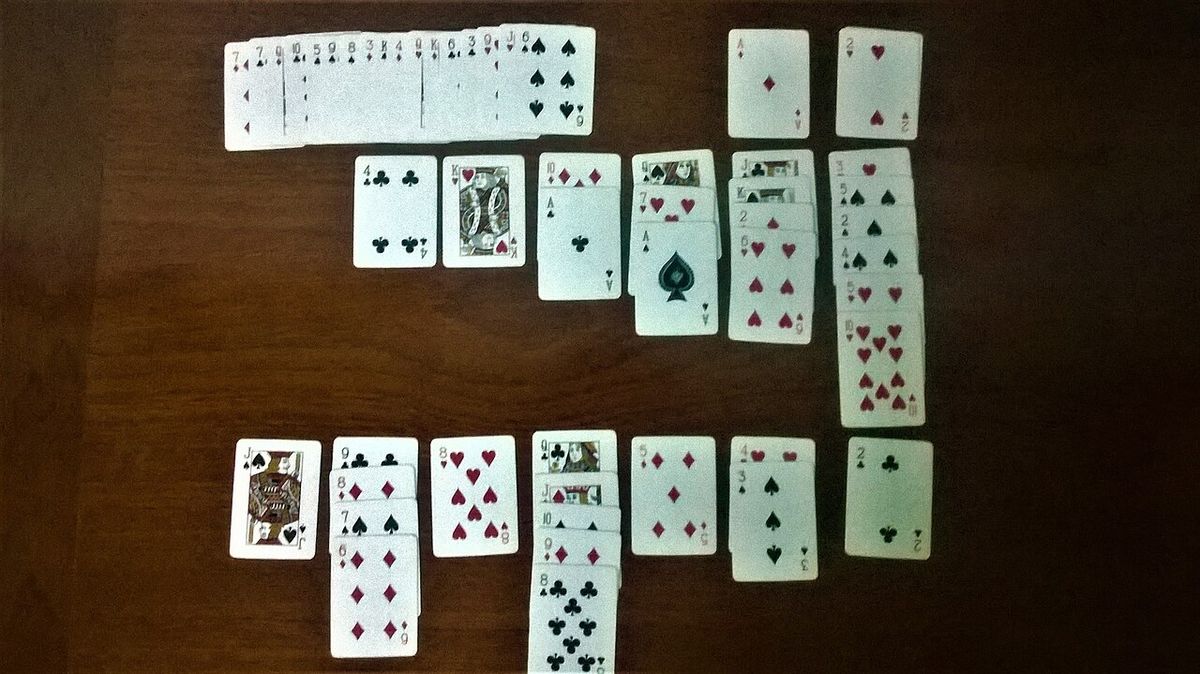
For multiplayer, Klondike can be adapted into a competitive two-player game known as Double Solitaire. In this version, each player uses their own standard 52-card deck. Players may not play cards to each other's tableaus, but they share the foundations. Players take turns until they are unable to play a card from their talons. The first player to play all 52 of their cards onto the shared foundations is the winner. Informally, this game can also be played as a party game with more than two players.
Probability of Winning and Strategic Depth
Determining the exact probability of winning a game of Klondike with perfect play is a famously unsolved problem in applied mathematics. Researchers use a theoretical model called "Thoughtful Solitaire," where the player knows the position of all 52 cards from the outset, to establish an upper bound. The win rate for Thoughtful Klondike under Turn 3 rules has been estimated at 81.942%, plus or minus 0.081%. However, the win rate for standard Klondike, where most cards are hidden, is significantly lower because optimal play often requires knowledge of face-down cards. Practical studies and data from millions of online games provide insight into real-world odds.
| Game Variant / Study | Estimated Win Rate | Notes |
|---|---|---|
| Theoretical Maximum (Thoughtful Klondike) | ~82% | Upper bound with perfect information |
| Turn 1 (Online Data, 2026) | 33.0% | Based on analysis of 2,898,974 games |
| Turn 3 (Online Data, 2026) | 11.1% | Considered one-third lower than Turn 1 |
| AI Algorithm (Turn 1) | 52% | Lower bound established by computer play |
| AI Algorithm (Turn 3) | 18% | Lower bound established by computer play |
| Skilled Human Player (Study) | 43% | Won 189 out of 442 games in one experiment |
These figures show that Klondike is a game of both luck and skill. While the random deal determines the potential winnability of a given game, a player's decisions significantly impact the outcome. Key strategies involve planning several moves ahead, prioritizing the uncovering of face-down tableau cards, being cautious about moving cards to foundations too early, and efficiently managing the stock and waste piles. The strategic depth, combined with the unique puzzle presented by each deal, is central to the game's enduring appeal.
Historical Origins and the Canadian Connection
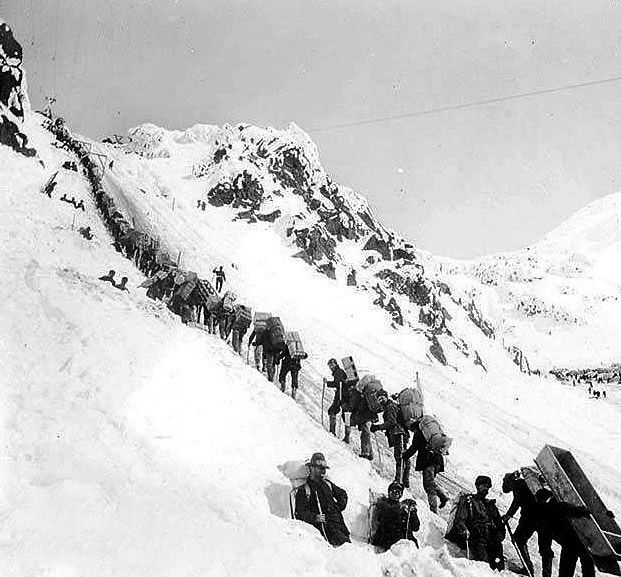
The precise origins of the name "Klondike" are not definitively documented, but the most persistent and plausible theory connects it to the Klondike Gold Rush in Canada's Yukon Territory during the late 1890s. As the story goes, prospectors and miners enduring the harsh winters would pass time playing this form of solitaire, and the name became associated with the region. The earliest known rules for the game as played today appear under the name "Seven-Card Klondike" in the 1907 edition of Hoyle's Games. This publication described it as a simpler version of another game also called Klondike, which was a gambling game similar to what is now known as Canfield or Demon in other parts of the world. By the 1913 edition of the Official Rules of Card Games, the seven-card version had simply become "Klondike." The game was also historically called Canfield in America, named after the Canfield Casino in Saratoga Springs, New York, where it was played as a casino game. This caused some historical confusion, as the name Canfield now more commonly refers to a different solitaire game entirely.
The Digital Revolution and Microsoft Solitaire
Klondike's transition from a physical card game to a digital phenomenon is a key chapter in its history. Before its inclusion in Windows, digital versions existed, such as Mark Reid's implementation for Atari 8-bit computers in 1981 and Michael A. Casteel's shareware version for Macintosh in 1984. However, the game's global popularity exploded when a version simply titled "Solitaire" was included in Microsoft Windows 3.0, released in 1990. The program was created by intern Wes Cherry. Microsoft officials stated it served a dual purpose: as a casual diversion and as a covert training tool to teach users how to drag and drop with a mouse, a novel interaction at the time. By 1994, Microsoft stated that Solitaire was the most-used application in Windows. The Microsoft Solitaire Collection, its modern successor, reportedly maintains over 35 million monthly active players, cementing Klondike's status as perhaps the most-played computer game in history.
The digital version introduced standardized scoring and timed games to a mass audience. In the classic Windows scoring system, moving a card from the waste directly to a foundation scores 10 points. However, moving a card to the tableau first and then to the foundation scores 15 points total, incentivizing intermediate moves. If the timed game option is enabled, the player loses points over time. A finishing bonus is calculated as 700,000 divided by the number of seconds taken, but only if the game lasts at least 30 seconds. Digital platforms also popularized features like hints, undo functions, and daily challenges, which are now standard in online and mobile versions from publishers like CBC Kids, AARP, and numerous app stores.
The digital version of Klondike introduced standardized scoring and timed games to a mass audience. In the classic Windows scoring system, moving a card from the waste directly to a foundation scores 10 points. Moving a card to the tableau first and then to the foundation scores 15 points total. If the timed game option is enabled, the player loses points over time. A finishing bonus is calculated as 700,000 divided by the number of seconds taken, but only if the game lasts at least 30 seconds.
- Moving a card from the waste directly to a foundation scores 10 points.
- Moving a card to the tableau first and then to the foundation scores 15 points total.
- If the timed game option is enabled, the player loses points over time.
- A finishing bonus is calculated as 700,000 divided by the number of seconds taken.
- The finishing bonus is only awarded if the game lasts at least 30 seconds.
Klondike in Contemporary Culture and Play
Today, Klondike remains immensely accessible, with countless free-to-play versions available online and on mobile devices, ensuring its status as a ubiquitous time-passer. Platforms like Solitaired and CBC Kids offer browser-based games with customizable rules. Modern digital implementations often provide statistics tracking, allowing players to monitor their personal win rates, which for dedicated players often range around 30-35% for Turn 1 games. The game is also featured in compilations like Nintendo's Clubhouse Games. The language of Klondike has permeated culture. The term "solitaire" is often used interchangeably with Klondike, and the game's imagery is instantly recognizable. While other solitaire games like FreeCell and Spider exist, Klondike retains its position as the archetypal version. Its simplicity for beginners, combined with deep strategic possibilities for experts, ensures its continued relevance. The game serves as a quiet, contemplative activity for many, a cognitive exercise for others, and for some, like the fictional commentator "Ace McShuffle," a subject of dedicated, almost obsessive practice and analysis.
Key actions in digital versions, such as the one from CBC Kids, are often tied to a points system that shapes how players approach the game. Common scoring actions in these implementations include earning 15 points for moving any card to a foundation pile for the first time, earning 5 points for moving any card onto the tableau board for the first time, and losing 8 points every 30 seconds when the timed game option is active, making time a factor. Players can also use an auto-finish feature to move all possible cards to the foundations at once, utilize undo and redo functions to correct or experiment with moves without penalty, and employ keyboard shortcuts to highlight specific cards, like aces or cards of a certain suit, to aid in planning. These features, combined with the game's fundamental challenge, keep Klondike a fixture in digital entertainment decades after its computer debut.
Questions about Klondike
What are the odds of winning a game of Klondike solitaire?
The odds depend heavily on the rules and player skill. The theoretical maximum win rate with perfect play and perfect information is about 82%. For the harder Turn 3 variant, the practical win rate drops to approximately 11.1%. A skilled human player in a controlled study won about 43% of Turn 1 games.
What is the difference between Turn 1 and Turn 3 Klondike?
The difference lies in how cards are revealed from the stock pile. In Turn 1 Klondike, cards are turned over one at a time from the stock to the waste pile, making every card immediately accessible. This is considered easier and offers a higher chance of winning. In Turn 3 Klondike, cards are turned over in batches of three, and typically only the top card of the three is available to play. This restricts options and makes the game more challenging, significantly lowering the win rate for most players.
Can you put any card in an empty column in Klondike?
No. A fundamental rule of classic Klondike is that an empty column in the tableau can only be filled by a King. You may place a single King or a sequence of cards that starts with a King into the empty space. This rule forces strategic consideration about when to move Kings and clear columns to access face-down cards beneath.
Where does the name 'Klondike' come from?
The origins of the name Klondike are not definitively known. Some authors have speculated the name derives from the late 19th-century Klondike Gold Rush in Canada, but no material evidence substantiates this claim. The earliest rules for the game known today as Klondike appear in the 1907 edition of Hoyle's Games under the name "Seven-Card Klondike". Historically, the game was also called Canfield in America, possibly because it was a casino game at the Canfield Casino in Saratoga Springs, New York.
Is Klondike a game of luck or skill?
Klondike is a game that blends both luck and skill. The initial random deal of the cards introduces a significant element of luck, determining whether a particular game is theoretically winnable. However, player skill is crucial for handling each unique puzzle, as decisions directly influence the outcome. Research indicates that roughly 79 to 82 percent of deals are theoretically winnable with optimal play, yet actual human win rates are much lower, often between 11 and 43 percent depending on the variant and player expertise. This large gap between theoretical and actual win rates highlights the substantial impact of strategic planning and skillful decision making. The game's enduring appeal lies in this balance, where each deal presents a new challenge that rewards careful thought and foresight.
How long does a typical game of Klondike take?
The duration of a typical game of Klondike is not specifically defined and can vary widely based on the player's skill level and the specific rules being used. In computerized versions like Microsoft Solitaire, time can be a scoring factor. When the 'Timed game' option is selected, the game deducts two points every ten seconds during play. A time based bonus is calculated using the formula 700,000 divided by the total seconds to finish, but this bonus is only awarded if the game takes at least thirty seconds to complete. Games finished in under thirty seconds receive no time bonus. The variability in game length is also influenced by the different dealing rules, such as turning one card or three cards at a time from the stock, which affect the pace and complexity of play.
Sources and further reading
- Klondike (Wikipedia)
- Klondike Solitaire, Play Online & 100% Free (solitaired.com)
- Klondike Solitaire: Rules, Strategy & Free Play (2026) (solitaireassociation.com)
- Klondike Solitaire | Games | CBC Kids (cbc.ca)
- Klondike Solitaire (greenfelt.net)
- Solitaire Engagement Rings (michaelhill.ca)
- Solitaire Rings | Engagement | Temple and Grace Canada (templeandgrace.ca)
Checked by the Nosy Mag desk. Last updated 2026-11-07.