FreeCell
FreeCell is a solitaire card game played with a standard 52-card deck, distinguished by having all cards dealt face-up from the start and a near-universal solvability rate. Created as a computer game by Paul Alfille in 1978, its popularity was cemented when Microsoft began including it with the Windows operating system starting in 1995. The game's clear rules and strategic depth, involving four free cells and four foundation piles, have made it a staple of digital card gaming for decades. This implementation standardized a deal numbering system, allowing players to share and discuss specific games.
Game Rules and Setup
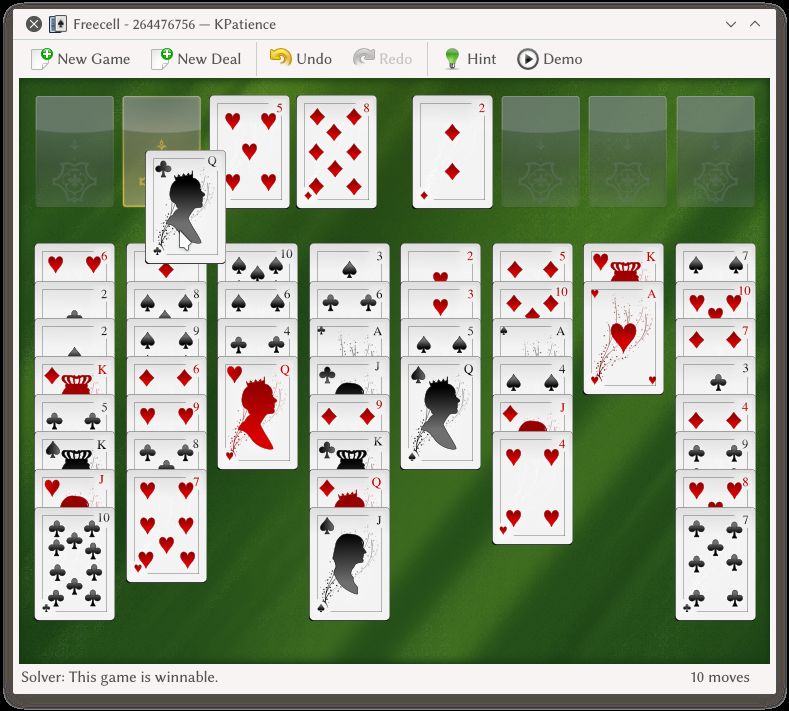
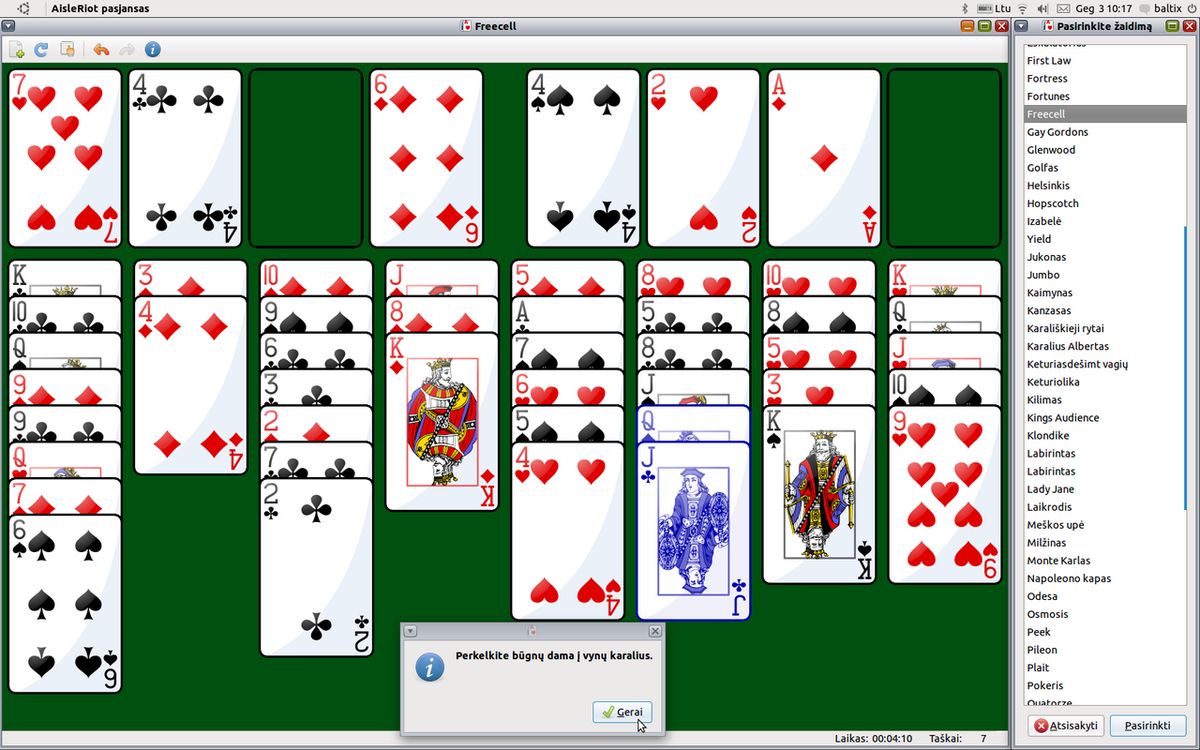
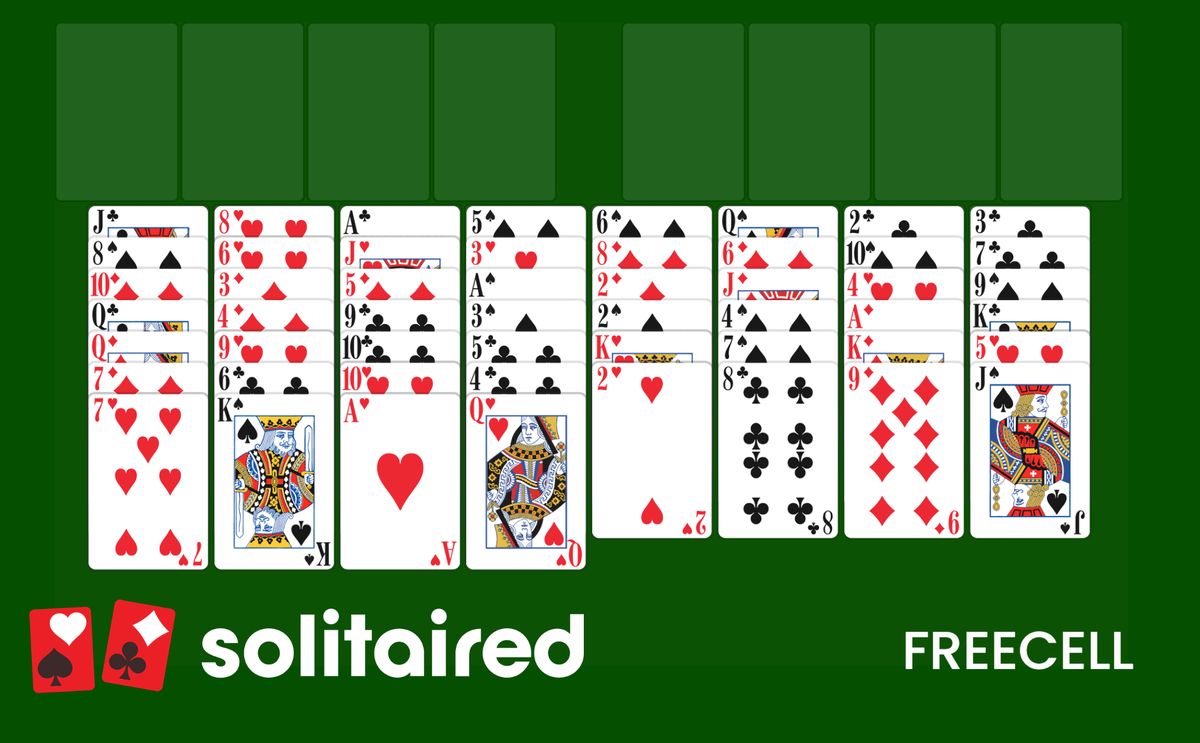
The game begins with a standard 52-card deck. All cards are dealt face-up into eight vertical columns called cascades. The first four columns from the left contain seven cards each, while the remaining four columns contain six cards each, making all 52 cards visible from the outset. Above the tableau are two key areas: four free cells on the left and four foundation piles on the right. The free cells are temporary holding spaces where any single exposed card from the tableau can be placed. The foundations are the ultimate destination for the cards, built up by suit from Ace to King.
The primary rule of movement involves building sequences on the tableau columns. A card may be moved onto another tableau card only if it is one rank lower and of the opposite colour. For example, a black seven can be placed on a red eight. An empty tableau column can be filled with any single card or valid sequence of cards. Cards can be moved from a tableau to an empty free cell, from a free cell back to a tableau following the build-down rule, or directly from a tableau or free cell to its appropriate foundation pile when it is the next card in sequence for that suit. The game is won when all 52 cards are successfully moved to the four foundation piles in correct order.
Strategic Concepts and Supermoves
A defining strategic element of FreeCell is the concept of the supermove, which allows players to move multiple cards as a sequence in a single action. Unlike many solitaire games where only one card can be moved at a time, FreeCell permits moving partial or complete tableau sequences provided there are enough empty free cells and empty columns to facilitate the transfer through intermediate steps. The mathematical formula governing the maximum number of cards (C) that can be moved in one sequence is C = 2^M × (N + 1), where M is the number of empty cascades and N is the number of empty free cells. When moving cards to an empty cascade, the maximum number is halved to C/2.
This rule is automatically handled in digital implementations, where players can drag a stack of cards and the software calculates the necessary intermediate moves. In physical play, players typically just move the sequence outright once they have mentally verified the move is legal. Effective use of free cells is critical to strategy, as they act as temporary buffers to unlock deeper cards in the columns. Since all cards are visible, planning several moves ahead is essential. Key tactics include clearing columns to create valuable empty spaces, avoiding filling free cells unnecessarily, and building down the tableau in alternating colours to create longer movable sequences.
- Plan moves by scanning the entire tableau before making your first move.
- Prioritize moving Aces and Twos to the foundations early to create more space.
- Use empty columns strategically to rearrange and re-sequence large blocks of cards.
- Be cautious about placing higher-ranking cards in free cells, as they can become trapped.
- Remember that an empty free cell or column is a powerful tactical asset for rearranging sequences.
History and Development
FreeCell's lineage can be traced to earlier solitaire games. One direct ancestor is Baker's Game, described by Martin Gardner in a 1968 Scientific American column, where cards in the tableau are built by suit rather than by alternate colours. Paul Alfille, while a medical student at the University of Illinois, modified Baker's Game by introducing the alternate-colour building rule, thus creating FreeCell. In 1978, he implemented the first computerized version using the TUTOR programming language on the PLATO educational computer system. The PLATO version featured a monochrome graphical display and supported a variety of game configurations with different numbers of columns and cells. The game's journey to mass popularity began when Microsoft included an implementation in every release of Windows starting in 1995. The bundled version standardized a specific deal numbering system derived from its random number generator seed, making deals reproducible across different platforms. This allowed players to share and discuss specific challenging deals, with deal number 11982 gaining notoriety as the only proven unsolvable game among the original 32,000 numbered deals in the Microsoft set.
Solvability and Game Complexity
FreeCell is renowned for its high solvability rate, a stark contrast to games like Klondike where a majority of deals are unwinnable. Research indicates that an estimated 99.999% of all possible FreeCell deals are solvable. A 2018 analysis of 8.6 billion deals from FreeCell Pro found only 102,075 unsolvable deals, equating to roughly one impossible game in every 84,000 random deals. The most famous unsolvable deal is number 11982 from the original Microsoft Windows version, which is the only unsolvable game among the first 32,000 numbered deals that came bundled with the software.
Despite using a fixed deck of 52 cards, the number of distinct possible games is astronomically high. When accounting for symmetrical situations where suits are interchangeable or columns can be swapped, the number of truly unique games is estimated at about 1.75 × 10^64. From a computational complexity perspective, a generalized version of FreeCell with a variable number of cards has been proven to be NP-complete. This means there is no known efficient algorithm to solve all arbitrary, larger versions of the game, making the standard 52-card version a complex but manageable puzzle for human and computer solvers alike.
| Statistic | Figure |
|---|---|
| Distinct FreeCell games | ~1.75 × 10^64 |
| Estimated solvability rate | ~99.999% |
| Unsolved deals in 8.6 billion sample | 102,075 |
| Online human win rate | 41.86% |
Variants and Related Games
The core mechanics of FreeCell have inspired numerous variants and related solitaire games. Some modify the difficulty by changing the building rules or the available resources. Relaxed FreeCell is a common variant where the limitation on moving card sequences based on the number of free cells is removed, making the game easier. Other popular games share a similar family tree or concept. Eight Off is considered a direct ancestor and uses a similar layout with eight tableau columns but different rules for building and using reserve cells. Baker's Game, the immediate precursor, requires building tableaus by suit instead of alternate colours.
Modern digital platforms often offer variations. Other solitaire games that incorporate similar strategic elements of clear tableau management and sequencing include Seahaven Towers, Penguin, Stalactites, ForeCell, and Antares. These games test similar skills in planning and spatial reasoning, offering fresh challenges to players who have mastered standard FreeCell. The proliferation of online gaming sites has made these variants easily accessible. The original PLATO version allowed games with 4-10 columns and 1-10 cells in addition to the standard 8 column and 4 cell game.
- Baker's Game: Tableau built by suit, not colour.
- Eight Off: Uses eight tableau piles and a reserve of eight cells.
- Relaxed FreeCell: Removes the free cell count limitation for moving sequences.
- Seahaven Towers: A more complex game with three decks and a different goal structure.
- Penguin: All cards are dealt face-up, but only cards of the same rank as the foundation base can be moved there.
Cognitive Benefits and Modern Play
Beyond entertainment, FreeCell offers documented cognitive benefits. The game is fundamentally a problem-solving exercise that requires planning, visualization of sequences, and strategic use of limited resources like the free cells. This engages critical thinking and executive function skills. Research, including a study referenced by the Oregon Center for Aging & Technology, suggests that performance patterns in FreeCell could potentially help identify early signs of memory problems or cognitive decline, as the game demands sustained attention and strategic foresight.
In the modern era, FreeCell is predominantly played online through web browsers and mobile apps, requiring no download. These platforms often enhance the experience with features like daily challenges, progress tracking, leaderboards, and detailed statistics. The reported human win rate on one major online platform is 41.86%, based on nearly two million games played, which is significantly lower than the theoretical near-100% solvability rate, highlighting the game's strategic depth. Players can often replay the same deal to improve their score. The game's design, which makes every card known from the start, reduces the element of luck and emphasizes skill, making it a satisfying and repeatable mental challenge for players of all ages.
Questions about FreeCell
What is FreeCell?
FreeCell is a solitaire card game played with one standard 52-card deck. All cards are dealt face-up into eight columns at the start. The goal is to move all cards to four foundation piles by building them up from Ace to King by suit, using four free cells as temporary holding spaces. It is known for its high solvability rate and strategic depth, differing from many solitaire games that rely more on luck.
How do you play FreeCell?
You start with 52 cards dealt into eight tableau columns, with four columns of seven cards and four of six cards. You build tableau columns down by alternating colours. You can move single cards or sequences to other columns, to empty free cells, or to the foundation piles. An empty tableau column can be filled with any card or legal sequence. The game is won when all cards are sorted onto the four foundations in correct suit order from Ace to King.
What are free cells used for in FreeCell?
The four free cells are temporary holding spaces located at the top left of the layout. Any single exposed card from the tableau can be moved to an empty free cell. This action is crucial for freeing up cards buried underneath in the columns, allowing you to access them and build sequences. Free cells are also key to performing supermoves, as their number directly impacts how many cards you can move in a sequence.
Are there different versions of FreeCell?
Yes, there are many variants. The original PLATO version allowed custom games with 4-10 columns and 1-10 cells. Common variants include Relaxed FreeCell, which removes movement restrictions. Related solitaire games with similar mechanics include Baker's Game, Eight Off, Seahaven Towers, and Penguin. Most are available to play for free on various websites and apps.
What is the history of FreeCell?
FreeCell was created by Paul Alfille in 1978. He adapted an earlier solitaire game called Baker's Game, which was described by Martin Gardner in 1968, by changing a key rule so that cards on the tableau build in alternating colours instead of by suit. Alfille implemented the first computerized version using the TUTOR programming language for the PLATO educational computer system. This original version featured a monochrome graphical display and supported different game configurations.
Sources and further reading
- FreeCell (Wikipedia)
- Freecell Solitaire (greenfelt.net)
- FreeCell, Play Online & 100% Free (solitaired.com)
- FreeCell Solitaire! Play this Game Now for Free (games.aarp.org)
Checked by the Nosy Mag desk. Last updated 2026-11-08.