Spider
Spider is a solitaire card game played with two decks. The objective is to build eight complete descending sequences, from King to Ace within the same suit, which are then removed from play. Its name derives from the spider's eight legs, referencing the eight foundation piles required to win. The game originated in 1949. It gained global popularity following its inclusion as a digital game in Microsoft Windows in 1998. For Canadian players, it remains a widely accessible and cognitively stimulating pastime, available in countless free online versions and mobile apps.
Game Origins and History
The game originated in 1949. The game's name is a direct metaphor, comparing the eight completed sequences needed to win to the eight legs of a spider. Its transition from a physical card game to a digital staple began with early computer versions. Its mass popularity was cemented in 1998 when it was included in the Microsoft Plus! 98 pack for Windows 98. It later became a standard inclusion in subsequent Windows operating systems like ME, XP, Vista, and 7.
Standard Rules and Setup
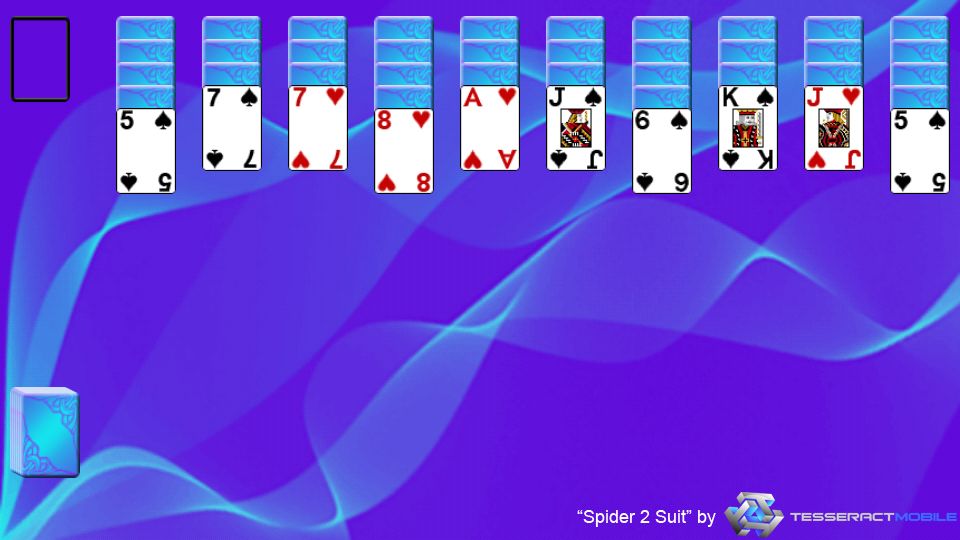
The initial setup involves dealing 54 cards into ten piles called the tableau. The first four piles from the left each contain six cards, while the remaining six piles each contain five cards. In each pile, only the top card is face up at the start of the game. The remaining 50 cards form the stock pile, placed face down. The primary objective is to build eight complete foundation sequences. Each sequence must be in descending order from King down to Ace, and all cards within a sequence must be of the same suit. Once such a complete sequence is assembled anywhere in the tableau, it is automatically removed from play. The game is won when all eight sequences are removed and no cards remain in the tableau or stock.
During gameplay, a player may move any face up card, or a valid sequence of cards, onto another face up card that is one rank higher. A valid sequence that can be moved as a unit must be in descending order and all of the same suit. When a column in the tableau becomes completely empty, any single card or valid sequence may be placed there. When no further moves are possible, the player can deal ten new cards from the stock pile, placing one card face up on top of each existing tableau column. This deal can only occur when all ten tableau columns contain at least one card.
Common Variants and Difficulty Levels
The classic game uses all four suits (spades, hearts, diamonds, clubs), which presents the highest level of strategic complexity. To accommodate different skill levels, most digital implementations offer simplified variants that reduce the number of suits in play. The one suit variant, typically using only spades, is the easiest as any card can be placed on any other card of the next higher rank regardless of suit. The two suit variant, commonly using spades and hearts, introduces a medium level of difficulty by requiring players to manage two distinct suits. Winning chances in a normal game with good play are considered to be about 1 in 3 games.
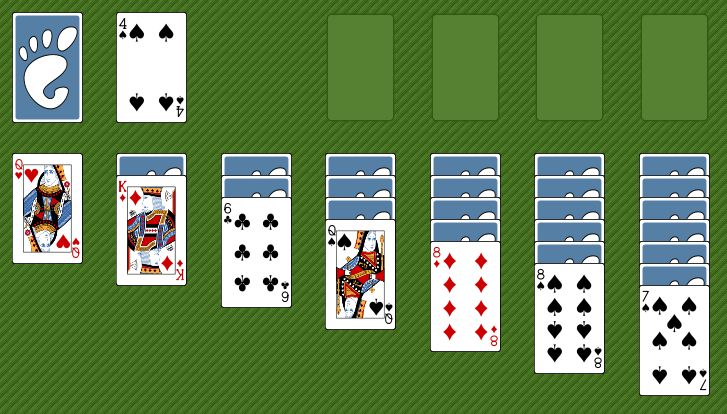
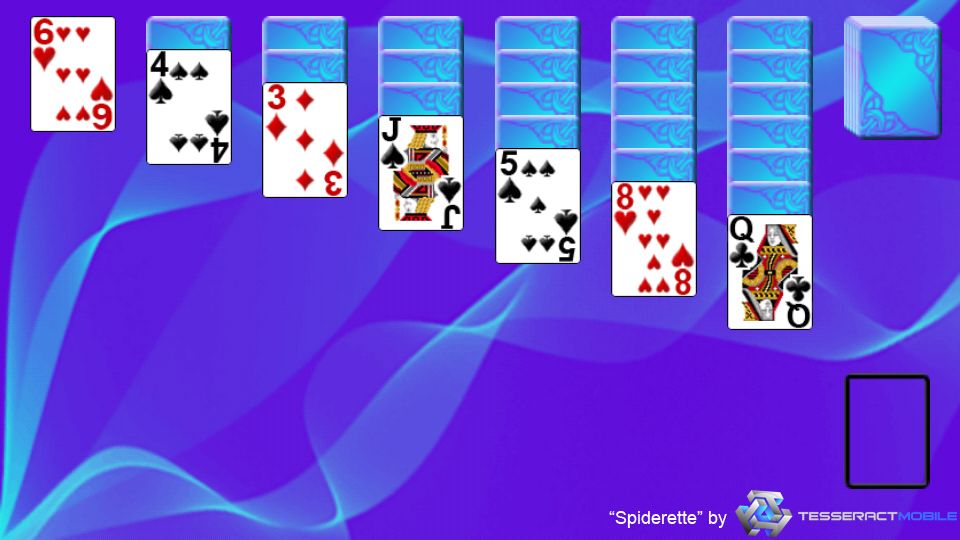
Beyond the suit based variants, several other Spider related solitaire games exist. Spiderette, also known as Spiderwort, is a popular one deck variant that uses a Klondike like layout with seven columns. Simple Simon and Mrs. Mop are other notable relatives within the broader spider solitaire family. Will o' the Wisp is another solitaire card game played the same way as Spiderette, but with twenty one cards dealt into seven columns of three initially. Modern online platforms often host extensive collections of these variants.
Digital Implementations and Scoring
Since its computerization, Spider Solitaire has been developed for nearly every major operating system. An earlier version was written for Windows 3.x in 1991 by John A. Junod. He also wrote an MS DOS version called EGA Spider. A similar game called Arachnid was released for Windows 3.x in 1991 by Ian Heath. The most influential version remains the Microsoft Windows implementation, which introduced the game to hundreds of millions of users. On Unix like systems, an early version was developed around 1989 at Sun Microsystems. A version of Spider Solitaire typically comes bundled with both the KDE and GNOME desktop environments under the names KPatience and AisleRiot Solitaire, respectively.
Scoring systems vary between software. The version from Sun Microsystems from 1989 awards 10 points for each initially face down card that gets turned over, 15 additional points for each column where all the face down cards have been turned over, 2 points for each card that is sitting atop the next higher card of the same suit, and 50 points for each completed suit removed from the tableau. This yields a maximum score of 990, or 1000 under special conditions. The widely recognized Windows scoring system starts the player with 500 points. One point is subtracted for every move made, including using the undo function. One hundred points are added for each completed suit sequence that is removed from the tableau.
- One point is subtracted for every move made, including using the undo function.
- One hundred points are added for each completed suit sequence that is removed from the tableau.
- The maximum theoretical score in this system is approximately 1256 points.
- Other features in modern apps include unlimited undo, hint options, and daily challenges.
Strategy and Solvability
Successful play in Spider Solitaire requires careful planning and strategic foresight, especially in the more difficult four suit version. A core principle is to prioritize exposing face down cards, as this increases the number of available moves and reveals critical cards. Players should aim to build in suit sequences whenever possible, as these can be moved as a unit and are necessary for removal. Creating empty columns is a powerful tactical goal, as an empty column can act as a temporary holding space for any card or sequence. It is generally advised to avoid dealing new cards from the stock until absolutely necessary. A detailed study has been done on the solvability of Spider solitaire games using software. Winning chances in a normal game with good play are considered to be about 1 in 3 games.

Popularity and Cultural Impact
Spider Solitaire's inclusion as a bundled game in Microsoft Windows transformed it from a niche card game into a global digital phenomenon. Its presence on home and office computers made it a default choice for brief mental breaks. The game's appeal lies in its blend of luck, strategy, and a clear, satisfying goal. For many Canadian players, it serves as a familiar and relaxing cognitive exercise. The game's digital lifecycle continues robustly today through free online gaming websites and mobile app stores. These platforms often offer the game without download or registration. The availability of multiple difficulty levels and variants ensures it remains accessible to newcomers while still challenging seasoned players.
- An earlier version was written for Windows 3.x in 1991 by John A. Junod.
- The game was included in Microsoft Plus! 98 for Windows 98 in 1998.
- It became a standard feature in Windows ME, XP, Vista, and 7.
- On Unix like systems, a version was developed around 1989 at Sun Microsystems.
- The game is bundled with the KDE and GNOME desktop environments on Linux.
Notable Software and Platform Availability
Spider Solitaire is available on a vast array of digital platforms. The original Microsoft Windows version set the standard for many players. For Apple users, numerous versions are available on the iOS App Store. On Android devices, similar apps can be found on the Google Play Store. A major avenue for play is through web browsers on sites dedicated to free card games. The game is also present on gaming consoles, with a version available for the Nintendo Switch. On personal computers running Linux, the game is commonly included in the KDE and GNOME desktop environments as part of their solitaire packages.
| Platform | Common Implementation Name(s) | Notes |
|---|---|---|
| Microsoft Windows | Spider Solitaire | Bundled since Windows 98 (Plus! 98 pack), standard in later versions. |
| Web Browsers | Various | Free, no download play often with multiple variants. |
| iOS (Apple) | Spider Solitaire, Spiderette | Available on App Store. |
| Android | Spider Solitaire | Available on Google Play Store. |
| Linux/Unix | KPatience (KDE), AisleRiot (GNOME) | Bundled with desktop environment solitaire collections. |
| Nintendo Switch | Spider Solitaire | Available for purchase in the Nintendo eShop. |
Questions about Spider
What are the basic rules of Spider Solitaire?
Spider Solitaire uses two decks (104 cards). Initially, 54 cards are dealt into ten tableau piles: four piles of six cards and six piles of five cards, with only the top card face up. The remaining 50 cards form the stock. The goal is to build eight complete descending sequences from King to Ace, all in the same suit. You can move a card or a same suit sequence onto any card one rank higher. When a column empties, you can place any card or sequence there. When stuck, you can deal ten new cards from the stock, one onto each column. Completed sequences are removed automatically, and you win when all cards are gone.
What is the difference between 1 suit, 2 suit, and 4 suit Spider Solitaire?
The number refers to how many of the four card suits are in play, which directly controls difficulty. One suit Spider uses only one suit, making it the easiest as suit matching is irrelevant for moves. Two suit Spider uses two suits, requiring management of two colours and offering medium difficulty. Four suit Spider uses all suits and is the classic, hardest version. These play modes are equivalent to disregarding suit difference, either within the colors or altogether.
Why is it called Spider Solitaire?
The name is a metaphor based on the game's winning condition. To win, a player must assemble and remove eight complete sequences of cards, each from King down to Ace. These eight finished piles are likened to the eight legs of a spider, hence the name Spider Solitaire. The analogy between the required eight foundations and a spider's anatomy has been associated with the game since its origin in 1949.
How do you score points in Spider Solitaire?
Scoring varies by software. The common system from Microsoft Windows starts you at 500 points. You lose one point for every move you make, including using the undo function. You gain 100 points for each completed suit sequence you remove from the tableau. The version from Sun Microsystems from 1989 awards 10 points for each initially face down card turned over, 15 points for each column where all face down cards are turned over, 2 points for each in suit build, and 50 points for each completed suit removed, with a maximum score of 990 or 1000.
What is Spiderette solitaire?
Spiderette is a popular one deck variant of Spider Solitaire. The layout is similar to Klondike solitaire, typically with seven columns. The core rules of building descending sequences within the same suit to remove them remain. It is also known as Spiderwort. Will o' the Wisp is another solitaire card game played the same way as Spiderette, but with twenty one cards dealt into seven columns of three initially.
Can you always win a game of Spider Solitaire?
No, not all Spider Solitaire deals are winnable. A detailed study on solvability indicates that winning chances in a normal game with good play are considered to be about 1 in 3 games. This inherent difficulty is confirmed by observed online win rates. The arrangement of cards from the initial shuffle creates a significant element of luck that influences every game's outcome.
Sources and further reading
- Spider (Wikipedia)
- Spider Solitaire, Play Online & 100% Free (solitaired.com)
- Spider Solitaire 247 - Play Free Spider Solitaire Card Games Online (247spidersolitaire.com)
- Spider Solitaire ・2026 - App Store, Apple (apps.apple.com)
- Spider Solitaire | Play it online (cardgames.io)
- Spider Solitaire, Jeu en Ligne Gratuit | Sélection (jeux.selection.ca)
- Spider Solitaire, Play Online & 100% Free (solitaired.com)
Checked by the Nosy Mag desk. Last updated 2026-11-07.