Canfield
Canfield, known as Demon in the United Kingdom, is a classic single-deck solitaire card game renowned for its challenging difficulty and low win rate. The objective is to build all 52 cards onto four foundation piles, starting from a randomly determined base card rank. For Canadian players, Canfield represents a significant and enduring variant within the solitaire canon, offering a stern test of patience and strategic skill distinct from the more common Klondike.
Historical Origins and Naming
The game was first recorded in England in 1891 by Mary Whitmore Jones, who published the rules under the name Demon Patience in the publication Bazaar, Exchange and Mart. She described it as the best single-pack patience game invented, noting its frustrating nature inspired the 'demon' moniker as a mocking spirit seemed to preside over play. Author Henrietta Stannard, writing under the pseudonym John Strange Winter, further popularized the game in her 1895 novel A Magnificent Young Man, where a character laments the game's tantalizing and perverse difficulty. By 1910, Fry's Magazine edited by C.B. Fry confirmed the name Demon patience reflected the player's frequent defeat by a single awkwardly placed card. The game travelled to America, where the earliest known description confusingly called it Klondike in the 1907 Hoyle's Games. The American name Canfield emerged from a story involving gambler Richard A. Canfield, who took over the Clubhouse casino in Saratoga Springs, New York in 1894. He reportedly sold decks to gamblers for $50 or $52, paying $5 for every card placed in the foundations, with a potential $2,600 payout for a perfect game. Historical sources are conflicted, with George Hapgood's 1908 rulebook using the name Canfield for the game now known as Klondike, leading to lasting confusion between the two solitaire variants. It has been argued that the game originally played at Canfield's casino was Klondike, not the game known today as Canfield.
Setup and Objective
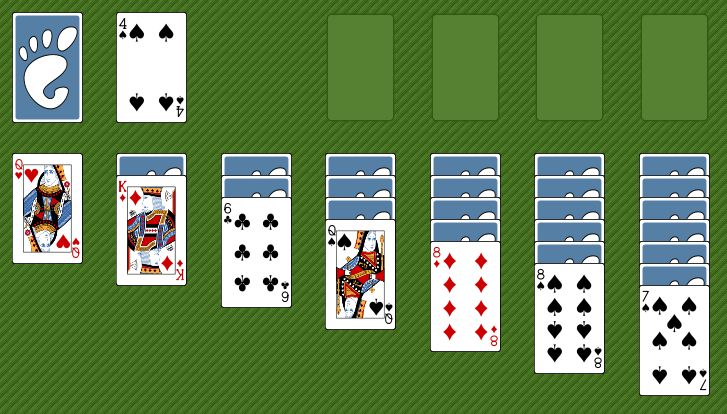
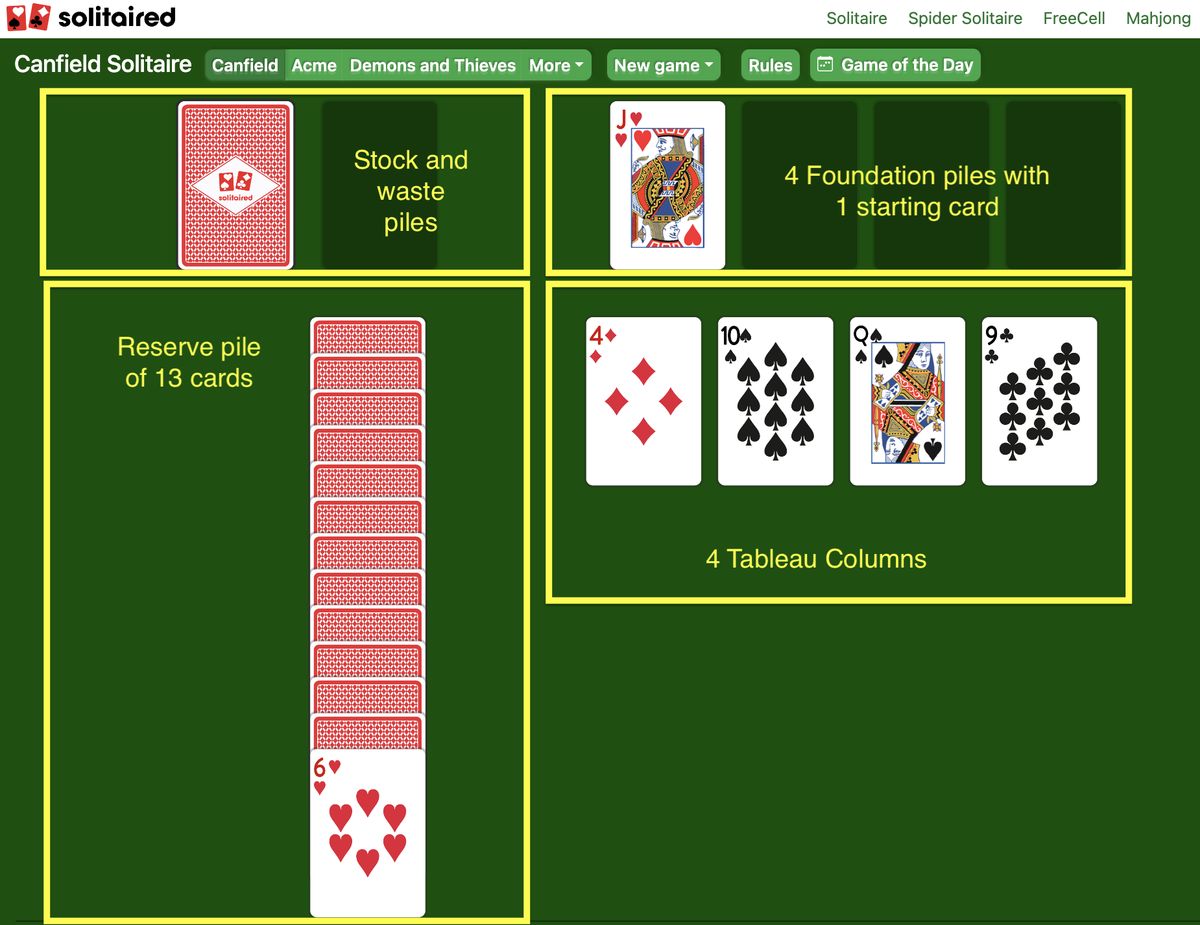
Canfield uses one standard 52-card deck. The initial setup creates five distinct playing areas. First, thirteen cards are dealt face down into a pile called the reserve or 'demon', and the top card of this pile is turned face up. The next card from the deck is dealt to the first of four foundation piles in the upper right. This card's rank becomes the base for all four foundations. The remaining three foundation piles start empty but must also be started with a card of the same rank as that first base card. Four cards are then dealt face up to form the initial tableau piles in a row below the foundations. All remaining cards form the stock pile, which is placed face down. The objective is to move all 52 cards from the reserve, tableau, and stock onto the four foundation piles. Foundations are built up in suit sequence, starting from the base rank and wrapping from king to ace as necessary. For example, if the base card is a 5, the sequence for that suit would be 5, 6, 7, 8, 9, 10, jack, queen, king, ace, 2, 3, 4. A successful game requires mastering the restrictive rules governing the reserve and the three-card draw from the stock, which together create the game's signature challenge.
Rules of Play and Key Moves
Gameplay in Canfield follows a strict set of procedures for moving cards between its five piles. The top card of the reserve is always available for play to either a foundation or the tableau. Cards on the four tableau piles are built down in descending order and must alternate in colour. Entire columns or partial sequences of face-up cards can be moved together between tableau piles as long as the building rule is maintained. Any empty tableau column must be filled immediately by the top card from the reserve pile, and if the reserve is exhausted, from the waste pile. Cards from the stock are dealt in packets of three face up to a waste pile, and after each deal the top waste card becomes available. The stock can be redealt an unlimited number of times by turning over the waste pile. The game is won when all 52 cards are moved in ascending suit sequence to the four foundation piles. The following are the primary allowed moves in a standard digital or physical game.
- Flip cards from the Stock onto the Waste, typically in packets of three.
- Move the top card of the Waste onto a Foundation pile if it follows the correct suit and sequence.
- Move the top card of the Waste onto a Tableau pile if it follows the descending, alternating colour rule.
- Move the top card of the Reserve onto a Foundation or an available Tableau pile.
- Move one or more cards from one Tableau pile to another, provided the move is valid.
- Fill an empty Tableau column with a card from the Reserve, or from the Waste if the Reserve is empty.
- Redeal the cards from the Waste pile back to the Stock to continue play when no moves remain.
Understanding these moves is essential for formulating a strategy. The restrictive filling of empty columns from the reserve is a defining and challenging aspect of the game. This rule demands careful planning and resource management from the player. Richard Canfield himself restricted the number of times that gamblers could redeal the stock.
Statistical Difficulty and Gambling Payouts
Canfield is notoriously difficult to win. Analysis of a large sample of 122,678 randomly played online games recorded only 10,962 wins, resulting in a practical win rate of approximately 8.94 percent. This is significantly lower than Klondike's win rate of 32.91 percent. However, computer solvers analyzing 50,000 random deals suggest a much higher theoretical solvability rate of about 71 percent, with an average of 39.9 cards moved to the foundation per game. The large gap between theoretical and practical win rates is attributed to the hidden cards in the reserve and the three-card draw from the stock, which makes long-term planning extremely challenging. Expert players might achieve win rates around 35 percent, but casual players will find victories infrequent. The game's historical use as a casino game by Richard Canfield was based on these poor odds. He sold a deck for $50 or $52 and paid $5 per card moved to the foundations. With players averaging a loss of about five to six cards per game, the house maintained a consistent edge. The game's duration took longer than an average casino game and required a croupier for each player, which are reasons it did not become a major casino staple. In 1907, Canfield sold the casino to the City of Saratoga Springs at a loss.
| Metric | Canfield | Klondike |
|---|---|---|
| Practical Win Rate | 8.94% | 32.91% |
| Theoretical Solvability Rate | ~71% | N/A |
| Average Cards to Foundation | 39.9 | N/A |
| Sample Size (Games) | 122,678 | N/A |
| Recorded Wins | 10,962 | N/A |
Common Variants and Related Games
Several variants of Canfield exist, often designed to alter the difficulty level or introduce new rules. The Storehouse variant, also called Reserve or Thirteen Up, is easier than standard Canfield. This version starts with the four deuces on the foundations, uses suit building, deals the stock one card at a time, and allows only two redeals. Its maximum win rate is about 44 percent, and most players can achieve rates close to this regardless of skill. Selective Canfield deals five cards face up after the reserve, letting the player choose one for the foundation base. Superior Canfield deals the entire 13-card reserve face up and allows any card to fill an empty tableau column. Chameleon uses a 12-card reserve, three tableau columns, and down building regardless of suit with no redeals. Rainbow also builds down regardless of suit and typically allows no redeals. Variegated Demon is a double-deck game where aces are always the base cards and there is a tableau of five cards. Closely related solitaire games include Duchess and the two-deck American Toad. A significant competitive, multi-player derivative is Racing Demon, known as Nerts or Pounce in the United States, which inspired the commercial games Dutch Blitz and Ligretto. The simpler children's game Beehive uses a Storehouse layout but matches cards by value.
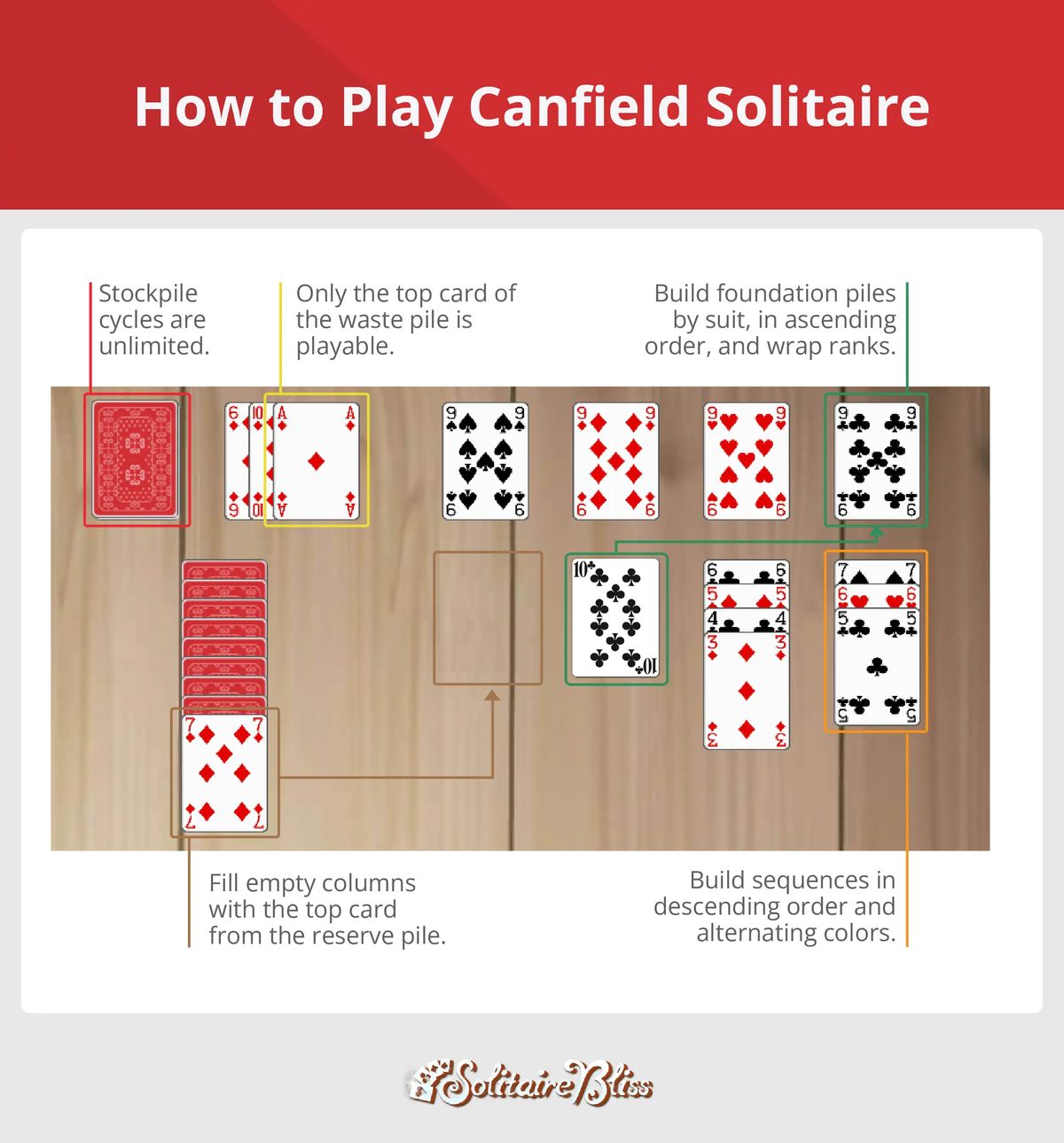
Canfield in Digital Gaming and Features
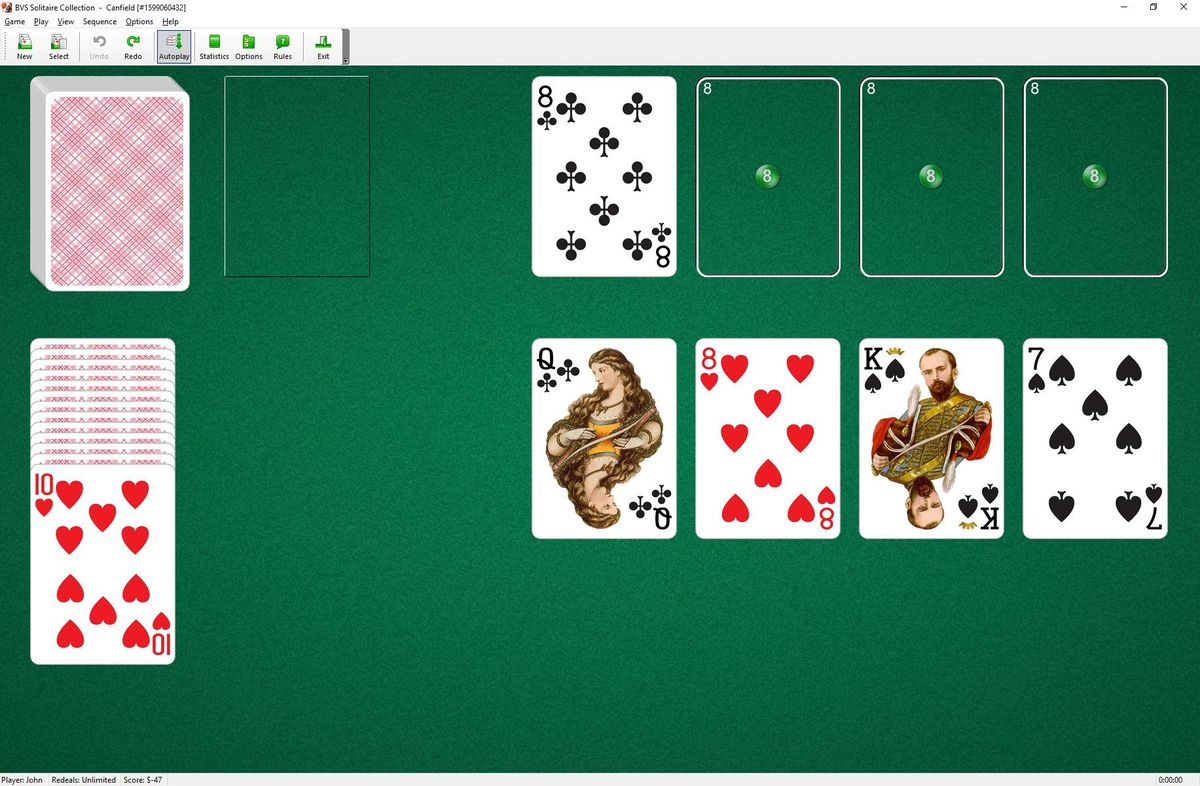
Canfield is widely available as a digital solitaire game across numerous websites and software applications, often offered for free. These digital versions faithfully replicate the physical game's rules but frequently include quality-of-life features to assist players. Common digital features include an auto-finish function that moves all possible cards to foundations, undo and redo buttons, and the ability to highlight specific cards or suits using keyboard shortcuts. Many online platforms allow players to configure whether cards are drawn from the stock one or three at a time. Digital implementations also track statistics, such as win rates and streak records, providing players with concrete data on the game's difficulty. The game is part of larger solitaire collections available for purchase or download on major software platforms. Digital versions offer several specific tools and shortcuts to improve the player experience.
- Keyboard Shortcuts: Space for auto-finish, 'z' to undo, 'x' to redo, 'n' for a new game, 'f' to flip stock cards.
- Card Finder: Pressing 'a' highlights aces, number keys (1-9, 0/t for tens) highlight cards of that rank.
- Suit/Colour Finder: Keys 'd' (diamonds), 'c' (clubs), 'h' (hearts), 's' (spades), 'r' (red), 'b' (black) highlight corresponding cards.
- Combination Highlights: Holding a rank key and a suit or colour key highlights only that specific card (e.g., '5' and 'd' for five of diamonds).
- Mouse Actions: Left-click moves a card to the most logical place, left-click in an empty area triggers auto-finish, right-click undoes a move.
- Super Moves: Dragging a blocked card attempts to move all cards above it, and dragging to the middle of a stack moves obstructing cards away temporarily.
Detailed Comparison with Klondike Solitaire
While both are single-deck solitaire games, Canfield and Klondike have several key differences that make Canfield distinctly more challenging. The most significant difference is the foundation starting card. In Klondike, all foundations start with aces, whereas in Canfield, the starting rank is determined randomly by the first card dealt to the foundations. Canfield also features a 13-card reserve pile, which is not present in Klondike. The tableau in Canfield begins with only four columns of one card each, compared to Klondike's seven columns of increasing size. Empty tableau columns in Canfield must be filled from the reserve, creating a stricter resource management element. These structural differences contribute to Canfield's lower practical win rate of 8.94 percent versus Klondike's 32.91 percent. The stock is also handled differently, as Klondike traditionally allows only one pass through the stock with a three-card draw, while Canfield typically permits unlimited redeals. The random foundation start in Canfield often creates immediate blockages if the base rank is high, adding another layer of luck-based difficulty not present in Klondike, which has a more predictable and open structure from the outset.
Strategy Tips for Players
Winning at Canfield requires careful planning and disciplined play. Prioritize moving cards from the reserve to the foundations whenever possible, as this frees up cards beneath it and is a primary method of scoring in the historical gambling context. Be strategic about creating empty tableau columns, as they can be filled with a king or a sequence starting with a king, which are otherwise difficult to place. Avoid filling empty columns hastily if a more beneficial card might become available from the waste pile. When building on the tableau, try to create long descending sequences of alternating colours to unlock more moves and expose buried cards. Always check the waste pile's top card after each deal of three from the stock before making other moves. Since unlimited redeals are typically allowed, patience is key, and players should cycle through the stock multiple times to uncover all possible plays. Practising with easier variants like Storehouse can help build foundational skills for the standard game.
Questions about Canfield
What is the win rate for Canfield solitaire?
The practical win rate for Canfield is about 8.94 percent, based on a large sample of 122,678 online games. Computer analysis of 50,000 random deals suggests a much higher theoretical solvability rate of about 71 percent. The game's difficulty is attributed to the hidden reserve cards and the three-card draw from the stock, which makes long-term planning challenging for human players. Expert-level players might achieve win rates around 35 percent, but casual players will find victories infrequent.
What is the difference between Canfield and Klondike solitaire?
Canfield and Klondike differ in several important rules. In Canfield, the foundation piles start with a randomly determined base card rank, while Klondike foundations always start with aces. Canfield uses a 13-card reserve pile, which Klondike does not have. The Canfield tableau begins with only four columns of one card each, compared to Klondike's seven columns of increasing size. Empty tableau columns in Canfield must be filled from the reserve, creating a stricter resource management element that contributes to its lower win rate.
Can you play Canfield solitaire for free online?
Yes, Canfield solitaire is widely available to play for free on numerous gaming websites and through downloadable applications. These digital versions do not require registration or payment and accurately implement the standard rules. Many sites offer additional features like undo options, statistics tracking, and configurable rules such as drawing one or three cards from the stock. The game is also commonly included in packaged solitaire collections available for computers and mobile devices.
What are the rules for the reserve pile in Canfield?
The reserve pile, also called the 'demon', consists of 13 cards dealt face down at the start, with only the top card turned face up. This top card is always available for play to the foundations or tableau. When the reserve card is played, the next card beneath it is turned face up. If the entire reserve is used up, any resulting empty tableau column can be filled from the waste pile instead, making the reserve a critical and restrictive element of the game.
Is there a double Canfield solitaire game?
A double-pack variant of Canfield exists, typically called Variegated Demon. This game uses two standard 52-card decks shuffled together. In this version, the foundation piles always start with aces, and the tableau consists of five initial piles. The rules for building sequences and moving cards are similar to standard Canfield, but the game allows for two redeals of the stock. The increased number of cards and different foundation base make it a distinct and complex challenge for experienced players.
Sources and further reading
- Canfield (Wikipedia)
- Canfield Solitaire (greenfelt.net)
- Canfield Solitaire, Play Online for Free (solitairebliss.com)
- Canfield Solitaire, Play Online & 100% Free (solitaired.com)
- Canfield Solitaire | Play it online (cardgames.io)
- Canfield Solitaire | Play it online (cardgames.io)
- Canfield Solitaire, Play Online & 100% Free (solitaired.com)
Checked by the Nosy Mag desk. Last updated 2026-11-10.