Whisky War
The Whisky War, also known as the Liquor Wars, was an amicable territorial dispute between Canada and the Kingdom of Denmark over Hans Island, a small, barren rock in the Arctic. Spanning from 1973 to 2022, the conflict was characterized by its humorous nature, featuring the ritual exchange of national flags and bottles of spirits rather than any military confrontation. The dispute was resolved through diplomatic negotiation, resulting in the island's division between Canada's Nunavut and Denmark's autonomous territory of Greenland. This peaceful settlement created Canada's first land border with a nation other than the United States.
The Island at the Centre
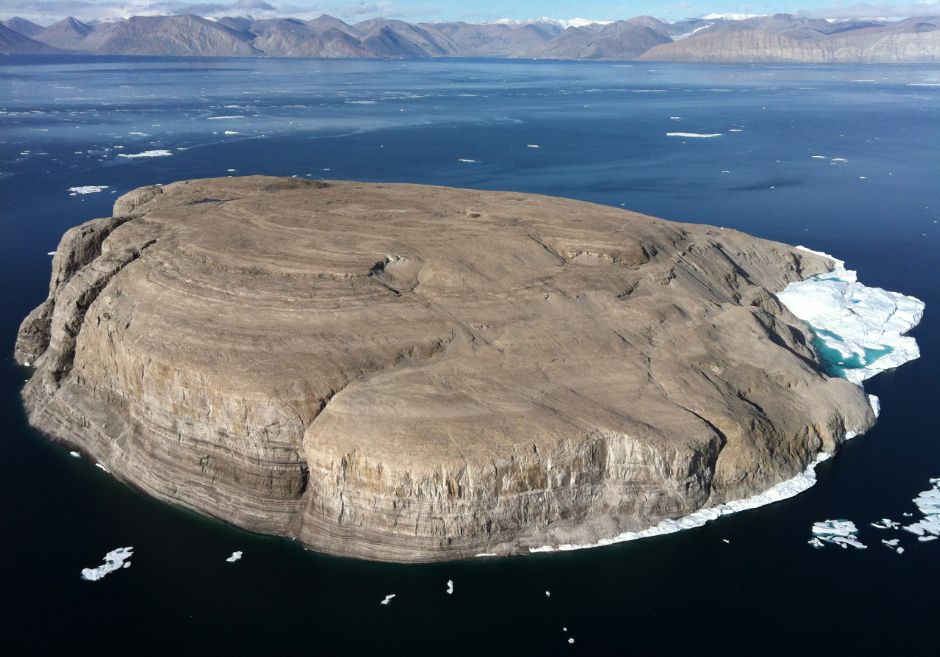
Hans Island, known as Tartupaluk in Greenlandic and Hans Ø in Danish, is a small, uninhabited landmass situated almost exactly midway in the Kennedy Channel of the Nares Strait. The island lies roughly 18 kilometres from both Canada's Ellesmere Island and Greenland. With an area of approximately 1.3 square kilometres, the island is barren and devoid of any permanent structures or population. Historically, the island was used by indigenous Inuit populations in the area during the 19th century. The core of the dispute stemmed from its location directly on what would be the maritime boundary between Canadian and Danish waters, making its sovereignty a technically unresolved question. The Canadian claim originated from the 1880 transfer of Hudson's Bay Company lands to the Canadian government, while Denmark argued the island was vital to indigenous Greenlandic populations for fishing. The island is composed of granite.
Origins and the 1973 Agreement
The legal origins of the Whisky War date back to December 17, 1973, when Canada and Denmark signed an agreement to delimit the continental shelf between Greenland and the Canadian Arctic Islands. This maritime boundary agreement established a median line through the Nares Strait, defined by a series of geodesic lines between specific latitudes for the purpose of each party's exploration and exploitation of natural resources. The agreed boundary line, however, was deliberately stopped at the low-water mark on one side of Hans Island and resumed on the other, leaving the island's terrestrial sovereignty explicitly unresolved. Article I of the agreement stated the dividing line was a median line determined and adjusted by mutual agreement. Both nations formally agreed to settle the issue of Hans Island at a later date. For decades, the matter was considered a low-priority issue, with a Canadian Special Senate Committee on the Arctic in March 2019 hearing testimony that the conflict was deemed almost insignificant by University of British Columbia professor Michael Byers. The 1973 agreement covered the area between latitude 61°00′N and 75°00′N.
The "War" of Flags and Spirits
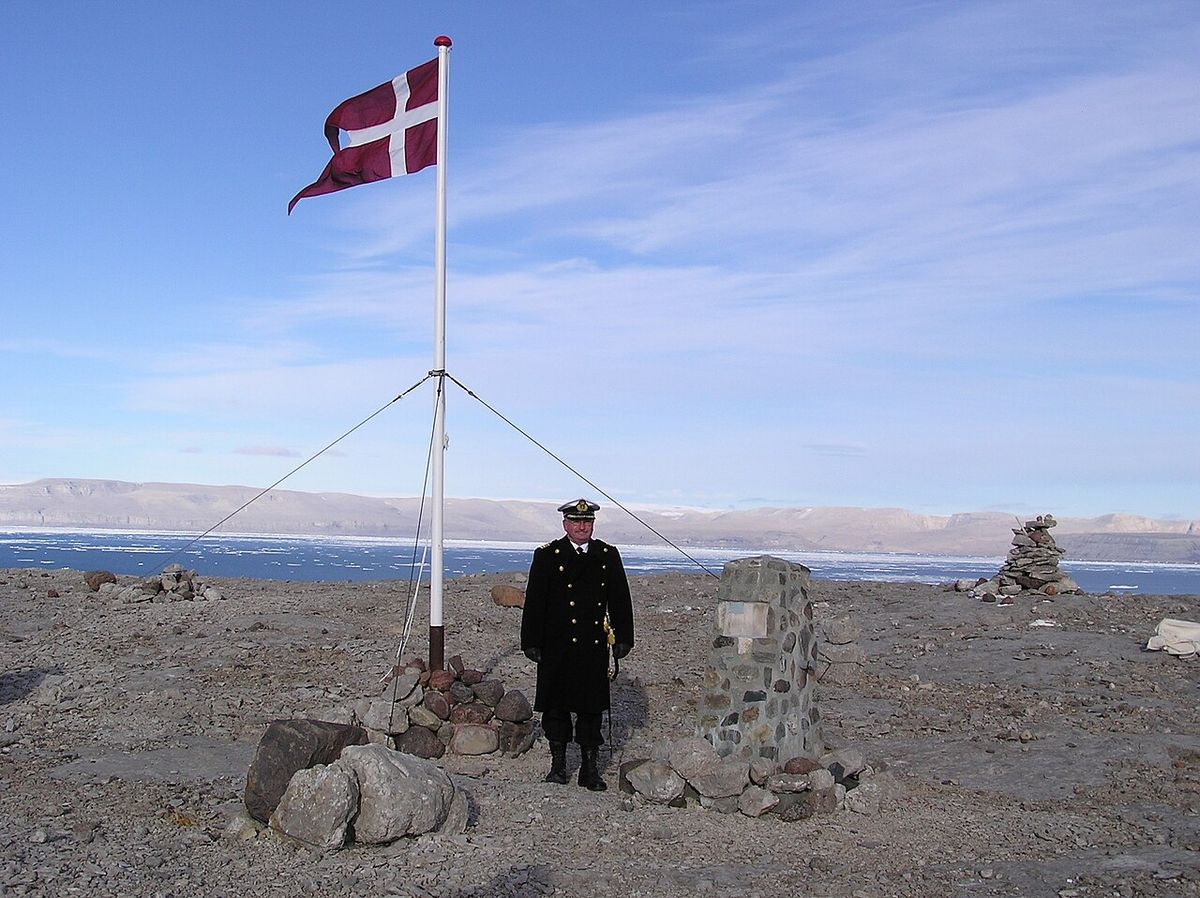
The conflict earned its whimsical name from a series of friendly, symbolic acts that began in 1984. In that year, Canadian soldiers visited the island, planted a Canadian flag, and left behind a bottle of Canadian whisky. Later the same year, Tom Høyem, the Danish Minister for Greenland, chartered a helicopter to the island, replaced the Canadian flag with a Danish one, left a bottle of schnapps, and deposited a note reading Welcome to the Danish Island. This initiated a decades-long ritual where both nations would periodically send officials, scientists, or naval vessels to the island to replace the other's flag and leave a bottle of their national liquor. The two nations are founding members of NATO and on friendly terms, which contributed to the light-hearted prosecution of the conflict. In 2005, a Canadian man and an unknown source on the Danish side also posted advertisements on Google to promote their respective claims, adding a modern, digital twist to the rivalry.
- 1980 to 1983: Canadian firm Dome Petroleum conducted research on and around the island.
- 1984: Canadian soldiers plant flag and leave whisky. Danish Minister Tom Høyem responds with flag and schnapps.
- 1988: Danish Arctic Ocean patrol cutter HDMS Tulugaq arrives, builds a cairn and erects a flagpole and Danish flag.
- 1995: Danish liaison officers and geodesists place another flagpole and flag.
- Late August 1997: Danish patrol cutter HDMS Agpa is forced to turn back 241 km from the island due to extreme ice.
- 2001: Geologists Keith Dewing and Chris Harrison of the Geological Survey of Canada map northern Ellesmere Island and fly by helicopter to Hans Island.
- August 13, 2002: Danish inspection ship HDMS Vædderen erects a new cairn and flag, finding the 1988 flag missing and the 1995 flag in pieces.
- August 1, 2003: Crew of the Danish frigate HDMS Triton lands and replaces the Danish flag.
- July 13, 2005: Canadian soldiers place a traditional Inuit stone marker (Inukshuk), a plaque, and a Canadian flag.
- July 20, 2005: Canadian Defence Minister Bill Graham visits the island symbolically.
- July 25, 2005: Denmark announces a letter of protest. Greenland's Deputy Premier Josef Motzfeldt states the island has been occupied by Canada.
- August 4, 2005: Denmark dispatches HDMS Tulugaq to assert sovereignty but instructs crew not to remove the Canadian flag.
Diplomatic Escalation and the 2005 Process
The year 2005 marked a significant escalation in diplomatic activity surrounding Hans Island, moving beyond symbolic flag placements. On July 28, the Danish Ambassador to Canada published an article in the Ottawa Citizen outlining the Danish position. By August 8, Danish newspapers reported Canada wished to open negotiations, a move welcomed by Danish Prime Minister Anders Fogh Rasmussen who stated it was time to stop the flag war and that countries like Denmark and Canada must be able to find a peaceful solution. On August 16, Danish Foreign Minister Per Stig Møller announced that Denmark and Canada had agreed to reopen negotiations, with geological surveys to begin immediately and a meeting scheduled with his Canadian counterpart Pierre Pettigrew in New York City in September. Both governments agreed that if they failed to reach an agreement, they would submit the dispute to the International Court of Justice in The Hague, with the government of Greenland approving this course. Pettigrew stated on August 20 that Canada's claim had a firm basis in international law and would likely not end up before a world court, asserting that Canadian sovereignty over the island had a very strong foundation. The crucial meeting occurred on September 19, 2005, where Pettigrew and Møller agreed on a process to resolve the dispute, committing to work together to put this issue behind us, though Pettigrew reiterated Canada's sovereignty claim.
Scientific Cooperation and Renewed Negotiations
Following the 2005 agreement on a process, the subsequent years featured increased scientific and survey cooperation on and around Hans Island, even as sovereignty remained unresolved. In August 2006, a Vancouver geologist received a prospecting permit for Hans Island from the Canadian government. Scientists from the University of Toronto and the Technical University of Denmark announced plans in March 2007 to install an automated weather station on the island that summer. By July 2007, Canada had updated satellite photos and recognized that the line constructed for the 1973 maritime agreement would have run roughly through the middle of the island, prompting continued negotiations over establishing an international land boundary. In May 2008, an international group of scientists from Australia, Canada, Denmark, and the UK successfully installed an automated weather station on Hans Island. A proposal to split the island was reported on April 11, 2012. On November 29, 2012, Canada and Denmark settled an agreement on the exact maritime border between them, though still without defining the border near Hans Island. The final push began on May 23, 2018, when Canada and Denmark announced a joint task force specifically tasked with settling the dispute over Hans Island, reflecting the growing importance of resolving Arctic sovereignty issues.
- August 16, 2006: A Vancouver geologist receives a prospecting permit from Canada.
- March 17, 2007: Scientists announce plans to install an automated weather station.
- May 4, 2008: An international group installs an automated weather station on the island.
- April 11, 2012: Proposal for Canada and Denmark to split Hans Island.
- November 29, 2012: Canada and Denmark settle an agreement on the exact maritime border, excluding Hans Island.
- May 23, 2018: Canada and Denmark announce a joint task force to settle the dispute.
- February 2019: Canadian geologist John Robins is granted a mineral exploration claim by the Canadian government.
- September 12, 2019: The Government of Greenland approves a temporary closure of Hans Island for mineral exploration permits, leading to the suspension of Robins's claim and the rejection of a Danish applicant's permit.
The 2022 Agreement and Division
The agreement ending the Whisky War was finalized and reported by The Globe and Mail on June 10, 2022, and officially unveiled on June 14, 2022. Canada and Denmark agreed to divide Hans Island roughly along its natural ridge line from north to south. Reports indicated the division allotted approximately 60 percent of the island's area to Denmark for Greenland and 40 percent to Canada, creating a land border on the island approximately 1.2 kilometres long. This marked the first terrestrial boundary between Canada and the Kingdom of Denmark, meaning Canada no longer bordered only the United States and Denmark no longer bordered only Germany. The settlement was formally signed in Ottawa, where Canadian Foreign Minister Mélanie Joly and Danish Foreign Minister Jeppe Kofod exchanged bottles of whisky in a nod to the conflict's history. Minister Joly stated the resolution showed it was possible to settle a disagreement through principles and norms that both parties recognize, while Minister Kofod emphasized resolving disputes by the force of law, not the law of force. The timing of the resolution during the Russian invasion of Ukraine was explicitly meant to create a symbolic example to other nations, implying that land disputes can be resolved peacefully, and was reported as evidence of the possibility of diplomatic approaches during a major conflict.
Ratification and Final Steps
For the agreement to take full effect, it required ratification by both nations' legislative bodies. In Denmark, a proposal to consent to ratifying the treaty was introduced in the Folketing on October 5, 2023. The Danish parliament formally approved the ratification on December 19, 2023, thereby finalizing the agreement from Denmark's perspective and legally ending the dispute. The resolution had several immediate consequences beyond establishing the new border, including providing clarity for any future resource or scientific activity on the island and removing a minor but persistent diplomatic item from the bilateral agenda. The agreement also led to the suspension of mineral exploration claims that had been granted during the dispute, as both parties moved to manage the island cooperatively under the new border regime. The peaceful resolution showed the friendly relations between the two NATO allies and demonstrated a commitment to resolving differences through established diplomatic and legal channels.
Strategic Context and Lasting Significance
While Hans Island itself held little intrinsic economic value, its resolution carried substantial strategic and symbolic weight within the broader context of Arctic geopolitics. The dispute occurred against a backdrop of increasing scientific and commercial interest in the Arctic region from the 1970s onward, particularly around the strategic Northwest Passage, a shorter sea route connecting the Atlantic and Pacific Oceans. As climate change accelerated and Arctic ice began to melt in the 21st century, interest in territorial claims and resource access surged among Arctic-bordering nations. Settling the Hans Island border preemptively removed any potential for future escalation or misunderstanding in a region growing in strategic importance for shipping and resource extraction. The manner of the resolution became its most celebrated aspect, transforming a potential point of friction into a demonstration of diplomatic goodwill. The final agreement was explicitly held up by both governments as a model of peaceful conflict resolution based on international law. The island's division also set a precedent for resolving other Arctic maritime boundaries, such as the Lincoln Sea boundary agreed upon in 2012.
Key Figures and Public Perception
The Whisky War involved several politicians, officials, and scientists who played defining roles in either perpetuating its friendly rituals or steering it toward resolution. On the Danish side, Tom Høyem, the Minister for Greenland, personally inaugurated the flag-and-spirits exchange with his 1984 visit. Later, Foreign Minister Per Stig Møller was instrumental in the 2005 agreement to seek a resolution, and Foreign Minister Jeppe Kofod signed the final 2022 treaty. For Canada, Defence Minister Bill Graham's 2005 visit was a notable symbolic assertion, while Foreign Affairs Minister Pierre Pettigrew negotiated the initial process with Denmark and Foreign Minister Mélanie Joly finalized the deal in 2022. Other individuals included Greenland's Deputy Premier Josef Motzfeldt, who commented on the occupation in 2005, and geologists from both countries whose scientific work on the island provided a neutral basis for cooperation. Public and media perception of the dispute was consistently light-hearted, with the conflict generating humorous headlines and being referenced in popular culture. The story of the bloodless war and its peaceful end continues to be cited as an instructive example of effective diplomacy, a narrative reinforced by its coverage in international media like the BBC World Service's Witness History program. The dispute has been compared to other humorous historical conflicts like the Pastry War and the War of the Bucket.
Questions about Whisky War
What was the Whisky War?
The Whisky War was a friendly, decades-long territorial dispute between Canada and Denmark over Hans Island, a small uninhabited rock in the Arctic. From 1973 to 2022, both nations claimed sovereignty but never engaged in military conflict. Instead, they periodically visited the island to replace each other's national flags and leave behind bottles of Canadian whisky or Danish schnapps, leading to the conflict's humorous nickname. The dispute was finally resolved by dividing the island, creating a new land border between Nunavut and Greenland.
How was the Whisky War resolved?
The dispute was resolved through diplomatic negotiation culminating in an agreement signed on June 14, 2022. Canada and Denmark agreed to divide Hans Island along its natural ridge, creating a land border. The island was split roughly 60-40 between Denmark for Greenland and Canada. The agreement was ratified by the Danish parliament on December 19, 2023, formally ending the dispute and establishing the first land border between the two nations. The foreign ministers marked the occasion by exchanging bottles of whisky, echoing the conflict's symbolic beginnings.
Why did it take so long to resolve?
The dispute was considered a very low-priority issue for both nations for many years, as the island itself had little immediate economic or strategic value. The conflict was conducted in a friendly, humorous manner, reducing the urgency for a settlement. It was only with increased focus on Arctic sovereignty and security in the 21st century, and a desire to set a diplomatic example during the 2022 Ukraine crisis, that both countries committed to a final resolution through a joint task force established in 2018. The 1973 agreement had explicitly deferred the issue, allowing it to remain unresolved for decades.
Did the resolution create a new border for Canada?
Yes, the resolution created Canada's first land border with a country other than the United States. The agreement established a terrestrial boundary on Hans Island between Canadian territory Nunavut and the Danish autonomous territory of Greenland. Similarly, it gave Denmark a second land border, as its only previous land border was with Germany. This geographical novelty was a direct result of the unique division of the island, which transformed a point of dispute into a point of connection.
Where is Hans Island located?
Hans Island is located in the middle of the Kennedy Channel between Greenland and Ellesmere Island. It is situated roughly 18 kilometres from both the Canadian and Greenlandic coastlines. The island is approximately 1.3 square kilometres in size and is barren and uninhabited. Its position meant the maritime boundary line from a 1973 agreement fell almost directly down its middle. This geographical location is why it became the focal point of a long standing border dispute between Canada and Denmark.
What was the significance of the timing of the 2022 agreement?
The agreement to divide Hans Island was settled in June 2022 during the Russian invasion of Ukraine. Canadian and Danish officials intended the peaceful resolution to create a symbolic example to other nations. It was meant to imply that land disputes can be resolved peacefully through diplomacy and international law. The timing provided a deliberate contrast to the use of force seen in Ukraine. This resolution demonstrated a commitment to principled conflict resolution between friendly NATO allies.
Sources and further reading
- Whisky War (Wikipedia)
- The Whiskey War between Canada and Denmark (unric.org)
- This Is Canada: The Whisky War, Canadian History Ehx (podcasts.apple.com)
- Operation Whisky: A Festive Fallout Fundraiser (diefenbunker.ca)
- The Whisky War: Denmark v Canada, Witness History (bbc.com)
Checked by the Nosy Mag desk. Last updated 2026-10-20.