McDonnell Douglas CF-18 Hornet
The McDonnell Douglas CF-18 Hornet, officially designated CF-188, is the primary multi role fighter aircraft of the Royal Canadian Air Force (RCAF). Selected in 1980 as the winner of the New Fighter Aircraft Project, the CF-18 replaced the CF 104 Starfighter, CF 101 Voodoo, and CF 116 Freedom Fighter fleets. Deliveries began in 1982, and the aircraft has since served a central role in Canadian air defence, conducting NORAD air sovereignty patrols and participating in combat operations from the Gulf War to the campaign against ISIL. Ongoing upgrade programs, including the Hornet Extension Project, are extending the fleet's service life as Canada proceeds with a long running procurement process to replace the CF 18 with the Lockheed Martin F 35 Lightning II.
Selection and Acquisition
In 1977, the Canadian government launched the New Fighter Aircraft (NFA) competition to replace its ageing fleets of CF 104 Starfighters, CF 101 Voodoos, and CF 116 Freedom Fighters. The competition had a purchase budget of approximately C$2.4 billion for 130 to 150 aircraft. Initial candidates included the Grumman F 14 Tomcat, McDonnell Douglas F 15 Eagle, Panavia Tornado, Dassault Mirage F1, General Dynamics F 16 Fighting Falcon, and the F/A 18 Hornet. By 1978, the shortlist was narrowed to the F 16 and two F 18 offerings, the standard naval version and a land based F 18L model proposed by Northrop. The F 14, F 15, and Tornado were rejected primarily due to high cost, while Dassault withdrew from the competition. The F 18L offered superior performance but was an unbuilt prototype, and its industrial benefits were contingent on other orders that did not materialize.
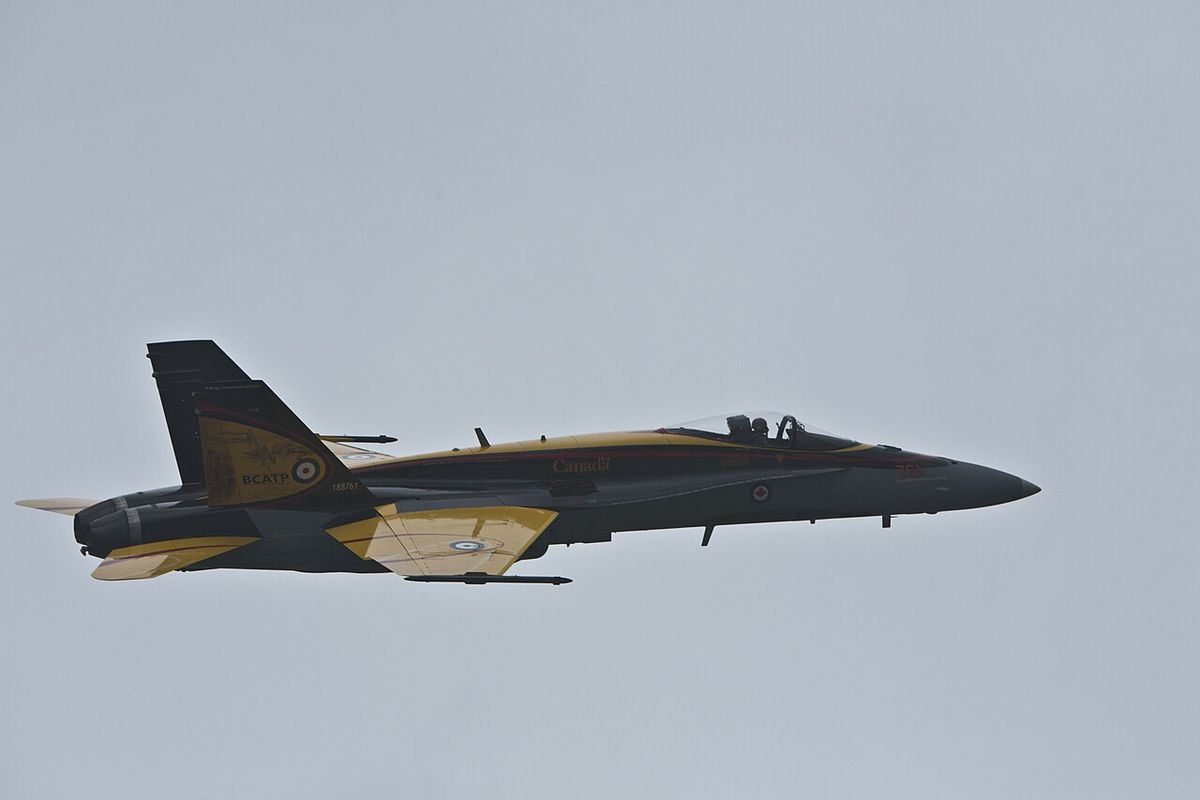
In April 1980, the McDonnell Douglas F/A 18 Hornet was declared the winner. Canada ordered 138 aircraft, comprising 98 single seat A models and 40 dual seat B models, with an option for 20 more that was never exercised. The aircraft was given the Canadian military designation CF 188, though it is commonly called the CF 18 Hornet. Key reasons for its selection included its twin engine reliability for over water and Arctic patrols, its advanced radar, and its affordability compared to the larger F 14 and F 15. The total capital cost for the procurement, which lasted from 1982 to 1988, was $4 billion in 1982 dollars. The CF 18s retained many features from the U.S. Navy version, including strong landing gear, an arrestor hook, and wing folding mechanisms. Visible Canadian specific modifications included a powerful 0.6 megacandela night identification light on the port side and a painted false canopy on the aircraft's underside.
Major Upgrade Programs
Following operational lessons from the Gulf War and Kosovo conflict, which highlighted obsolescent avionics, the Canadian government initiated a major modernization effort. The Incremental Modernization Project (IMP), launched in 2001, was executed in two phases over eight years to upgrade 80 selected CF 18s to a standard similar to the U.S. Navy's later F/A 18C and D models. Phase I, contracted to Boeing and L 3 Communications, began in 2002 and was completed in August 2006. It involved comprehensive upgrades to the aircraft's core systems, including a new AN/APG 73 radar, modern identification friend or foe transponder, new radios, mission computers, and a stores management system for precision weapons. The first upgraded Phase I aircraft was delivered in May 2003.
Phase II of the IMP was awarded to Boeing in February 2005 and focused on enhancing network centric warfare capabilities with additions like the Link 16 data link and the Joint Helmet Mounted Cueing System. The first Phase II CF 18 was delivered in August 2007, and the final upgraded aircraft from the IMP was delivered in March 2010. The total cost for the IMP and concurrent Hornet upgrades was approximately C$2.6 billion. To further extend the fleet's life, the Hornet Extension Project (HEP) was launched. Phase I, applying to the entire fleet of 94 aircraft, started in 2020 and included upgrades like Automatic Dependent Surveillance Broadcast (ADS B) transponders and new radios to maintain interoperability with NATO and civil aviation standards until 2032.
Phase II of the HEP is focused on 36 airframes with the longest projected service life, receiving significant combat capability enhancements. This phase includes the integration of 38 new CA/APG 79(V)4 Active Electronically Scanned Array (AESA) radars and 50 AIM 9X Block II Sidewinder missiles. Initial delivery of HEP Phase II aircraft occurred in 2023, with Full Operational Capability expected by June 2025. The U.S. Congressional Budget Office estimated the cost of the HEP Phase II package at US$862.3 million. As of February 2025, the RCAF has officially begun equipping the AIM 9X Block II missile on its HEP Phase II upgraded CF 18s.
Key IMP and HEP Upgrades
The modernization of the CF 18 fleet was conducted through the Incremental Modernization Project (IMP) and the Hornet Extension Program (HEP). These programs implemented a wide array of specific technological enhancements to the aircraft. Major system improvements included new radars, mission computers, and communication systems. The total cost of the entire CF-18 Incremental Modernization Project and concurrent Hornet upgrades was approximately C$2.6 billion.
- Radar: AN/APG-65 replaced by AN/APG-73 (IMP I), later upgraded to CA/APG-79(V)4 AESA radar for 36 aircraft (HEP II).
- Communications: New AN/ARC-210 radios (IMP I), upgraded to AN/ARC-210 RT-2036 (Gen 6) and Airborne Joint Tactical Radios (HEP I).
- Weapons Integration: Stores Management System upgraded for precision guided munitions and AIM-120 AMRAAM (IMP I). Integration of AIM-120D and AIM-9X Block II missiles (HEP).
- Navigation: Addition of Global Positioning System/Inertial Navigation System (IMP I). New Honeywell GPS/INS systems (HEP I).
- Cockpit: Cathode-ray tubes replaced with full colour LCD displays. Addition of Joint Helmet Mounted Cueing System (IMP II).
- Data Links: Addition of Link 16 data net system (IMP II) and Multifunctional Information Distribution System Joint Tactical Radio System.
- Identification: AN/APX-111 Combined Interrogator and Transponder (IFF) added to meet NATO standards (IMP I).
- Support Systems: Upgrades to the Advanced Distributed Combat Training System for networked simulation (IMP & HEP).
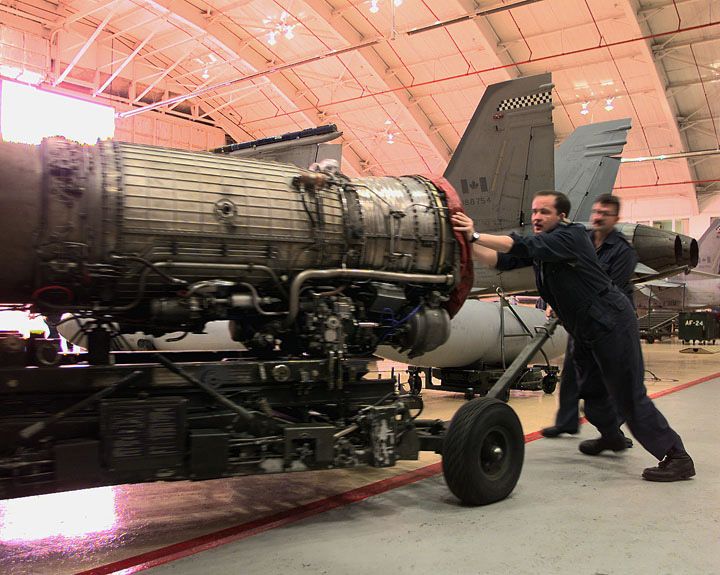
In March 2024, Arcfield Canada was awarded a CA$211.6 million sustainment contract effective 1 April 2024 to support the CF 18's avionics weapons systems and supply chain. These cumulative investments have been essential for extending the operational life of the CF 18 fleet as Canada transitions to a future fighter. The total program cost for the CF 18 purchase and upgrades up to 2011 was approximately $11.5 billion, with maintenance costs averaging about $250 million per year over a 20 year period. Additional concurrent upgrades during the IMP era included a landing gear corrosion program, new infrared sensor pods, and night vision imaging systems.
Operational Deployments and Combat History
The CF 18 entered service with 410 Squadron at CFB Cold Lake, Alberta, on 25 October 1982. It quickly assumed roles with squadrons based in Canada and at CFB Baden Soellingen in West Germany, fulfilling both NORAD interception and NATO commitments. The aircraft's first major combat deployment came during the Gulf War in 1991 under Operation Friction. Canada committed 26 CF 18s based in Doha, Qatar, which flew over 5,700 hours. These missions included 2,700 combat air patrols and, during the ground invasion, 56 bombing sorties dropping unguided bombs on Iraqi targets, as the aircraft were not yet equipped with precision guided munitions.
CF 18s were deployed twice to the Balkans, first in 1997 for Operation Mirador over Bosnia and Herzegovina, and again from 1998 to 2000 for Operation Echo. Their most intensive combat deployment in the region was during the Kosovo War in 1999. Eighteen CF 18s based in Aviano, Italy, flew 678 combat sorties, conducting 10 percent of NATO strike missions. They dropped 397 precision guided munitions and 171 unguided bombs on targets including airfields and surface to air missile sites. In the post 9/11 era, CF 18s have responded to thousands of potential threats to North American airspace under NORAD. They have also been deployed for domestic security during major events like the 2002 G8 summit in Alberta and the 2010 Winter Olympics in Vancouver.
In 2011, six CF 18s were deployed to Sicily as part of Operation Mobile, enforcing the UN mandated no fly zone over Libya. They conducted 946 sorties, dropping 696 bombs including Laser guided Paveway II and Joint Direct Attack Munitions. From 2014 to 2016, six CF 18s participated in Operation Impact, conducting air strikes against ISIL targets in Iraq and Syria. These deployments demonstrated the aircraft's versatility and the RCAF's ability to contribute significantly to international coalitions. Since 2001, CF 18s have responded to nearly 3,000 possible threats to Canada and the United States as part of their NORAD duties, and they were also deployed to Alaska in 2007 to help defend U.S. airspace when the USAF's F 15 fleet was grounded.
The CF-18 Replacement Process
The process to replace the CF 18 has been protracted, beginning when Canada joined the Joint Strike Fighter program as a partner in 1997. In July 2010, the government announced its intent to purchase 65 F 35 Lightning II aircraft, with an initial contract estimate of C$9 billion and deliveries projected to start in 2016. Media reports and audits later suggested lifetime program costs could be significantly higher, leading to political controversy and a re evaluation of the procurement. Other aircraft considered as potential replacements have included the Eurofighter Typhoon, Saab JAS 39 Gripen, Dassault Rafale, and the Boeing F/A 18E/F Super Hornet, with Boeing indicating the Super Hornet could be a less expensive alternative.
The replacement project has been characterized by delays and policy shifts. The need to keep the CF 18 fleet operational has directly driven the Hornet Extension Project, designed to maintain capability until a new fighter is fully operational. According to recent reports, if negotiations for the F 35 succeed, deliveries could begin in 2026, with final delivery expected in 2032. The Royal Canadian Air Force anticipates the next generation fighter, referred to as the CF 35A, will reach full operational capability in the early 2030s. This timeline shows the critical role of the HEP upgrades in bridging a capability gap that has stretched for decades since the first replacement studies began. One manufacturer in the earlier competition had promised to assemble the entire replacement aircraft in Canada, though its name was not disclosed.
Fleet Status and Public Role
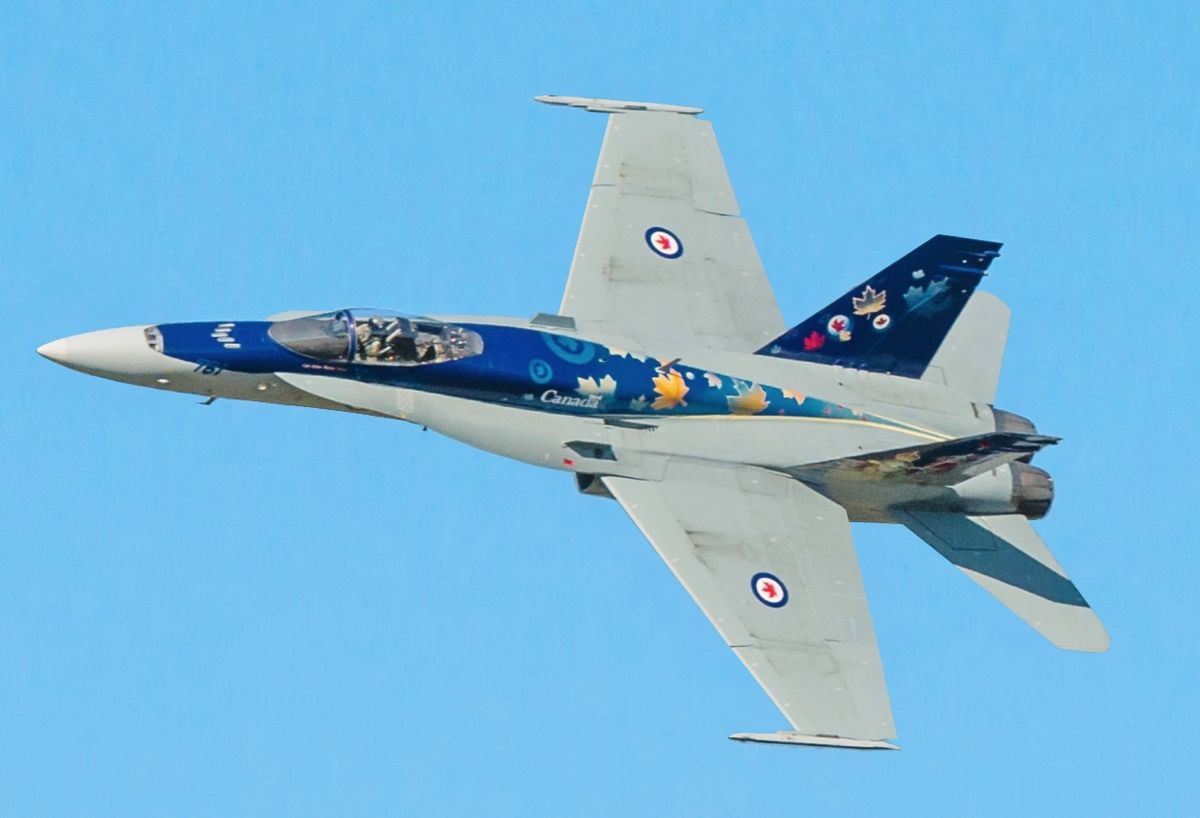
As of early 2025, the Royal Canadian Air Force continues to operate and upgrade its CF 18 fleet. The Hornet Extension Project achieved Initial Operational Capability with the delivery of the first six HEP2 upgraded aircraft to 3 Wing Bagotville. A total of 84 aircraft are slated to receive HEP1 interoperability upgrades, with 36 of those also receiving the HEP2 combat capability enhancements. Full Operational Capability for the upgraded fleet is expected in spring 2026. The aircraft remains a familiar sight at air shows across Canada, such as the Canadian International Air Show in Toronto and the Abbotsford Airshow, where the CF 18 Demonstration Team performs tactical displays noted for speed and manoeuvrability.
The first CF 188 delivered to Canada, a dual seat B model manufactured in July 1982, is now preserved at the Canada Aviation and Space Museum in Ottawa. It was transferred to the museum in 2001 after its maintenance became prohibitively expensive, requiring a mobile arrestor gear for a safe landing at the museum's short runway. This aircraft serves as a historical artifact representing the beginning of the CF 18's long service career. The ongoing public demonstrations and museum presence highlight the aircraft's prominent status in Canadian military aviation, even as the fleet approaches the end of its operational life after more than four decades of service. The RCAF has worked with the U.S. Navy's F/A 18 program office for nearly 45 years to facilitate these upgrades and sustainment efforts.
Questions about McDonnell Douglas CF-18 Hornet
What is the difference between a CF-18 and a regular F/A-18?
The CF-18 Hornet is the Canadian designation for the F/A-18A and B models purchased in the early 1980s. They are largely identical to the U.S. Navy versions, retaining features like arrestor hooks and folding wings. The most visible Canadian modifications are a 0.6 megacandela high intensity night identification light mounted on the port side gun door and a painted false canopy on the aircraft's underside to confuse adversaries in dogfights. Internally, through extensive upgrade programs, Canadian CF-18s have been modernized with systems comparable to later U.S. models.
How many CF-18 Hornets did Canada buy and how many are left?
Canada originally purchased 138 CF-18 Hornets, consisting of 98 single seat CF-188A models and 40 dual seat CF-188B models. The fleet size has been reduced over decades of service. As of 2025, the RCAF operates 89 Hornets, including 83 CF-18AM/BM standard aircraft and 6 HEP Phase II upgraded aircraft. Current upgrade programs focus on 94 aircraft for basic interoperability upgrades under the Hornet Extension Project (HEP) Phase I, with a subset of 36 airframes receiving more extensive combat capability upgrades under HEP Phase II. The RCAF plans to maintain and operate these upgraded aircraft until the future fighter fleet is fully delivered and operational.
When will Canada's CF-18s be replaced?
The process to replace the CF-18 has been ongoing since Canada joined the Joint Strike Fighter program in 1997. The selected replacement is the Lockheed Martin F-35 Lightning II. In December 2022, Canada approved $7 billion to procure a first batch of 16 F-35As. Recent reports indicate that if contract negotiations are successful, deliveries of the F-35 could begin in 2026, with final delivery expected around 2032. The Royal Canadian Air Force anticipates the new CF-35A fleet will reach full operational capability in the early 2030s. The Hornet Extension Project is explicitly designed to maintain the CF-18's capability until that transition is complete.
What combat operations have Canadian CF-18s participated in?
CF-18s have seen combat in several major conflicts. They first saw action in the 1991 Gulf War (Operation Friction), flying combat air patrol and bombing missions. They provided air support during the Kosovo War in 1999, conducting a significant portion of NATO strike sorties. In 2011, they enforced the no fly zone over Libya (Operation Mobile), dropping precision guided bombs. Most recently, from 2014 to 2016, CF-18s conducted air strikes against ISIL targets in Iraq and Syria as part of Operation Impact. They have also consistently flown NORAD air defence missions over North America.
What are the key upgrades in the Hornet Extension Project?
The Hornet Extension Project (HEP) is a two phase program. Phase I applies to most of the fleet and includes upgrades like new Automatic Dependent Surveillance Broadcast (ADS B) transponders for modern air traffic control, new GPS navigation systems, and upgraded radios to maintain interoperability. Phase II applies to 36 aircraft and focuses on enhanced combat capability, integrating new Active Electronically Scanned Array (AESA) radars and the latest AIM 9X Block II Sidewinder air to air missiles. These upgrades are intended to keep the CF 18 operationally relevant until the future fighter is fully operational.
Where are Canada's CF-18 fighter jets based?
The Royal Canadian Air Force's CF-18 fleet is primarily based at two main operating bases in Canada. 3 Wing Bagotville in Quebec is home to 425 and 433 Squadrons. 4 Wing Cold Lake in Alberta is home to 401, 409, and 410 Squadrons. The Aerospace Engineering Test Establishment is also at Cold Lake. Historically, CF-18s were also based at CFB Baden Soellingen in Germany as part of Canada's NATO commitment until the base closed in the 1990s. The aircraft deploy regularly from these home bases for exercises, NORAD patrols, and international operations.
Sources and further reading
- McDonnell Douglas CF-18 Hornet (Wikipedia)
- CF 18 Demonstration, Canadian ... (cias.org)
- Canada Receives First Six Upgraded CF-18 Fighter Aircraft (defensemirror.com)
- McDonnell Douglas CF-188B (CF-18B) - Ingenium (ingenium.ca)
Checked by the Nosy Mag desk. Last updated 2026-10-20.