Standard 52-card deck
The standard 52-card deck of French-suited playing cards is the most common pack of playing cards used worldwide today. Comprising four suits of thirteen ranks each, this versatile deck is the foundation for thousands of games, from family classics like Crazy Eights and Go Fish to complex strategy games like Bridge and Poker. Its design, featuring double-headed court cards and corner indices, has evolved over centuries to become a familiar and accessible tool for entertainment and competition. In English-speaking countries, the 52-card French-suited deck is the predominant traditional pack used for card games.
Composition and Structure
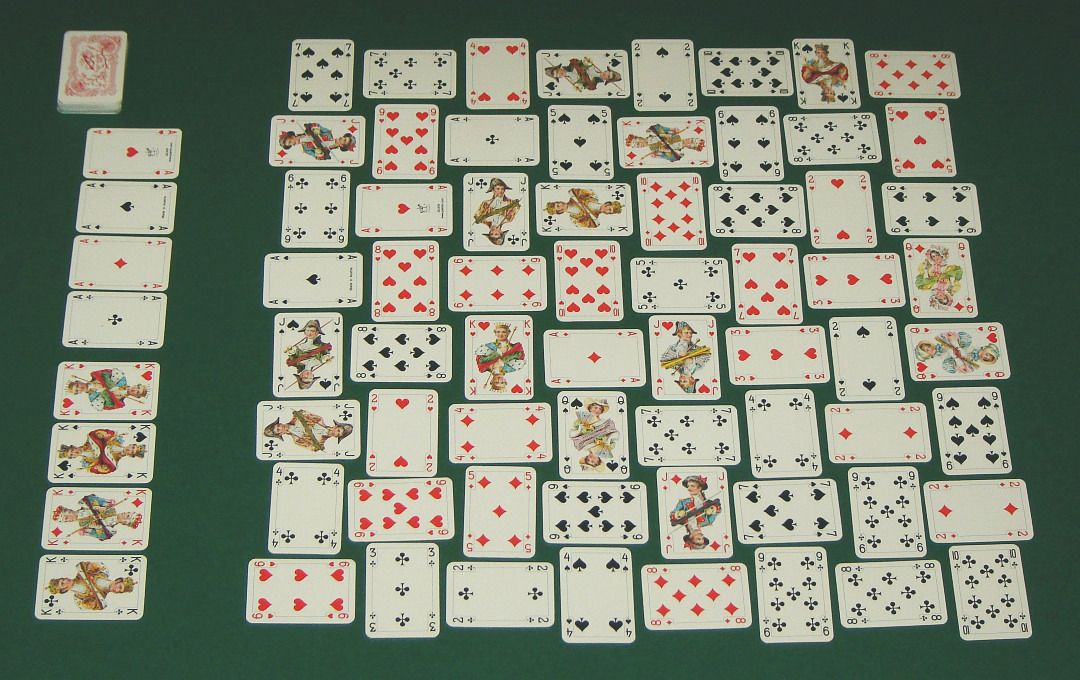
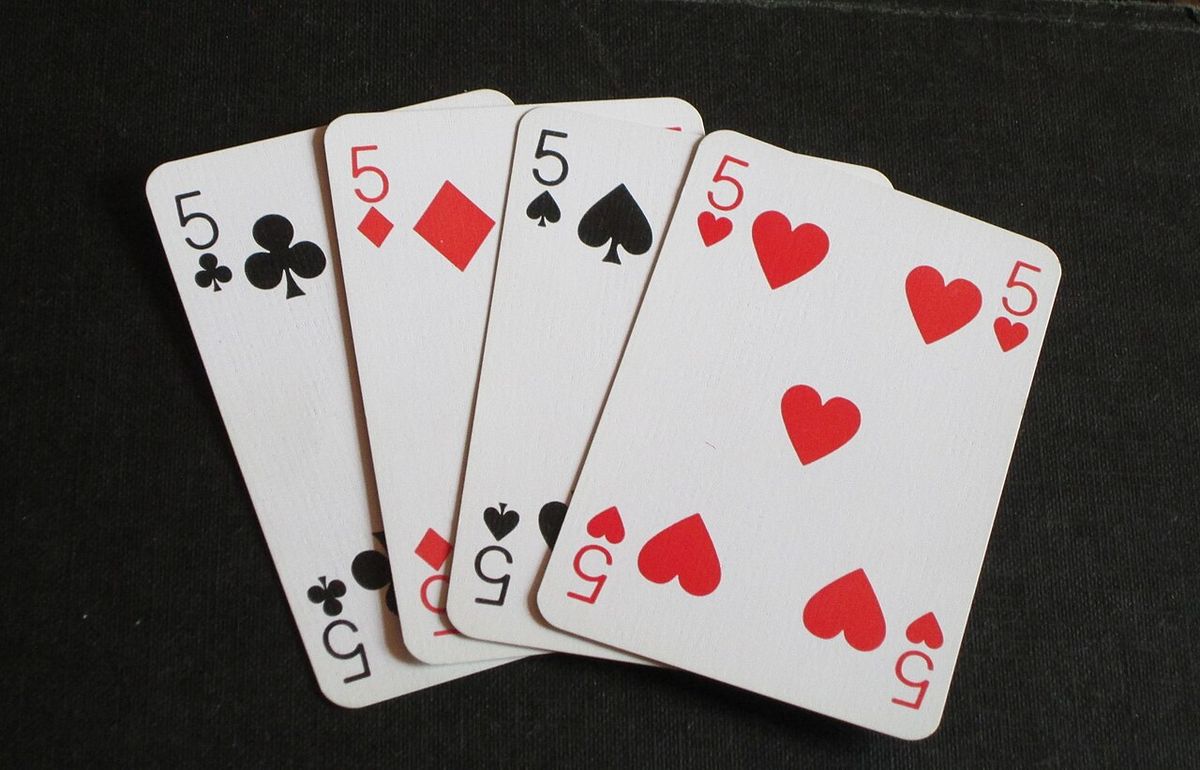
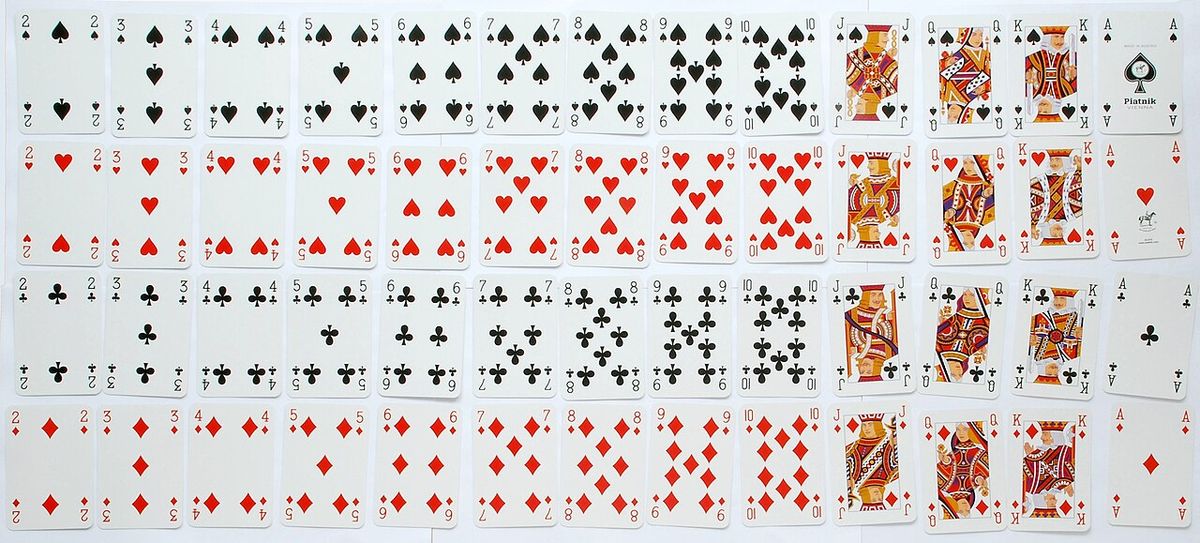
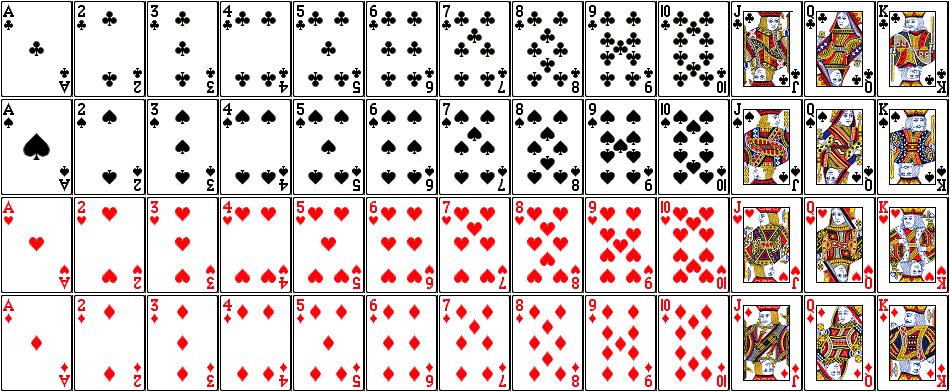
A standard 52-card deck is built on a consistent and logical structure of four suits, each containing thirteen ranks. The four suits are clubs, diamonds, hearts, and spades, with hearts and diamonds traditionally printed in red and clubs and spades in black. Within each suit, the thirteen ranks are the Ace, numbered cards two through ten, and the three court cards: Jack, Queen, and King. This arrangement yields forty numeral or pip cards, which display the corresponding number of suit symbols, and twelve court cards, which feature illustrated figures. Most modern decks also include one or two Joker cards, which are not part of the standard fifty-two but are used in specific games like Canasta or as wild cards. The number of possible arrangements when shuffling a full deck is 52 factorial, which is exactly 80,658,175,170,943,878,571,660,636,856,403,766,975,289,505,440,883,277,824,000,000,000,000 or approximately 8.0658×10^67.
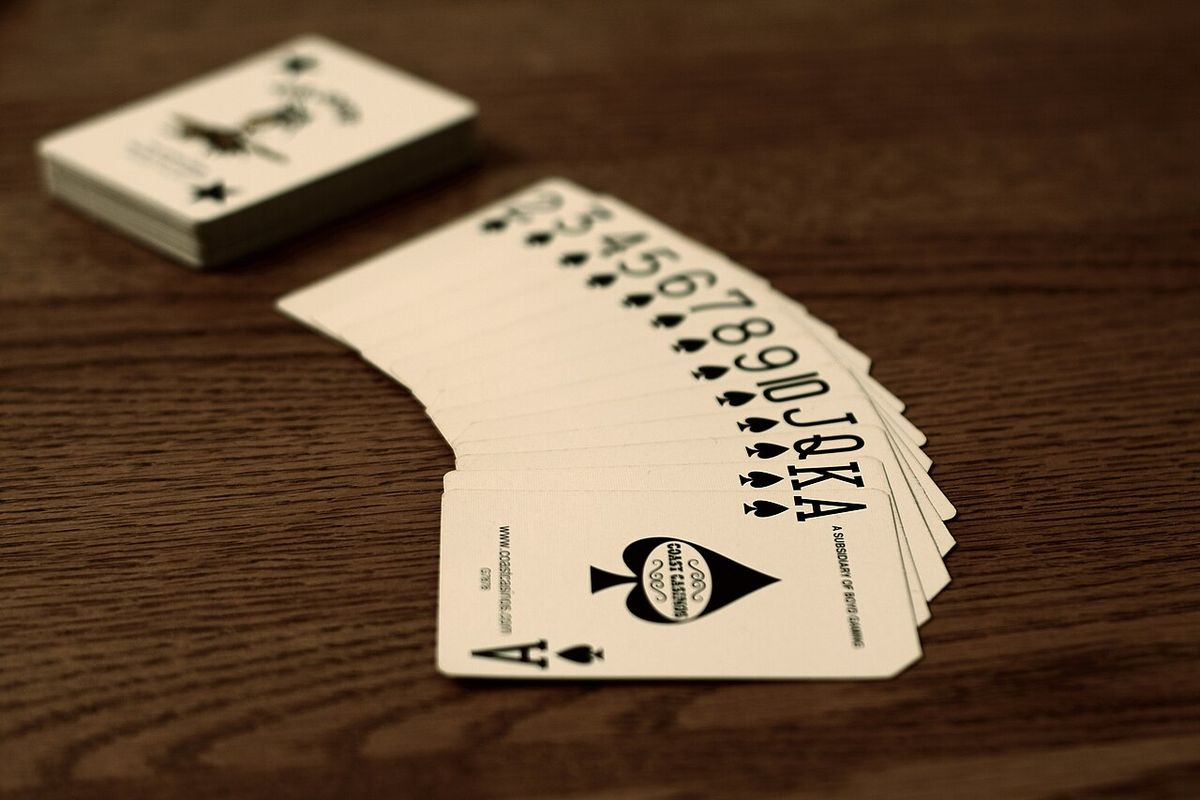
The design of the cards facilitates easy identification during play. Since the late 19th century, manufacturers have added corner indices, small letters or numbers in the corners of the card faces. In English-speaking countries, these indices are A for Ace, K for King, Q for Queen, and J for Jack. This allows players to identify a card even when it is held in a fanned hand with only the corners visible. Another critical design element is the use of double-headed court cards, introduced around 1860, which present the Jack, Queen, and King right-side-up regardless of which end of the card is up. This eliminated the inconvenience of single-headed cards, where half the players would see the court figures upside down. The backs of all cards in a deck are identical, a fundamental feature that ensures the concealment of each card's identity from opponents during gameplay.
Historical Development and Standardization
The English pattern deck, which is the most common standard today, has its origins in 16th-century Britain. The earliest English pattern cards date to around 1516. Britain only started manufacturing its own cards towards the end of the 16th century, when card production began in London. These were based on the Rouen pattern, but unlike the traditional French cards, they dropped the names on the court cards. The English pattern evolved, losing some of its Rouen flavour and elegance and becoming more stylised. A significant regulatory development occurred under King James I, who passed a law requiring an insignia on the Ace of Spades as proof of payment of a tax on card manufacture. This tradition made the Ace of Spades a uniquely ornate card, a practice that continued in the United Kingdom until the playing card tax was abolished on August 4, 1960. Until that date, decks printed and sold in the UK were liable for taxable duty and the ace of spades carried the printer's name and proof of tax payment. The packs were also sealed with a government duty wrapper.
The deck's physical characteristics also became standardized during the 19th century. Prior to this, card sizes were determined by individual printers. During the 19th century, sizes became standardised, initially to a size of 3½ by 2½ inches, now called poker-sized cards. Narrower bridge-sized cards, probably first appearing in Europe, allow players to comfortably hold a larger number of cards, as required in games like contract bridge. Modern manufacturers produce cards in a range of sizes, including miniature versions for solitaire and large-format jumbo cards for magic tricks or those with limited eyesight. Despite these variations, the 52-card composition and the English pattern imagery have become a global standard, disseminated widely during the British Empire's expansion and now used almost everywhere.
Popular Game Categories and Mechanics
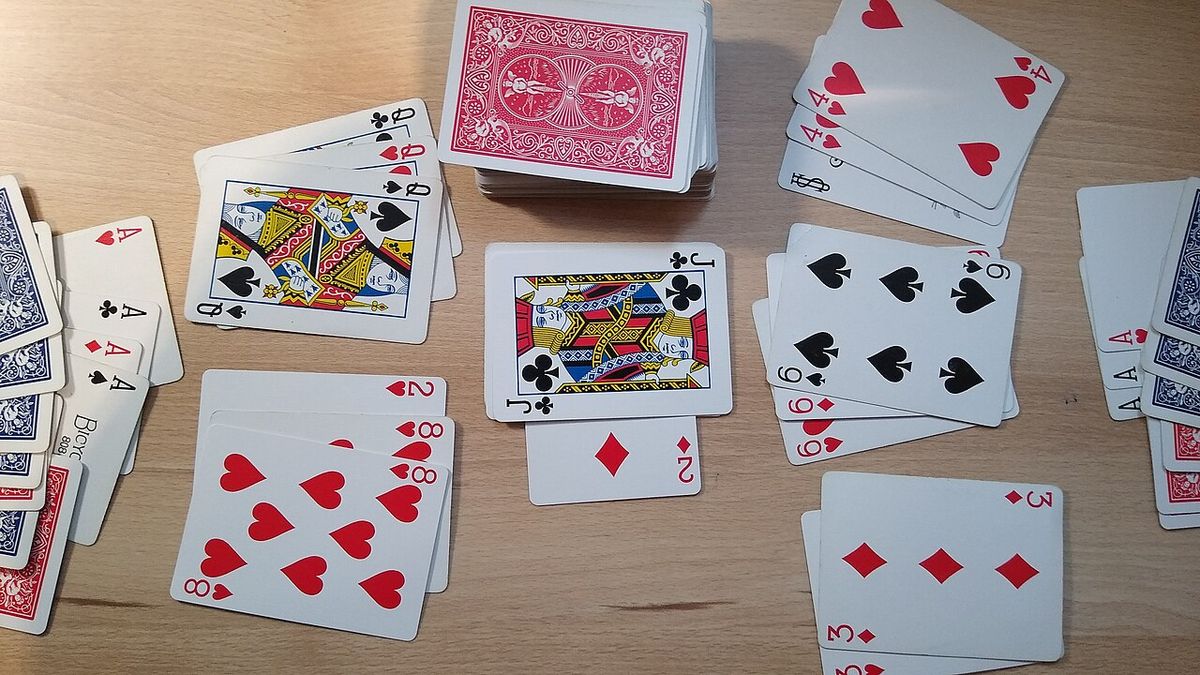
The standard deck's enduring popularity stems from its ability to support a vast array of game mechanics and player counts. Games can be broadly categorized by their core rules and objectives, with many classic games falling into a few well-defined families. Trick-taking games, where players follow suit to win tricks, are a major category exemplified by Bridge, Whist, and Euchre. Shedding games, where the goal is to be the first player to discard all cards, include classics like Crazy Eights. Rummy-style games involve forming matching sets or sequences, with Gin Rummy and Canasta being prominent examples. The deck also supports a wide variety of gambling and betting games, with Poker being the most famous globally.
Beyond these families, the deck enables countless other play styles. Solitaire or patience games, designed for a single player, use the deck to create complex puzzles of sorting and sequencing. Children's games like Go Fish, Old Maid, and War provide simple, luck-based introductions to card play. The deck is also the engine for popular social and party games. These games often use simple rules to create engaging group dynamics. Modern designer card games often create specialized decks, but many demonstrate mechanics that have their roots in traditional card play. The standard deck offers exceptional versatility and value for money, providing access to thousands of games for a minimal cost.
- Blitz (Scat/Thirty-One): A casual game for 2-12 players where players draw and discard to get a hand value close to 31 in one suit.
- Cheat (I Doubt It): A bluffing game for 3-13 players where players discard cards secretly and can be challenged if suspected of lying.
- Egyptian Ratscrew: A fast-paced, physical slapping game for 2-6 players, reacting to specific card combinations.
- Fan Tan (Sevens): A game for 3-6 players where players build sequences of cards in suit from the sevens upward and downward.
- Golf: A scoring game for 2-6 players where players try to achieve the lowest point total over several hands by improving a grid of cards.
- GOPS (Game Of Pure Strategy): A two-player bidding game using the diamond suit as point cards and another suit as bidding tokens.
- Knock Out Whist: A simplified trick-taking game where players aim to win at least one trick each hand to avoid elimination.
- Mao: A game for 2-7 players with secret rules that players must deduce during play.
The Classic Game of Crazy Eights
Crazy Eights is one of the most accessible and widely played card games for families, using the standard 52-card deck to create a simple yet engaging shedding game. The primary objective for each player is to be the first to discard all the cards from their hand. The game is typically played by two to seven players, with each player being dealt an initial hand of either five or seven cards, depending on the number of participants. The remaining deck forms a draw pile, and its top card is turned face-up to begin a discard pile. If this starter card is an eight, it is buried back into the deck and the next card is turned. Gameplay proceeds clockwise from the dealer.
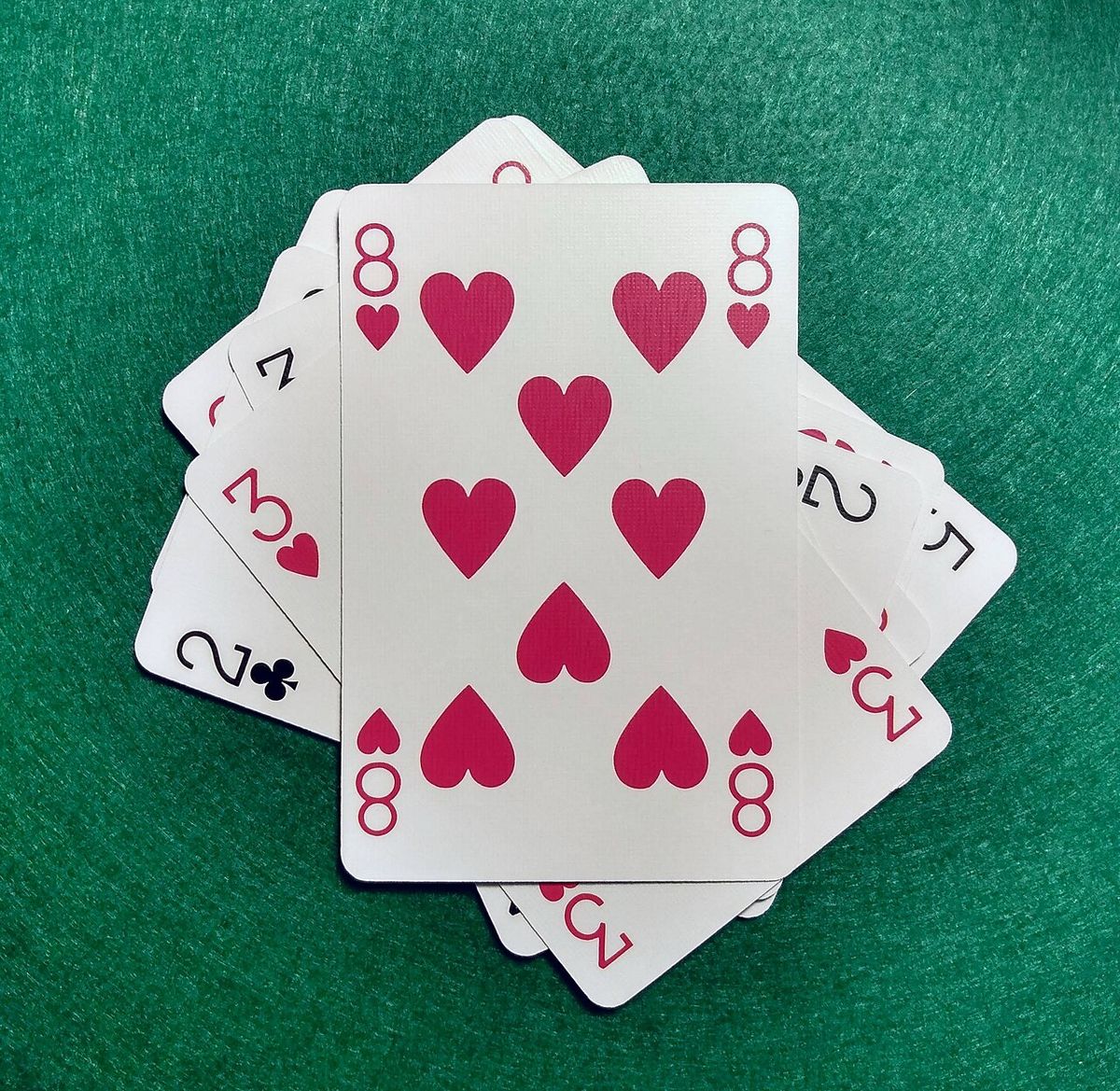
On a turn, a player must place one card from their hand onto the discard pile. This card must match the top card of the discard pile either in suit or in rank. The defining rule of the game is that all eights are wild. A player may play an eight at any time during their turn, regardless of the top card. When playing an eight, the player must declare which suit it represents for the next player, who must then follow that suit or play another eight. If a player cannot play a matching card or an eight, they must draw cards from the stock pile until they draw a playable card. If the stock is exhausted, the player must pass their turn. Scoring in Crazy Eights typically occurs after one player empties their hand.
The winner collects points from all other players based on the cards remaining in their hands. The point value is assigned to each card type held by opponents at the end of a round. The game often continues over multiple rounds until one player reaches a predetermined point total. Variations of the game abound, reflecting the game's adaptability and regional flavour. The number of cards used can vary by game, as some formats remove certain ranks from the deck before play begins.
| Card Type | Point Value |
|---|---|
| Each Eight | 50 points |
| Each King, Queen, Jack, or 10 | 10 points |
| Each Ace | 1 point |
| Each numbered card (2-9) | Face value (e.g., a 5 is 5 points) |
Design Variations and Specialized Decks
While the English pattern is dominant, several other traditional designs persist in specific regions. The Belgian-Genoese pattern, originally designed in France for export, is the second most common pattern worldwide and is used across Spain, Italy, the Balkans, North Africa, and the Middle East. Other regional patterns include the Berlin, Nordic, and Dondorf Rhineland patterns in Europe. Many countries use decks with entirely different suit systems and sizes, such as the 36-card German-suited packs common in Bavaria and Austria, or the 40- or 48-card Spanish-suited packs used on the Iberian peninsula. These traditional decks remain preferred for local games despite the global reach of the 52-card French deck. Tarot cards are required for games such as French Tarot, which uses a 78-card deck widely played in France, and the Tarock family of games played in Austria and Hungary.
Specialized versions of the standard deck have been created to suit different purposes. Four-colour decks use a distinct colour for each suit, such as green for clubs and blue for diamonds, to make suits easier to distinguish, which is particularly helpful for games like poker or for new players. Decks designed for casino use often include sophisticated markings, machine-readable barcodes on the edges, or four corner indices instead of two to allow for automated shuffling and verification. Large-print decks with oversized indices cater to players with visual impairments. For magicians and cardists, decks are produced with specific finishes, weights, and new deck order arrangements to facilitate sleight of hand and complex manipulations. The New Deck Order, often used by manufacturers, arranges cards in a specific ascending and descending sequence that is useful for many card tricks and effects.
Cultural Impact and Card Nicknames
Over centuries of use, certain cards in the English pattern have acquired colourful nicknames and cultural significance, often based on their distinctive artwork. These nicknames are woven into game slang and popular culture. The King of Hearts is frequently called the Suicide King because he is typically depicted with a sword behind his head, appearing to stab himself. The King of Diamonds, often shown with an axe, is known as the Man with the Axe. Among the Jacks, the Jack of Spades and Jack of Hearts are profiled with one eye visible, earning them the collective name One-eyed Jacks. The King of Diamonds is also profiled, making him a One-eyed Royal. The Ace of Spades holds a unique place due to its ornate design history linked to tax stamps, and it has earned nicknames like Old Frizzle and Spadille.
The Queen of Spades, often the only queen facing to the right and holding a sceptre, is sometimes called the Black Lady. In contrast, the Queen of Clubs, who commonly holds a flower, is known as the Flower Queen. These personalities on the cards contribute to the folklore of card games and are sometimes referenced in game rules, such as in variations of poker where one-eyed jacks and the man with the axe are designated as wild cards. This layer of tradition enriches the playing experience, connecting modern players to a long history of illustrated symbolism and shared cultural references. The following list details some of the most common nicknames for specific cards in the English pattern.
- One-eyed Jacks: The Jack of Spades and Jack of Hearts, depicted in profile.
- One-eyed Royals: The King of Diamonds and the one-eyed Jacks.
- Suicide Kings: The King of Hearts (sword behind head) and King of Diamonds (axe behind head).
- The Man with the Axe: The King of Diamonds.
- Old Frizzle / Spadille: The Ace of Spades.
- The Black Lady: The Queen of Spades.
- The Flower Queen: The Queen of Clubs.
Manufacturing and Physical Attributes
The production of playing cards is a precise industry, with manufacturers paying close attention to materials and processes to ensure durability and performance. Modern playing cards are most commonly made from layers of paper or plastic, or a combination of both. Paper cards are often coated with a plastic or cellulose acetate finish to provide a smooth, durable surface that resists dirt and moisture, allowing them to be easily shuffled. Plastic-coated cards are a standard for casino use due to their longevity and resistance to marking. Fully plastic cards, made from materials like PVC, offer the highest durability and are waterproof, making them ideal for outdoor use or in humid environments.
The feel and handling of a deck are influenced by its finish and cut. A linen finish, which creates a slightly textured surface, improves grip and control during shuffling and dealing. The cut of the cards, how the edges are trimmed after printing, can affect how smoothly the deck fans and shuffles. High-quality decks often undergo a process called cellophaning, where each card is individually wrapped before being boxed, to protect the finish. When purchased new, decks are often arranged in a manufacturer's New Deck Order, a predictable sequence that aids in quality control and provides a neutral starting point for consumers. This order typically starts with any Jokers, followed by the Ace to King of spades, Ace to King of diamonds, then the King to Ace of clubs, and finally the King to Ace of hearts. This specific arrangement is also valued by magicians for certain tricks and memorized stacks, and it ensures a perception of untouched freshness for the buyer.
Questions about Standard 52-card deck
How many cards are in a standard deck for poker?
A standard deck used for poker contains 52 cards. This includes four suits each with thirteen ranks from Ace to King. Most poker variants, such as Texas Hold'em and Omaha, use this full deck. Some poker games may designate certain cards as wild, but the physical deck remains the standard 52-card pack. The deck may also include one or two Jokers, but these are not used in traditional poker games.
Can you play Bingo with a deck of cards?
While traditional Bingo uses numbered balls and cards, a card game sometimes called Bingo or Lotto can be played with a standard deck. This is typically a matching game for children where players try to cover spaces on a board with cards drawn from the deck. However, the classic game of Bingo as played in halls and community centres requires specialized equipment and is not played with a standard 52-card deck. The phrase 'bingo deck of cards' more commonly refers to a specific, non-standard deck used for a different game.
What are the rules for Crazy Eights?
Crazy Eights is a shedding game where players aim to be the first to discard all their cards. Players match the top card of the discard pile by suit or rank. All eights are wild. Playing an eight allows the player to choose the suit that must be followed next. If a player cannot play, they draw cards from the stock until they can. The game ends when one player runs out of cards. The winner then scores points based on cards left in opponents' hands: 50 points for each eight, 10 points for face cards and tens, 1 point for Aces, and pip value for other cards.
Why is the King of Hearts called the 'suicide king'?
The King of Hearts in the standard English pattern deck is nicknamed the Suicide King due to his traditional illustration. He is typically depicted with a sword behind his head, with the hilt near his head and the blade extending outward. This positioning makes it appear as though he is stabbing himself in the head. This distinctive imagery inspired the macabre nickname. Similarly, the one-eyed King of Diamonds is shown with an axe behind his head.
What is the difference between poker-sized and bridge-sized cards?
Poker-sized and bridge-sized cards refer to two common physical dimensions for playing cards. Poker-sized cards are wider, typically 3½ by 2½ inches, and are often preferred for games like poker. The narrower bridge size, probably first appearing in Europe, allows players to comfortably hold and fan a larger number of cards, which is common in games like contract bridge. Both sizes use the same standard 52-card composition. Modern manufacturers produce cards in a range of sizes, including miniature and jumbo versions.
What does 'new deck order' mean?
New Deck Order is the specific sequence in which cards are arranged by the manufacturer when packaged and sold. A common NDO starts with any Jokers, followed by the Ace through King of spades, then the Ace through King of diamonds, then the King down to Ace of clubs, and finally the King down to Ace of hearts. This standardized order simplifies quality control, assures customers the deck is new and unshuffled, and is useful for magicians who perform tricks that rely on a known starting arrangement. Casino decks are an exception, as they are pre-shuffled.
Sources and further reading
- Standard 52-card deck (Wikipedia)
- The 8 Best Card Games of 2026 | Reviews by Wirecutter (nytimes.com)
- 40+ Great Card Games For All Occasions (playingcarddecks.com)
- Crazy Eights (bicyclecards.com)
- How to Play Crazy Eights (eeboo.com)
- Crazy 8's (outsetmedia.com)
- Crazy Eights | Play it online (cardgames.io)
Checked by the Nosy Mag desk. Last updated 2026-11-11.