Go Fish
Go Fish is a classic card game of matching and memory, typically played by children and families. The game is designed for two to five players and uses a standard 52-card deck, with the objective of collecting the most 'books', or sets of four cards of the same rank. Its simple rules and reliance on recall and basic strategy make it a popular introductory game for teaching card-playing skills to young Canadians. Variations and themed decks, including a Bluey version released in 2026, keep the game relevant for new generations.
Standard Rules and Gameplay
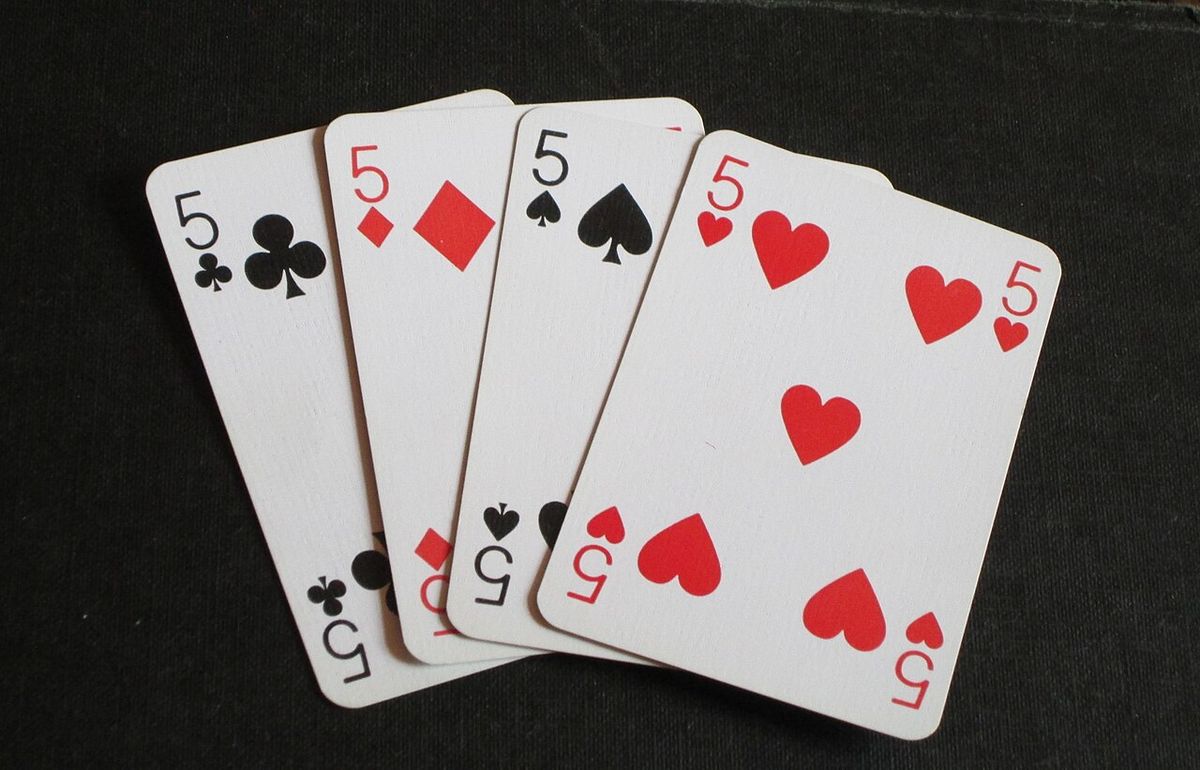
Go Fish is played with a standard 52-card deck. Suits are irrelevant for gameplay. To determine the dealer, each player draws one card from the deck, and the player with the lowest card deals. The dealer shuffles the cards and deals them clockwise, one at a time and face down. If there are two or three players, each receives seven cards. With four or five players, each receives five cards. The remaining cards are placed face down in the centre of the table to form the stock pile, often called the 'pond'. The player to the left of the dealer begins the game. On a player's turn, they ask any other specific player for all cards of a particular rank, such as 'Do you have any eights?'. The asking player must hold at least one card of the rank they are requesting. If the asked player has any cards of that rank, they must hand all of them over. The asking player's turn then continues, and they may ask the same or another player for a card, which can be the same or a different rank. If the asked player has no cards of the requested rank, they say 'Go fish' or 'Fish', and the asking player must draw the top card from the stock pile.
If the drawn card is the rank the player just asked for, this is considered a 'catch', and the player shows the card and continues their turn. If it is a different rank, their turn ends and play passes clockwise to the next player. Whenever a player collects all four cards of a rank, they form a 'book'. The player places these four cards face up on the table in front of them, and their turn continues. The game proceeds until one player runs out of cards in their hand or until all thirteen possible books have been collected. Common scoring determines the winner as the player with the most books at the game's end. Some rule variations declare the winner as the first player to run out of cards, while others continue play until all books are made, with players who run out of cards drawing from the stock on their turn. If the stock is exhausted, a player told to 'go fish' simply ends their turn, and the game continues until a player's hand is empty. Other rules specify that if two players go out simultaneously, the player with the most collected books is declared the winner.
Common Variations
Beyond the standard rules, numerous house rules and variations exist for Go Fish, altering gameplay and strategy. Some variations simplify the game for very young players, while others add complexity for more experienced groups. These modifications can change how cards are requested, how books are formed, and how the game concludes. The flexibility in rules is a key reason for the game's enduring popularity across different households and age groups. A 1940 French language syllabus proposed a similar game as a language-learning exercise, describing its rules as the same as those of Authors.
- Single Card Requests: A player asks for and receives only one specific card of a rank, rather than all cards of that rank.
- Pair Collection: Players form and lay down pairs of matching cards instead of four-card books, which shortens the game.
- Specific Card Ask: Similar to Happy Families, a player must ask for a specific card by rank and suit, and must reveal a card of that rank when asking.
- Memory Round: After the main game, a secondary round begins where the player with the most books may ask another player for a rank they remember that player has. If correct they win the pair. If incorrect, play passes to the next player.
- Joker Rules: Jokers can be included as wild cards or as a unique rank where two jokers form a pair, adding an extra element.
- Loss Condition: If one player is left with an unmatched card and the stock is empty, that player loses the game.
- Book Concealment: Books are saved by each player face down, requiring memory in the later stage of play.
- Turn Continuation: Some rules allow a player's turn to continue if the card drawn from the stock is the rank they last named, or if it completes a book.
Strategy and Skill
While often considered a game of chance, Go Fish incorporates elements of memory and basic strategy that can influence the outcome. A core strategic principle involves remembering which cards other players have asked for, as a request is a tell that the asking player holds at least one card of that rank. Effective players conceal the composition of their own hand by varying whom they ask and what they request, making it harder for opponents to deduce their holdings. When forced to 'go fish', a player should ask for the rank of the card they just drew if it is new to their hand. Otherwise, they should rotate through asking for ranks they already possess. The game operates largely on an honour system, as preventing players from lying about the cards in their hand is difficult, adding a social dimension to the gameplay. Strategic depth increases in variants where players must ask for specific cards or where a memory round is played after the initial game. In these versions, meticulously tracking which cards each player has collected and requested becomes paramount to victory. Online platforms that track statistics have shown that games among skilled players often hinge on these memory elements rather than pure luck of the draw. This blend of simple mechanics and cognitive challenge makes Go Fish a useful tool for developing memory and logical deduction skills in children.

Specialty Decks and Modern Adaptations
While traditionally played with a standard deck, Go Fish has inspired numerous specialty card packs designed for children and thematic play. Manufacturers have produced decks featuring animals, alphabets, or personalized names, where players match characteristics instead of numerical ranks. For example, the Kids Classic Go Fish Card Game by U.S. Games Systems contains 169 cards. Themed versions based on popular children's properties also exist, such as the Bluey: Go Fish Card Game released by Asmodee Canada in October 2026. These adaptations maintain the core matching mechanics while using engaging artwork and themes to attract young players. The game's structure also paved the way for the similar card game genre known as Quartets. Specialty decks often expand the possible number of matches and introduce educational elements, such as matching letters in Alphabet Go Fish or animal traits in Safari Pals packs. Commercial products like the 'Go Fish Card Game Over-Sized 36 Cards' are marketed for family play with children aged four and up.
- Kids Classic Go Fish Card Game: A 169-card deck manufactured by U.S. Games Systems.
- Safari Pals Packs: Use animal characteristics to form the matching sets.
- Personalized Name Packs: Decks which use names to form the sets for matching.
- Bluey: Go Fish Card Game: A Bluey-themed version released in October 2026 by Asmodee Canada.
- Over-Sized Card Decks: Such as the 36-card family play version for ages 4+.
- Alphabet Go Fish: Uses letters instead of numbers for educational matching.
- Quartets: A similar kind of card game inspired by Go Fish.
Playing Go Fish Online
As of 2026, Go Fish is widely available as a free online card game played in web browsers without requiring downloads or user accounts. Online platforms typically seat four players, dealing five cards to each and using a virtual 'pond' as the stock. Players can join public tables or create private games to invite friends, with the option to fill empty seats with computer-controlled bots. The online interface often includes interactive tutorials for learning the rules. Gameplay statistics from these sites indicate an average game length of about nine minutes, ending as soon as any player's hand is empty. Online play highlights the game's casual, social nature and provides a convenient way for Canadians to enjoy the classic pastime remotely. Platforms like World of Card Games update real totals from every game played, providing data on average playtime and common outcomes. To host a private game online, a player typically clicks a 'Play' button, chooses 'Host table', enables the private setting, and creates a table name. They can then invite friends via a shareable link or have friends join by entering the same private table name. If fewer than four players are available, bots can be added to each empty seat to complete the table. This online ecosystem allows for immediate play against bots for practice or for scheduled games with friends and family across distances.
| Online Feature | Typical Implementation |
|---|---|
| Players per game | 4 |
| Cards dealt per player | 5 |
| Game end condition | First player with empty hand |
| Average game length | 9 minutes |
| Access requirement | None (free, no signup) |
| Private games | Available with invite links |
| Bot opponents | Available to fill empty seats |
| Learning tools | Interactive tutorials and guides |
Related classic card games often featured on the same online sites include Old Maid, Crazy Eights, and Cribbage. The free access and social features ensure Go Fish remains a readily accessible digital pastime. The rules are consistently applied by the software, which eliminates disputes over variations and scoring. An account is only required if a player wishes to maintain long-term statistics or participate in ranked competitive play on these platforms.

Educational and Developmental Value
Go Fish is frequently recommended as a first card game for children due to its straightforward rules and its capacity to teach foundational skills. The game helps young players learn how to hold cards, take turns, follow simple instructions, and practice basic social interaction. The matching mechanic reinforces number and pattern recognition, which is beneficial for early math skills. When played with specialty alphabet decks, it directly supports letter recognition and literacy development. The requirement to remember which cards opponents have asked for exercises short-term memory and attention. For older children and adults, the strategic elements of concealing information and deducing opponents' holdings introduce basic concepts of game theory and logical deduction. The game's dependence on an honour system, where players must truthfully disclose whether they have a requested card, provides a context for discussing honesty and fair play. These combined elements make Go Fish more than mere entertainment. It is a tool for cognitive and social development that has been utilized in educational settings since at least the 1940s, as evidenced by its inclusion in a French language syllabus. The game's simplicity allows it to be adapted for various learning objectives, making it a versatile resource for parents and educators alike.
Questions about Go Fish
How many people can play Go Fish?
Go Fish is designed for two to five players. The game can be played by two players or more, up to about five or six. Five cards are dealt to each player if there are four or five players. If there are only two or three players, each receives seven cards from the standard 52-card deck.
What is the goal of Go Fish?
The goal is to collect the most 'books', which are sets of four cards of the same rank. The winner is the player with the most books when the game ends. The game ends when a player runs out of cards in their hand or when all thirteen possible books have been collected. Some rule variations declare the winner as the first player to run out of cards.
Can you play Go Fish online for free?
Yes, as of 2026, Go Fish is available as a free online game played in web browsers with no download or signup required. Players can join public tables or create private games to invite friends, with the option to fill empty seats with computer-controlled bots. Online platforms typically seat four players and deal five cards to each. Gameplay statistics from these sites indicate an average game length of about nine minutes.
Are there different versions of the Go Fish card game?
Yes, there are many rule variations and themed decks. Instead of a standard 52-card deck, various specialty decks have been manufactured. These include the 169-card Kids Classic Go Fish, Safari Pals packs with animals, and licensed themes like the Bluey Go Fish Card Game released in 2026. The core matching gameplay remains the same across these versions.
What happens if the stock pile runs out of cards?
If a player is told to 'go fish' and the stock pile is empty, their turn ends without drawing a card. Play continues with the remaining cards in players' hands. If a player runs out of cards and cannot draw, they may be out of the game. The game ends when all books are made or a player runs out of cards.
What is the historical origin of Go Fish?
The game was played at least as early as 1933, as referenced in a psychological study of a teenage boy. A 1940 French syllabus described a similar game as a language-learning exercise, with rules the same as Authors. An Italian game from the late 15th century named Andare e piscere may have had similar rules, but no contemporary description survives. This history shows the game's long-standing popularity.
Sources and further reading
- Go Fish (Wikipedia)
- How to play Go Fish? (themahjongline.com)
- Go Fish (bicyclecards.com)
- Go Fish, Online & Free | Play Classic Card Games (worldofcardgames.com)
Checked by the Nosy Mag desk. Last updated 2026-11-10.