Wampum
Wampum refers to the traditional white and purple shell beads crafted by Indigenous peoples of the Northeastern Woodlands of North America, primarily from the quahog clam and the channeled whelk. These beads, woven into strings and belts, served as vital instruments for recording treaties, historical events, and laws, and as ceremonial gifts and a medium of exchange. For centuries, wampum belts have been central to diplomatic protocols between Indigenous nations and European colonists, embodying spoken agreements and serving as living records. In contemporary Canada, wampum remains a powerful cultural and political symbol for many First Nations, with historic belts being repatriated and featured in major museum exhibitions that highlight their enduring significance.
Origins, Etymology and Manufacture
The term wampum is a shortening of wampumpeag, derived from the Massachusett or Narragansett word meaning 'white strings of shell beads.' The white beads were traditionally called wampum or wampi, made from the inner spiral of the channeled whelk shell Busycotypus canaliculatus. The black or purple beads were known as sewant, suckauhock, or saki, crafted from the quahog or poquahock clamshell Mercenaria mercenaria. The Lenape name for Long Island, Sewanacky, reflects its connection as a source for these dark wampum shells. Before European contact, the manufacturing process was exceptionally labour-intensive, requiring women artisans to shape small shell pieces with stone tools, drill holes using wooden pump drills with quartz bits and steatite weights, and smooth the beads on grinding stones with water and sand. The introduction of European metal tools in the late 16th century, evidenced by shell beads from New York showing signs of metal work, revolutionized production and enabled mass manufacturing. By the mid-17th century, Dutch colonists and later specialized operations were producing tens of millions of beads. A single craftsman using metal tools was estimated to produce an average of only 42 beads per day, illustrating the immense value of belts containing thousands of beads.
Cultural and Diplomatic Functions
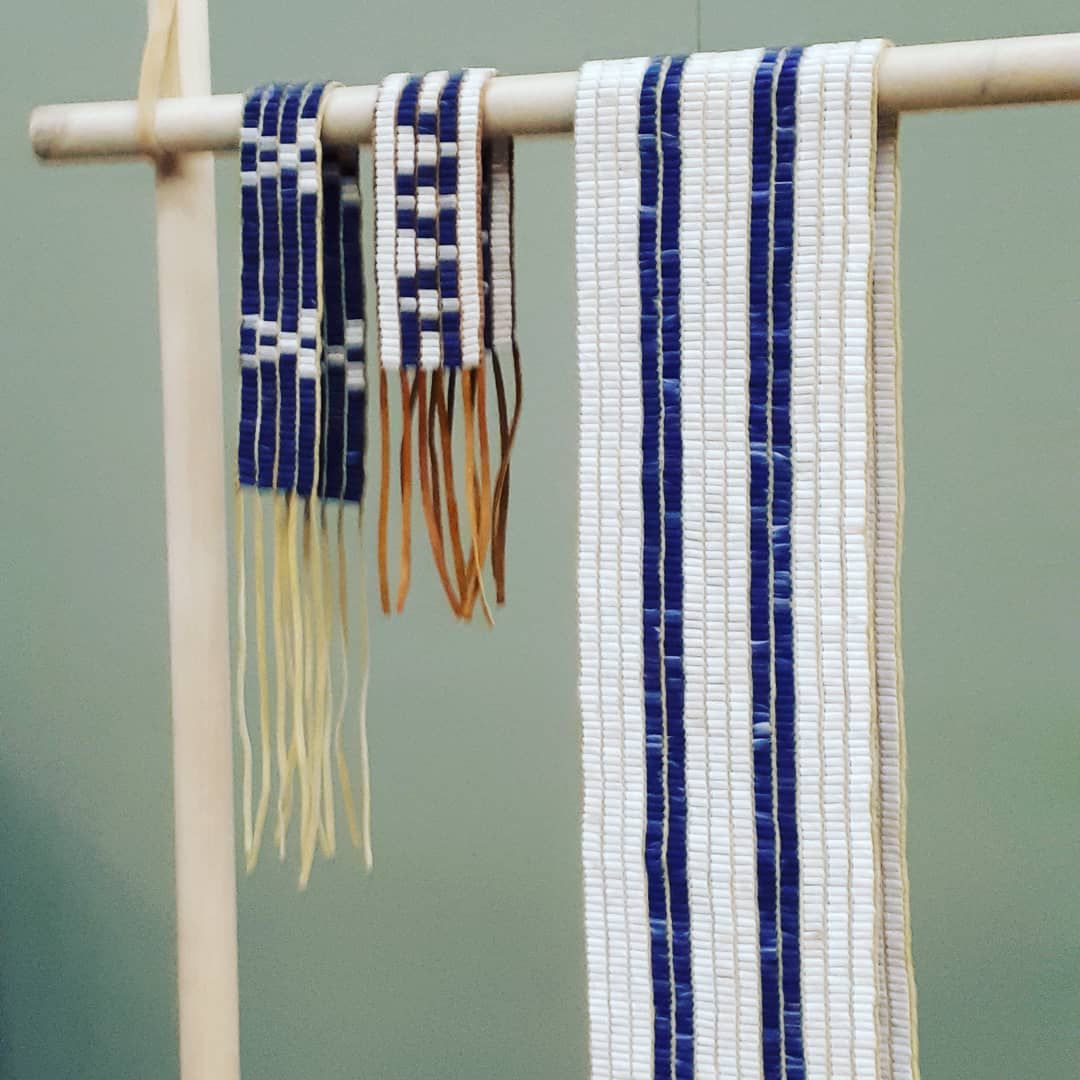
Wampum's primary Indigenous use was as a mnemonic device and record-keeping system within oral traditions, considered a form of writing where designs denoted specific ideas. Woven belts and strings served as material witnesses to treaties, laws, and historical narratives, with the number of beads indicating the importance of the message. The Haudenosaunee and other nations used wampum belts as 'belts of truth,' where spoken words in council were only considered sincere and binding when accompanied by a wampum presentation. This international protocol was adopted by European nations for diplomatic negotiations with First Nations from the early 17th to the early 19th century. Wampum also held profound social functions within communities, symbolizing authority, continuity, and personal obligation. Strings were used to formally invite other nations to council meetings, with a notched wooden stick attached to indicate the meeting date as notches were cut off each day. Every chief and clan mother held a specific string of wampum as their certificate of office, which was passed to their successor. Wampum was central to the ceremony of raising up a new chief and in the Haudenosaunee Thanksgiving ceremonies. In the practice of giving names, a wampum inscribed with the name of a deceased person was laid on the shoulders of a successor, potentially transferring personal history and obligations, such as the duty to avenge a death or care for a family.
- Runners carrying messages would present wampum to show their authority to carry the message.
- Warriors with exceptional skills were trained in interpreting wampum belts to aid in narrating history.
- The Onondaga Nation was designated the Keeper of the Wampum for the Haudenosaunee Confederacy at its founding, responsible for safeguarding these central records.
- Wampum was used to bind peace between tribes and to rearrange relations between people, serving more social than mundane economic purposes within Indigenous societies.
Wampum belts are considered living history. Speakers use them to recall the original terms of agreements and all subsequent related history. They put words into the wampum as it is woven. As memory aids in oral tradition, these belts could be read by anyone acquainted with the wampum language. They were used to record treaties and historical events, such as the Two Row Wampum Treaty. Wampum belts are still woven today for historical and contemporary purposes.
Use as Colonial Currency and Trade
European colonists quickly adopted wampum as a medium of exchange in trade with Indigenous peoples, recognizing its value within existing networks and its scarcity due to the labour-intensive production. Colonial governments formalized its use as legal tender, setting official exchange rates to standardize transactions in a coin-scarce environment. The rarity of the purple quahog shells made them more valuable than the white whelk shells, a disparity that led people to dye white beads to mimic the more expensive purple ones and dilute the value of genuine black shells. This period of wampum currency was intense but relatively brief, as mass production by European settlers and the introduction of European coinage led to its devaluation and eventual disappearance as a common medium of exchange. The use of wampum as currency is documented as early as 1622 with Dutch traders, and its control became a key factor in dominating the European-Indigenous fur trade. Colonists could trade for wampum, use it to acquire Indigenous goods, and then sell those goods in Europe for profit, amassing wealth through this triangular trade. However, the conversion of wampum to European currencies and the introduction of a monetary system was not a desire of Indigenous peoples, creating economic tensions as trades held different value for each party.
| Colony/Region | Period as Legal Tender | Official Exchange Rate |
|---|---|---|
| New England | 1637 to 1661 | Legal tender status established |
| New York | Until 1673 | 8 white or 4 black beads = 1 stuiver (equal to copper duit) |
| New Jersey & Delaware | Proclamation issued | 6 white or 3 black beads = 1 penny |
| North Carolina | 1710 | Briefly declared legal tender |
In his 1705 writings, Robert Beverley Jr. described white shell beads called 'peak' valued at nine pence per yard. He noted the darker 'wampom peak' beads were more expensive at a rate of one shilling and six pence per yard. He added that these beads were made from the conch shell. Beverley distinguished these from a lesser value currency called roenoke made from the cockleshell. Wampum was legal tender in New England from 1637 to 1661 and in New York until 1673. Its use as common currency in settler transactions died out in New York by the early 18th century.
Mass Production, Mechanization and Devaluation
The demand for wampum in trade led to its mass production, first by Long Island Algonquians using European metal tools and then by colonists in dedicated workshops. In the 18th century, Dutch colonists in the Hudson Valley established small-scale manufacturing to supplement scarce coinage. As demand surged in the early 19th century, the Campbells adopted mechanization to improve efficiency. During their peak production years from 1835 to 1866, the Campbell factory alone produced approximately one million black wampum beads annually. This industrial-scale output, combined with the later introduction of imitation beads made from glass, porcelain, ivory, or marble in European workshops, flooded the market. The widespread circulation of these manufactured and imitation beads directly contributed to the devaluation of wampum as a currency and led to the effective disappearance of older, traditionally crafted wampum as a medium of exchange by the 19th century. The market became glutted, severing the direct link between the object's labour value and its worth in trade.
Historic Wampum Belts and Their Meanings
Specific wampum belts carry the weight of foundational histories and agreements, each pattern a readable text. The Two Row Wampum, or Teiohate Kaswenta, records an agreement made in 1613 between the Haudenosaunee and Dutch settlers, featuring two parallel purple rows on a white background symbolizing separate but equal paths of the ship and canoe, governing with mutual respect and non-interference. The Hiawatha Belt records the founding of the Haudenosaunee Confederacy by the Peacemaker, uniting the Seneca, Cayuga, Onondaga, Oneida, and Mohawk nations. The 1794 Canandaigua Treaty belt, which is six feet long, commemorates the peace treaty between the Haudenosaunee and the United States, featuring thirteen figures holding hands connected to two figures and a house. The Two Dog Wampum from Kanesatake was used by Chief Joseph Onasakenrat in the 19th century to assert Mohawk land claims regarding the Lake of Two Mountains and Oka. Other significant belts include the Circle Wampum representing the 50 united and equal chiefs of the confederacy, and belts symbolizing the Great Law of Peace, the Tree of Peace, and the combing of snakes from Tadadaho's hair. These belts are not static artifacts but active documents that continue to inform governance, relationships, and the spreading of the white roots of peace.
Repatriation and Modern Museum Exhibitions
The removal of wampum belts from their communities by collectors, anthropologists, and governments has been a source of longstanding grievance, often through illegal sales or seizures deemed necessary for preservation by colonial authorities. A significant repatriation occurred in 1989 when the National Museum of the American Indian returned eleven sacred wampum belts, dating to the late 18th century and central to the Longhouse religion, to Haudenosaunee chiefs at the Onondaga Longhouse Six Nations Reserve after over a century away. In 2017, a belt purchased by anthropologist Frank Speck in 1913 was returned to Kanesatake, where it is now used in cultural and political events. Major museum exhibitions have recently worked to centre Indigenous perspectives and facilitate reconnection. The exhibition 'Wampum: Beads of Diplomacy' at Montreal's McCord Stewart Museum, which ran until March 2024, represents a landmark moment, bringing together over 40 historic belts from public and private collections in Quebec, Canada, and Europe. The exhibition included thirteen belts from the McCord's own collection and the belt presented by Kanesatake to Pope Gregory XVI in 1831, which had not been repatriated since that date. Developed with the Musée du quai Branly-Jacques Chirac and the Seneca Art and Culture Center, the exhibition featured contextual objects and the work of contemporary Indigenous artists like Hannah Claus, Nadia Myre, Teharihulen Michel Savard, and Skawennati. A key event before the public opening welcomed representatives from several nations to reconnect with the belts, an act of walking the talk on decolonizing museum practices and acknowledging wampum as a living, diplomatic record begging to be read and understood.
Contemporary Revival, Artistry and Practice
Wampum artistry and use have seen a dedicated revival in recent decades, driven by Indigenous artists and communities reclaiming their cultural heritage and ensuring its continuation. The state-recognized Unkechaug Nation on Long Island established a wampum factory in 1998, producing traditional beads for artists and enabling the creation of new belts and jewelry. This factory supplied beads for the Seneca Nation's 2008 commission of replicas of five historic belts, woven by artist Lydia Chavez using beads manufactured on Unkechaug territory. Contemporary wampum makers and faith keepers like Ken Maracle, a Cayuga, and the late Julius Cook, a Mohawk artisan also known as Sakaronkiokeweh, continue to use, teach, and innovate with traditional methods. Communities are also actively preserving historical sites, such as the Shinnecock Indian Nation's work to protect Ayeuonganit Wampum Ayimꝏup, a traditional manufacturing site in the Parrish Pond subdivision of Southampton, Long Island. Wampum continues to be used in ceremonies, political events, and as an educational tool, as seen in presentations by knowledge keepers like Darin Wybenga of the Mississaugas of the Credit First Nation during the 2025 Culture Days. Its role in modern treaty and relationship-building was exemplified by the 2025 exchange of a sacred wampum belt between Garden River First Nation and the City of Sault Ste. Marie to honour unity. These practices highlight wampum's ongoing function as a living record, a certificate of authority, and a means of conveying truthful speech in both traditional and new contexts.
Questions about Wampum
What is wampum made from?
Wampum beads are traditionally made from the shells of two marine animals. The white beads are crafted from the inner spiral or columella of the channeled whelk shell, specifically the species Busycotypus canaliculatus or Busycotypus carica. The purple or black beads are made from the thick lip of the quahog, a hard-shelled clam known scientifically as Mercenaria mercenaria. The process involves breaking the shell lip into sections, cutting them into tubes, drilling holes with drills that used quartz bits, and smoothing them with water and sand on a grinding stone, a method that was revolutionized by the introduction of European metal tools.
Was wampum used as money?
Yes, European colonists adopted wampum as a currency for trade with Indigenous peoples and among themselves. It was declared legal tender in several colonies, including New England from 1637 to 1661 and in New York until 1673 at the rate of eight white or four black beads equalling one stuiver. The New Jersey colonial government set a rate of six white or three black beads to one penny. The purple beads were rarer and more valuable than the white ones.
What is the Two Row Wampum Treaty?
The Two Row Wampum Treaty is a historical wampum belt. It records an agreement between Indigenous people and Dutch settlers. Before European contact, strings of wampum were used for recording important treaties and historical events like this one. The belt features two parallel rows of purple beads on a white background. It symbolizes two paths traveling side by side in peace and mutual respect. This belt remains a significant symbol for Indigenous-settler relations.
Are historic wampum belts being returned to Indigenous communities?
Yes, repatriation efforts have been ongoing. A major event occurred in 1989 when the National Museum of the American Indian returned eleven wampum belts to Haudenosaunee chiefs at the Onondaga Longhouse Six Nations Reserve. In 2017, a belt collected by Frank Speck in 1913 was returned to the Kanesatake community. Modern museum exhibitions, such as 'Wampum: Beads of Diplomacy' in Montreal, also prioritize collaboration with originating nations, hosting private viewings for community representatives to reconnect with the belts. This act facilitates a form of cultural and spiritual repatriation even when physical transfer may not occur immediately.
Is wampum still made and used today?
Absolutely. There is a strong contemporary revival of wampum artistry and use. The Unkechaug Nation operates a wampum factory on Long Island that has supplied beads for projects like the Seneca Nation's 2008 replica historic belts. Artists like Ken Maracle, Lydia Chavez, and Elizabeth Perry create new belts and jewelry. Wampum is used in ceremonial contexts, such as raising new chiefs and Haudenosaunee Thanksgiving, and in political events, like the 2025 unity belt exchange between Garden River First Nation and Sault Ste. Marie. It also features in educational programs to teach about history, treaties, and the recording of relationships.
What was the role of the Onondaga Nation regarding wampum?
The Onondaga Nation was given the responsibility of Wampum Keeper for the Haudenosaunee Confederacy at the founding of the Great Peace. For centuries, the Onondaga have been the caretakers of the central wampum belt records, entrusted with their preservation and interpretation. This role included training warriors in reading the belts and safeguarding the physical embodiments of treaties and laws. The nation also led efforts to repatriate belts illegally taken from them, culminating in the successful return of eleven belts in 1989 after determined advocacy by the chiefs.
Sources and further reading
- Wampum (Wikipedia)
- Wampum: Beads of Diplomacy, McCord Stewart Museum (musee-mccord-stewart.ca)
- Wampum (onondaganation.org)
- Wampum Belts Discovery (culturedays.ca)
- Montreal museum brings together unprecedented ... (cbc.ca)
Checked by the Nosy Mag desk. Last updated 2026-10-22.