Pontiac's War
Pontiac's War, also known as Pontiac's Rebellion, was a widespread Indigenous uprising against British rule in the Great Lakes and Ohio Valley regions from 1763 to 1766. The conflict was launched by a confederation of First Nations, including the Odawa, Ojibwe, Potawatomi, Shawnee, and Delaware, who were dissatisfied with the policies of the British after their conquest of New France. Named for the prominent Odawa leader Obwandiyag, known to the British as Pontiac, the war saw the capture of eight British forts, the deaths of hundreds of colonists and soldiers, and protracted sieges of major posts like Detroit and Pitt. Although ultimately unsuccessful in driving the British from the region, the resistance forced a shift in imperial policy, most notably the Royal Proclamation of 1763, which sought to establish a boundary between colonial settlement and Indigenous lands. The war is a significant episode of First Nations resistance in North American history.
Origins of Discontent
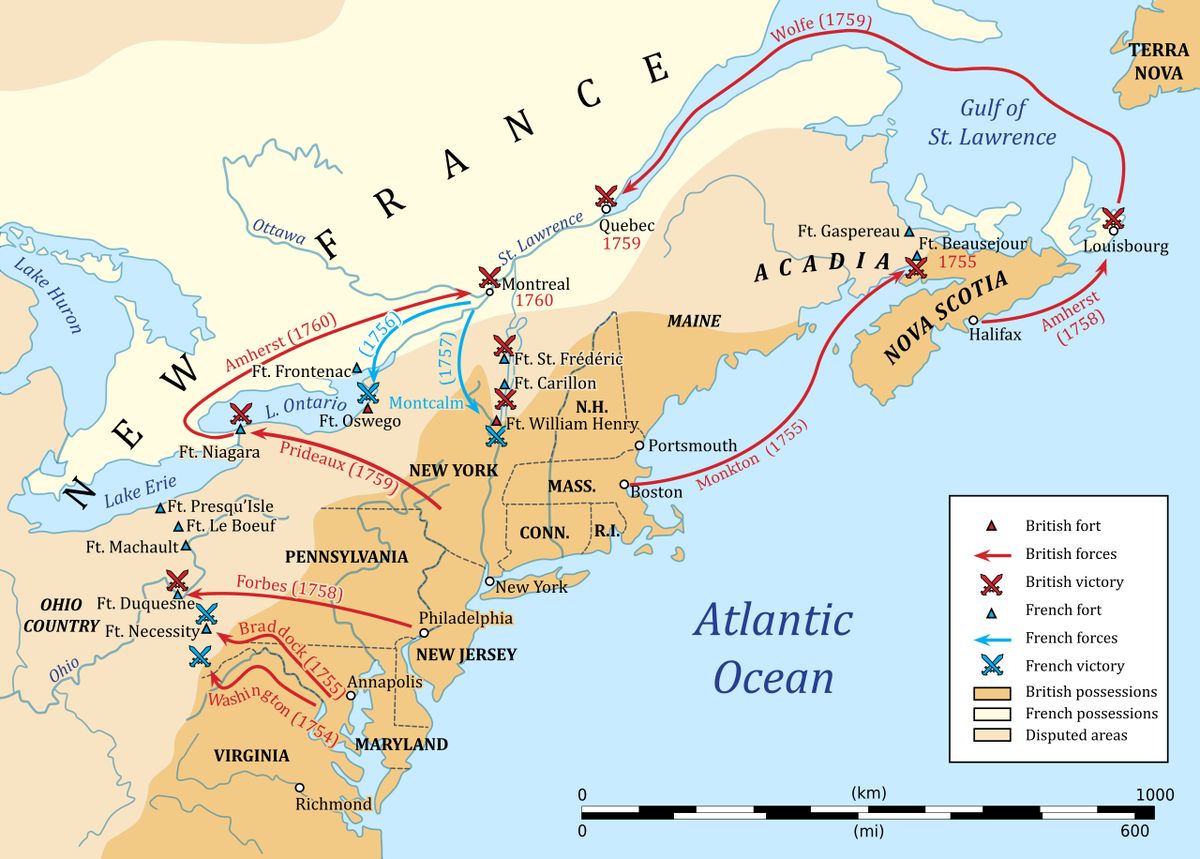
The roots of Pontiac's War lay in the shift of power in North America following the British victory in the Seven Years' War, known in the colonies as the French and Indian War. With the Treaty of Paris in 1763, France ceded its territory of New France, including the pays d'en haut or upper country, to Great Britain. Indigenous nations of the Great Lakes and Ohio Valley, who had long maintained alliances with French habitants, suddenly found themselves under British sovereignty. The French approach had been characterized by gift-giving and trade reciprocity. In contrast, the new British commander-in-chief, General Jeffery Amherst, viewed the Indigenous peoples as a conquered population. Amherst drastically cut the ceremonial gifts that were a part of Indigenous diplomacy and restricted the sale of gunpowder and ammunition. These actions convinced many Indigenous leaders that the British intended to subjugate them. The British had only about 500 troops stationed in the vast region where the war would erupt.
Land encroachment was a concern, particularly for tribes like the Shawnee and Delaware who had been displaced from the east. While not all participants faced immediate settlement pressure, the fear of colonial expansion fueled resentment. A spiritual awakening swept through Indigenous communities in the early 1760s. This movement was led by Neolin, the Delaware Prophet, who preached a message of cultural revitalization and rejection of European goods. Neolin taught that the Master of Life was displeased with Indigenous adoption of white customs and that their survival depended on expelling the British from their lands. His prophecy provided an ideological foundation for unified action. This combination of political grievance and religious fervour created a tinderbox across the frontier. The influential Haudenosaunee (Iroquois) Confederacy largely stayed out of the war, but the western Seneca, disillusioned with the British Covenant Chain alliance, became key instigators.
The Indigenous Coalition and War Planning
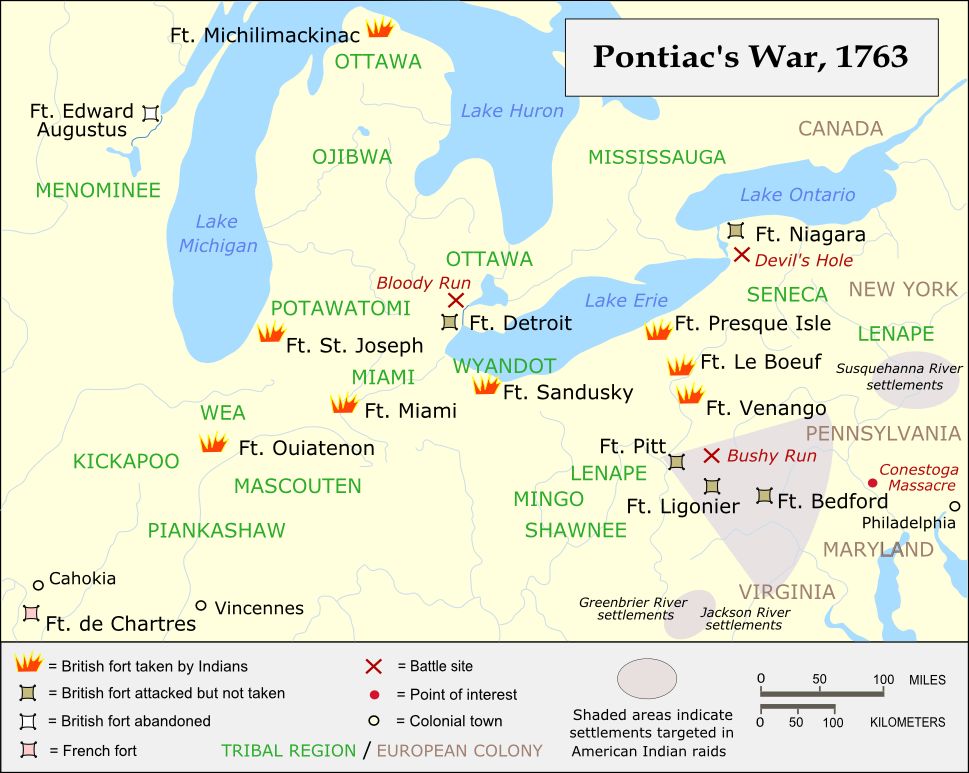
The resistance involved a diverse coalition of nations from the pays d'en haut, united by common cause rather than a single command. The primary participants fell into three regional groups. The first consisted of Great Lakes nations with deep French ties, including the Odawa, Ojibwe, Potawatomi, and Wyandot (Huron). These groups had intermarried and traded with French colonists for decades. The second group was from the Illinois Country, such as the Miami, Wea, Kickapoo, Mascouten, and Piankashaw. The British found it difficult to project power into this remote area. The third comprised nations of the Ohio Country, including the Delaware (Lenape), Shawnee, Wyandot, and Mingos (Ohio Seneca). These tribes had migrated to the Ohio Valley earlier in the century to escape pressure from colonists and other tribes.
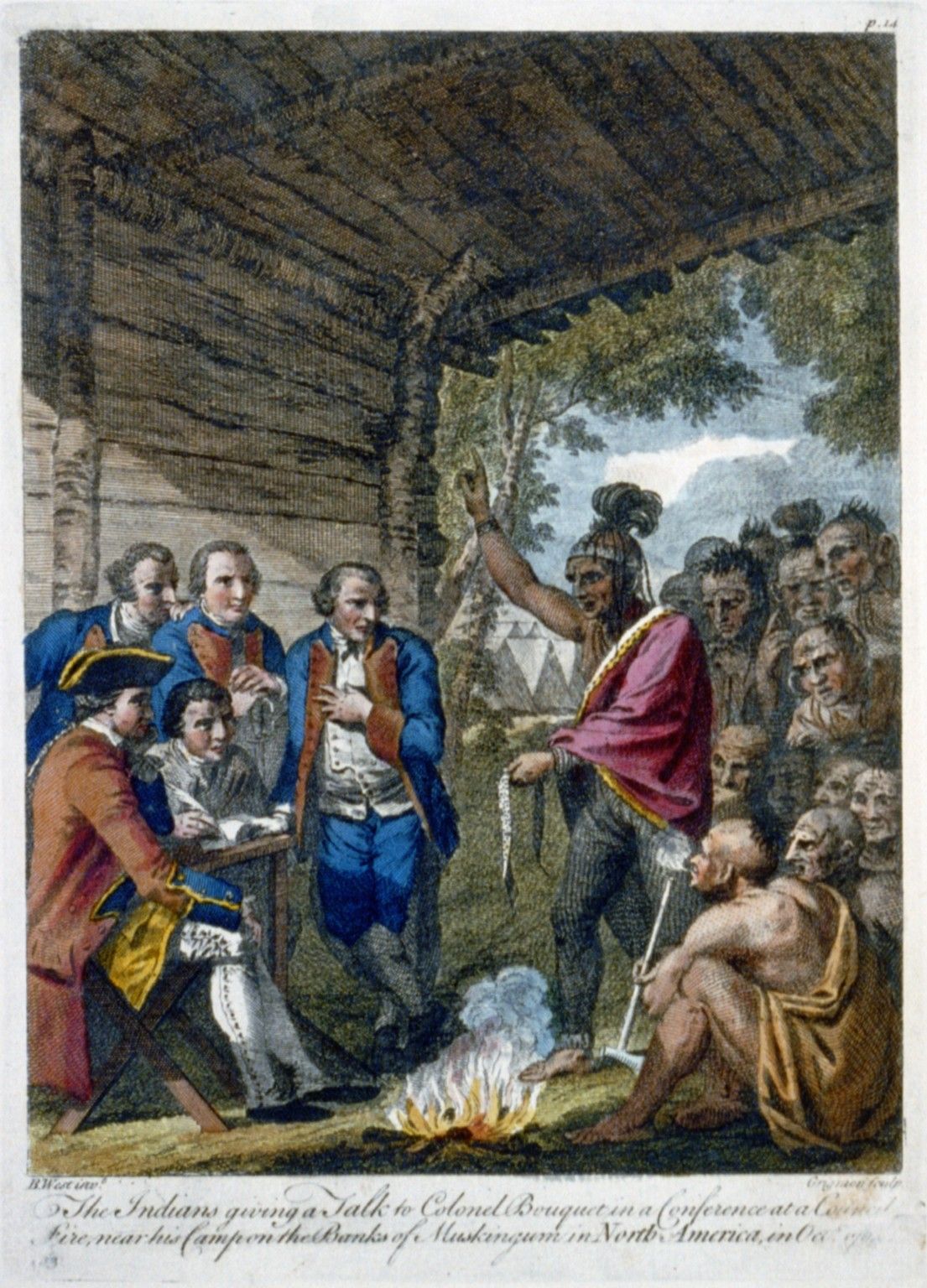
Planning was a growing movement that gained critical momentum from the actions of the Odawa war chief Obwandiyag, or Pontiac. As early as 1761, Seneca leaders Guyasuta and Tahaiadoris began circulating war belts, woven wampum symbols, calling for a confederacy to drive out the British. Pontiac was inspired by Neolin's teachings and worked to galvanize the tribes. By early 1763, he had embraced this plan for a broad uprising. He coordinated through the distribution of war belts to nations near Michilimackinac, along the Allegheny River, near Fort Pitt, and in the Wabash region. The common goal was to strike the string of British forts. There is no evidence of official French involvement in instigating the war. Indigenous leaders hoped their actions would inspire France to return and renew the alliance. The attacks, while not perfectly simultaneous, represented an unprecedented pan-Indigenous military and diplomatic effort.
Outbreak and Major Engagements of 1763
Pontiac's War erupted in May 1763, with the focal point at Fort Detroit, the region's most important British post. After a failed attempt to seize the fort by surprise on May 7, Pontiac, joined by warriors from the Odawa, Potawatomi, and Wyandot, initiated a siege. Violence quickly escalated outside the fort's walls, with British soldiers and settlers being killed. In one instance, a soldier was ritually cannibalized according to Great Lakes custom. The siege attracted over 900 warriors from six nations. In late July, a British relief force under Captain Henry Dalyell attempted a surprise sortie against Pontiac's camp. Pontiac was prepared and ambushed the column at a bridge over Parent's Creek on July 31, in a fierce engagement that became known as the Battle of Bloody Run. The British suffered heavy casualties and were forced to retreat. Despite this tactical victory, Pontiac could not capture the fort, and his influence began to wane as the siege dragged into the fall. He finally lifted the siege on October 31 and withdrew to the Maumee River.
As word of Pontiac's actions spread, attacks flared across the frontier, capturing British forts in rapid succession. Between May 16 and June 2, Indigenous war parties successfully seized five smaller outposts: Fort Sandusky, Fort Miami, Fort Ouiatenon, Fort Michilimackinac, and Fort Venango. The capture of Fort Michilimackinac on June 2 was particularly notable, achieved through a clever ruse where Ojibwe warriors used a game of lacrosse to distract the garrison before storming the gates. Later in June, Forts Le Boeuf and Presque Isle were also captured, bringing the total to eight forts taken. By late spring, the conflict had spread east of the Alleghenies, where Delaware and Shawnee forces laid siege to the crowded Fort Pitt in western Pennsylvania. Simultaneously, war parties raided deep into Pennsylvania and Virginia. The British military was caught completely off guard.
- May 7, 1763: Pontiac begins siege of Fort Detroit after failed surprise attempt.
- May 16-June 2, 1763: Indigenous forces capture Forts Sandusky, Miami, Ouiatenon, Michilimackinac, and Venango.
- June 22, 1763: Siege of Fort Pitt begins by Delaware and Shawnee warriors.
- July 31, 1763: Battle of Bloody Run. Pontiac ambushes and defeats British relief force near Detroit.
- August 5-6, 1763: Colonel Henry Bouquet defeats a Shawnee, Delaware, and Mingo force at the Battle of Bushy Run, relieving Fort Pitt.
- September 14, 1763: Devil's Hole Massacre: Senecas, Odawas, and Ojibwas attack a supply train near Niagara, killing over 70 soldiers and teamsters.
- October 31, 1763: Pontiac lifts the siege of Fort Detroit.
British Counteroffensive and the Path to Peace
Following the shocking losses of 1763, the British launched a concerted military and diplomatic campaign to reclaim control. General Amherst, whose policies had helped spark the war, was recalled to London in late 1763. His replacement, General Thomas Gage, initiated a more conciliatory approach but authorized two major punitive expeditions in 1764. Colonel John Bradstreet led an army of about 1,200 men into the Great Lakes region by boat. Colonel Henry Bouquet marched from Fort Pitt with 1,150 men into the Ohio Country. Bouquet's campaign proved decisive. His victory at Bushy Run in August 1763 had already broken the siege of Fort Pitt, and his 1764 expedition pressured the Delaware and Shawnee into suing for peace. This successfully fractured Pontiac's alliance. Bradstreet's expedition had mixed results but helped reassert British presence along the lakes. He negotiated controversial treaties at Fort Presque Isle and Detroit which were later rejected by Gage.
Isolated and unable to secure French support, Pontiac's coalition steadily disintegrated. Key allies made separate peace. The final peace was negotiated at a great council convened by Sir William Johnson, the Superintendent of Indian Affairs, at Fort Ontario in July 1766. Pontiac, representing the western nations, formally made peace with the British Crown. On July 25, he declared to Johnson, "I speak in the name of all the Nations to the westward whom I command." This diplomatic conclusion, however, came at a personal cost. His acquiescence angered some former allies like the Shawnee leader Charlot Kaské, who continued resistance in the Illinois Country. In 1769, while visiting the Illinois Country, Pontiac was murdered by a Peoria tribesman, an act that sparked retaliatory warfare among Indigenous nations. The war officially ended not with a decisive military victory, but through negotiated treaties. British losses included about 400 soldiers killed in action. George Croghan estimated 2,000 settlers were killed or captured, and approximately 4,000 settlers fled the frontier.
Atrocities, Biological Warfare, and the Paxton Boys
The conflict on the frontier was marked by extreme brutality from both sides, reflecting deep racial and cultural divisions. Indigenous warriors frequently killed prisoners and targeted civilian settlers in raids. The British and colonial forces responded in kind. The most notorious British action was the attempt to use biological warfare. During the siege of Fort Pitt, with smallpox raging inside, the fort's commander, Simeon Ecuyer, gave besieging Delaware representatives blankets and a handkerchief from the smallpox hospital. This act followed a suggestion from General Amherst. The actual effect of this attempt is debated by historians, but it illustrates the ruthlessness of the conflict. These atrocities hardened attitudes on both sides.
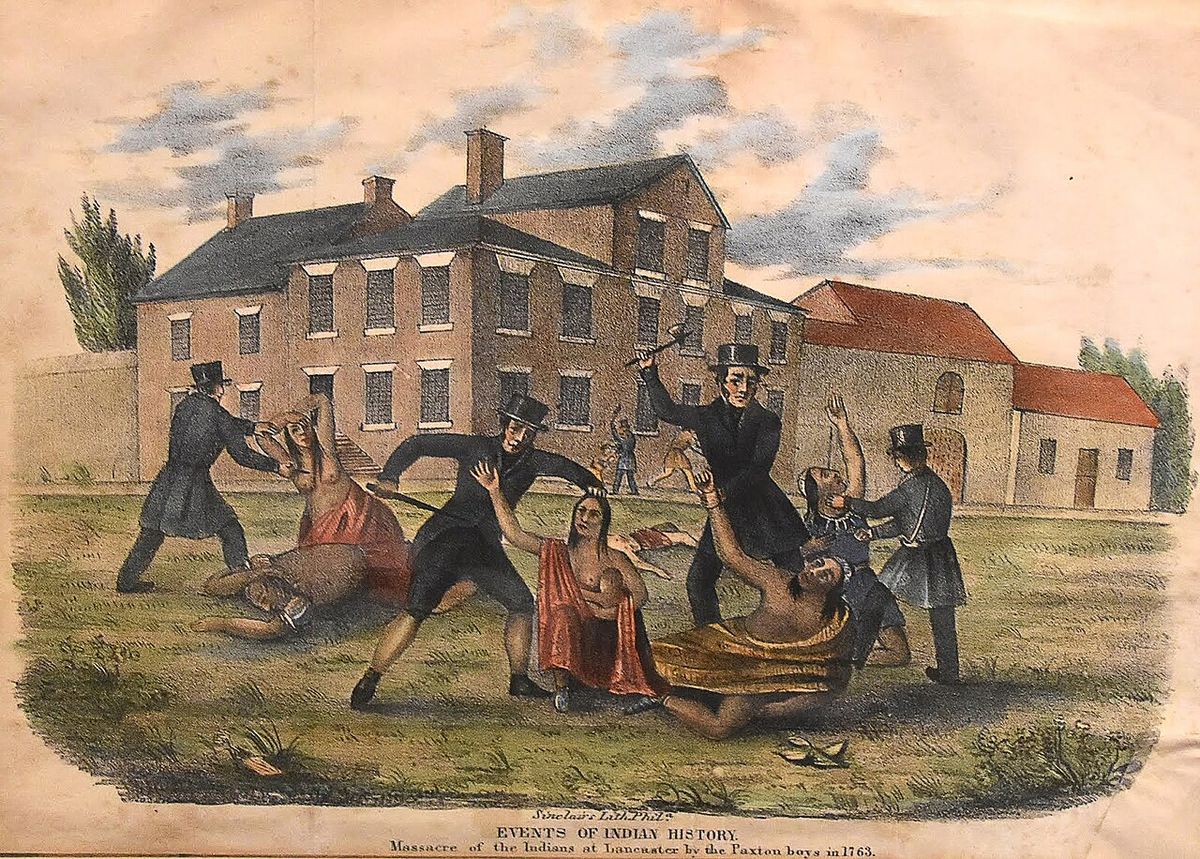
The violence also sparked a vigilante uprising by colonists known as the Paxton Boys. In December 1763, they murdered six Susquehannock Indians at Conestoga Town and later killed 14 more who were in protective custody in Lancaster. In February 1764, several hundred Paxton Boys marched on Philadelphia intending to attack Moravian Lenape and Mohican refugees, but were dissuaded by British troops and militia. Benjamin Franklin negotiated an end to the crisis and published a condemnation of their actions. The Pennsylvania Assembly reintroduced scalp bounties for enemy Indians above the age of ten. These events showed the war's character as a brutal struggle that intensified racial hatred and led to calls for separation between colonists and Indigenous peoples.
Consequences and the Royal Proclamation of 1763
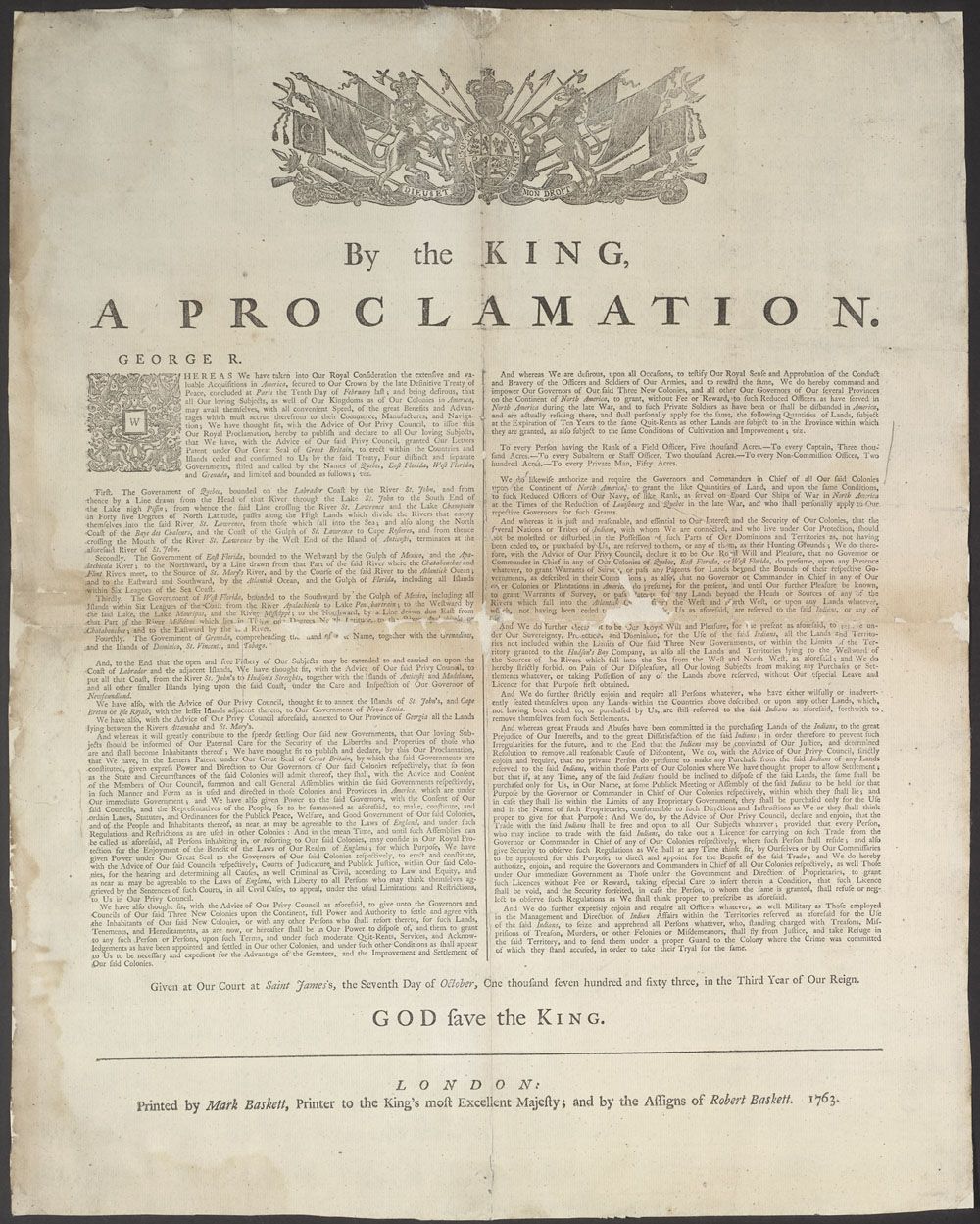
The most immediate and deep political consequence of Pontiac's War was the issuance of the Royal Proclamation of 1763 by King George III. Issued in October 1763, as the war still raged, the Proclamation was a direct attempt to prevent further conflict by regulating colonial expansion and land speculation. It established a boundary line along the crest of the Appalachian Mountains, declaring all lands west of this line to be reserved for Indigenous nations and off-limits to colonial settlement. The Proclamation also created the new British province of Quebec and formalized the process for acquiring Indigenous land through Crown negotiation. For Indigenous peoples, the Proclamation was a rare imperial document that seemed to recognize their territorial rights and sovereignty. For American colonists, particularly land speculators and veterans promised western lands, it was a deeply unpopular restriction that bred resentment towards the Crown.
Beyond the Proclamation, the war had lasting effects. It demonstrated the power and potential of pan-Indigenous resistance, a lesson that would inspire future leaders like Joseph Brant, Little Turtle, Blue Jacket, and Tecumseh in their struggles against American expansion. For the British Empire, the enormous cost of the war and subsequent garrisoning of the frontier contributed to the financial pressures that led to new taxes on the colonies, such as the Stamp Act, helping to fuel the movement toward the American Revolution. Militarily, the war forced the British to abandon Amherst's punitive policies and return to a system of diplomacy and gift-giving more akin to the French model, overseen by Sir William Johnson's Indian Department. While Pontiac's War did not achieve its ultimate goal of expelling the British, it successfully altered imperial policy, affirmed Indigenous military power, and reshaped the geopolitical dynamics of eastern North America. The Proclamation's boundary was largely ineffective in stopping westward migration, but it established a foundational legal principle in Canadian Indigenous law and remains a key document in modern land claims.
Historical Significance and Naming the Conflict
The naming of the conflict itself reflects its evolving interpretation. It was widely known in the 19th century as "Pontiac's Conspiracy," a term popularized by historian Francis Parkman's 1851 book, The Conspiracy of Pontiac. This framing suggested a secret, unified plot orchestrated by a single leader. In the 20th century, scholars like Francis Jennings challenged this view, arguing that Parkman exaggerated Pontiac's role and that the uprising was a broader, decentralized resistance involving many autonomous nations. Jennings noted that Pontiac was a local Odawa war chief, not the supreme commander of a vast conspiracy. This led to proposals for alternate names such as "The Amerindian War of 1763." However, the names "Pontiac's War" or "Pontiac's Rebellion" have endured in common usage.
Recent 21st-century scholarship has reassessed Pontiac's importance, acknowledging his exceptional skills as an orator, strategist, and coalition-builder whose personal leadership was crucial in activating the widespread revolt. For many First Nations, it is remembered as a war of liberation. Pontiac's War holds a central place in the history of Indigenous-European relations in Canada. It was the most successful First Nations resistance to European invasion prior to the 19th century, temporarily rolling back British control. The war highlighted the failure of British policy under Amherst and the necessity of diplomatic engagement with Indigenous nations as allies, not subjects. This lesson directly influenced the approach of British authorities in Canada, contributing to the alliance with Indigenous nations that would prove crucial during the American Revolution and the War of 1812. The legacy of the Royal Proclamation, a direct outcome of the war, continues to resonate in Canadian law and Indigenous rights discussions today.
Questions about Pontiac's War
Who was Pontiac and what was his role in the war?
Pontiac, known as Obwandiyag, was an Odawa war chief who became the most prominent Indigenous leader. Inspired by the Delaware Prophet Neolin, he played a major role in galvanizing a coalition of Great Lakes and Ohio Valley nations. He personally initiated the siege of Fort Detroit in May 1763 and worked to coordinate resistance through war belts. Modern scholarship recognizes him as a key strategist and symbol. After the war, he made peace with the British in July 1766 but was murdered by a Peoria tribesman in 1769 near Cahokia.
What caused Pontiac's War to start?
The war was caused by multiple factors following the British conquest of New France. Indigenous nations were dissatisfied with the harsh policies of British General Jeffery Amherst, who cut off ceremonial gift-giving and restricted trade in gunpowder. This contrasted with the more diplomatic French approach. Land encroachment fears, particularly among Ohio tribes, and a powerful religious revival led by the Delaware Prophet Neolin, who preached cultural renewal and expulsion of the British, provided the ideological spark. The convergence of these political, economic, and spiritual grievances led to coordinated attacks in spring 1763.
How many British forts were captured during Pontiac's War?
Indigenous forces successfully captured eight British forts during the initial outbreaks in 1763. These included Forts Sandusky, Miami, Ouiatenon, Michilimackinac, Venango, Le Boeuf, and Presque Isle. The capture of Fort Michilimackinac on June 2, achieved through a lacrosse game ruse, was one of the most notable successes. Two major forts, Detroit and Pitt, were placed under prolonged sieges but ultimately held out. The loss of these outposts represented a severe blow to British military control in the region.
What was the Royal Proclamation of 1763 and how was it related to the war?
The Royal Proclamation of 1763 was a decree issued by King George III in October 1763, directly in response to the outbreak of Pontiac's War. Its primary purpose was to prevent further conflict by regulating colonial expansion. It established a boundary line along the Appalachian Mountains, reserving all lands west of the line for Indigenous nations and prohibiting colonial settlement without Crown purchase through treaty. The Proclamation also created the province of Quebec. It was a major policy shift intended to replace Amherst's confrontational approach, though it was widely ignored by American colonists and became a source of tension leading to the American Revolution.
How did Pontiac's War end?
The war ended through a combination of British military pressure and diplomatic negotiation. British expeditions in 1764 under Colonels Henry Bouquet and John Bradstreet reasserted military presence and pressured key nations like the Delaware and Shawnee to make peace, fracturing the Indigenous alliance. Isolated and without hoped-for French support, Pontiac's coalition disintegrated. The final peace was formalized at a great council convened by Sir William Johnson at Fort Ontario in July 1766. There, Pontiac made a formal peace with the British Crown. The war concluded with treaties, though sporadic violence continued afterwards.
What is the historical significance of Pontiac's War for Canada?
Pontiac's War is deeply significant in Canadian history as the most successful First Nations resistance to European invasion prior to the 19th century. It forced the British Empire to abandon a policy of conquest in favour of diplomacy and treaty-making, a shift embodied in the Royal Proclamation of 1763. This established the foundational legal framework for Crown-Indigenous relations in Canada. The war demonstrated the necessity of Indigenous alliances for British interests in North America, a lesson that shaped British strategy during the American Revolution and War of 1812. It is a powerful early example of pan-Indigenous political and military coordination in defence of land and sovereignty.
Sources and further reading
- Pontiac's War (Wikipedia)
- Pontiac's War (thecanadianencyclopedia.ca)
- Pontiac's Rebellion (battlefields.org)
- Ottawa Chief Pontiac's Rebellion against the British begins (history.com)
- Pontiac's Rebellion | 9-12 US History Essay (billofrightsinstitute.org)
Checked by the Nosy Mag desk. Last updated 2026-10-21.