United States-Mexico-Canada Agreement
The United States, Mexico, Canada Agreement (USMCA), known in Canada as the Canada, United States, Mexico Agreement (CUSMA), is the trilateral free trade pact governing North American commerce. It entered into force on July 1, 2020, replacing the 1994 North American Free Trade Agreement (NAFTA). The agreement updates provisions on digital trade, intellectual property, labour standards, and automotive manufacturing. For Canada, the USMCA secured continued preferential access to its largest trading partner while introducing new market access commitments, notably in the dairy sector. It also established a formal review process to assess the pact's future, with the first review occurring in 2026.
Background and Negotiation Process
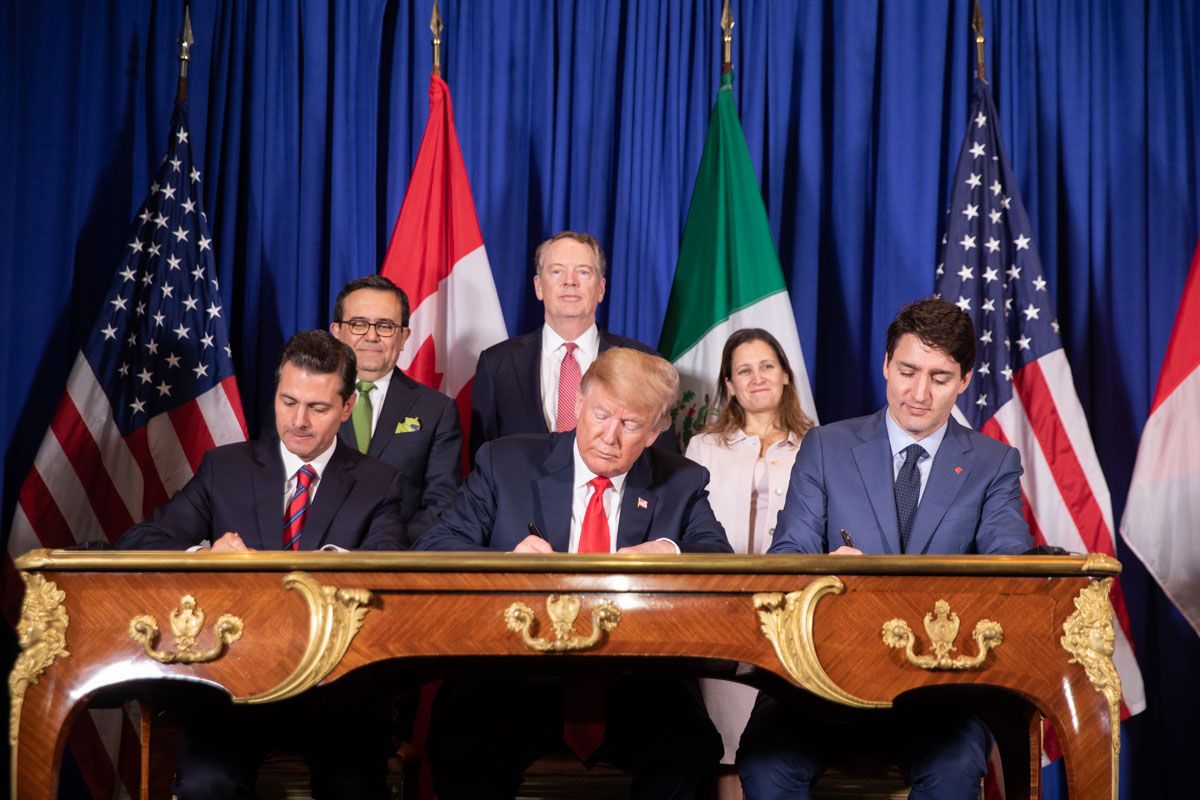
The drive to renegotiate NAFTA was a central promise of Donald Trump's 2016 U.S. presidential campaign, part of a broader shift in U.S. trade policy. The formal process began on May 18, 2017, when U.S. Trade Representative Robert Lighthizer notified Congress of the intent to start talks within 90 days. Eight formal rounds of negotiations were held between August 16, 2017, and April 8, 2018. A critical deadline emerged in the summer of 2018, driven by the impending December 1 departure of Mexican President Enrique Peña Nieto and a mandatory 60-day review period requiring a final text by September 30. The United States and Mexico reached a bilateral deal on August 27, 2018, leaving Canada to negotiate its terms separately. Intensive talks culminated in a finalized text published on October 1, 2018, with Lighthizer crediting Jared Kushner for salvaging the deal. The leaders of the three nations, U.S. President Donald Trump, Mexican President Enrique Peña Nieto, and Canadian Prime Minister Justin Trudeau, signed the agreement on November 30, 2018, during the G20 summit in Buenos Aires. A revised version, incorporating further consultations including a breakthrough on a US$16 per hour minimum wage for Mexican auto workers, was signed on December 10, 2019. Ratification by all three national legislatures was completed by March 13, 2020, allowing the USMCA to take effect on July 1, 2020. Key figures in bridging differences included U.S. Ambassador to Canada Kelly Craft and, behind the scenes, Blackstone CEO Stephen Schwarzman, who reportedly urged Canadian Prime Minister Justin Trudeau to compromise on dairy market protections during a January 2017 meeting with Canada's Liberal Cabinet. The agreement is referred to differently in each country: USMCA in the United States, CUSMA in Canada, and T-MEC in Mexico.
Key Provisions and Modernization
The USMCA is widely characterized as a modernization of NAFTA, incorporating elements from the Comprehensive and Progressive Agreement for Trans-Pacific Partnership and the Beyond the Border accord. It introduced several significant new chapters and updated existing rules to reflect 21st-century economic realities. A central feature is the inclusion of chapters on Digital Trade, Anticorruption, and Good Regulatory Practices, alongside a dedicated chapter for Small and Medium Sized Enterprises. The agreement also includes a novel chapter on Macroeconomic Policies and Exchange Rate Matters, establishing transparency requirements to deter currency manipulation and aligning with International Monetary Fund Articles of Agreement. Intellectual property protections were strengthened, extending copyright terms in Canada to life of the author plus 70 years and to 75 years for sound recordings. The agreement eliminated requirements for companies to establish headquarters or localize data in other member countries. Key sector-specific updates were made in agriculture, automotive manufacturing, and labour standards. Article 32.10 represents a strategic provision affecting future trade diplomacy, requiring member countries to notify each other three months in advance if they intend to begin free trade negotiations with a non-market economy, a clause widely seen as targeting China.
- Automotive rules of origin requiring 75 percent regional content value, up from 62.5 percent, though an initial U.S. proposal for 85 percent and 50 percent U.S.-specific content was not adopted.
- New labour standards, including a US$16 per hour wage requirement for 40 to 45 percent of automotive manufacturing, enforced via a neutral third party and phased in over five years.
- Increased access for U.S. dairy, poultry, and egg products to the Canadian market, with the U.S. gaining tariff-free access to 3.6 percent of Canada's dairy market.
- Higher de minimis thresholds for duty-free online shopping, with Canada raising its tax threshold to C$40 and its duty threshold to C$150 for courier shipments. Mexico set its threshold at US$50 for taxes and US$117 for duties.
- Revised dispute settlement mechanisms, with Canada securing a full exemption from investor-state dispute settlement (ISDS) three years after NAFTA termination.
- A sunset clause mandating a joint review every six years, with an initial 16-year term that can be extended, or the agreement enters annual reviews.
- Extended data exclusivity for new pharmaceutical products to at least five years, with biologics included in this definition.
Economic Impact and Trade Flows
The USMCA governs one of the world's most economically integrated regions, accounting for nearly 30 percent of global GDP. In 2022, total goods and services trade among the three countries was estimated at US$1.8 trillion. U.S. goods exports to its USMCA partners were $680.8 billion that year, up 16 percent from 2021 and representing 33 percent of overall U.S. exports. Imports were $891.3 billion, up 20.5 percent from 2021, resulting in a U.S. goods trade deficit of $210.6 billion. Trade in services showed a surplus for the United States, estimated at $26.0 billion in 2022, with U.S. services exports at $109.0 billion led by travel, professional and management services, and financial services. Foreign direct investment linkages are deep, with U.S. direct investment stock in USMCA countries at $569.0 billion in 2022, a 9.5 percent increase led by manufacturing, nonbank holding companies, and finance and insurance. Conversely, USMCA direct investment in the United States reached $623.1 billion, up 8.0 percent, led by finance and insurance, manufacturing, and depository institutions. An International Monetary Fund working paper from 2019 projected the agreement would have a negligible effect on real GDP. A 2019 International Trade Commission analysis estimated the USMCA would increase U.S. real GDP by 0.35 percent and U.S. employment by 0.12 percent (176,000 jobs) when fully implemented. The agreement's rules have influenced supply chains, particularly in automotive and manufacturing, encouraging greater regional production to meet stricter rules of origin.
Sector-Specific Changes and Regulations
Canada agreed to provide United States dairy farmers with tariff-free access to 3.6 percent of its $15.2 billion dairy market. This is an increase from the 3.25 percent access under the never-ratified Trans-Pacific Partnership. Canada also agreed to eliminate Class 7 pricing provisions on certain dairy products. However, Canada's domestic supply management system remains in place. The agreement contains the strongest due process and transparency requirements for geographic indicator protection systems in any free trade agreement. Canada secured specific exemptions from USMCA import and export restrictions for logs, unprocessed fish, goods produced by forced labour, illegal firearms, and certain prohibited literature.
Automotive Manufacturing: The rules of origin were significantly tightened. To qualify for tariff-free treatment, vehicles must now have 75 percent of their content by value sourced from within North America, up from NAFTA's 62.5 percent. A new labour value content rule requires that 40 to 45 percent of automotive content be made by workers earning at least US$16 per hour, a measure phased in over the first five years after ratification. Mexico, which imports all its aluminum, initially opposed U.S. steel and aluminum content rules but conceded to finalize ratification. These rules aim to shift production and high-wage jobs to the region.
Labour and Environment: The USMCA includes enforceable labour obligations, requiring Mexico to pass legislation aligning with International Labour Organization Convention 98 on freedom of association and collective bargaining. President Andrés Manuel López Obrador's administration introduced such legislation in late 2018. The novel rapid response mechanism allows for sanctions against specific factories that deny workers' rights. Environmental provisions were strengthened and made subject to the same dispute settlement procedures as commercial chapters, a first for a U.S. trade agreement.
Intellectual Property and Pharmaceuticals: Protections were extended across multiple areas. Copyright terms were lengthened, and criminal penalties were mandated for theft of satellite and cable signals and for recording copyrighted movies in theaters. For pharmaceuticals, a minimum five-year data exclusivity period was established for new drugs, including biologics defined as products like vaccines or blood components made using biotechnology. Mexico agreed to extend its data protection laws, while Canada's existing eight-year regime for innovative drugs remained unchanged. The agreement provides for patent term extensions to compensate for unreasonable regulatory delays and requires customs officials to have ex officio authority to stop suspected counterfeit goods. Industrial design protection was extended from 10 to 15 years.
Dispute Settlement Mechanisms and Governance
The USMCA retains and modifies the three primary dispute settlement mechanisms from NAFTA. Chapter 20 provides for country-to-country dispute resolution regarding violations of the agreement and was sustained largely in its original form. Such cases can be appealed on currency transparency grounds under the new Chapter 33. Chapter 19, which allows for binational panel reviews of anti-dumping and countervailing duty determinations, was preserved despite the Trump administration's attempt to remove it during negotiations. This mechanism provides an alternative to domestic courts for trade remedy challenges, with a panel acting as an International Trade Court. The most controversial mechanism, Chapter 11's investor-state dispute settlement (ISDS), was significantly scaled back in the USMCA, now covered under Chapter 14. Canada secured a full exemption from ISDS with the United States and Mexico three years after NAFTA's termination, while limited ISDS remains for certain sectors like energy, infrastructure, and telecommunications between the U.S. and Mexico. The agreement also established a formal governance structure with the six-year joint review process and a 16-year sunset clause. This built-in review was a corrective to NAFTA's lack of an update mechanism, designed to allow the agreement to adapt to new economic realities. The process leads to a decision where each country must choose to renew for 16 years, agree to a revised text, or continue without renewal, triggering annual reviews.
The 2026 Joint Review and Subsequent Status
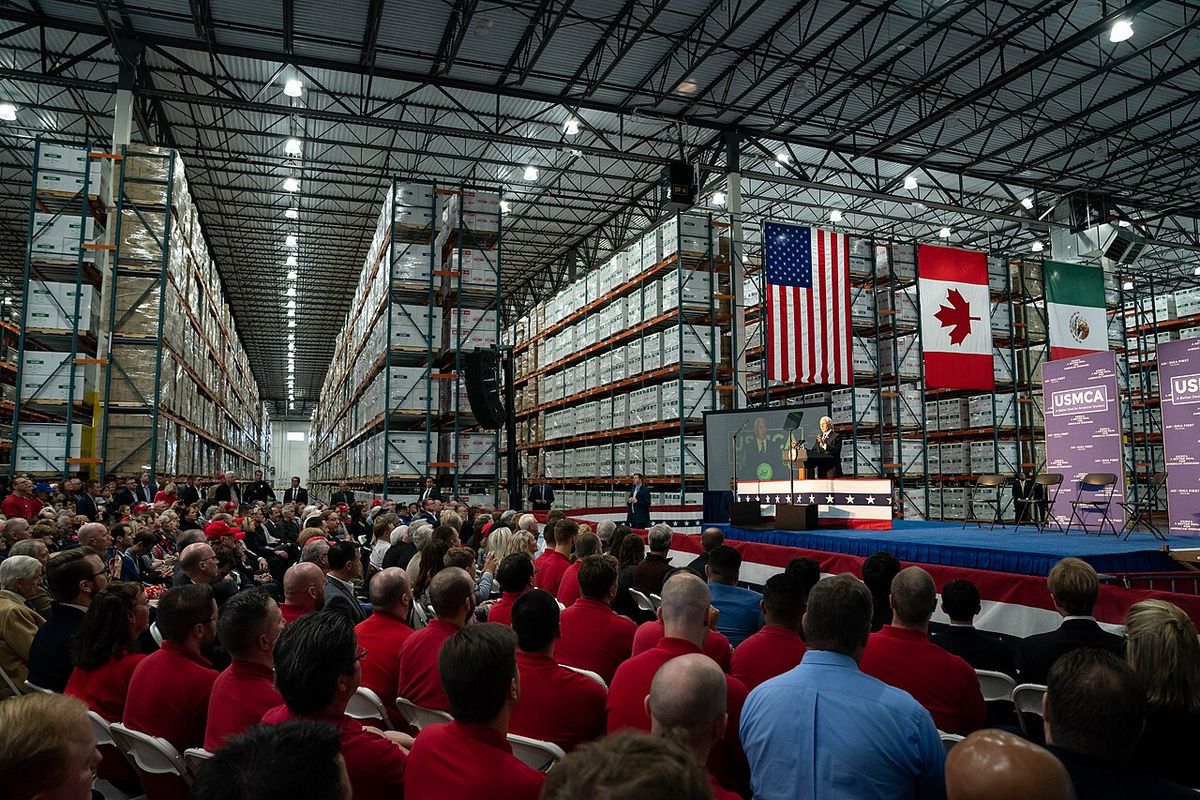
A fundamental component of the USMCA is its built-in review mechanism, mandated to occur six years after implementation. The agreement set a July 1, 2026, deadline for the United States, Mexico, and Canada to affirmatively agree to extend the USMCA for another 16-year term as-is, approve a revised agreement, or allow the agreement to enter a new phase. In the lead-up to the deadline, stakeholders and governments prepared for what many anticipated would be a high-stakes negotiation. On June 1, 2026, Canada formally asked the United States and Mexico to renew the agreement for another 16 years. Mexico and Canada both affirmed their support for renewal by the July 1 deadline. However, the United States announced on July 1, 2026, that it would not renew the agreement as-is. U.S. Trade Representative Robert Lighthizer had indicated to congressional committees in December 2025 that he was not prepared to recommend renewal to the president without changes, signaling a preference for continuation without renewal. Consequently, the agreement entered a new phase as outlined in its provisions.
With the U.S. refusal to renew, the USMCA is now subject to annual joint reviews for the next ten years. The agreement remains in force but will expire on July 1, 2036, unless all three parties agree to renew it at a future annual review. Alternatively, any signatory can withdraw from the pact by providing six months' written notice. This outcome creates a period of sustained uncertainty for businesses with long-term cross-border investments, particularly in integrated manufacturing supply chains like automotive, which require significant capital commitment. The annual review process will serve as a continuous forum for negotiation and potential adjustment of the agreement's terms until a resolution on its long-term future is reached.
Comparison of Key Trade and Investment Statistics (2022)
The USMCA encompasses one of the world's largest free trade zones, with a total population of more than 510 million people. The agreement covers an economy of US$30.997 trillion in nominal GDP. This is nearly 30 percent of the global economy and the largest trade bloc economy in the world. The agreement's provisions govern extensive trade and investment flows between the three countries.
| Category | Value (US$ billions) | Notes and Annual Change |
|---|---|---|
| U.S. Goods Exports to USMCA | 680.8 | Up 16.0% ($94.1B) from 2021. Up 34% from 2012 |
| U.S. Goods Imports from USMCA | 891.3 | Up 20.5% ($151.5B) from 2021. Up 48% from 2012 |
| U.S. Goods Trade Deficit with USMCA | 210.6 | 37.5% increase ($57.4B) over 2021 |
| U.S. Services Exports to USMCA | 109.0 | Up 23.6% from 2021. Led by travel and professional services |
| U.S. Services Imports from USMCA | 83.0 | Up 27.0% from 2021. 66% greater than 2012 levels |
| U.S. Services Trade Surplus with USMCA | 26.0 | Up 14.0% from 2021 |
| U.S. FDI Stock in USMCA | 569.0 | 9.5% increase from 2021. Led by manufacturing, holding companies, finance |
| USMCA FDI Stock in the United States | 623.1 | 8.0% increase from 2021. Led by finance, manufacturing, depository institutions |
The agreement fosters deep economic interdependence among the three nations. The treaty contains a provision for review and adjustment in 2026. On June 1, 2026, Canada formally asked the United States and Mexico to renew the agreement for another 16 years. On July 1, 2026, the United States announced it would not renew the agreement. The signatories will now engage in an annual review for the next 10 years until the agreement expires on July 1, 2036, or one gives six months' notice of withdrawal.
Ongoing Challenges and Strategic Implications
The USMCA's future is now shaped by the annual review process initiated in 2026, a period of flux that echoes the uncertainty of its original negotiation. Key challenges identified by analysts ahead of the review include long-standing trade disputes, the impact of U.S. tariffs on reshoring, and non-trade issues like migration and continental defense being linked to trade discussions. The agreement's digital trade rules, which empower large technology corporations, have faced criticism for potentially undermining online privacy, safety, and right to repair laws, with coalitions urging fixes to these conflicts. From a strategic perspective, the USMCA is viewed as a foundation of North America's shared competitiveness and a key counterweight to China's global economic influence. Its provisions, such as Article 32.10 on non-market economies and the rules encouraging regional automotive production, are explicitly designed to bolster North American manufacturing against external competition. The potential expiration of the agreement in 2036, or a withdrawal before then, would force a return to World Trade Organization terms or bilateral deals, likely resulting in tariffs and regulatory barriers that increase costs. Sectors requiring large investments in cross-border supply chains, such as automotive and energy, face particular uncertainty, which may discourage future investment. The outcome of the ongoing annual reviews will determine whether the region modernizes its trade framework to meet contemporary economic and security challenges or risks losing thirty years of integrated economic progress. The agreement has been criticized by labor groups like the AFL-CIO for having unenforceable standards and by figures like Senator Elizabeth Warren for provisions that could raise drug prices.
Questions about United States-Mexico-Canada Agreement
What is the USMCA and how is it different from NAFTA?
The United States, Mexico, Canada Agreement (USMCA) is the free trade agreement that replaced the North American Free Trade Agreement (NAFTA) on July 1, 2020. It is often called a modernization of NAFTA. Key differences include stricter rules of origin for automobiles, new labour and environmental standards that are enforceable, increased U.S. access to Canada's dairy market, and new chapters covering digital trade, anticorruption, and good regulatory practices. It also introduced a formal review process with a sunset clause, which NAFTA lacked.
How does the USMCA affect Canadian dairy farmers?
The USMCA grants the United States increased tariff-free access to the Canadian dairy market. Specifically, the U.S. gained access to 3.6 percent of Canada's $15.2 billion dairy market, which is a slight increase from the 3.25 percent under the unratified Trans-Pacific Partnership. Canada also agreed to eliminate its Class 7 pricing system for certain dairy products like skim milk and milk protein concentrates. However, Canada's domestic supply management system for dairy, poultry, and eggs remains fundamentally in place.
What are the new rules for cars under the USMCA?
The USMCA introduced stricter rules for automobiles to qualify for zero tariffs. The regional value content requirement was raised from 62.5 percent under NAFTA to 75 percent, meaning more of a vehicle's parts must originate in North America. A new labour value content rule requires that 40 to 45 percent of a vehicle's content be made by workers earning at least US$16 per hour. This rule is being phased in over the first five years of the agreement and is intended to support higher-wage manufacturing jobs in the region.
What happened with the USMCA review in 2026?
The first mandatory six-year joint review of the USMCA concluded in the summer of 2026. While Canada and Mexico formally asked for and supported renewing the agreement for another 16 years, the United States announced on July 1, 2026, that it would not renew the pact as-is. U.S. Trade Representative Robert Lighthizer indicated a desire for changes before recommending renewal. Consequently, the agreement entered a new phase of annual reviews for up to ten years. It will now remain in force but is set to expire on July 1, 2036, unless all three countries agree to renew it during a future annual review.
Can companies still sue governments under the USMCA?
The investor-state dispute settlement (ISDS) mechanism, which allowed companies to sue governments, was significantly scaled back in the USMCA compared to NAFTA. Under Chapter 14 of the USMCA, Canada secured a full exemption from ISDS with both the United States and Mexico three years after NAFTA's termination. Limited ISDS provisions remain for certain sectors between the U.S. and Mexico, such as oil and gas, infrastructure, and telecommunications. The traditional state-to-state dispute settlement (Chapter 20) and the panel review system for trade remedies (Chapter 19) were retained.
How did the USMCA change online shopping for Canadians?
The USMCA increased the de minimis threshold for Canadians buying goods online from the United States and Mexico. This is the value below which no taxes or duties are applied. For taxes like GST, the threshold was raised from C$20 to C$40 for courier shipments. For customs duties (tariffs), the threshold was raised to C$150. This makes it cheaper and easier for Canadian consumers to import lower-value goods purchased online. Some goods, such as alcohol and tobacco, do not qualify for these exemptions. Mexico maintained its de minimis threshold at US$50 for taxes and agreed to duty-free shipments up to US$117.
Sources and further reading
- United States-Mexico-Canada Agreement (Wikipedia)
- United States-Mexico-Canada Agreement (ustr.gov)
- USMCA Review 2026 (csis.org)
- United States-Mexico-Canada Agreement 2026: Review ... (brookings.edu)
- U.S.-Mexico-Canada Agreement (rethinktrade.org)
Checked by the Nosy Mag desk. Last updated 2026-10-19.