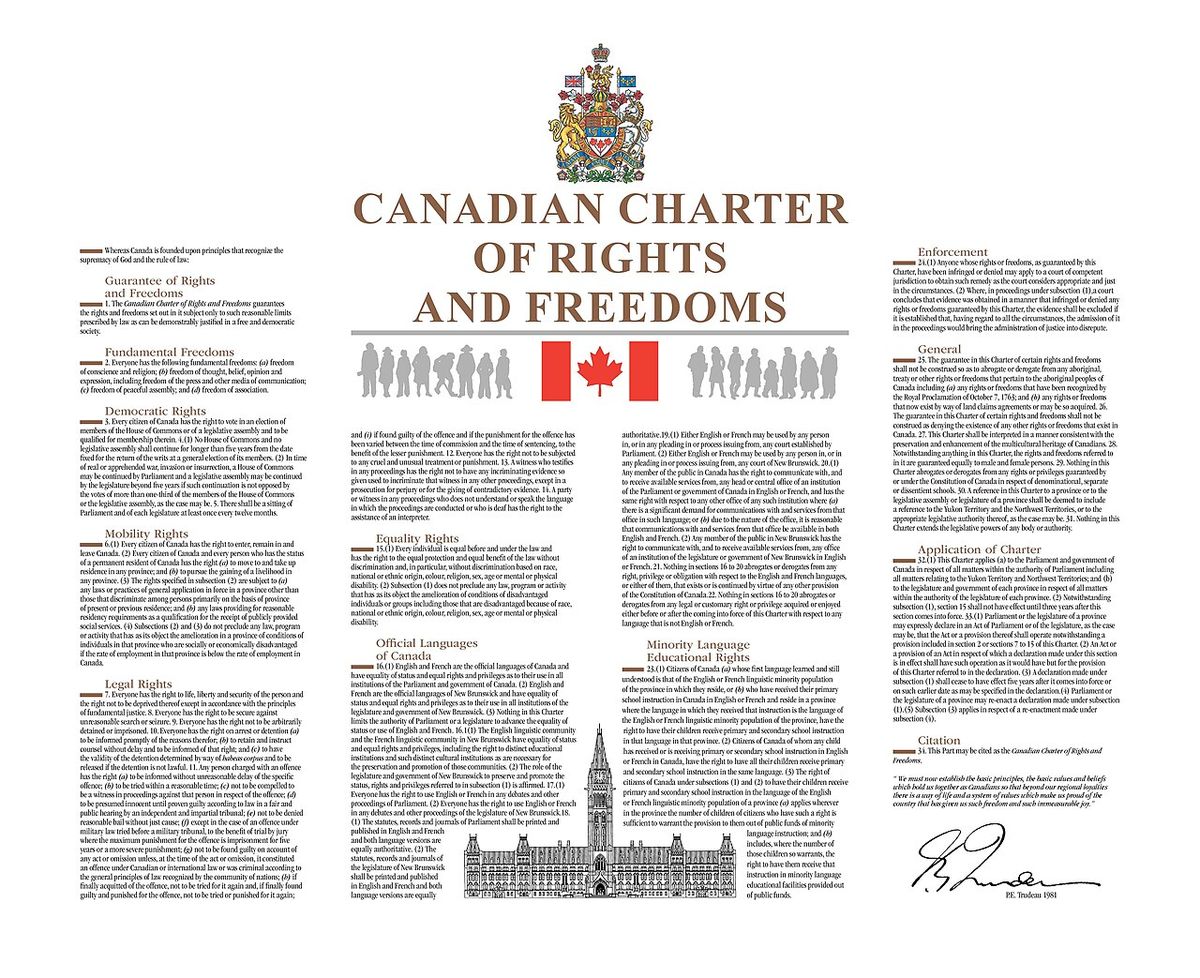
Section 7 of the Canadian Charter of Rights and Freedoms
Section 7 of the Canadian Charter of Rights and Freedoms is a constitutional provision that protects an individual's autonomy and personal legal rights from government actions. It guarantees everyone the right to life, liberty, and security of the person, stating these rights cannot be deprived except in accordance with the principles of fundamental justice. This section has evolved from a procedural safeguard into one of the Charter's most powerful and frequently litigated rights, touching upon major national policy issues such as abortion, assisted dying, and health care. Its interpretation by the courts, particularly the Supreme Court of Canada, has made it a central and sometimes controversial engine of constitutional change in Canadian law.
Text and Application
The text of section 7 states that everyone has the right to life, liberty and security of the person and the right not to be deprived thereof except in accordance with the principles of fundamental justice. The term 'everyone' has been interpreted broadly to include all individuals physically present in Canada, encompassing citizens, permanent residents, and non-citizens alike. This broad application ensures fundamental protections for anyone within Canadian jurisdiction. However, the Supreme Court has clarified that corporations cannot claim the benefit of section 7 rights as they are not individuals. A section 7 violation can occur if the government is a participant or complicit in conduct where a deprivation of these rights is a reasonably foreseeable consequence.
The provision is situated within the Charter's 'Legal Rights' sections, which run from sections 7 to 14. It is subject to the general limitation clause in section 1, which allows governments to justify reasonable limits on rights in a free and democratic society. In practice, the analysis under section 7 and the principles of fundamental justice often subsumes the section 1 justification analysis. The rights protected are negative rights, meaning they guard against state deprivation rather than imposing positive obligations on the government to provide life, liberty, or security. The Supreme Court has not ruled out the possibility of section 7 imposing positive obligations in the future, but jurisprudence has consistently held it does not create a right to government assistance or services.

The Three Protected Rights
Section 7 protects three distinct but interrelated rights: life, liberty, and security of the person. The right to life constitutes the basic right to be alive and was historically treated as paramount. In the 1993 case Rodriguez v British Columbia (AG), the Supreme Court denied that a right to assisted suicide could be derived from security of the person, as it would destroy life. This position was unanimously reversed in 2015 in Carter v Canada (AG), where the Court found a blanket criminal ban on physician-assisted dying violated section 7 for competent adults with grievous medical conditions, leading to the passage of federal legislation. The right to life continues to be a foundational concept, but its interaction with personal autonomy has been significantly redefined.
The right to liberty protects an individual's freedom from physical restraint, such as unjust imprisonment. It has also been expansively interpreted to include the power to make fundamentally personal choices about one's life. In R v Clay (2003), the Court described it as touching the core of autonomous human dignity in matters that are inherently personal. This right is individual in nature. The Supreme Court has rejected arguments that it protects collective or family rights, as seen in B (R) v Children's Aid Society (1995) and I.L.W.U. v The Queen (1992) regarding union strike rights. Specific liberties like freedom of religion or movement are addressed by other Charter sections, such as sections 2 and 6.
The right to security of the person encompasses both physical and psychological integrity. It protects against significant government-inflicted harm to one's body or mental state. This right was central to legalizing abortion in R v Morgentaler (1988), where the Court found procedures threatening women's health breached security of the person. It was also invoked in Chaoulli v Quebec (AG) (2005), where a majority found bans on private health insurance could breach security by causing treatment delays. In R v Levkovic (2013), the Supreme Court found that security of the person could not be used to justify a mother's failure to report a stillbirth. The courts have generally resisted reading pure economic rights into security of the person, maintaining the provision's focus on legal and personal integrity rather than socioeconomic entitlements.
Principles of Fundamental Justice
The deprivation of life, liberty, or security of the person is only permissible if done in accordance with the principles of fundamental justice. These principles are the core values underlying the justice system and form a crucial limit on state power. In the landmark 1985 decision Re BC Motor Vehicle Act, the Supreme Court established that these principles include substantive guarantees, not just procedural fairness. A principle must be a legal principle, there must be sufficient societal consensus that it is fundamental to how the legal system operates fairly, and it must be precise enough to provide a manageable legal standard. Over decades, the Court has identified a wide array of such principles.
The established principles of fundamental justice include both procedural and substantive guarantees. Procedural principles ensure fair legal processes, such as the right to make full answer and defence and the right to silence. Substantive principles govern the content of laws themselves and include prohibitions on arbitrariness, vagueness, overbreadth, and gross disproportionality. These principles are core values within the justice system that must prevail over the rights to life, liberty, and security of the person for the greater good of society.
- Arbitrariness: Laws must not be arbitrary. A limit on rights must relate to the law's objective.
- Vagueness: Laws must be sufficiently clear to provide notice and guide legal debate.
- Overbreadth: Laws must not be broader than necessary to achieve their objective.
- Gross Disproportionality: State actions cannot be so extreme as to be disproportionate to any legitimate government interest.
- Requirement of Mens Rea: For serious crimes, a guilty mind (intent) must generally be proven.
- Right to Make Full Answer and Defence: Includes the right to disclosure, counsel, and to confront witnesses.
- Right to Silence: The state cannot compel self-incrimination or infer guilt from silence.
- Moral Culpability for Youths: Young people are presumed to have diminished moral culpability.
- Shocks the Conscience: Extradition to a risk of torture would breach fundamental justice.
- Court-Appointed Counsel: For an indigent accused facing a serious criminal charge.
- Moral Involuntariness: A person may not be found guilty if deprived of a realistic choice to break the law due to perilous circumstances.
- Lawyers' Duty to Clients: The state cannot impose obligations that undermine a lawyer's duty of commitment to clients.
The Supreme Court of Canada has rejected numerous proposed principles of fundamental justice. For example, in the 2003 case R v Malmo-Levine, the Court rejected the claim that an element of 'harm' was a required component for all criminal offences. In R v DeSousa, the Court rejected the requirement for symmetry between all actus reus and mens rea elements. The Court also rejected, in Canadian Foundation for Children, Youth and the Law v Canada (AG), the claim that laws affecting children must be in their best interests. Finally, in R v Safarzadeh‑Markhali, the Court held that sentencing proportionality did not have freestanding constitutional status as a principle of fundamental justice.
Major Cases and Policy Impact
Section 7 jurisprudence has been the vehicle for some of the most significant constitutional decisions in Canadian history, directly reshaping national policy. The 1988 case R v Morgentaler struck down Canada's abortion law, finding the procedural hurdles of Therapeutic Abortion Committees violated women's security of the person. In 2015, Carter v Canada (AG) reversed prior precedent and declared the criminal prohibition on physician-assisted dying unconstitutional, leading to the federal medical assistance in dying regime. The 2013 case Canada (AG) v Bedford invalidated certain prostitution-related laws for violating the security of person of sex workers, prompting legislative reform.
- R v Morgentaler (1988): Struck down Canada's abortion law for violating security of the person.
- Carter v Canada (AG) (2015): Struck down the blanket criminal ban on physician-assisted dying.
- Canada (AG) v Bedford (2013): Invalidated laws against bawdy-houses and living on the avails of prostitution.
- Chaoulli v Quebec (AG) (2005): Found Quebec's ban on private health insurance could breach security of the person.
- PHS Community Services Society v Canada (2011): Upheld an exemption for a supervised drug consumption site in Vancouver.
- R v Clay (2003): Affirmed that liberty includes the power to make fundamental personal choices.
- Rodriguez v British Columbia (AG) (1993): Initially upheld the ban on assisted suicide, later reversed.
- Re BC Motor Vehicle Act (1985): Established that principles of fundamental justice include substantive guarantees.
Section 7 has broad application beyond merely protecting due process in administrative and adjudicative proceedings. It has touched upon major national policy issues such as entitlement to social assistance and public health care. The provision provides both substantive and procedural rights. The Supreme Court has not ruled out the possibility that section 7 could be interpreted to convey positive rights or impose positive obligations upon the government, though it has not been interpreted to do so thus far.
Comparison with Other Instruments
Section 7 finds parallels in other human rights documents but has distinct Canadian characteristics. The Fifth and Fourteenth Amendments to the United States Constitution protect life, liberty, and property, and prohibit deprivation without 'due process of law.' The Canadian Charter's use of 'fundamental justice' rather than 'due process' was intentional, allowing Canadian courts to develop a uniquely substantive interpretation beyond mere procedure. The pre-Charter Canadian Bill of Rights also protected life, liberty, security, and enjoyment of property, but was a statutory instrument with less force. A critical difference is the explicit omission of property rights from section 7, a deliberate choice that has been upheld by the courts and distinguishes the Charter from its American counterpart.
The section's protections are reflected in international instruments binding on Canada, including the International Covenant on Civil and Political Rights, which protects the right to life and liberty and security of person. The exclusion of property rights is a defining feature that shapes how section 7 operates within Canada's constitutional framework. The substantive interpretation of fundamental justice, which includes principles governing the content of laws, sets it apart from similar provisions elsewhere. Jurisprudence does not support reading economic rights into security of the person, as courts have held that purely economic rights are not protected by section 7.
Evolution and Contemporary Significance
The interpretation of section 7 has evolved dramatically since the Charter's enactment in 1982. The early shift from a purely procedural to a substantive understanding in Re BC Motor Vehicle Act (1985) set the stage for its expansive application. Over four decades, the Supreme Court has developed a sprawling set of principles of fundamental justice. This doctrinal fluidity, combined with the frequent bypassing of the section 1 reasonable limits analysis, has substantially expanded the scope of judicial review. Section 7 is now frequently described as the most important right in the Charter, operating at the intersection of law, policy, and morality.
It requires courts to balance individual autonomy against state interests in areas from criminal law to healthcare. This expansion has increased the role of courts in resolving intensely political questions, raising debates about judicial activism and the proper limits of constitutional adjudication. The provision continues to be a dynamic and central feature of Canadian constitutional law, ensuring that any state interference with the core of personal autonomy must meet the highest standards of justice. Its ongoing development guarantees it will remain a primary focus for legal challenges and scholarly analysis for years to come.
Questions about Section 7 of the Canadian Charter of Rights and Freedoms
What does Section 7 of the Charter protect?
Section 7 protects three core rights: life, liberty, and security of the person. The right to life is the basic right to be alive. The right to liberty includes freedom from physical restraint and the autonomy to make fundamental personal choices. The right to security of the person protects both physical and psychological integrity from significant state-inflicted harm. These rights cannot be taken away by the government unless the deprivation is in accordance with the principles of fundamental justice, which are the basic standards of fairness in Canada's legal system.
Who does Section 7 apply to?
Section 7 applies to 'everyone' physically present in Canada. This includes Canadian citizens, permanent residents, refugees, visitors, and non-citizens. It does not apply to corporations, as they are not considered individuals capable of holding these personal rights. The Supreme Court has also held that the Charter, including section 7, can apply extraterritorially in certain circumstances, particularly where Canadian government actions abroad participate in or enable deprivations of these fundamental rights.
What are the principles of fundamental justice?
The principles of fundamental justice are the core legal values that set the standard for when the government can deprive someone of life, liberty, or security. They include both procedural and substantive rules. Key principles include that laws must not be arbitrary, vague, or overbroad, that punishments cannot be grossly disproportionate, that serious crimes require proof of criminal intent, and that individuals have rights to silence, full answer and defence, and counsel. Additional principles include the prohibition on extradition to a risk of torture, the right to court-appointed counsel for indigent accused, and the doctrine of moral involuntariness.
Can Section 7 be used to claim economic or social rights?
Generally, no. The courts have consistently held that section 7 does not protect pure economic rights, such as a right to a specific job, income, or business revenue. It is primarily concerned with legal rights and personal autonomy, not socioeconomic entitlements. For example, the Supreme Court has ruled that the ability to generate business revenue or practise a profession free from regulation is not protected. While there has been academic debate, jurisprudence does not support reading positive rights to social assistance or healthcare into section 7, though delays in medical treatment that cause serious harm can engage security of the person.
How did Section 7 change the law on assisted dying?
Section 7 was central to legalizing medical assistance in dying. In the 1993 case Rodriguez, the Supreme Court upheld the ban on assisted suicide. However, in the 2015 case Carter v Canada, the Court unanimously reversed itself. It found that the blanket criminal prohibition deprived competent adults with grievous and irremediable medical conditions of their liberty and security of the person in a manner that was overbroad and not in accordance with fundamental justice. This decision required the federal government to create a legislative framework for medical assistance in dying, which it did with Bill C-14 in 2016.
Does Section 7 protect property rights?
No, section 7 explicitly does not protect property rights. This was a deliberate choice during the drafting of the Charter. The text protects 'life, liberty and security of the person' but omits 'property,' which was included in the earlier Canadian Bill of Rights and the U.S. Constitution's Fifth Amendment. The courts have respected this omission and have refused to read property rights into the concepts of liberty or security of the person.
Sources and further reading
- Section 7 of the Canadian Charter of Rights and Freedoms (Wikipedia)
- Section 7, Life, liberty and security of the person (justice.gc.ca)
- The Supreme Court's expansion of fundamental justice ... (macdonaldlaurier.ca)
- Section 7 Rights | Life Liberty Security Explained (aclrc.com)
Checked by the Nosy Mag desk. Last updated 2026-11-03.