Constitutional history of Canada
The constitutional history of Canada is the story of the country's governing legal framework evolving from a set of British colonial rules into a sovereign national constitution. It began with the 1763 Treaty of Paris, which transferred New France to Great Britain, and encompasses the foundational Constitution Act, 1867, which created the Dominion of Canada. This history is marked by a gradual shift towards legislative autonomy, achieved fully with the Statute of Westminster in 1931, and culminated in the patriation of the constitution in 1982, which included the Canadian Charter of Rights and Freedoms. The constitution defines the structure of government, divides powers between federal and provincial authorities, and embodies the core principles of Canadian democracy and law.
Colonial Foundations and Early Governance
The constitutional journey of Canada commenced with the 1763 Treaty of Paris, which saw France cede most of New France, including Canada and Acadia, to Great Britain. The British government established its policy through the Royal Proclamation of October 7, 1763, which renamed the territory the Province of Quebec, redefined its borders, and set up a colonial government under a British-appointed governor. This proclamation served as the colony's initial constitution. Governor James Murray, appointed in 1764, faced tensions between newly arrived British merchants demanding British institutions and the existing Canadian population, who were guaranteed certain rights under the Articles of Capitulation of Montreal.
The Royal Proclamation of 1763 contained requirements like the Test Act that effectively excluded Catholics from administrative positions. This conflicted with the Articles of Capitulation of Montreal, which had granted Canadians the privilege to maintain their civil laws and practise their religion. The application of British laws caused administrative problems and legal irregularities. This led to a restoration movement among Canadian subjects, who petitioned in 1764 and again in 1773 for the full restoration of their ancient laws, privileges, and customs. Concurrently, a reform movement began as early as 1765, with British merchants in Quebec City petitioning for a representative assembly. All the other colonies of British America had parliamentary institutions, even Nova Scotia, which obtained its assembly in 1758. The British government's response to these competing pressures was the Quebec Act of 1774.
The Quebec Act of 1774 fully restored French civil law and established British criminal law. It dispensed Canadians of the test oath, replacing it with an oath to George III that had no reference to Protestantism. However, no assembly of representatives was created, which allowed the governor to keep ruling under the advice of his counsellors. The British merchants of Quebec were not pleased by this new act, which ignored their most important demands. They continued to campaign to abolish the current civil code and establish a house of assembly excluding Catholics and French speakers. The Quebec Act was also very negatively received in the British colonies to the south, where it was listed among the Intolerable Acts.
The Path to Parliamentary Government
During the American Revolutionary War, the Continental Congress attempted to rally the Canadian people to its cause. The delegates wrote three Letters to the inhabitants of Canada inviting them to join in the revolution, pleading the cause of democratic government and principles like habeas corpus and trial by jury. On May 22, 1775, Bishop of Quebec Jean-Olivier Briand sent out a mandement asking the Canadians to close their ears to the call of the rebels and defend their country and their king. Although both the British and the revolutionaries succeeded at recruiting Canadian men for militia, the majority of the people chose not to get involved in the conflict. Soon after the war ended in 1783, the constitutional question resurfaced, and numerous United Empire Loyalists were seeking refuge in Quebec and Nova Scotia. In Quebec, the newly arrived settlers contributed to increase the number of people voicing for a rapid constitutional reform, while in Nova Scotia, the immigrants demanded a separate colony.
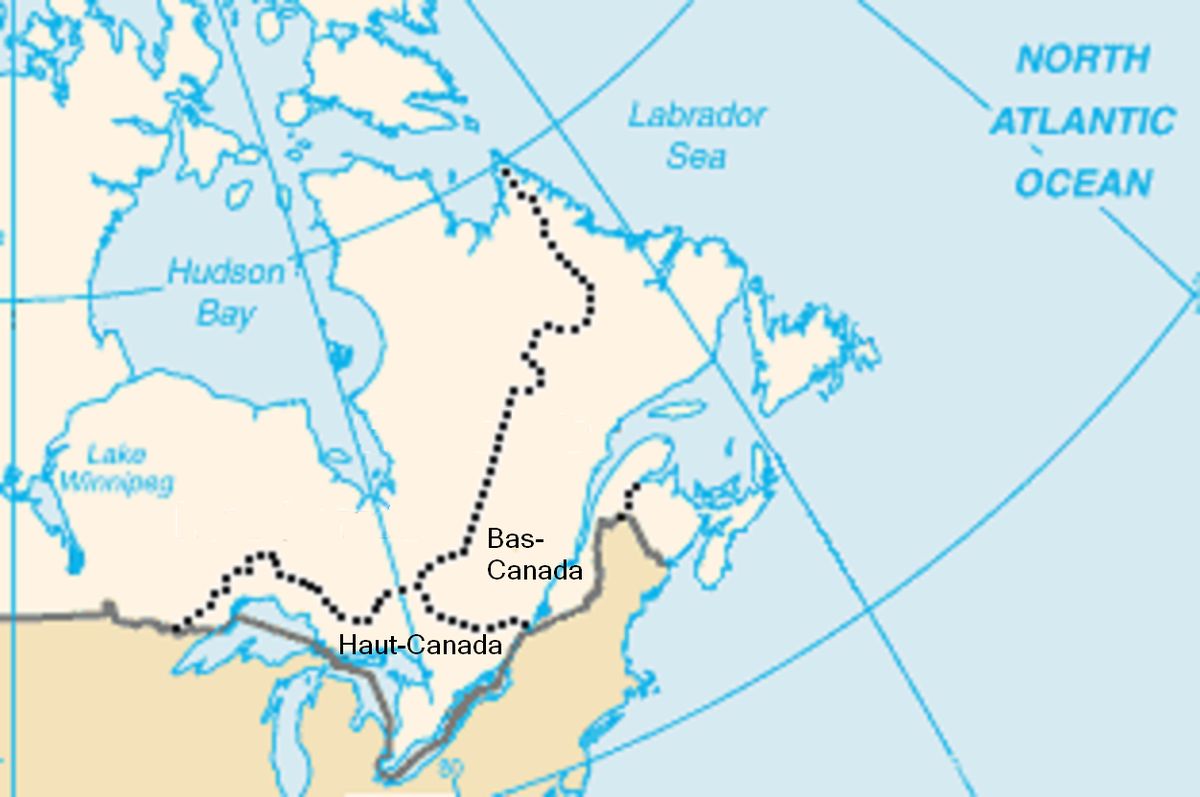
On October 20, 1789, Home Secretary William Wyndham Grenville wrote a private and secret letter to Governor Guy Carleton, now Lord Dorchester, informing him of plans to modify Canada's constitution. The letter leaves little doubt as to the influence that American independence and the recent taking of the Bastille in France had on the decision. Grenville prepared the constitution in August 1789, and it was later presented to the House of Commons. British merchants established in Quebec sent Adam Lymburner to Britain to present their objections to the plan. They requested revisions like elections every three years instead of seven and an electoral division which would have overrepresented the Old Subjects. The result was the Constitutional Act of 1791, enacted in London, which gave Canada its first parliamentary constitution by dividing the Province of Quebec into Lower Canada and Upper Canada.
The Constitutional Act of 1791 gave each new province an elected Legislative Assembly, an appointed Legislative Council, and an appointed Executive Council. The Legislative Assembly was to be established with no fewer than sixteen members in Upper Canada and fifty members in Lower Canada. The Legislative Council was to have no fewer than seven members in Upper Canada and fifteen in Lower Canada. Provisions were made to allot clergy reserves to the Protestant churches in each province. This partition ensured that Loyalists would constitute a majority in Upper Canada and allowed for the application of exclusively British laws in this province. In Lower Canada, the coexistence of French civil law and English criminal law continued. Although it solved immediate problems, the new constitution brought political problems rooted in the constitution, including that the Legislative Assemblies did not have full control over provincial revenues and the Executive and Legislative Councils were not responsible to the Legislative Assembly.
Struggles and Proposals for Reform
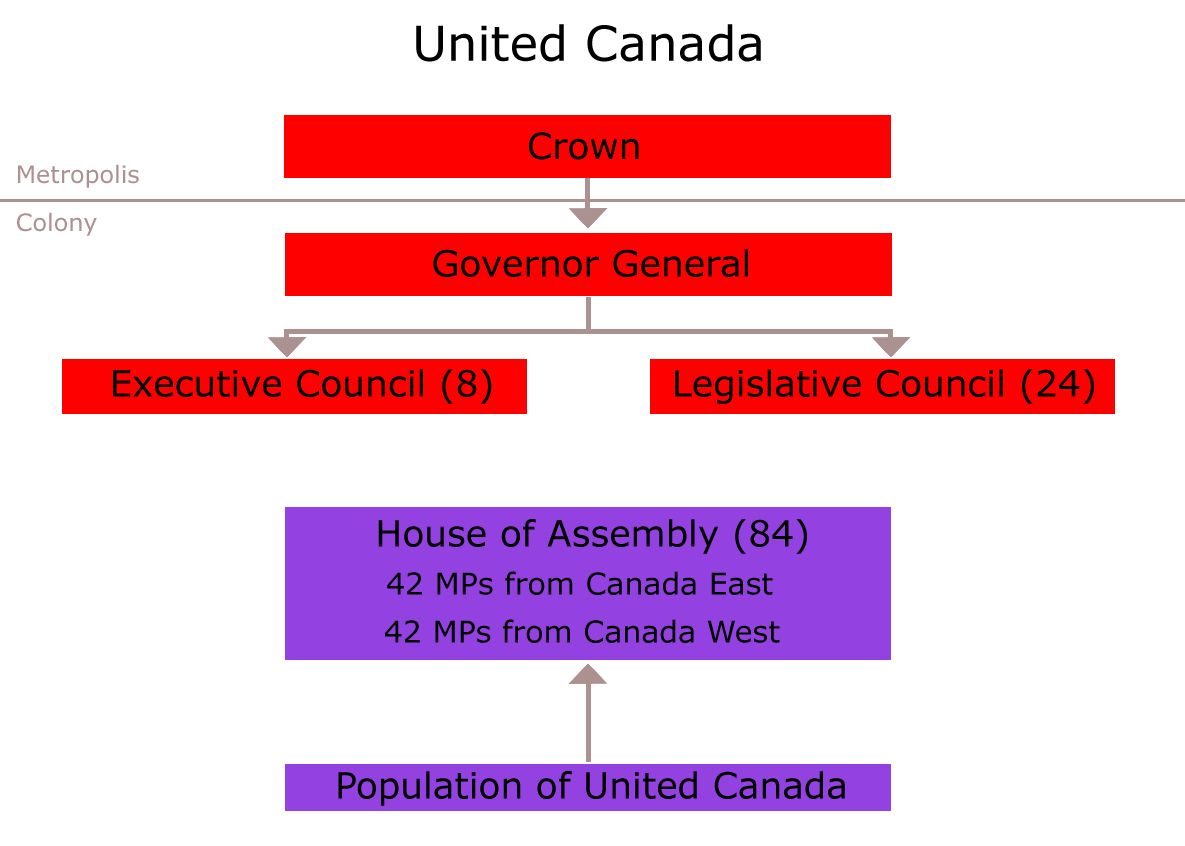
The constitutional systems established in 1791 soon revealed inherent flaws, leading to sustained movements for reform in both provinces led by the Parti canadien in Lower Canada and the Reformers in Upper Canada. In Lower Canada, leader Pierre-Stanislas Bédard formulated a project for ministerial responsibility, proposing that the governor appoint Legislative Council members on the recommendation of the elected House to end the opposition between the assembly and the governor's council. A major crisis emerged in 1822 with the secret submission of a union bill to the British House of Commons by Colonial Secretary Lord Bathurst and his under-secretary Robert John Wilmot-Horton. This bill proposed merging the two provinces into one, with a legislature where each section would have a maximum of 60 representatives, effectively placing the French-speaking majority of Lower Canada into a minority position, a plan supported by Governor Dalhousie and some anglophone petitioners. The revelation of this bill sparked widespread mobilization and opposition in both Canadas, with petitions gathering some 60,000 signatures, and the subject was discussed as soon as the Parliament of Lower Canada opened on January 11, 1823. The Legislative Assembly adopted a resolution ten days later authorizing a delegation to go to London to present the quasi-unanimous opposition of Lower Canada to the project of union. Having in their possession a petition of thousands of signatures, the Speaker of the House of Assembly, Louis-Joseph Papineau, and John Neilson went to London to present the opinion of the colony. In 1828, a Select Committee of the House of Commons on the Civil Government of Canada recommended against the union and in favour of constitutional reforms. In 1834, the Legislative Assembly of Lower Canada adopted the Ninety-Two Resolutions, demanding vast democratic reforms, but these were rejected by the British government in the 1837 Russell Resolutions.
Confederation and the Division of Powers
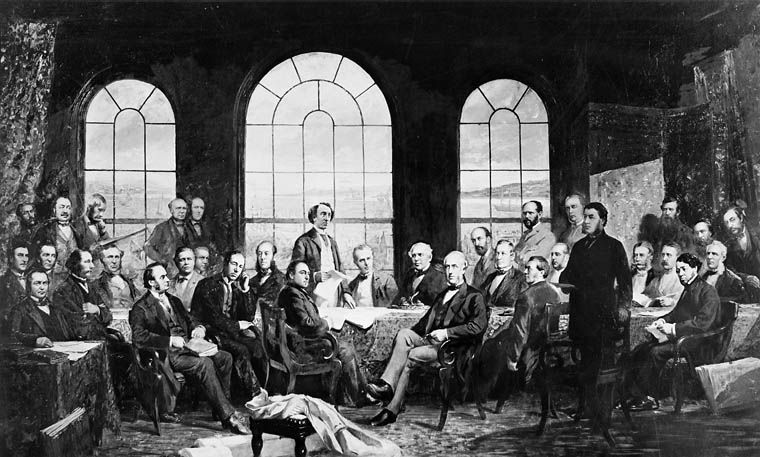
The culmination of earlier attempts to resolve political deadlock and expand a colonial union was the British North America Act, 1867, now known as the Constitution Act, 1867. This act created the Dominion of Canada by federating the provinces of Ontario, Quebec, Nova Scotia, and New Brunswick, with other provinces joining later. It served as the new country's foundational constitutional document, outlining a federal system with a division of powers between the central Parliament and the provincial legislatures, where the federal legislature was given power to legislate on all matters not explicitly assigned to the provincial legislatures. The federal government was granted authority over matters of national concern like trade, defence, criminal law, money, and the postal service, while provinces controlled local matters such as education, property, civil rights, and the administration of justice. The act also established the basic structure of Parliament, including the House of Commons, the Senate, and the Crown's representative, the Governor General, and it gave the federal government the right to disallow any provincial act within two years of its passage. Despite creating a self-governing dominion, the Constitution Act, 1867 remained an act of the British Parliament, meaning major amendments still required approval from Westminster as the act comprised no domestic amendment formula. Britain retained the theoretical right to disallow Canadian laws, a power used occasionally in the first decade but which stopped after 1880, and the judicial system allowed for final appeals to the Judicial Committee of the Privy Council in London until 1933 for criminal cases and 1949 for civil cases, which often applied a stricter interpretation of federal powers.
Achieving Legislative Independence and Patriation
Canada's journey to full legislative independence was a gradual process, with a key milestone being the Statute of Westminster, passed by the British Parliament on December 11, 1931. This statute implemented the 1926 Balfour Declaration, formally establishing that Canada and other dominions were autonomous communities equal in status to the United Kingdom and independent of it. It renounced British powers to disallow Canadian laws or legislate for any dominion without its consent, and it brought about the legal division of the Imperial Crown into a distinct Crown for each Dominion. Despite this achievement, the Canadian Constitution, the British North America Acts, remained a British Act of Parliament, as the federal and provincial governments could not agree on a suitable amending formula to patriate it. For decades, negotiations continued, with a constitutional conference in 1971 producing the Victoria Charter, a proposal for patriation that the provinces failed to confirm, and similar efforts failed in 1975 and 1976. The movement was further fueled by the 1960 Canadian Bill of Rights, a federal statute that protected rights but was not constitutionally entrenched and only applied to the federal government. In 1982, the Canada Act 1982 was passed by the British Parliament, enacting the Constitution Act, 1982 which included the Canadian Charter of Rights and Freedoms and a set of procedures allowing the Constitution to be amended in Canada. This act finally patriated the constitution, transferring ultimate constitutional authority from London to Canada and marking the country's full sovereignty over its fundamental law. The government of Quebec did not assent to this patriation.
The Modern Constitutional Framework
The Constitution of Canada today is not one legal document but a complex mix of statutes, orders, British and Canadian court decisions, and generally accepted practices known as constitutional conventions. Its core written components are the Constitution Act, 1867, which outlines the distribution of powers, and the Constitution Act, 1982, which includes the Charter of Rights and Freedoms. The constitution also includes principles from English laws like the Bill of Rights of 1689 and the Act of Settlement of 1701, and it reaffirms Canada's dual legal system by incorporating Quebec's Civil Law derived from France. Unwritten conventions are of the utmost importance to effective constitutional government, such as the rule that the prime minister must have the support of the elected House of Commons to remain in power and the convention for regional allocation of Supreme Court seats. The courts will not enforce these conventions, but a government that violated them would almost certainly face electoral defeat, as they form a critical part of the total constitution of the country alongside constitutional law. The Constitution defines the three branches of government: the executive branch where the King's powers are exercised by the Cabinet on the advice of Ministers responsible to Parliament, the legislative branch consisting of the King, the Senate and the House of Commons, and the judicial branch composed of independent judges. The federal structure divides legislative powers, with Parliament able to make laws for all of Canada on assigned matters like national defence and interprovincial trade, and provincial legislatures making laws on matters within their borders like hospitals and municipalities. The Constitution Act, 1867 authorized Parliament to establish a general court of appeal, and the constitution continues to evolve, reflecting the shifting legal, social and political pressures facing Canadians from colonial times to the present day.
Key Constitutional Documents and Their Provisions
| Document | Year | Key Provisions |
|---|---|---|
| Treaty of Paris | 1763 | Ceded New France (Canada) and Acadia to Great Britain. |
| Royal Proclamation | 1763 | Renamed colony Province of Quebec, established British colonial government. |
| Quebec Act | 1774 | Expanded borders, restored French civil law, allowed Catholic faith, established British criminal law. |
| Constitutional Act | 1791 | Divided Quebec into Upper and Lower Canada, created elected Legislative Assemblies. |
| Act of Union | 1840 | United Upper and Lower Canada into the Province of Canada. |
| British North America Act / Constitution Act, 1867 | 1867 | Created Dominion of Canada, established federal system and division of powers. |
| Statute of Westminster | 1931 | Granted full legislative autonomy, established equality of dominions with UK. |
| Canada Act / Constitution Act, 1982 | 1982 | Patriated constitution, entrenched Canadian Charter of Rights and Freedoms, created amending formula. |
Questions about Constitutional history of Canada
What was the first constitution of Canada?
The first constitutional document for the territory that became Canada was the Royal Proclamation of 1763. It renamed Canada "The Province of Quebec", redefined its borders, and established a British-appointed colonial government. The proclamation was considered the constitution of Quebec until the Quebec Act of 1774. The first parliamentary constitution was the Constitutional Act of 1791, which divided Quebec into Upper and Lower Canada and created elected Legislative Assemblies for each province.
When did Canada become fully independent from Britain?
Canada achieved full legislative independence from the United Kingdom with the Statute of Westminster in 1931. This statute formally established that Canada was an autonomous dominion equal in status to Britain, and it ended British powers to disallow Canadian laws. The Canadian constitution itself remained an act of the British Parliament until it was patriated in 1982. The Constitution Act, 1982, which included the Charter of Rights and Freedoms, was the final step, transferring ultimate constitutional authority from London to Canada.
What is the difference between the Constitution Act, 1867 and 1982?
The Constitution Act, 1867, originally called the British North America Act, is the founding document that created the Dominion of Canada as a federation. It outlines the structure of the federal government and the division of powers between federal and provincial jurisdictions. The Constitution Act, 1982, is a later major amendment that achieved two primary goals. It patriated the constitution, meaning it was brought fully under Canadian control, and it entrenched the Canadian Charter of Rights and Freedoms, which guarantees fundamental freedoms and legal rights to all Canadians.
Why was the Quebec Act of 1774 significant?
The Quebec Act was a major pre-Confederation statute that significantly shaped Canada's legal and cultural character. It addressed grievances of the French Canadian majority by restoring French civil law for private matters, officially permitting the free practice of the Catholic faith, and removing the Protestant test oath for holding public office. It also greatly expanded the province's territory. The act was a pragmatic response to govern a predominantly French and Catholic colony, but its refusal to create an elected assembly angered British merchants and was one of the Intolerable Acts that contributed to the American Revolution.
What are constitutional conventions?
Constitutional conventions are unwritten rules and practices that are considered binding in the operation of a government. They are not laws enforceable by courts but are essential to the functioning of the constitutional system. Key conventions in Canada include the requirement that the prime minister and premiers must have the confidence of the elected legislature to govern, and that the Governor General exercises royal powers only on the advice of ministers. These conventions fill in the gaps left by written documents and adapt the constitution to changing political realities without formal amendment.
How can the Canadian Constitution be amended?
The Canadian Constitution can be amended using the procedures set out in the Constitution Act, 1982. There is no single formula. The general amending formula, often called the 7/50 rule, requires the approval of the Senate and House of Commons, plus the legislative assemblies of at least two thirds of the provinces (seven) that together represent at least 50 percent of the national population. Some changes, like altering the composition of the Supreme Court or the monarchy, require unanimous consent of all provinces and the federal Parliament. This complex system is designed to balance national unity with provincial autonomy.
Sources and further reading
- Constitutional history of Canada (Wikipedia)
- Canada, Constitutional history of (constitutionnet.org)
- The Canadian Constitution, About Canada's System of ... (justice.gc.ca)
- Constitutional History of Canada (thecanadianencyclopedia.ca)
Checked by the Nosy Mag desk. Last updated 2026-10-31.