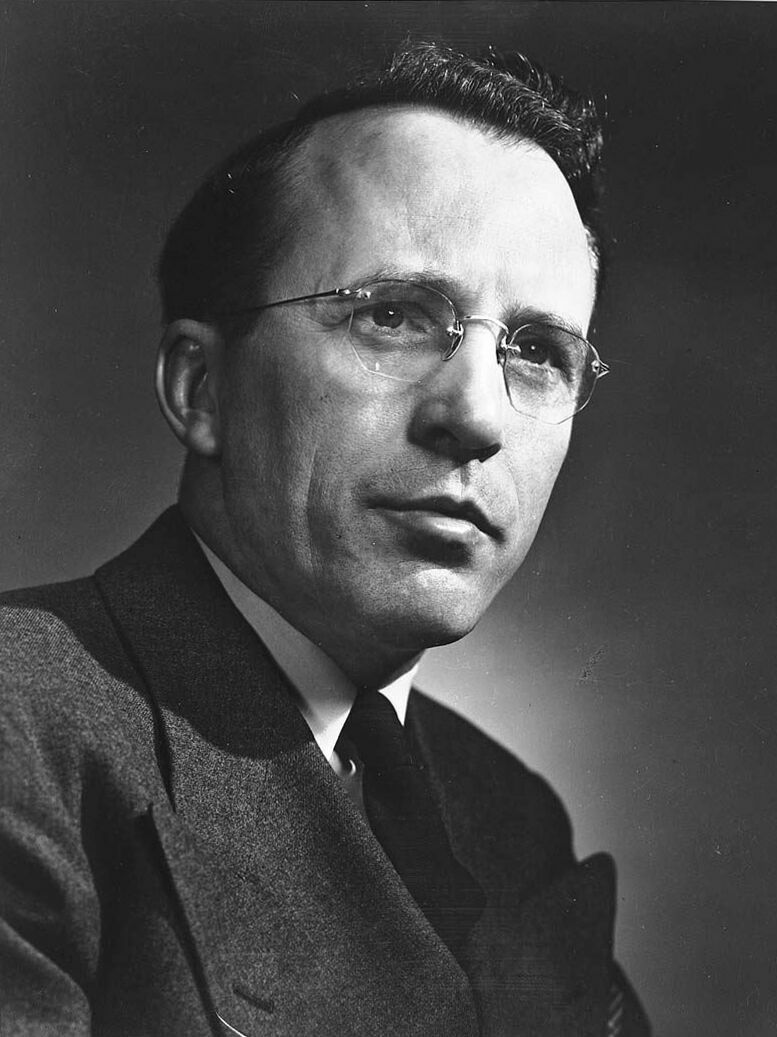
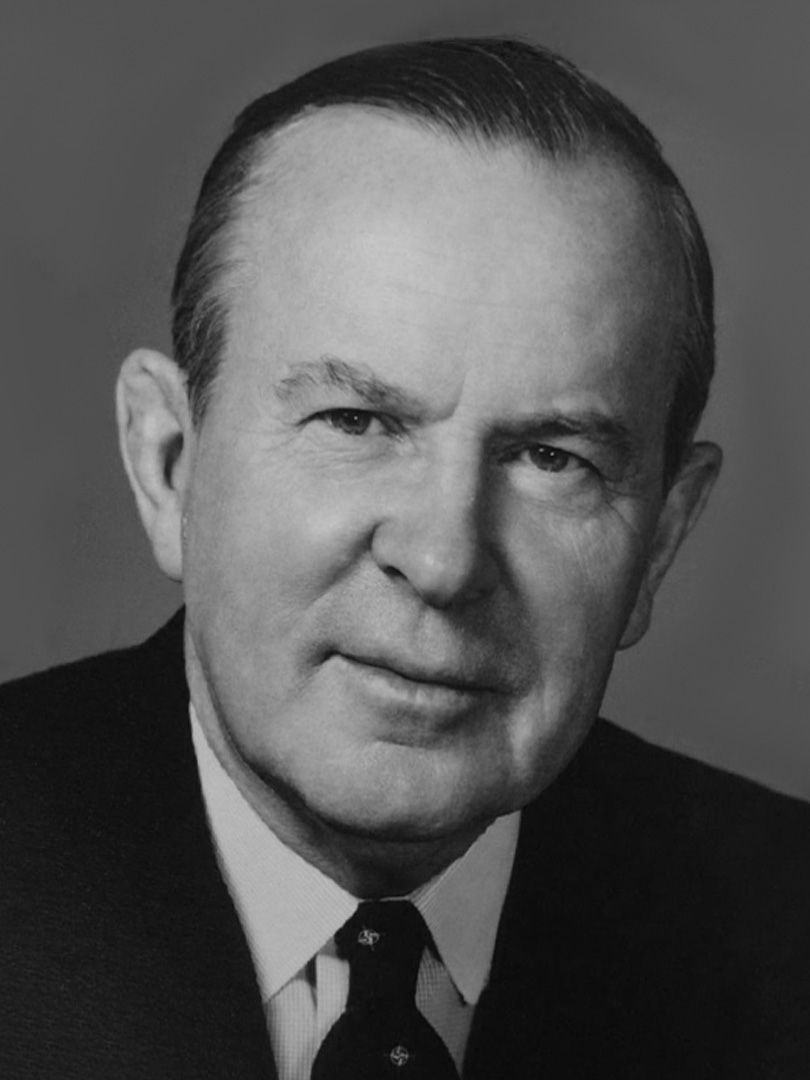
Louis St. Laurent
Louis Stephen St. Laurent was the 12th prime minister of Canada, serving from 1948 to 1957. A bilingual lawyer from Quebec, he succeeded William Lyon Mackenzie King and led the Liberal Party to two decisive majority governments. His tenure oversaw a period of significant nation-building, marked by the creation of major infrastructure projects and the expansion of the social safety net. St. Laurent's government also played a major role in shaping Canada's postwar international identity, championing NATO and the concept of UN peacekeeping.
Early life and legal career
Louis St. Laurent was born on February 1, 1882, in the predominantly English-speaking village of Compton, Quebec. He was the eldest of seven children born to Jean-Baptiste-Moïse Saint-Laurent, a French Canadian shopkeeper and Liberal supporter, and Mary Anne Broderick, an Irish Canadian. This heritage made him fluently bilingual from childhood, with an Irish lilt to his English and distinctly French mannerisms. His early political awareness was shaped by his father's fervent support for Sir Wilfrid Laurier, and as a 14-year-old, he relayed election returns from his father's store when Laurier won in 1896. St. Laurent earned a Bachelor of Arts from Séminaire Saint-Charles-Borromée in 1902 and a law degree from Université Laval in 1905, declining a Rhodes Scholarship upon graduation. He married Jeanne Renault in 1908, and they had five children together, including their son Jean-Paul St. Laurent.
St. Laurent established a highly successful legal career, practising corporate, commercial, and constitutional law in Quebec from 1905 to 1942. He became a professor of law at Université Laval in 1914 and served as president of the Canadian Bar Association from 1930 to 1932. His courtroom prowess was notable, including a 1907 case where he unusually cross-examined a priest and nuns over a contested will, and a 1912 victory in a case against the Canadian Pacific railway. In 1923, he opened his own law office, and in 1926, he argued before the Supreme Court for religious minority rights, advocating for Jewish representation on Montreal's Protestant school board. Although this specific bid failed, it contributed to Quebec recognizing the right to establish separate schools for non-Christians. Despite his Liberal convictions, St. Laurent remained detached from active politics, focusing on his practice and family, and he twice declined offers of a seat on the Supreme Court of Canada, cementing his reputation as one of the country's most respected counsel.
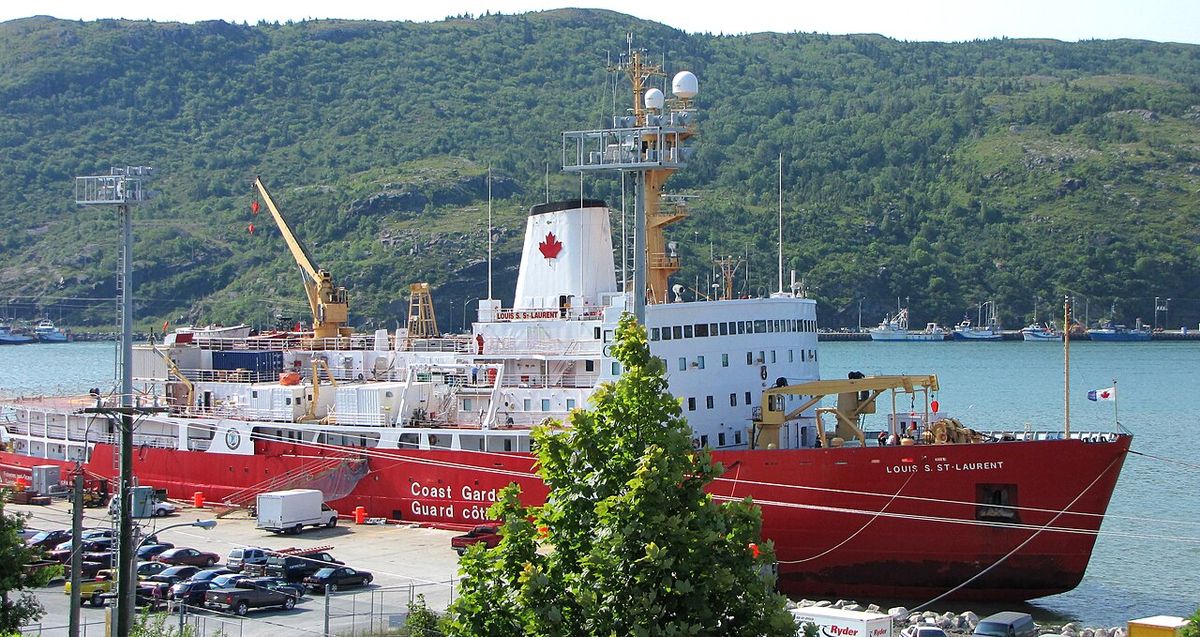
Entry into politics and cabinet service
St. Laurent's entry into politics came at the urgent request of Prime Minister William Lyon Mackenzie King in late 1941, following the death of King's Quebec lieutenant, Ernest Lapointe. King needed a respected figure from Quebec to manage the volatile conscription issue and maintain national unity, fearing a repeat of the divisions from the 1917 Conscription Crisis. Persuaded by a sense of duty, St. Laurent agreed to a temporary wartime role and entered cabinet as Minister of Justice on December 9, 1941. He won a by-election in the riding of Quebec East in February 1942, a seat previously held by both Lapointe and Wilfrid Laurier. As justice minister, his crucial support for King's decision to introduce limited conscription in 1944 prevented more than a handful of Quebec Liberal MPs from leaving the party and was therefore essential to keeping the government united during the Conscription Crisis of 1944. St. Laurent became King's right-hand man and represented Canada at the 1945 San Francisco Conference that founded the United Nations.
In 1946, King promoted St. Laurent to Secretary of State for External Affairs, a portfolio the prime minister had always kept for himself, seeing him as his natural successor. In this role, St. Laurent articulated a vision for Canada's postwar foreign policy. In a seminal 1947 speech at the University of Toronto, he described the five basic principles of Canadian policy, emphasizing national unity, political liberty, respect for the rule of law, and a willingness to accept international responsibilities. He was a leading proponent of the North Atlantic Treaty Organization, advocating for a collective security pact to supplement what he saw as a United Nations failing to provide security from Soviet communism. St. Laurent also played a direct role in bringing Newfoundland into Confederation, leading negotiations with Joey Smallwood in the summer of 1947 and the fall of 1948, and ignoring objections from the Quebec government which had land claims. Newfoundland became Canada's tenth province on March 31, 1949, with St. Laurent presiding over the ceremonies as prime minister.
- December 9, 1941: Appointed Minister of Justice by Prime Minister King following Ernest Lapointe's death.
- February 1942: Won by-election in Quebec East, securing a seat in Parliament.
- 1944: Provided key support for conscription, preventing a major Liberal split in Quebec.
- 1945: Attended the San Francisco Conference as Canada's representative during the founding of the UN.
- 1946: Appointed Secretary of State for External Affairs, taking over King's former portfolio.
- 1947: Delivered the defining 'Gray Lecture' on the foundations of Canadian foreign policy.
- 1948: Led final successful negotiations for Newfoundland's entry into Confederation.
- August 7, 1948: Won the Liberal Party leadership convention, succeeding the retiring Mackenzie King.
Prime Minister and election victories
When William Lyon Mackenzie King retired in 1948 after over 21 years in power, he quietly persuaded his senior ministers to support St. Laurent's selection as the new Liberal leader. St. Laurent won the Liberal leadership convention on August 7, 1948, exactly 29 years after King became leader, and was sworn in as prime minister on November 15, becoming Canada's second French Canadian prime minister after Laurier. He was the first prime minister to reside at the official residence at 24 Sussex Drive, then known as 24 Sussex Street, moving in during 1951 and living there until 1957. St. Laurent immediately sought a public mandate, leading the Liberals into the 1949 federal election. On the campaign trail, he cultivated a warm, approachable 'Uncle Louis' persona, chatting with children and giving speeches in his shirtsleeves, which resonated powerfully with voters. This common touch helped secure a historic landslide victory over Progressive Conservative leader George Drew, with the Liberals winning 191 seats, a record for the party that still stands and their second-best result in terms of proportion of seats. St. Laurent led the Liberals to another powerful majority in the 1953 federal election, once again defeating PC leader George Drew. Although the party lost 22 seats from its 1949 high, it still maintained a comfortable majority of three dozen seats more than needed, enabling them to dominate the House of Commons. These back-to-back majorities reflected broad public approval of the government's postwar management and St. Laurent's personal popularity, with many considering him unbeatable.
Domestic policy and nation-building
The St. Laurent government presided over a period of remarkable economic growth and social expansion, using postwar taxation surpluses no longer needed for the military to fund ambitious programs after paying down war and depression debts. His administration significantly enlarged the Canadian welfare state, introducing federal-provincial cost-sharing for old-age pensions and launching the Hospital Insurance program in 1957, an early foundation for the nationwide Medicare system that would follow. This scheme laid the groundwork for Tommy Douglas's healthcare system in Saskatchewan and later nationwide universal healthcare. Under the legislation, the federal government paid about fifty percent of the cost of provincial plans covering a basic range of inpatient hospital services, with the condition that all citizens be entitled to benefits. By March 1963, 98.8 percent of Canadians were covered by this Hospital Insurance.
Other social reforms included the universalization of old-age pensions for all Canadians aged seventy and above in 1951, the introduction of old age assistance for needy Canadians aged sixty-five and above in 1951, and allowances for the blind in 1951 and the disabled in 1954. The government amended unemployment insurance in 1953 to provide benefits for those incapacitated due to illness or injury and amended the National Housing Act in 1954 to provide federal financing for non-profit organizations. In 1951, the government also introduced the registered retirement savings plan, providing a new tool for personal financial security. St. Laurent's era was also defined by monumental public works projects that physically connected and modernized the country. His government initiated the construction of the Trans-Canada Highway, a coast-to-coast roadway system. It partnered with the United States to develop the St. Lawrence Seaway, a major engineering feat for navigation and power. Other key infrastructure projects included the Canso Causeway linking Cape Breton to mainland Nova Scotia and the controversial Trans-Canada Pipeline to transport natural gas from Alberta to central Canada. These initiatives represented a confident, forward-looking vision of federal leadership in nation-building.
Foreign policy and international affairs
St. Laurent and his foreign minister, Lester B. Pearson, crafted an activist international policy for Canada as a 'middle power,' a role he described as occupying a social, military, and economic position in the postwar world. A fundamental element was Canada's role as a founding member and strong proponent of the North Atlantic Treaty Organization in 1949, serving as an architect and signatory of the treaty, which marked a departure from Mackenzie King's reticence about military alliances. During the Korean War, Canada committed the third-largest overall contribution of troops, ships, and aircraft to the United Nations force, sending over 26,000 volunteers selected on a voluntary basis. The government's most celebrated foreign policy achievement came in 1956 during the Suez Crisis. Pearson, acting on St. Laurent's long-held belief from 1946 in a UN military force to preserve peace, proposed and helped establish the United Nations Emergency Force, the first official peacekeeping mission, which helped resolve the conflict. Pearson was awarded the 1957 Nobel Peace Prize for this innovation.
In early 1954, St. Laurent took a 42-day world tour, visiting 12 countries including France, Germany, Japan, India, and Pakistan to get a better picture of global problems. While the tour was a diplomatic success, some observers, including cabinet ministers and author Dale C. Thomson, noted it marked a personal turning point, after which the prime minister showed signs of fatigue, indifference, and even depression. His government also authorized the 1953 High Arctic relocation, a controversial program that forcibly moved 92 Inuit to modern-day Nunavut, an action with lasting negative consequences for the communities involved. St. Laurent was always highly sensitive to national cleavages, insisting that external policies must not destroy Canada's internal unity, stating that a disunited Canada would be a powerless one.
| Key Foreign Policy Initiative | Year | Significance and Canadian Role |
|---|---|---|
| Founding of NATO | 1949 | Canada was a founding member. St. Laurent was a leading proponent and signatory, seeing it as necessary to supplement UN security. |
| Suez Crisis & UNEF Creation | 1956 | Pearson's peacekeeping proposal, based on St. Laurent's 1946 ideas, won the Nobel Peace Prize. |
| World Tour | 1954 | St. Laurent visited 12 countries across Europe and Asia. Some saw it as the beginning of his political decline. |
| Gouzenko Affair | 1945 | As justice minister, St. Laurent's office was where Soviet cipher clerk Igor Gouzenko defected, revealing a major spy ring. |
1957 defeat, retirement, and historical view
Despite his government's popularity, St. Laurent's final term was marred by the contentious debate over the Trans-Canada Pipeline in 1956. Facing procedural delays from the opposition, the government invoked closure to limit debate and force the bill through Parliament. This heavy-handed tactic was widely perceived as arrogance born of 22 years in power and damaged the Liberals' reputation, creating the perception they had become arrogant. In the 1957 federal election, the Progressive Conservatives under John Diefenbaker successfully capitalized on this sentiment, along with a platform criticizing the government for being out of touch.
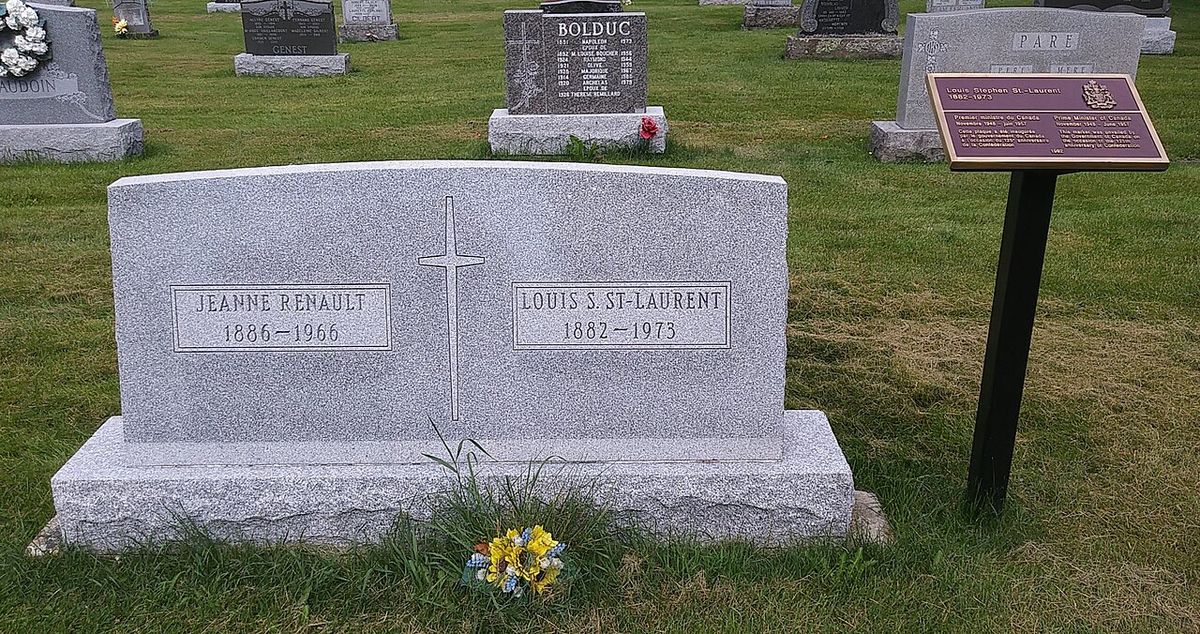
St. Laurent accepted responsibility for the loss and retired from politics shortly after the election, returning to his law practice in Quebec City. He lived quietly in retirement until his death on July 25, 1973. Historians generally rank St. Laurent highly among Canadian prime ministers, noting his moderate and cautious temperament, strong Canadian nationalism, and the period of stability and growth over which he presided. Historian Donald Creighton described him as 'eminently moderate, cautious...and a strong Canadian nationalist.' His legacy includes the physical and social infrastructure that defined mid-century Canada, such as the highway and seaway, and an internationalist foreign policy that established Canada's postwar role on the world stage through NATO and peacekeeping. The federal electoral district of Louis-Saint-Laurent and its successor, Louis-Saint-Laurent, Akiawenhrahk, are named in his honour.
Questions about Louis St. Laurent
What is Louis St. Laurent best known for?
Louis St. Laurent is best known as Canada's 12th prime minister, serving from 1948 to 1957. He is remembered for overseeing a period of major nation-building, including initiating projects like the Trans-Canada Highway and the St. Lawrence Seaway. His government expanded social programs like hospital insurance, old-age pensions, and the registered retirement savings plan. In foreign policy, he was a key architect of Canada's role in NATO and supported Lester Pearson's creation of UN peacekeeping during the Suez Crisis, for which Pearson won the Nobel Peace Prize.
What riding did Louis St. Laurent represent?
Louis St. Laurent represented the riding of Quebec East in the House of Commons from 1942 until his retirement in 1957. He won the seat in a by-election following the death of Ernest Lapointe and was re-elected four consecutive times, establishing himself as a durable Liberal standard-bearer in that constituency. The federal electoral district named in his honour, Louis-Saint-Laurent, and its successor Louis-Saint-Laurent, Akiawenhrahk, are located in Quebec. In the 2025 election, Conservative MP Gérard Deltell was re-elected in the new riding of Louis-Saint-Laurent, Akiawenhrahk.
What was St. Laurent's role in bringing Newfoundland into Canada?
As Secretary of State for External Affairs under Prime Minister King, St. Laurent was a strong supporter of Newfoundland joining Confederation. He personally led the final two rounds of negotiations with Newfoundland's representatives, led by Joey Smallwood, in the summer of 1947 and the fall of 1948. St. Laurent successfully managed the process, ignoring objections from the Quebec government which had land claims and demanded a veto. He presided over the ceremonies in Ottawa on March 31, 1949, when Newfoundland officially became Canada's tenth province.
What were St. Laurent's key contributions to Canadian foreign policy?
St. Laurent's key foreign policy contributions include being a leading proponent and architect of the North Atlantic Treaty Organization, founded in 1949. He articulated a principled vision for Canada as a 'middle power' willing to accept international responsibilities in a 1947 speech that set parameters for a rules-based international order. His government committed significant voluntary forces to the Korean War. He supported the idea of a UN military force, which his foreign minister Lester Pearson realized as the first peacekeeping mission during the 1956 Suez Crisis. He also represented Canada at the 1945 San Francisco Conference founding the United Nations.
How did Louis St. Laurent get the nickname 'Uncle Louis'?
Louis St. Laurent earned the nickname 'Uncle Louis' during the 1949 federal election campaign. A reporter submitted an article entitled 'Uncle Louis can't lose' after observing St. Laurent disembark his train and immediately gravitate to and chat with a group of children on the platform instead of the assembled adults. This affectionate nickname, 'Papa Louis' in Quebec, stuck in the English media due to his common touch and approachable campaigning style. His image was developed into a character, considered the first media image used in Canadian politics, which involved chatting with children and giving speeches in his shirt sleeves. This broad appeal contributed to his landslide victory in that election.
Why did St. Laurent's government lose the 1957 election?
St. Laurent's Liberal government lost the 1957 federal election in an upset to John Diefenbaker's Progressive Conservatives. A key factor was his government's decision to rush the 1956 Trans Canada Pipeline debate by invoking closure, which led to a public perception that the Liberals had become arrogant after two decades in power. Despite his personal popularity as 'Uncle Louis' and predictions of an easy win, this controversy contributed to a narrow defeat. The loss ended nearly 22 years of consecutive Liberal rule. Following his defeat, St. Laurent retired from politics and returned to his law practice.
Sources and further reading
- Louis St. Laurent (Wikipedia)
- Canada election, Louis-Saint-Laurent, Akiawenhrahk (globalnews.ca)
Checked by the Nosy Mag desk. Last updated 2026-10-26.