Online Poker in Canada: How It Works and Where to Play
Online poker in Canada is not run from one single national site. Depending on where you live, you might use a provincial site such as PlayNow, PlayAlberta, PlayOLG or Loto-Québec, or an offshore or Ontario-licensed casino that also carries poker-style and card games. There is no single federal licence for poker rooms, so the market looks different province by province, and the international poker rooms that Canadians often hear about, such as GGPoker, PokerStars on FanDuel, PartyPoker, 888poker and WPT Global, sit alongside the provincial and offshore casino sites covered in this guide.
This page explains how online poker works for Canadians, how we picked the casinos below, what rules and provincial differences apply, how poker itself is structured, and the common mistakes to avoid. None of the operators listed here are dedicated poker rooms in the traditional multi-table tournament sense, they are casinos with real-money gaming licensed for Canadian players, several of them in Ontario through iGaming Ontario and the AGCO.
| # | Casino | Best for | Licence | Min. deposit | Payouts |
|---|---|---|---|---|---|
| 1 | PokerStars Casino | Recognizable poker brand | Malta Gaming Authority | Unknown | Processed within 72 hours, then 3-5 business... |
| 2 | PlayNow | BC, Manitoba and Saskatchewan players | Government of British Columbia | $5 CAD | 2-3 business days |
| 3 | PlayAlberta | Alberta residents | Alberta Gaming, Liquor & Cannabis Commission... | $10 | INTERAC e-Transfers estimated at two business... |
| 4 | PlayOLG | Ontario government-backed play | iGaming Ontario / AGCO | Between one to five business days after... | |
| 5 | Loto-Québec | Quebec players | |||
| 6 | BetMGM Casino | Large game library in Ontario | iGaming Ontario / AGCO | $10 | 3–5 business days for internal processing |
| 7 | Casino Days | Multiple licences including Ontario | Malta Gaming Authority (MGA), AGCO, iGaming... | $1 | Under 24 hours for most methods, 1-5 business... |
| 8 | TonyBet | Wide game selection | Kahnawake Gaming Commission, iGaming Ontario /... | $20 for sports welcome bonus | Interac/card up to 7 days, e-wallets within... |
| 9 | Betano | Ontario-licensed table games | iGaming Ontario / AGCO | $10 | Interac e-Transfer: 30 minutes; PayPal: within... |
| 10 | PartyCasino | Established Ontario operator | Malta Gaming Authority (MGA), iGaming Ontario /... | $10 CAD | Processed within 2 business days, can take up... |
What online poker means for Canadians
When Canadians talk about online poker, they usually mean real money cash games and tournaments played on a licensed site. The legal picture is split by province. Ontario runs a regulated market through iGaming Ontario and the AGCO, and operators must hold a provincial licence to serve Ontario players, who can then only play against others physically located in the province. The Ontario Court of Appeal has upheld the province's ability to let its regulated sites allow gambling, including games like online poker and daily fantasy sports, within that framework. Elsewhere, provincial lottery corporations such as PlayNow in British Columbia, Manitoba and Saskatchewan, PlayAlberta in Alberta, and Loto-Québec in Quebec run their own government-backed sites. Many Canadians outside these systems also use offshore-licensed sites, commonly under Kahnawake Gaming Commission or Malta Gaming Authority licences, since provinces such as Alberta and Saskatchewan permit residents to access international poker rooms without a dedicated local platform for poker specifically.
None of the casinos in our list are dedicated poker rooms with multi-table tournament series in the classic sense. They are online casinos, several of which carry the PokerStars brand or operate alongside sportsbooks and casino games under provincial or offshore licences. If you are looking specifically for cash game poker and tournament series with large guarantees, you will likely end up looking at international poker-specific rooms rather than a general casino site, so check what card games and formats a site actually offers before signing up.
How poker itself is structured
Understanding the game helps when comparing sites. Online poker follows structured betting rounds, usually pre-flop, flop, turn and river, though different variants use different structures. Blinds, the small blind and big blind, are posted before hole cards are dealt, and the player to the left of the big blind acts first pre-flop. Depending on the situation, players can check, bet, call, raise or fold, and in no-limit games there is always the option to go all-in. A hand ends when only one player remains or at showdown, where hands are compared using standard rankings from high card up to a royal flush.
Texas Hold'em, using two hole cards and five shared community cards, is the most common variant. Omaha uses four hole cards and requires exactly two of them combined with three community cards. Seven Card Stud deals seven individual cards with no community cards at all. Mixed games such as HORSE rotate through several variants, including Hold'em, Omaha Hi-Lo, Razz, Seven Card Stud and Eight-or-Better, within a single session. Formats also vary: cash games let players join, leave or reload chips whenever they want with no rising blinds, while tournaments require a buy-in, start everyone with a fixed stack, and raise blinds at set intervals until one player or a paid group of finishers remains. Tournament types include bounty formats that pay out for eliminating opponents, satellites that offer cheaper entry into bigger events, and freerolls that charge no entry fee at all.
How online play differs from live poker
Online tables deal far more hands per hour than a live table, since there is no physical shuffling or chip counting to slow things down. Physical tells disappear online, replaced by timing patterns and bet-sizing habits that experienced players learn to read instead. Online platforms run continuously, with games available at any hour and no need to travel to a venue, and many sites allow multi-tabling, where a single player plays several tables at once. Larger combined player pools online generally support bigger tournament guarantees and a wider spread of stakes and formats than most physical card rooms can offer, which is part of why big-field guaranteed tournaments are mostly an online phenomenon.
Licensed online poker uses random number generator technology to shuffle and deal cards fairly, and regulated sites undergo independent auditing of that software. Regulatory bodies such as the AGCO in Ontario or the Kahnawake Gaming Commission set standards operators must meet, and internal systems on licensed platforms are built to flag unfair play such as collusion.
How we chose the sites below
We picked entries from our casino list that are either provincial government sites available to Canadians, or sites carrying recognizable poker branding, or Ontario-licensed operators with card game offerings. We looked at licensing, whether the site is available in Ontario through iGaming Ontario, deposit and withdrawal details, and game counts where stated. We left out anything where the facts did not support a connection to poker-style play. We did not include international poker-specific rooms mentioned in general market coverage, such as GGPoker, PartyPoker, 888poker or WPT Global, because they are not part of our casino list and we only have secondary references to them rather than full fact sheets.
The picks
Below are sites from our list with a direct link to the Canadian poker and card-game landscape, based only on their stated facts.
- PokerStars Casino carries the PokerStars name, holds a Malta Gaming Authority licence, and offers over 1,300 slot games along with other real money products, though it is not listed as available in Ontario.
- PlayNow is the BC Lottery Corporation site covering British Columbia, Manitoba and Saskatchewan, licensed by the Government of British Columbia, with a huge selection of games and a match deposit offer up to $1,500 at the time of writing (September 2026).
- PlayAlberta is the Alberta Gaming, Liquor and Cannabis Commission site, with over 800 titles and a welcome package that includes a deposit match, sports bonus bet and bonus spins at the time of writing (September 2026).
- PlayOLG is the Ontario Lottery and Gaming site, licensed by iGaming Ontario and the AGCO, with more than 1,150 casino games and a $15 bonus for new players at the time of writing (September 2026).
- Loto-Québec is the provincial operator for Quebec, named in our facts without further detail, and is not available in Ontario.
- BetMGM Casino is licensed through iGaming Ontario and the AGCO, offers over 6,000 titles, and runs the BetMGM Rewards loyalty program with points and tier credits.
- Casino Days holds Malta Gaming Authority, AGCO, iGaming Ontario and Curacao licences, with over 6,000 titles and a welcome match up to CA$2,000 plus 100 free spins at the time of writing (September 2026).
- TonyBet is licensed by iGaming Ontario, the AGCO and the Kahnawake Gaming Commission among others, with over 7,000 games and a sports VIP program.
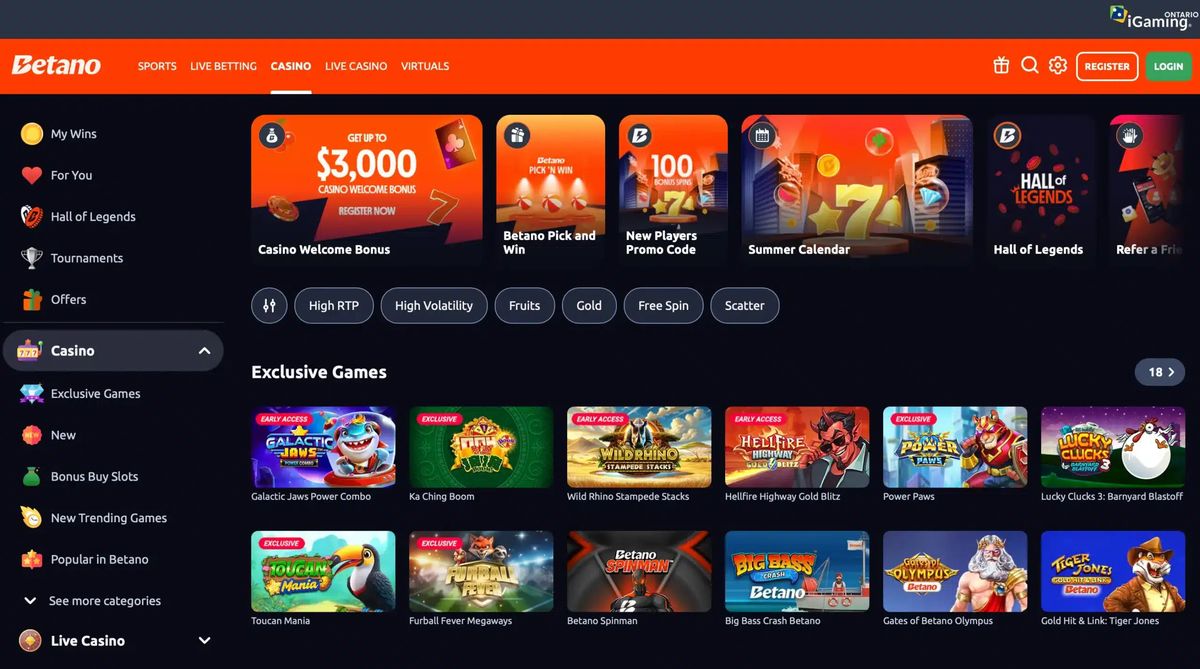
- Betano is licensed by iGaming Ontario and the AGCO, offering 443 RNG games including 401 slots and 42 table games.
- PartyCasino holds a Malta Gaming Authority licence alongside iGaming Ontario and the AGCO, with over 1,500 games and an invite-only VIP program.
Rules and legality in Canada and Ontario
There is no specific federal law that bans online poker in Canada, and provinces set their own rules for regulation under the framework the Criminal Code of Canada provides. Ontario is the clearest example of a fully regulated market, operating through iGaming Ontario and the AGCO since the province opened its regulated market in April 2022. Players physically located in Ontario using Ontario-licensed sites can only play against other Ontario players on those platforms, which affects player pool size for any poker-style game and was confirmed by an Ontario Court of Appeal ruling on the province's regulated online gaming structure.
Outside Ontario, provincial lottery corporations such as PlayNow, PlayAlberta and Loto-Québec run government sites, and many Canadians also use offshore-licensed sites holding licences such as Kahnawake Gaming Commission or Malta Gaming Authority. Provinces like Alberta and Saskatchewan do not run their own dedicated poker platform but allow residents to access international sites without legal repercussions. The gambling age is 19 in most provinces, but 18 in Alberta, Manitoba and Quebec.
Taxes on poker winnings
For most Canadians, poker winnings are not taxed. Casual players, meaning those who do not rely on poker as a primary source of income, generally are not required to pay tax on what they win. The situation changes for people who play poker as a business, treating it as their main source of income. In that case, winnings are treated as business income and are subject to income tax, though players in that position can also deduct related expenses such as travel costs and tournament buy-ins. Whether you fall into the casual or professional category depends on your individual circumstances, so it is worth checking current Canada Revenue Agency guidance or speaking with a tax professional if poker is a significant part of your income.
Practical tips
- Check whether a site is licensed in your province, or through iGaming Ontario if you live in Ontario, before registering.
- Compare minimum deposits and withdrawal times stated by each operator, since these vary widely, from under 24 hours to several business days.
- Read welcome bonus terms carefully and note the date, since offers change. At the time of writing (September 2026), bonus sizes and structures differ across operators.
- Confirm what payment methods are accepted, Interac e-Transfer is common across Canadian-facing sites.
- Look at loyalty or VIP programs if you plan to play regularly, some casinos list tiered rewards programs with cashback or points.
- If you want dedicated poker tournaments and cash games rather than casino-style card products, research sites built specifically around poker traffic and compare rake structures before committing funds.
Common mistakes and risks
A common mistake is assuming all provinces work the same way. Ontario's market is distinct, with players restricted to licensed sites and local player pools, confirmed by court rulings on the province's regulated structure. Another mistake is not checking a site's actual licence, since names like Kahnawake Gaming Commission, Malta Gaming Authority and Curacao licences carry different levels of oversight and come from different regulatory traditions. Players sometimes also overlook withdrawal timelines, which can stretch to several business days for bank transfers compared to quicker e-wallet or Interac processing on some sites.
Chasing large welcome bonuses without reading wagering terms is another frequent risk, since bonus structures and wagering conditions are not always straightforward and they do change over time. It is also a mistake to confuse a general online casino offering card games with a dedicated poker room built for large tournament fields and consistent cash game traffic, since the experience and competition level can be very different between the two.
Responsible gambling
Set a budget before you play and use the deposit limits, session limits and self-exclusion tools that licensed Canadian sites are required to offer. If gambling is affecting you or someone close to you, contact the Canadian Centre for Addiction and Mental Health or your provincial problem gambling helpline for confidential support. The legal gambling age is 19 in most provinces and 18 in Alberta, Manitoba and Quebec.
Pros
- Several provincial sites give Canadians a government-backed option for real money play
- Ontario's regulated market means AGCO oversight for licensed operators
- Many sites accept Interac e-Transfer, a familiar Canadian payment method
- Some operators offer loyalty programs with points or cashback for regular players
Cons
- None of the listed sites are dedicated poker rooms with full tournament series
- Ontario players are restricted to playing against others within the province on licensed sites
- Bonus terms and sizes change often and need checking at the time of signup
- Withdrawal times vary a lot between operators and payment methods
Online Poker in Canada: frequently asked questions
Is online poker legal in Canada?
There is no specific federal law banning online poker in Canada. Provinces regulate their own markets. Ontario runs a fully regulated system through iGaming Ontario and the AGCO, while other provinces run their own lottery corporation sites or allow access to offshore-licensed sites.
Can I play poker against players in other provinces if I live in Ontario?
No. Sites licensed through iGaming Ontario and the AGCO restrict Ontario players to playing against others physically located in Ontario on those licensed platforms, a structure upheld by the Ontario Court of Appeal.
What is the minimum age to play online poker in Canada?
The minimum gambling age is 19 in most provinces, but it is 18 in Alberta, Manitoba and Quebec. Always check the specific site's registration requirements for your province.
Which provincial sites can Canadians use for real-money play?
PlayNow covers British Columbia, Manitoba and Saskatchewan under the BC Lottery Corporation. PlayAlberta is run by the Alberta Gaming, Liquor and Cannabis Commission. PlayOLG is Ontario's site through iGaming Ontario. Loto-Québec operates in Quebec.
Are winnings from online poker taxed in Canada?
Casual players who do not rely on poker as their main income generally do not pay tax on winnings. Players who treat poker as a business are taxed on their profits as income but can deduct related expenses like travel and tournament fees. Check current CRA guidance for your situation.
What licences should I look for on a Canadian-facing site?
Common licences include iGaming Ontario and the AGCO for Ontario-regulated sites, the Kahnawake Gaming Commission, and the Malta Gaming Authority. Government of British Columbia and the Alberta Gaming, Liquor and Cannabis Commission licence their own provincial sites.
What is the difference between a cash game and a tournament?
In cash games, chips represent real money and players can join, leave or add more chips at any time, with blinds staying fixed. In tournaments, everyone buys in for a set fee, starts with the same chip stack, and blinds rise at intervals until one player or a paid group of finishers remains.
Online gambling is for adults: 19+ in most provinces, 18+ in Alberta, Manitoba and Quebec. Set a budget and time limit before you play and use the deposit limits and self-exclusion tools every licensed site offers. Help is free and confidential: ConnexOntario 1-866-531-2600, Gambling Support BC 1-888-795-6111, Alberta Addiction Helpline 1-866-332-2322, Jeu : aide et référence (Quebec) 1-800-461-0140.