Conscription Crisis of 1944
The Conscription Crisis of 1944 was a political and military crisis following the introduction of forced military service for overseas deployment in Canada during the Second World War. Prime Minister William Lyon Mackenzie King, who had promised in September 1939 not to impose overseas conscription, was forced to reverse this pledge due to severe infantry casualties after the D-Day landings. The crisis exposed deep national divisions, with 64.5 percent of Canadians in a 1942 plebiscite voting to release the government from its promise, but 72.9 percent in Quebec voting against. While the political fallout was less catastrophic than during the First World War, the episode tested national unity and resulted in the deployment of thousands of conscripts to the European front.
Political Background and King's Promise
Prime Minister Mackenzie King was determined to avoid a repeat of the divisive Conscription Crisis of 1917. He had first asserted Canadian autonomy during the 1922 Chanak Crisis, stating Canada would not automatically go to war as part of the British Empire. During the 1930s, King displayed an abiding aversion to conscription and a conviction in the efficacy of appeasement, supporting the Munich Agreement in 1938. In April 1939, he declared defence spending priorities that made the Royal Canadian Air Force the main service and the militia the last. Canada declared war on Germany on September 10, 1939. King initially attempted to limit Canada's participation to the British Commonwealth Air Training Plan, believing it would not lead to conscription. When Quebec Premier Maurice Duplessis called a snap election on September 25, 1939, to oppose the war, King pledged that same month not to introduce overseas conscription. The Dominion government intervened unprecedentedly in the provincial campaign, using the War Measures Act to block Duplessis from radio broadcasts and throwing all federal resources behind the pro-war Quebec Liberals under Adélard Godbout. All federal cabinet ministers from Quebec threatened to resign if Duplessis was re-elected. Duplessis, struggling with alcoholism, ran an inept campaign and was defeated on October 25, 1939, creating an understanding that Quebec's reward would be no overseas conscription.
The National Resources Mobilization Act and 'Zombies'
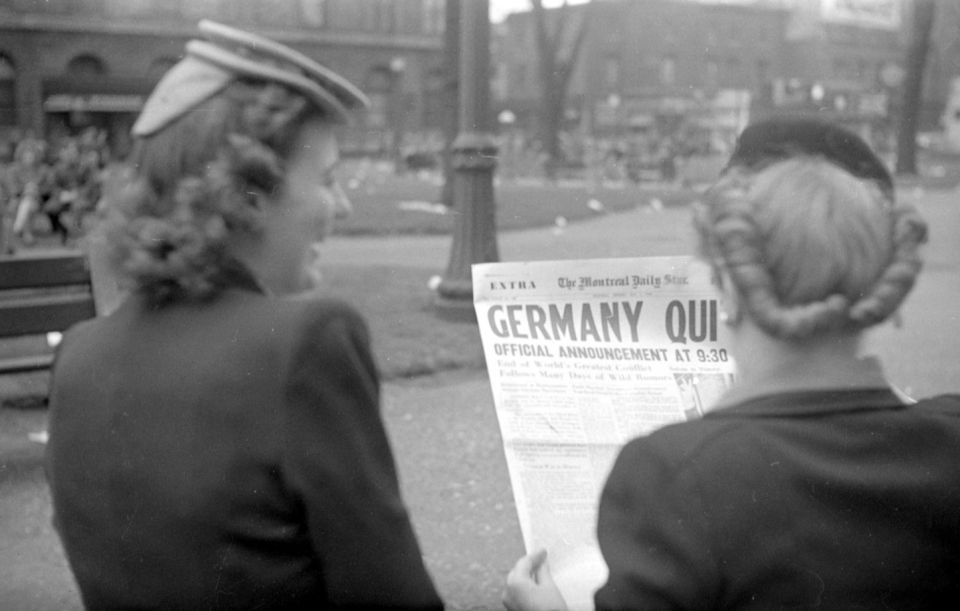
As Allied fortunes worsened in 1940 with the fall of France, pressure mounted for greater mobilization. In June 1940, King's government passed the National Resources Mobilization Act (NRMA), which allowed for conscription for home defence within Canada. Men conscripted under the NRMA could not be deployed overseas unless they voluntarily 'went active'. Those who refused were derisively labelled 'Zombies', implying they were like the reanimated dead. The Canadian military was divided between 'A' class volunteers for overseas service and 'R' class NRMA conscripts. Training camps became tense as officers pressured Zombies to volunteer. Montreal Mayor Camillien Houde urged men not to register under the NRMA, leading to his arrest under the War Measures Act and detention without charge until 1944. Defence Minister James Ralston and Navy minister Angus MacDonald were seen as advocates for the armed forces in cabinet, favouring winning the war even at the price of domestic disunity. A Gallup poll in November 1941 showed 61 percent of Canadians satisfied with the war effort, but 60 percent also wanted conscription for overseas service.
Mounting Pressure and the 1942 Plebiscite
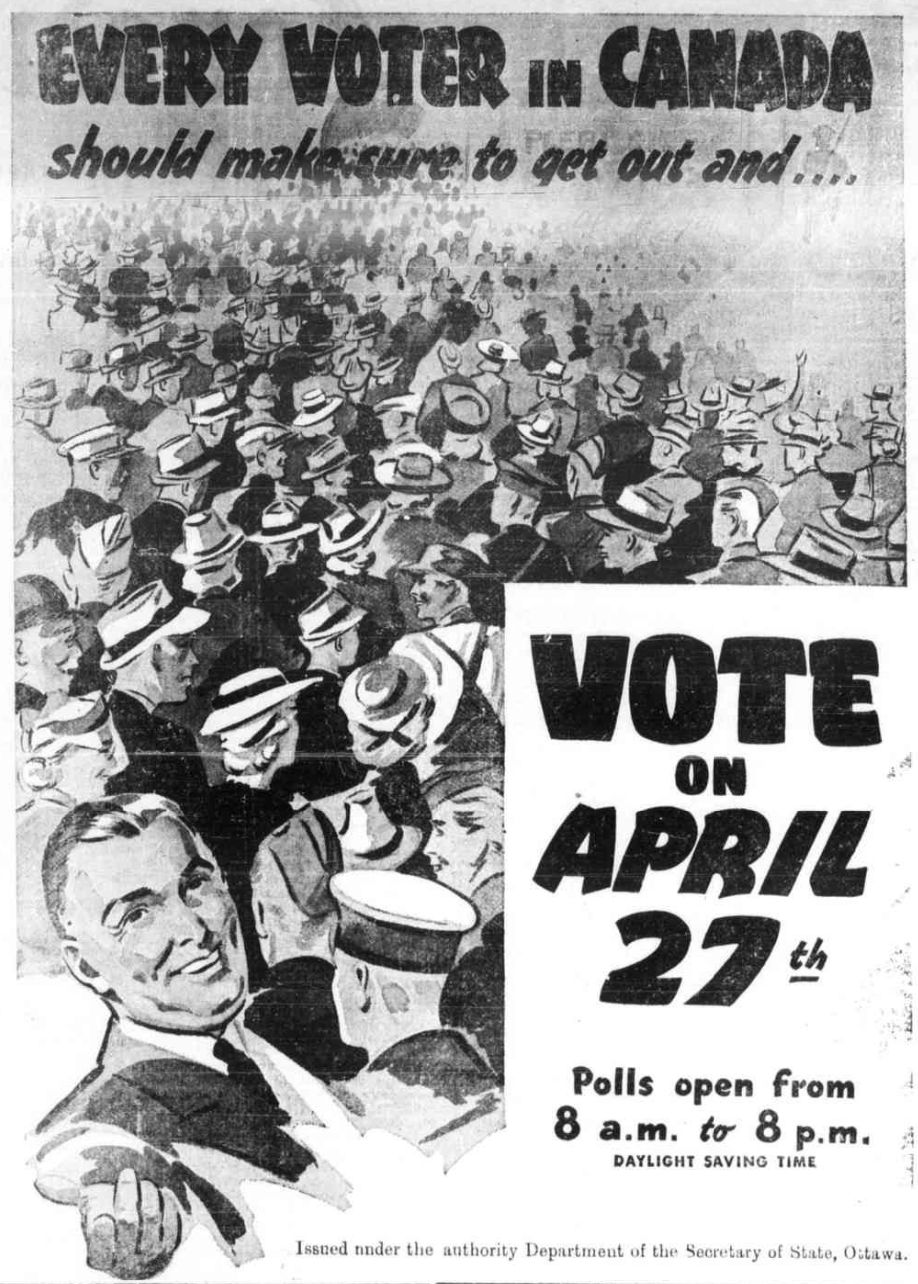
Pressure for conscription intensified following the disaster at the Battle of Hong Kong in December 1941, where two Canadian battalions were lost, with 290 killed and 487 wounded. Conservative leader Arthur Meighen, who became party leader on November 13, 1941, made his call for 'total war' the centrepiece of his criticism. To counter this, King announced a national plebiscite. Held on April 27, 1942, it asked Canadians 'Are you in favour of releasing the Government from any obligations arising out of any past commitments restricting the methods of raising men for military service?' The campaign starkly revealed the country's linguistic split. In Quebec, the Ligue pour la Défense du Canada, led by figures like André Laurendeau, Henri Bourassa, Jean Drapeau and Pierre Trudeau, campaigned for a 'No' vote under the slogan 'Jamais, Jamais...a dit M. Lapointe'. The League's rallies sometimes expressed approval of Vichy France and anti-Semitic tendencies, with one Montreal event almost degenerating into a pogrom. Across Canada, 64.5 percent voted 'Yes', including 83 percent of English Canadians. In Quebec, 72.9 percent voted 'No', as did several French-Canadian ridings in Ontario and New Brunswick and the ridings of Vegreville, Alberta, and Rosthern, Saskatchewan. Armed with this national majority, King's government passed Bill 80 in July 1942 by a vote of 158 to 58, amending the NRMA to allow overseas conscription if necessary. Public Works Minister Pierre Joseph Arthur Cardin quit the cabinet over the issue, and a number of Quebec Liberal MPs left to later join the Bloc populaire canadien.
Campaigns in Italy and the Aleutians
King had tried to keep the military out of action to avoid casualties, but by 1943 he feared the war might end with Canada winning no land battles. In 1943, the 1st Canadian Infantry Division was included in the Allied invasion of Sicily, Operation Husky. The I Canadian Corps, comprising the 1st Division, the 5th Canadian Armoured Division and the 1st Canadian Armoured Brigade, later fought in the Italian campaign. The mountains in Italy favoured defensive operations, leading to heavy casualties in battles like Ortona and the Gothic Line. To dispel criticism of idle home defence forces, the 13th Brigade from a home defence division was sent to the Aleutian Islands Campaign in 1943, as the islands were technically North American soil. The brigade landed on Kiska on August 15, 1943, to find the Japanese had already left. The only struggle during its six-month stay was a fight with taxmen over whether servicemembers were overseas, as deployment west of the International Date Line was argued to be in Asia. General Andrew McNaughton, commander of the First Canadian Army, was removed in December 1943 after a poor performance in the Operation Spartan wargame and for protesting the loss of I Canadian Corps to the Italian front.
The Reinforcement Crisis of 1944
The situation changed dramatically after the D-Day landings in June 1944. The Canadian Army suffered high infantry casualties in Normandy and northwest Europe, particularly in the battles for Caen and the Falaise Gap. By autumn 1944, a critical shortage of trained infantrymen developed. Defence Minister James Ralston returned from a tour of the front in October 1944 convinced that sending NRMA conscripts overseas was the only solution. He informed the Cabinet that to continue combat operations, the overseas Canadian Army needed 15,000 new infantrymen immediately from the pool of 60,000 Zombies. King resisted Ralston's demands. The cabinet was deeply divided. King's first attempt at a solution was to ask British Prime Minister Winston Churchill for a statement that Canada had done enough, a request Churchill refused. King also fired General Kenneth Stuart for underreporting Canadian losses. An additional concern was the return of Maurice Duplessis to power in the Quebec election of August 8, 1944, after a campaign using antisemitic rhetoric claiming a secret deal to settle 100,000 Jewish refugees in Quebec. When consensus proved impossible, King forced Ralston to resign on November 1, 1944.
McNaughton's Appointment and the Final Order
In an attempt to avoid conscription through voluntary means, King appointed General Andrew McNaughton as the new Minister of National Defence on November 2, 1944. McNaughton began a speaking tour to military camps but met with resistance, protests, and booing from audiences. Members of King's cabinet, including J. L. Ilsley, C. D. Howe, Angus Macdonald, Colin W. G. Gibson, Thomas Crerar, and William Pate Mulock threatened to resign and bring down the government if the Zombies were not sent overseas. On the morning of November 22, 1944, General John Carl Murchie told McNaughton that the voluntary system had failed. Later that day, McNaughton informed King. King finally agreed to a one-time levy. On November 22, 1944, the government ordered the dispatch of 16,000 NRMA conscripts for overseas service. When word reached soldiers in Terrace, British Columbia, it resulted in the short-lived Terrace Mutiny, where a brigade mounted guns on a railroad. General George Pearkes resolved it by warning of the death penalty for mutiny but promising amnesty if arms were laid down. McNaughton announced the decision at the bar of the House of Commons on November 23.
Implementation, Military Impact, and Political Fallout
The decision triggered protests but widespread civil disorder on the scale of 1917 did not materialize. The implementation was gradual. Approximately 13,000 NRMA conscripts were sent overseas before the end of the war. Of these, only 2,463 reached front-line units in Northwest Europe before the fighting concluded in May 1945. A total of 69 conscripts died in battle. The political management of the crisis allowed King to maintain a fragile national consensus. In the House of Commons on December 8, 1944, a motion of no-confidence in the government was defeated 143 to 70, though 34 Quebec Liberal MPs voted for the motion. Air Minister Charles 'Chubby' Power resigned in protest. In the 1945 federal election on June 11, the Liberals retained power. Progressive Conservative leader John Bracken's proposal of conscription for the invasion of Japan hurt his chances, while King promised only a volunteer division. The Japanese surrender in August 1945 averted a new crisis. The crisis demonstrated that the country could implement overseas conscription without completely fracturing.
| Category | Number |
|---|---|
| NRMA Conscripts Sent Overseas | ~13,000 |
| Conscripts Reaching Frontline Units | 2,463 |
| Conscripts Killed in Action | 69 |
| National 'Yes' Vote in 1942 Plebiscite | 64.5% |
| Quebec 'No' Vote in 1942 Plebiscite | 72.9% |
French-Canadian Military Service and Regiments
Throughout the war, French-Canadian soldiers served with distinction in several regiments. Units like the Regular Army's Royal 22e Régiment, Les Fusiliers Mont-Royal, the Régiment de la Chaudière and the Régiment de Maisonneuve built outstanding records. French-Canadian leaders had requested these units be grouped into a single Francophone brigade. The army high command dispersed them among English-speaking divisions, citing a shortage of French-speaking staff officers. Historian J.L. Granatstein suggested a shortage of trained Francophone staff officers meant any attempt to create an entire Francophone brigade would have likely ended in failure. In the rest of the military, similar French-speaking units were not created, with justifications including the predominance of radio and technical instruction only available in English. The 12th Armoured Regiment, originally mobilized by the Francophone Three Rivers Regiment, was reorganized as an English-speaking unit. Some Francophone soldiers, like Jean-Victor Allard, rose to high command. Allard eventually became a brigade commander in Northwest Europe and Korea, commanded a British division in NATO and later became Chief of the Defence Staff. The experience of the Second World War, with greater acceptance of French-language units than in 1914, did lessen some of Quebec's resistance.
Broader Opposition and Wartime Context
Opposition was not confined to French Canada. In British Columbia, many white citizens opposed conscription because they feared it would lead to the drafting of Chinese-Canadians and Japanese-Canadians, which might fuel demands for voting rights. The political left, including the Co-operative Commonwealth Federation (CCF), held ambivalent views towards the war. The initial policy of home defence conscription under the NRMA was accepted by many French Canadians. King's government also created Zombie divisions for coastal defence. This included the 6th and 8th Divisions for the Pacific coast and the 7th for the Atlantic, despite military advice that invasion threats were minimal. This was done partly to show the government was not indifferent to regional concerns. There was an ethnic dimension to volunteering. Historian Jack Granatstein noted that Canadians who identified most strongly with the British Empire were most likely to volunteer. In both world wars, Anglo-Canadians made up the lion's share of enlistments. Brigadier W.H.S. Macklin reported in May 1944 that he experienced almost total failure persuading French-Canadians to 'go active', and that many other NRMA soldiers were of German, Italian, and Slavic origin from farms.
Key Figures and Their Roles
The crisis involved several central figures. Prime Minister William Lyon Mackenzie King was the architect of the 'conscription if necessary' policy. Defence Minister James Ralston became the leading cabinet advocate for sending conscripts overseas after witnessing the reinforcement crisis. General Andrew McNaughton succeeded Ralston and failed to secure voluntary transfers. Louis S. St. Laurent, King's Quebec lieutenant, played a major role in managing the political fallout in French Canada. In Quebec, nationalist leader Henri Bourassa returned to prominence as a vocal opponent. Former Prime Minister Arthur Meighen relentlessly criticized the government's war policy but lost a by-election to CCF candidate Joseph Noseworthy in February 1942. Air Minister Charles 'Chubby' Power resigned in protest at the violation of the government's promises to Quebec. Major Conn Smythe, owner of the Toronto Maple Leafs, went public in September 1944 about green replacements at the front, escalating the crisis. These individuals represented the conflicting pressures of military necessity and national unity.
Questions about Conscription Crisis of 1944
What was the Conscription Crisis of 1944?
The Conscription Crisis of 1944 was a political and military crisis during the Second World War when Prime Minister Mackenzie King's government decided to send conscripted soldiers overseas to reinforce the Canadian Army in Europe. King had promised in September 1939 not to impose overseas conscription, but severe infantry casualties after D-Day forced a reversal of this policy in November 1944. On 22 November 1944, the government decided to send 16,000 home defence draftees to Europe. The decision highlighted the deep division between English Canada, which largely supported conscription, and French Canada, which remained strongly opposed, a division intensified by the return of nationalist Quebec Premier Maurice Duplessis to power in August 1944.
Why did Mackenzie King initially oppose conscription?
Mackenzie King was haunted by the memory of the Conscription Crisis of 1917. He believed domestic unity was paramount and that victory could not come at the cost of shattering that unity. His strategy was to support the war effort through voluntary enlistment and industrial production, hoping to avoid the heavy casualties of a land war. In the 1930s, he had displayed an aversion to conscription and a conviction in appeasement, regarding another world war as the ultimate catastrophe.
Who were the 'Zombies'?
'Zombies' was a derogatory term for men conscripted under the National Resources Mobilization Act (NRMA) for home defence who refused to volunteer for overseas service. The term implied they were like the living dead. They were widely reviled by volunteers and faced intense pressure at training camps. The divide between volunteer 'A' class soldiers and NRMA 'R' class conscripts created significant tension within the military. In April 1945, volunteers in the First Canadian Army were ordered to wear the Zombie's black tie, causing resentment.
How many conscripts were sent overseas and how many saw combat?
Approximately 13,000 NRMA conscripts were sent overseas after the November 1944 order. However, only 2,463 of these men reached front-line army units in Northwest Europe before the war ended in May 1945. Of the conscripts who served overseas, 69 were killed in battle. The limited number who actually fought was a result of the late timing of the decision and the three-month rest period for the First Canadian Army after the Battle of the Scheldt.
What was the political outcome of the crisis?
Politically, Mackenzie King managed the crisis carefully. While the decision angered many in Quebec, it did not cause the widespread riots seen in 1917. King's government survived a no-confidence vote on December 8, 1944, and the Liberals won the 1945 federal election. The crisis demonstrated that the country could implement overseas conscription without completely fracturing, though it reaffirmed the enduring linguistic divide. King's policy was often summarized as 'not necessarily conscription but conscription if necessary'.
What was the 1942 plebiscite about?
The 1942 plebiscite, held on April 27, asked Canadians 'Are you in favour of releasing the Government from any obligations arising out of any past commitments restricting the methods of raising men for military service?' Prime Minister William Lyon Mackenzie King called the vote to free himself from his September 1939 pledge against overseas conscription. The result revealed a deep national division, with 64.5 percent of Canadians overall voting 'Yes' but 72.9 percent of Quebec voters voting 'No'. The plebiscite's passage allowed the government to pass Bill 80, amending the National Resources Mobilization Act to allow for overseas conscription if necessary. King's policy following the vote was summarized as 'Not necessarily conscription, but conscription if necessary'.
Sources and further reading
- Conscription Crisis of 1944 (Wikipedia)
- Democracy at War, Conscription, Canada and the War (warmuseum.ca)
- Conscription, Louis S. St. Laurent National Historic Site (parks.canada.ca)
- The Conscription Issue in Canada's Two World Wars, NAOC (natoassociation.ca)
- Conscription in Canada (thecanadianencyclopedia.ca)
Checked by the Nosy Mag desk. Last updated 2026-10-31.