History of Canadian currencies
The history of Canadian currencies began with Indigenous peoples using items such as wampum and furs for trade. During French colonization, coins were introduced, as well as one of the first examples of paper currency by a Western government. During British colonization, additional coinage and banknotes were introduced. The Canadian colonies gradually moved away from the British pound and adopted currencies linked to the United States dollar. With Confederation in 1867, the Canadian dollar was established. By the mid-20th century, the Bank of Canada became the sole issuer of paper currency.
Indigenous Trade and Early Currency
Prior to European contact, the First Nations and Inuit peoples of Canada traded goods on a bartering basis. Various items played the role of currency, such as copper, wampum and beaver pelts. In eastern Canada, wampum belts, made of numerous tiny shells, were used to measure wealth and as gifts. They were later recognised as legal tender in the early Dutch and British colonies. The Ojibwe in eastern Canada were noted for mining and trade in copper. Objects such as copper shields had special economic and social value. The Haida of the west coast used copper shields as a measure of status and wealth. During the North American fur trade, the beaver pelt was universally accepted as a medium of exchange. Beaver pelts, called "Made Beavers", were used as a unit of account by the Hudson's Bay Company to establish consistent pricing of all its trade goods.
New France and the Chronic Coin Shortage
With the foundation of Quebec in 1608, French settlement and trade began. The early French colonists bartered goods and used French coins. The basic unit of currency was the denier or penny. Twelve deniers made a sol or sou, and twenty sols made a livre of New France. There was a chronic shortage of hard currency. Silver coins sent from France were quickly hoarded or used to pay for European goods. To address the scarcity, the colonial government authorized the use of coins limited to New France, the monnoye du pays. These coins had no value outside the colony. Authorities also over-stamped Spanish-American piastres with a fleur-de-lys and a Roman numeral to certify their silver weight. By 1685, the coin shortage was so severe that Intendant Jacques de Meulles issued playing card money to pay soldiers. This was the first issue of paper money by a Western government. The cards began to circulate as a medium of exchange. Card money was reintroduced in 1729 with French government approval, backed by bills of exchange. The financial demands of the Seven Years' War led to massive over-issuance. By 1760, the volume of paper money in circulation was fifteen times greater than in 1750, leading to rampant inflation. After the British conquest in 1760, the card money was redeemed at only one-quarter of its face value, leaving a deep distrust of paper money.
British Colonial Currency and Banking
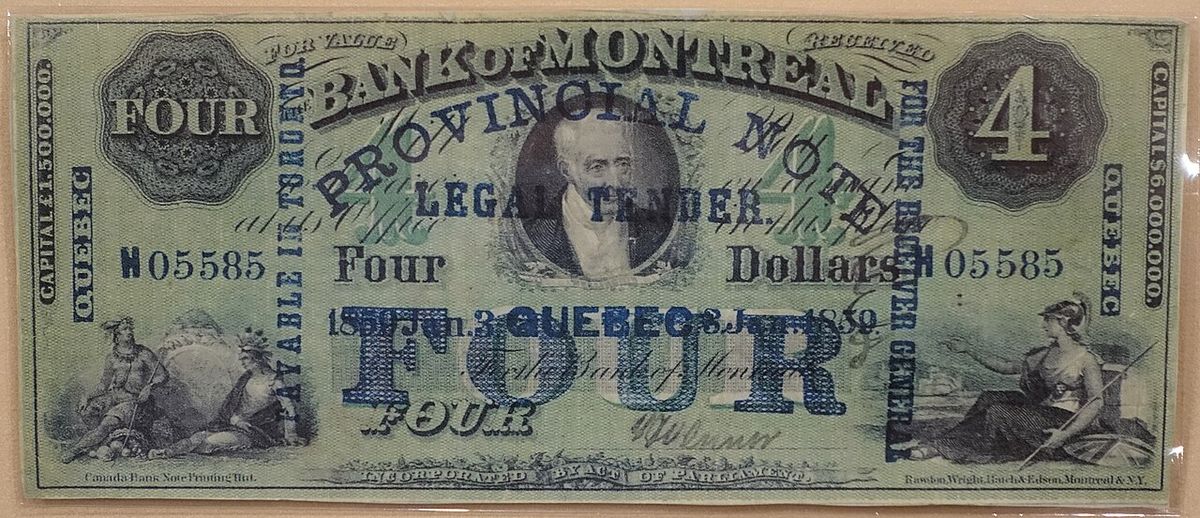
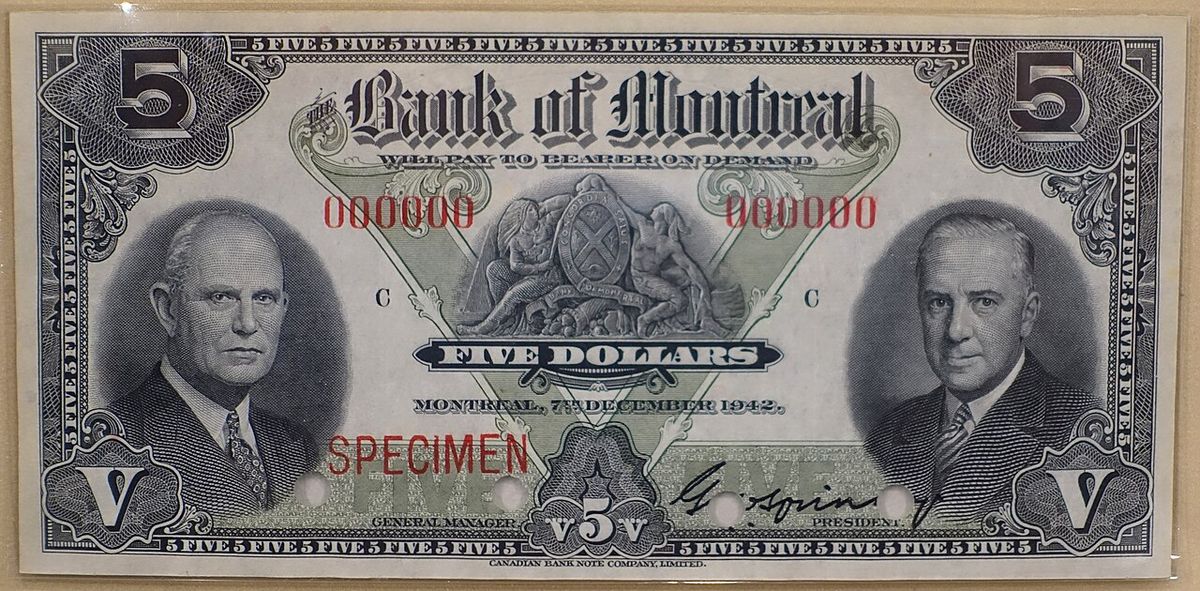
The British colonial period from 1760 onward inherited a shortage of currency, leading to a chaotic mix of foreign coins, merchant notes, and government paper. Colonial governments adopted creative solutions. In 1808, Prince Edward Island created the "holey dollar" by punching the centre out of Spanish dollars to create two separate coins. Colonies used units of account based on British pounds, shillings, and pence, with local "ratings" to value foreign money. The two dominant systems were the Halifax rating, which valued a Spanish dollar at five shillings, and the York rating, which valued it at eight shillings. Colonial governments began issuing treasury bills to finance expenses, with Prince Edward Island being the first in 1790. During the War of 1812, the British Army issued £1.5 million in "Army bills," which were successfully redeemed by 1816. The rise of commercial banking was a major development. The first bank to issue notes was the Montreal Bank (Bank of Montreal) in 1817. Other early banks included the Bank of Upper Canada, the Bank of New Brunswick (1820), the Bank of Nova Scotia and the Bank of Prince Edward Island. Bank notes were interest-free loans to the banks and could trade at a discount when far from a redemption branch. In addition to bank notes, merchants and banks issued trade tokens accepted as local currency. In Lower Canada, banks cooperated to issue tokens featuring the arms of Montreal and an image of a habitant, nicknamed "Papineaus" after Louis-Joseph Papineau. The Hudson's Bay Company and the North West Company also issued trade tokens based on the "Made beaver" pelts. Key early banks and their first note issues:
- Montreal Bank (Bank of Montreal): 1817
- Bank of Upper Canada: Early 1820s
- Bank of New Brunswick: 1820
Transition to a Decimal Dollar
The mid-19th century saw a policy disagreement between the British Empire, which wanted sterling use, and the Canadian colonies, which favoured linking their currencies to the United States dollar due to strong commercial ties. An imperial Order-in-council of 1825 aimed to encourage sterling but drove out existing sterling coins in the Canadas. Each colony had its own pound currency, such as the Canadian pound, the New Brunswick pound, and the Nova Scotian pound. Following the union of Upper and Lower Canada into the Province of Canada in 1841, a new system based on the Halifax rating was adopted. The new Canadian pound was set at one pound, four shillings and four pence Canadian equal to one pound sterling. The legislation also set the legal tender value of the American gold eagle at two pounds, ten shillings Canadian, formally linking the currency to the US dollar. The economic pull of trade with the United States proved decisive. Throughout the 1850s, the imperial and colonial governments debated decimal currency. In 1853, the Province of Canada enacted a statute to introduce the gold standard, based on both the British gold sovereign and the American gold eagle. Sterling coinage was made legal tender, and dollar transactions were legalized. In 1857, the Province of Canada provided that all public accounts were to be kept in dollars and cents. The first Canadian decimal coins were released in 1858, minted at the Royal Mint in London.
The Canadian Dollar and Modern Central Banking
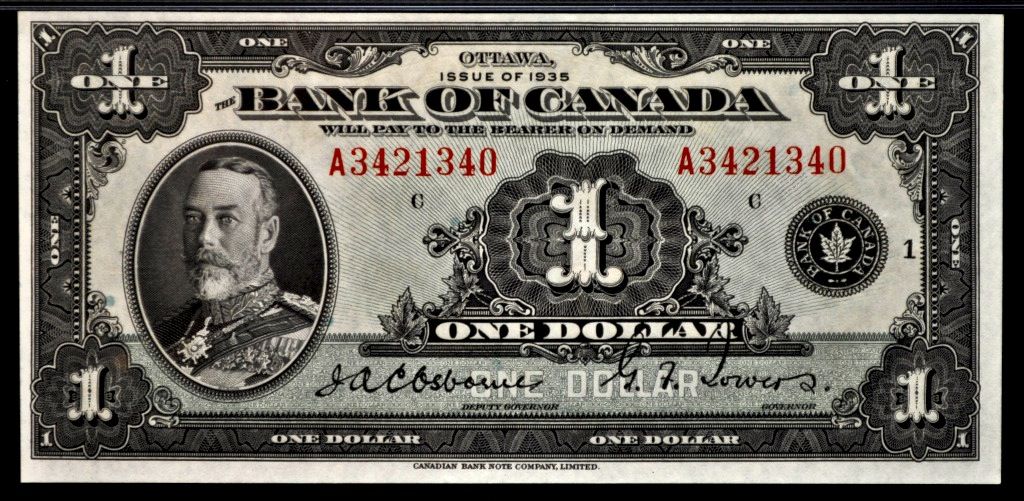
With Confederation in 1867, the Canadian dollar was formally established. The federal Parliament passed the first Currency Act in 1868 and the Uniform Currency Act in 1871, creating a uniform dollar across Canada. The government began issuing its own coins in 1870. The Bank of Canada was established in 1934 and began operations on March 11, 1935. It issued its first series of bank notes in 1935, beginning a history of eight distinct series. The Bank of Canada became the sole issuer of paper currency by 1953. The central bank has issued four commemorative bank notes: the 1935 note for the Silver Jubilee of King George V, the 1967 Centennial note, a 2015 note honouring Queen Elizabeth II as the longest-reigning sovereign, and a 2017 note for Canada's 150th anniversary. Modern series have transitioned to polymer substrate, starting with the Frontier series. Recent announcements include a new vertical $20 polymer note featuring King Charles III and a December 2024 announcement that Terry Fox will feature on the new $5 note.
Modern Coinage and Exchange Rate History
The Royal Canadian Mint, responsible for coin production, has a long history of issuing commemorative circulation coins. A recent example is the 2026 commemorative one-dollar circulation coin to mark Canada's hosting of the FIFA World Cup 2026. The coin design features a mosaic maple leaf and the tournament logo. It will be produced in both coloured and non-coloured versions following an Order in Council in 2025. The modern history of the Canadian dollar's value against the US dollar has seen significant fluctuations. The Canadian dollar traded in a range of US$1.02 to US$1.06 from 1953 to 1960, reaching a high of US$1.0614 on August 20, 1957. Since the 1970s, there have been three major declines in the dollar's value, each seeing a drop of over 30 percent from peak to trough. The most recent decline was the fastest, partly due to a collapse in oil prices. Following a trough in 2016, the dollar traded in a relatively narrow range. Recent exchange rate data shows ongoing variation. The Bank of Canada's key interest rate was 2.25 percent as of September 2026.
| Date | Exchange Rate (1 USD =) |
|---|---|
| May 31, 2026 | 1.372451 CAD |
| June 30, 2026 | 1.404938 CAD |
| July 31, 2026 | 1.411462 CAD |
| August 31, 2026 | 1.390572 CAD |
| October 22, 2026 | 1.4034 CAD |
Commemorative Issues and National Identity
Commemorative currency issues celebrate national identity and educate the public about Canadian history. The Mint's commemorative programs often include fine silver sets. The Bank of Canada's commemorative bank notes are issued decades apart, each reflecting the design and technological sensibilities of its era. These special issues are intended for circulation but are often collected. The process for creating new circulation coin designs involves an Order in Council from the Governor General on the recommendation of the Minister of Finance. The Bank of Canada has issued eight series of notes: 1935, 1937, 1954, 1970, 1986, 2001, 2011, and the eighth series released in 2018. The current Frontier Series consists of five polymer notes: $5 (Wilfrid Laurier), $10 (John A. Macdonald), $20 (Queen Elizabeth II), $50 (William Lyon Mackenzie King), and $100 (Robert Borden). A new eighth series began release in 2018 with a $10 note featuring Viola Desmond.
Questions about History of Canadian currencies
What was the first paper money used in Canada?
The first paper money used in Canada was playing card money, issued in 1685 by the Intendant of New France, Jacques de Meulles. He wrote denominations on the backs of playing cards to pay soldiers. This was the first issue of paper money by a Western government. Card money was reintroduced in 1729 and used until the end of French rule.
When did Canada switch from the British pound to the dollar?
The Canadian colonies gradually shifted from the British pound to currencies linked to the United States dollar throughout the mid-19th century. This change was driven by strong local trade links with the United States. The Canadian dollar was formally established with Confederation in 1867. The Uniform Currency Act of 1871 then created a uniform dollar across Canada, fully consolidating the transition.
What are Habitant tokens?
Habitant tokens were trade tokens issued by banks and merchants in Lower Canada in the early 19th century to address coin shortages. One specific type featured the arms of Montreal on one side and an image of a habitant on the other. They were nicknamed 'Papineaus' after Louis-Joseph Papineau, the leader of the 1837 rebellion who was known for wearing habitant clothing. These tokens had no legal status but were accepted as currency on a local basis.
What is the 2026 commemorative Canadian dollar coin for?
The Royal Canadian Mint will issue a special one-dollar commemorative circulation coin in 2026. This coin is intended to mark Canada's role as a host country for the FIFA World Cup 2026 tournament. Its design features a mosaic maple leaf along with the official tournament logo. This issue continues Canada's 20th century practice of releasing commemorative coins into circulation.
Who will be featured on the new Canadian $5 bill?
On December 16, 2024, the Government of Canada announced that the new five-dollar bank note will feature Terry Fox. The announcement also confirmed that a new vertical twenty-dollar polymer note will feature King Charles III. These new designs continue the evolution of Canadian banknotes, which began with provincial notes before Confederation in 1867. The federal Parliament has exclusive jurisdiction over the issue of paper money in Canada.
When did the Bank of Canada become the only issuer of paper money?
The Bank of Canada became the sole issuer of paper currency by 1953. This process ended the long-standing practice of chartered banks issuing their own notes, which had begun with the Montreal Bank in 1817. The centralization of note issuance provided a uniform and secure national currency. As a result, all chartered banks ceased to issue their own banknotes by the mid-20th century.
Sources and further reading
- History of Canadian currencies (Wikipedia)
- History of the Canadian Dollar (cclfg.cclgroup.com)
- Complete Bank Note Series (bankofcanadamuseum.ca)
Checked by the Nosy Mag desk. Last updated 2026-10-29.