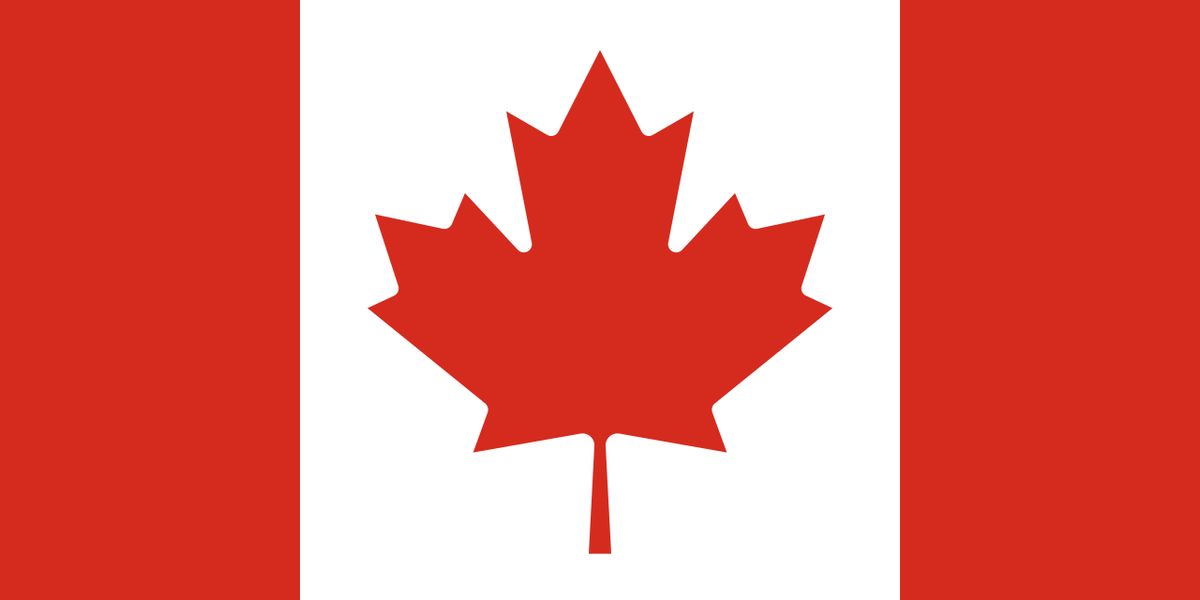
Canadian dollar
The Canadian dollar is the official currency of Canada, denoted by the symbol $ and the currency code CAD. It is colloquially known as the "loonie" after the common loon depicted on the one-dollar coin. The currency is a major global reserve, accounting for approximately two percent of all reserves worldwide, ranking as the fifth-most held reserve currency as of January 2024. Its value is closely watched against the US dollar, given the deep trade ties between the two nations, and it has experienced significant historical fluctuations influenced by factors like commodity prices and central bank policy.
Historical Development and Confederation
The evolution of the Canadian dollar is a story of colonial negotiation and gradual standardization. In the 1850s, a major debate unfolded across British North America over whether to adopt a sterling-based monetary system or a decimal system aligned with the United States dollar. The Province of Canada moved first, passing legislation in 1853 to introduce a gold standard and then, decisively, issuing its first decimal coins in 1858, thereby aligning its currency with the American unit. This set a precedent, with New Brunswick and Nova Scotia adopting similar decimal systems based on the US dollar in 1860. Other colonies followed distinct paths. Newfoundland adopted a decimal unit in 1865 based on the slightly more valuable Spanish dollar, while British Columbia created its own dollar at par with the Canadian dollar in 1865 before joining Canada in 1871. The political unification of the Province of Canada, New Brunswick, and Nova Scotia into the Dominion of Canada in 1867 necessitated a merged currency. The federal Parliament passed the Uniform Currency Act in April 1871, formally creating a singular Canadian dollar to replace the various provincial currencies.
The new nation's currency remained on the gold standard until the pressures of the First World War forced its temporary abandonment. The standard was definitively abolished on April 10, 1933. During the Second World War, the government fixed the exchange rate at Can$1.10 = US$1.00, a peg that shifted to parity in 1946 and then back to Can$1.10 = US$1.00 after a 1949 devaluation. In a significant policy shift, Canada allowed its dollar to float in 1950, leading to a period where it traded at a slight premium over the US dollar. This float was interrupted in 1962 when the dollar was pegged at Can$1.00 = US$0.925, a rate critics nicknamed the "Diefenbuck" after Prime Minister John Diefenbaker. This fixed rate lasted until 1970, after which the Canadian dollar returned to a floating exchange rate, a system that has remained in place ever since.

Coins and Their Evolution
Canadian coinage is produced by the Royal Canadian Mint at its facilities in Winnipeg, Manitoba, and Ottawa, Ontario. The coins in active circulation are the 5¢ (nickel), 10¢ (dime), 25¢ (quarter), $1 (loonie), and $2 (toonie). A 50¢ coin is minted but is not distributed to banks for general circulation, making it a collector's item. The standard designs feature Canadian wildlife on the reverse and an effigy of the reigning monarch, currently King Charles III, on the obverse. The journey to this modern set involved considerable change. The first decimal coins of the Province of Canada were issued in 1858 in bronze and silver. After Confederation, coin production resumed in 1870, introducing the 25¢ and 50¢ pieces. The 20th century saw numerous compositional changes driven by economics and war. The silver content in coins was gradually reduced, with the 5¢ coin transitioning to pure nickel in 1922. Wartime measures saw the 5¢ coin made from tombac and changed to a twelve-sided shape in 1942. The last circulating silver coins were issued in 1968, after which Canada's coinage became entirely base metal.
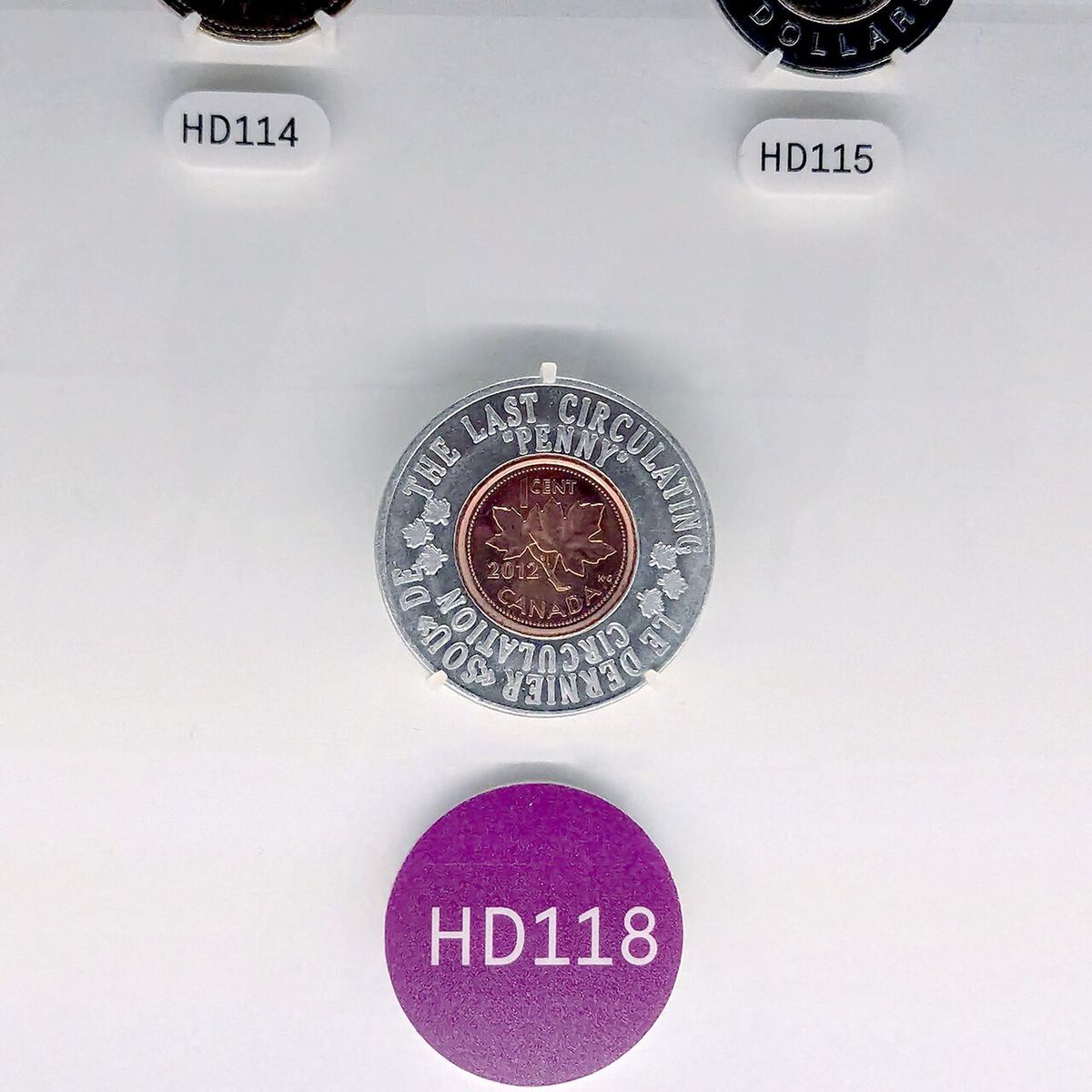
Two of the most significant changes in recent decades were the introduction of the dollar and two-dollar coins. The $1 banknote was replaced in 1987 by a gold-coloured, aureate-plated nickel coin featuring a loon, instantly earning it the nickname loonie. This was followed in 1996 by a bimetallic $2 coin, quickly dubbed the toonie. The other major shift was the demise of the penny. The last 1¢ coin was struck on May 4, 2012, and its distribution ceased on February 4, 2013. Since then, cash transactions are rounded to the nearest five cents, though the penny remains legal tender for payment. Modern coins are made from plated steel to reduce costs, a technology extended to the $1 and $2 coins in 2012. Gold coins in denominations of $5 and $10 were produced from 1912 to 1914, with much of the gold sourced from the Klondike River valley in the Yukon.
- 1858: First decimal coins issued by the Province of Canada.
- 1922: 5¢ coin switches from silver to pure nickel.
- 1968: Last year for circulating silver coinage.
- 1987: $1 coin (loonie) enters circulation.
- 1996: $2 coin (toonie) introduced.
- 2012: Final penny minted. Multi-ply plated steel used for $1 and $2 coins.
- 2013: Penny withdrawn from distribution.
Banknotes and Security
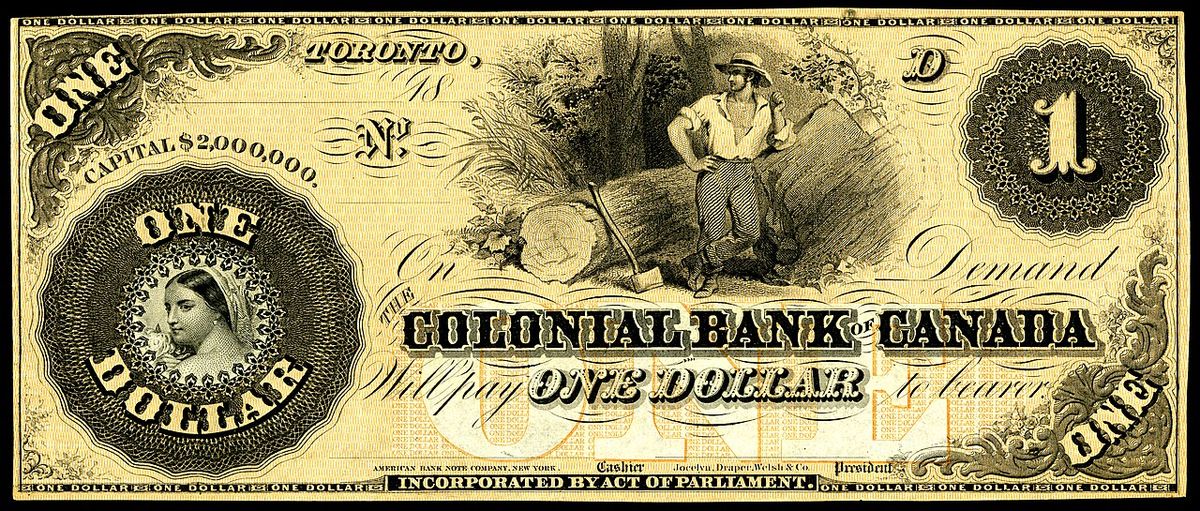
Paper money in Canada has a long history, beginning with British Army bills issued between 1813 and 1815. In the 19th century, notes were issued by chartered banks, colonial governments like the Province of Canada, and later the Canadian government itself. This era of multiple issuers ended with the founding of the Bank of Canada on July 3, 1934, which became the sole issuer of federal notes. Its first series was released in 1935, featuring denominations from $1 to $1000, including a commemorative $25 note for King George V's Silver Jubilee. The chartered banks were finally prohibited from issuing their own notes in 1944. Since 1935, all banknotes have been printed under contract for the Bank of Canada. For decades, this work was shared between the Canadian Bank Note Company and BA International. In 2011, BA International announced it would close its banknote printing business at the end of 2012, leaving the Canadian Bank Note Company as the nation's sole banknote printer.
Banknote design has evolved through several major series, each introducing new security features and artistic themes. Significant series were introduced in 1937, 1954, 1970, 1986, and 2001. The most significant change in recent years was the move to polymer substrate notes. Announced in June 2011, these durable, secure notes began entering circulation with the $100 bill on November 14, 2011. The $50, $20, $10, and $5 polymer notes followed in 2012 and 2013. This polymer series replaced the older cotton-paper notes, which are now considered unfit for circulation due to their lack of modern security features like metallic stripes. Financial institutions must return these old notes to the Bank of Canada for destruction, though individuals may keep them indefinitely. As of January 1, 2021, the $1, $2, $25, $500, and $1000 banknotes are no longer legal tender, though all other Bank of Canada notes remain so.
Terminology and Slang
The Canadian dollar has generated a rich vocabulary of colloquial terms in both official languages. In English, the slang term buck for a dollar has Canadian origins, deriving from the beaver pelt trade and a coin issued by the Hudson's Bay Company. The loonie name for the one-dollar coin emerged naturally after its 1987 introduction, inspired by the common loon on its reverse. When the two-dollar coin arrived in 1996, the portmanteau toonie quickly followed. In Canadian French, the currency is formally le dollar, but slang terms are common. Piastre or its colloquial form piasse is widely used, harkening back to the original French term for dollar. The dollar coin is often called a huard, the French word for loon. The subdivision, the cent, is usually called a cent, but the informal sou is also heard. A particularly enduring idiom is trente sous for a 25-cent coin, a historical artifact from the complex exchange rates between French, British, and American currencies in the 18th and 19th centuries.
Value and Exchange Rate Dynamics
The value of the Canadian dollar is of paramount importance to the national economy due to Canada's deep trade integration with the United States. With over three-quarters of exports destined for the US market, movements in the USD/CAD exchange rate directly impact Canadian exporters, importers, and consumers. A higher Canadian dollar makes exports more expensive for US buyers but makes foreign goods and materials cheaper for Canadian industry. The Bank of Canada does not target a specific exchange rate and has not intervened in foreign exchange markets since 1998, preferring to let market conditions determine the currency's value. Historically, the loonie has tended to move in correlation with the US dollar, but since the early 2000s it has also gained value against other international currencies. In recent decades, its value has shown a notable correlation with global oil prices, earning it the classification of a petrocurrency due to Canada's status as a major oil exporter.
The exchange rate has experienced significant fluctuations over its floating history. It traded at a record high in terms of US greenbacks on July 11, 1864, during the American Civil War when the US dollar was an inconvertible paper currency. In the modern era, it reached a peak against the US dollar on August 20, 1957, at US$1.0614. Analysis shows there have been three major declines in the Canadian dollar's value since 1970, each representing a drop of a little over 30 percent from peak to trough. The most recent decline was the fastest, partly due to a swift collapse in oil prices. Since a trough in 2016, the currency has traded in a relatively narrow range. As of late October 2026, the exchange rate was approximately 1.4034 Canadian dollars per US dollar, reflecting ongoing market assessments of relative economic strength, interest rates, and commodity prices.
| Period | Key Event or Rate |
|---|---|
| 1864 | Record high vs. US paper dollar (US$2.78) |
| 1957 | Peak in post-war period (US$1.0614) |
| 1962 to 1970 | Pegged at Can$1.00 = US$0.925 |
| 1970 | Return to floating exchange rate |
| July 2026 | CAD strengthened 1.36%, closing at 1.40148 per USD |
| October 22, 2026 | Exchange rate at 1.4034 CAD per USD |
Legal Tender and International Use
The rules governing what constitutes legal tender in Canada are set out in the Currency Act. For coins, there are limits on the amounts that must be accepted in a single transaction. A person can tender up to $40 in toonies or other coins of $2 to $10 denomination, $25 in loonies, $10 in dimes or quarters, $5 in nickels, and 25 cents in pennies. For banknotes, all current Bank of Canada issues remain legal tender except for the $1, $2, $25, $500, and $1000 denominations, which lost that status on January 1, 2021. Crucially, the law requires that the method of payment be mutually agreed upon by the parties in a transaction. This means a retailer can legally refuse certain banknotes, such as $100 bills, over counterfeiting concerns, or even refuse cash altogether if an alternative method is agreed upon.
The Canadian dollar also sees use beyond the country's borders, primarily due to geographic and economic proximity. Canadian coins and notes are commonly accepted by businesses in the northernmost cities of the United States and in Canadian snowbird enclaves in warmer US states, just as US currency is often taken by Canadian businesses near the border. The currency's stability has occasionally attracted international attention as a potential alternative for other nations. In 2012, Iceland seriously considered adopting the Canadian dollar as a stable replacement for its volatile króna, citing Canada's northern geography, resource-based economy, and economic soundness. While the Canadian ambassador stated Iceland could adopt the currency, the proposal was ultimately not implemented. The Canadian dollar is held as a reserve currency by a number of central banks, particularly in the Americas and the Caribbean.
Recent Economic Context and the Loonie
The performance of the Canadian dollar in the mid-2020s illustrates the complex factors that influence its value. In July 2026, the loonie strengthened by about 1.36 percent against the US dollar, partially reversing a rise from the previous month. This movement occurred amidst key domestic economic developments. The Bank of Canada held its target for the overnight rate steady at 2.25 percent at its July 15 announcement, a decision that typically supports a currency by maintaining relative returns on Canadian-dollar assets. Concurrently, inflation data showed a cooling trend, with the Consumer Price Index rising 2.8 percent year-over-year in June, down from 3.2 percent in May. This easing was driven largely by a significant monthly drop in gasoline prices. While the price of oil, a key Canadian export, fell by roughly five percent in July, which often weighs on the currency, the supportive effects of steady interest rates and moderating inflation appeared to outweigh that drag during this period.
Other economic indicators provided context for the Bank of Canada's policy stance and the currency's environment. Labour market data from June 2026 showed a slight improvement, with the unemployment rate edging down to 6.5 percent and average hourly wages rising 3.3 percent from a year earlier. Gross domestic product data indicated the economy continued to expand. This combination of factors, controlled inflation, steady monetary policy, moderate growth, and a softening but influential oil price, created the conditions for the Canadian dollar's appreciation in that month. The currency's closing rate of 1.40148 Canadian dollars per US dollar at the end of July 2026 reflected these intertwined domestic and global market forces. The Canadian dollar's value against the US dollar has fluctuated widely in the 21st century, trading as low as US$0.6179 in January 2002 and reaching parity in 2007.
Questions about Canadian dollar
Why is the Canadian dollar called the loonie?
The Canadian dollar coin, introduced in 1987, features the image of a common loon on its reverse side. This distinctive design led English-speaking Canadians and financial traders to quickly adopt the nickname loonie for the coin. The term has since become synonymous with the Canadian dollar itself in everyday parlance and international finance. In French, the coin is similarly called a huard, which is the French word for loon.
Are Canadian pennies still legal tender?
Yes, the one-cent coin (penny) remains legal tender in Canada. However, the Royal Canadian Mint ceased production of pennies in 2012, and financial institutions stopped distributing them in February 2013. As a result, cash transactions are now rounded to the nearest five cents. While businesses are not obligated to give pennies as change, they must still accept them as payment from customers up to a limit of 25 cents for a single transaction.
What happened to the Canadian one-dollar and two-dollar bills?
The one-dollar banknote was removed from circulation and replaced by the one-dollar coin (loonie) in 1987. The two-dollar bill was replaced by the two-dollar coin (toonie) in 1996. These paper notes are no longer issued by the Bank of Canada. As of January 1, 2021, the $1 and $2 banknotes issued by the Bank of Canada are no longer legal tender, meaning they cannot be used to pay for goods and services, though they can still be exchanged at financial institutions.
How does the Bank of Canada influence the value of the dollar?
The Bank of Canada does not target a specific value for the Canadian dollar and has not directly intervened in foreign exchange markets since 1998. Its official position is that market conditions should determine the currency's worth. The Bank's primary tool for influencing the economy is its policy interest rate. By raising or lowering this rate, it affects economic activity and inflation, which in turn can impact the currency's attractiveness to international investors. While the Bank primarily focuses on inflation targeting, its interest rate decisions are the main channel through which it indirectly influences the dollar's value.
Why is the Canadian dollar considered a petrocurrency?
The Canadian dollar is often labelled a petrocurrency because its value has shown a strong historical correlation with the price of crude oil. Canada is a major exporter of oil, and energy products constitute a significant portion of its exports. When global oil prices rise, it typically increases demand for Canadian dollars from international buyers needing to purchase Canadian oil, which can strengthen the currency. Conversely, a sharp drop in oil prices often puts downward pressure on the loonie. This link makes the currency particularly sensitive to developments in global energy markets.
Can businesses in Canada refuse to accept cash?
Yes, businesses in Canada can refuse cash payments under certain conditions. The law states that the method of payment for a transaction must be mutually agreed upon by the buyer and seller. Therefore, a store can establish a policy of accepting only debit cards, credit cards, or other electronic payments. They can also refuse specific banknotes, such as large denominations like $100 bills, due to concerns about counterfeiting. If a customer and a business cannot agree on a method of payment, the transaction does not occur.
Sources and further reading
- Canadian dollar (Wikipedia)
- History of the Canadian Dollar (cclfg.cclgroup.com)
- USD to CAD Historical Exchange Rates (mtfxgroup.com)
- Canadian Dollar Recap: July 2026 (keyhanexchange.ca)
Checked by the Nosy Mag desk. Last updated 2026-10-30.