Dalton McGuinty
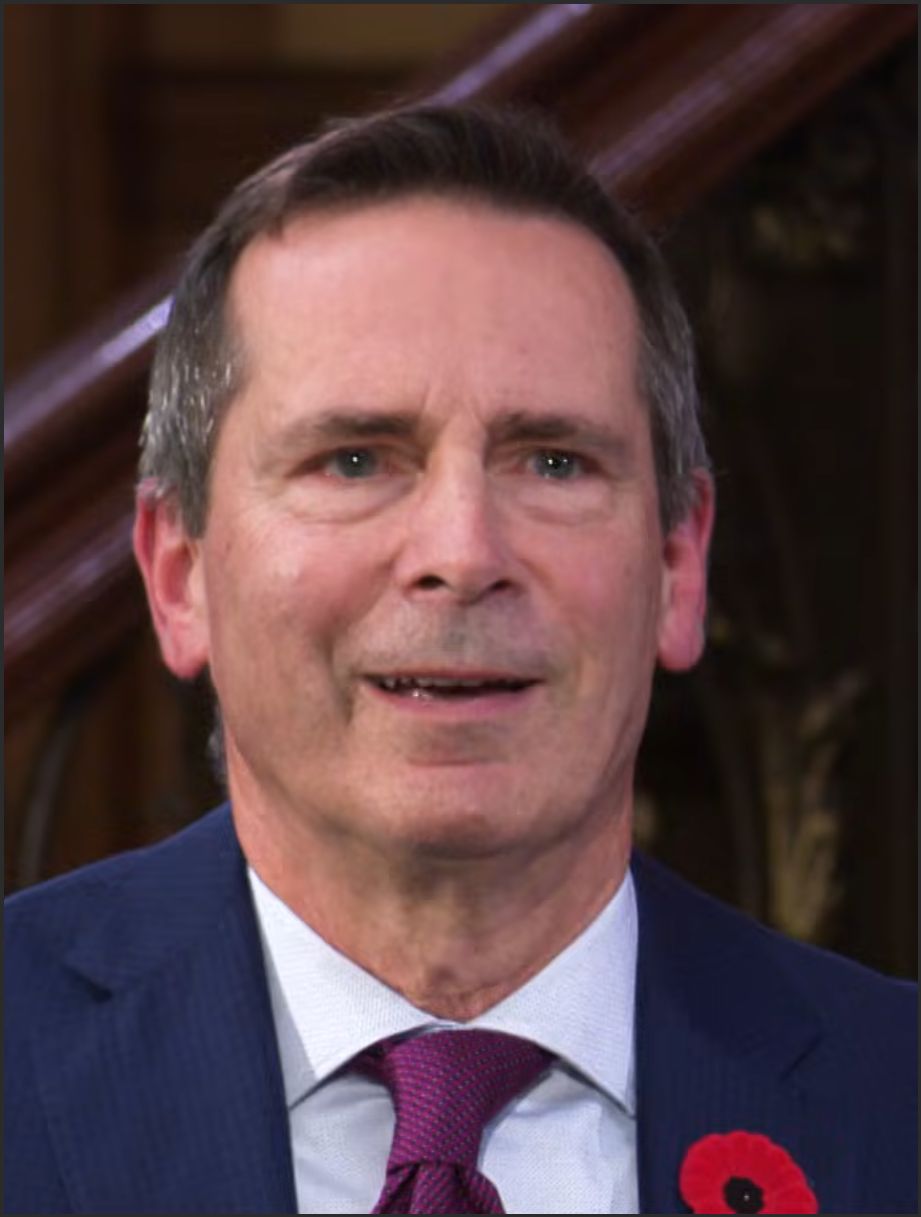
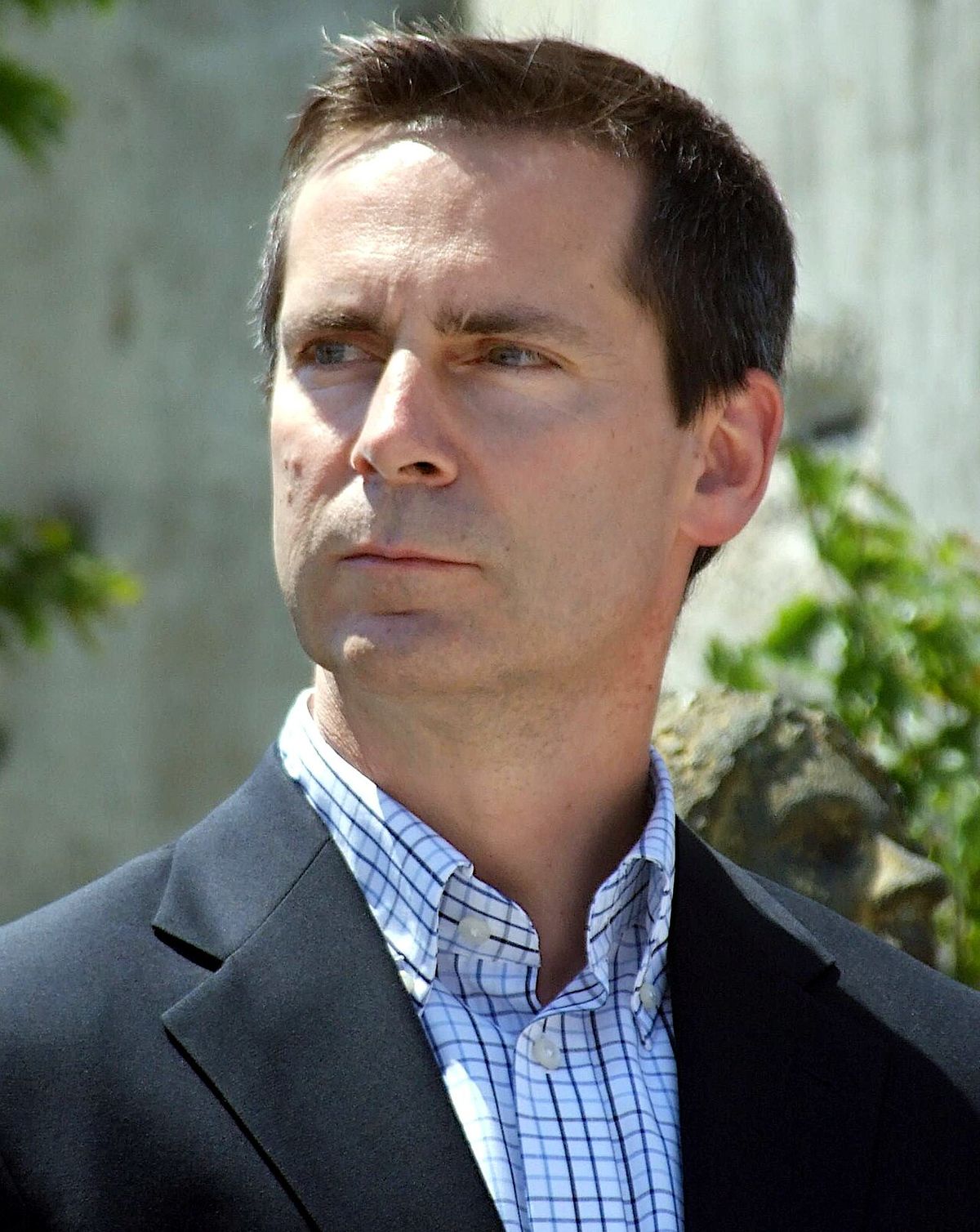
Dalton James Patrick McGuinty Jr. is a Canadian former politician who served as the 24th premier of Ontario from 2003 to 2013. He was the first Liberal leader to win two majority governments since Mitchell Hepburn nearly 70 years earlier. In 2011, he became the first Liberal premier to secure a third consecutive term since Oliver Mowat after his party was re-elected. His premiership was defined by major investments in public education and health care, ambitious environmental policies, and significant economic reforms. His time in office concluded amidst controversy, notably the costly cancellation of gas-fired power plants, which contributed to the end of his political career.
Early Life, Education, and Entry into Politics
Dalton McGuinty was born in Ottawa on July 19, 1955, the second of ten children in a bilingual, Catholic household. His mother, Elizabeth (Pexton) McGuinty, was a francophone nurse of English and French Canadian ancestry, and his father, Dalton Sr., was an anglophone professor of Irish descent who later entered politics. McGuinty attended St. Patrick's High School in Ottawa before enrolling at McMaster University, where he earned a Bachelor of Science in biology. He then obtained a law degree (LL.B.) from the University of Ottawa and practiced law in the city. He married his high school girlfriend, Terri McGuinty, an elementary school teacher, in 1980, and the couple had one daughter and three sons. His entry into politics followed the death of his father in 1990, who had served as the Liberal MPP for Ottawa South since 1987. McGuinty successfully won the Liberal nomination for his father's former riding in the 1990 provincial election and was elected, even as the incumbent Liberal government of David Peterson was defeated by the Ontario New Democratic Party led by Bob Rae.
Rise to Party Leadership and Years in Opposition
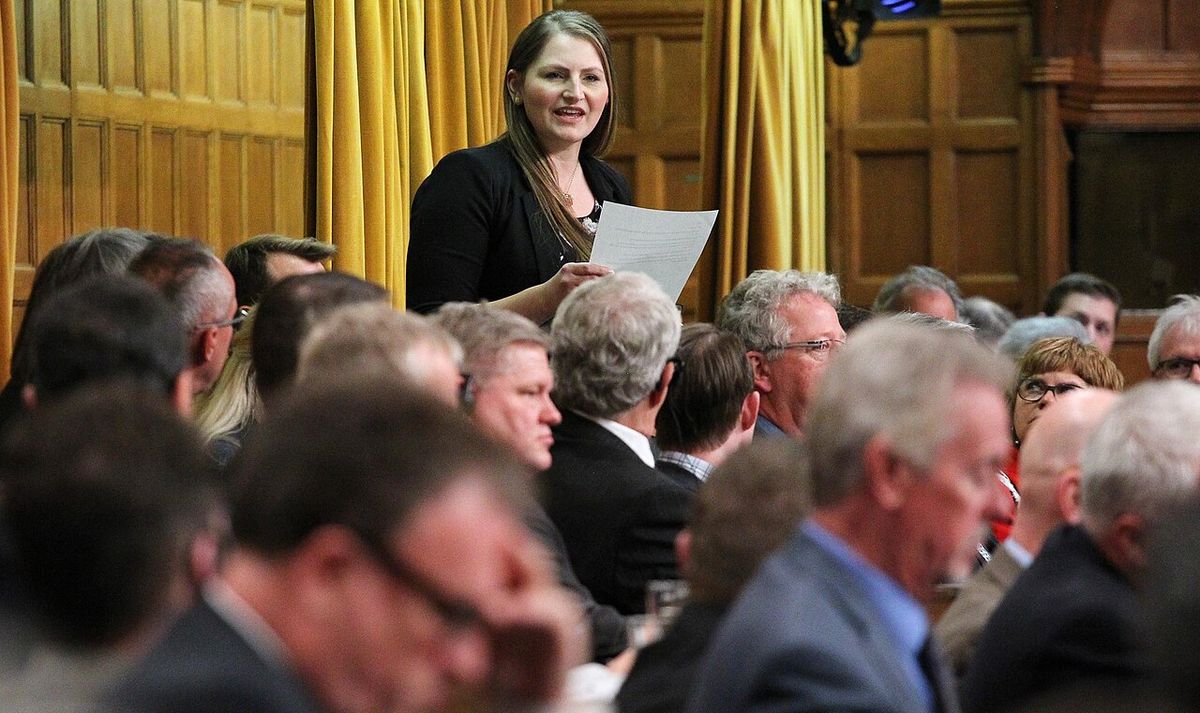
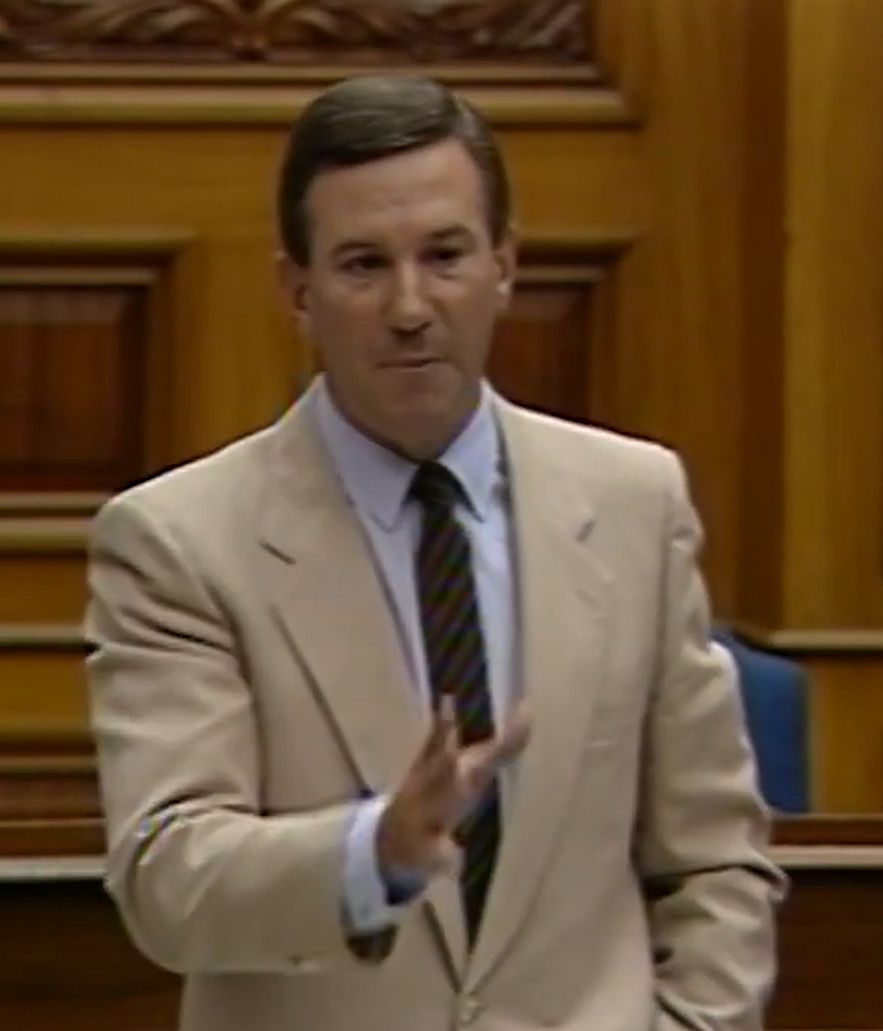
As a backbench MPP in opposition, McGuinty served as the Liberal critic for energy, environment, and colleges and universities. Following the party's second consecutive election loss in 1995 under leader Lyn McLeod, a leadership convention was called for 1996. McGuinty entered the race as an underdog candidate from the party's more centrist, pro-business wing, with supporters that included John Manley, Murray Elston, and Bob Chiarelli. He was elected leader at the December convention in a surprise victory over front-runner Gerard Kennedy after a five-ballot contest where he overtook rivals Dwight Duncan and Joe Cordiano. His early years as opposition leader were challenging, with the governing Progressive Conservatives under Mike Harris running a series of television advertisements that defined him as "not up to the job." The 1999 election campaign was difficult for McGuinty personally. His performance in the early weeks was widely criticized, and he was regarded as having performed poorly in the election's only leaders' debate, during which he called Mike Harris a "thug." Despite this, he rallied his party in the closing days to draw 40 percent of the popular vote, the Liberal Party's second-best performance in fifty years, increasing their seat count from 30 to 36. He faced a surprisingly difficult re-election in his own Ottawa South riding before defeating his Conservative opponent by about 3,000 votes.
During his second term as opposition leader, McGuinty hired a more skilled group of advisors and drafted former cabinet minister Greg Sorbara as party president. He also rebuilt the party's fundraising operation by launching the Ontario Liberal Fund. In preparation for the 2003 election, the party adopted a platform that emphasized lowering class sizes in schools, hiring more nurses, increasing environmental protections, and "holding the line" on taxes. McGuinty also worked to improve his debating skills, receiving coaching from Scott Reid. His chances for victory were improved by controversies involving the governing PC Party, including the fallout from the Ipperwash shooting death of protester Dudley George, the Walkerton tainted water tragedy that killed seven people, and the decision to provide tax credits for private school attendance.
The 2003 Election and First Majority Government
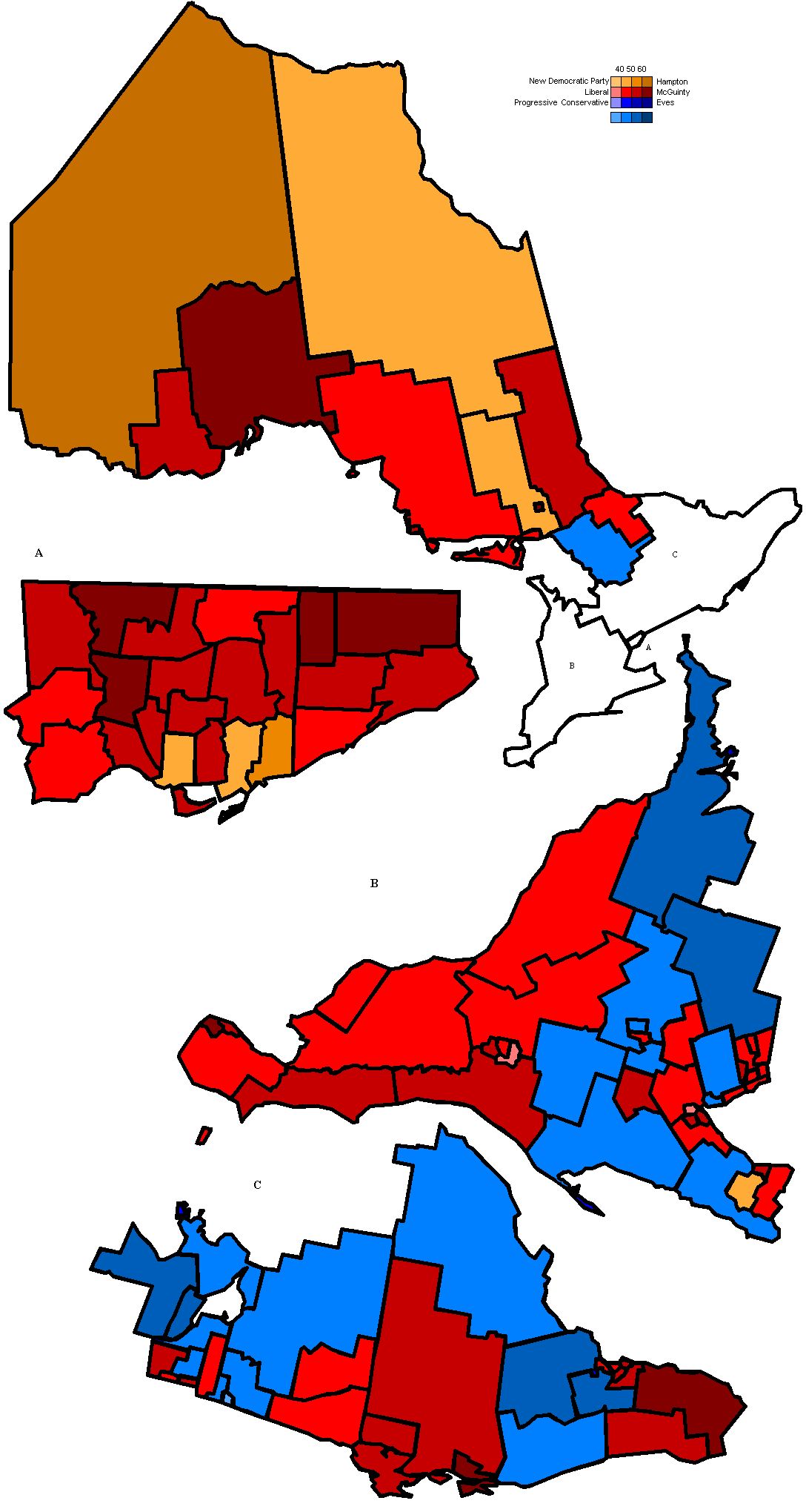
McGuinty led the Liberals into the 2003 election against new Progressive Conservative Premier Ernie Eves. The campaign dynamics shifted after the August 2003 North America blackout, which initially gave Eves increased exposure and narrowed the Liberal lead. The Tories accidentally distributed a press release describing McGuinty as an "evil reptilian kitten-eater from another planet," which Eves later called an inappropriate joke. McGuinty undertook a series of choreographed events, including signing a taxpayer protection pledge not to raise taxes and appearing on the sports show "Off the Record" where he received an endorsement from Canadian Idol winner Ryan Malcolm. He was able to maintain his party's standing in the polls, preventing Eves from making up ground during the leader's debate. On election day, the Liberals won a commanding majority government, securing 72 of the legislature's 103 seats, reducing the PC Party to 24 seats and costing the NDP its official party status. Following the election, the McGuinty government asked former Provincial Auditor Erik Peters to examine the province's finances, and he revealed a hidden deficit of at least $5.6 billion left by the previous government, a figure the Conservatives disputed.
First Term as Premier: The 'Fair Share' Agenda and Broken Pledges
McGuinty took office as Premier and Minister of Intergovernmental Affairs on October 23, 2003. His government recalled the legislature in late 2003 and moved quickly on a packed agenda, passing auto insurance reforms with a price cap, rolling back scheduled corporate and personal tax cuts, and enacting a ban on partisan government advertising. The centrepiece of his first budget in May 2004, delivered by Finance Minister Greg Sorbara, was a large infusion of new money into hospitals specifically to shorten wait times in five key areas: knee and hip replacements, cancer treatment, cardiac treatment, cataracts, and MRI and CT scans. The budget also included free immunizations for children, funding for 150 new Family Health Teams, almost 100,000 new home care spaces, and almost 4,000 new long-term care beds. To pay for this plan, the Liberals imposed a controversial new Health Premium of $300 to $900, staggered according to income, which violated their campaign pledge not to raise taxes. The government defended the move by arguing the previous government's hidden deficit left no choice, but the broken promise caused a severe drop in poll numbers and became a major issue in the 2004 federal election, hampering Liberal Prime Minister Paul Martin's bid for re-election.
Other elements of the first budget were a four-year plan to tackle the deficit, funding for 1,000 new teachers, a transfer of two cents of the existing gas tax to municipalities for transit, and a three percent increase to social assistance rates, the first in ten years. The government also eliminated coverage for health services not covered by the Canada Health Act, including eye examinations and physical therapy. Soon after the federal election, McGuinty attended a First Ministers' Meeting that resulted in a new national health accord, with provinces receiving new federal funding in exchange for reports on waiting times. The government ended the year by releasing "Progress Report 2004: Getting Results for Ontario," which set specific targets on education dropout rates, post-secondary participation, and medical wait times.
Major legislative initiatives from Dalton McGuinty's first term as premier included several significant reforms. His government enacted auto insurance reforms and rolled back scheduled tax cuts. It passed legislation to enshrine publicly funded healthcare into provincial law and hired more meat and water inspectors. The government also opened provincially owned electricity companies to freedom of information laws and enacted a ban on partisan government advertising. It implemented a controversial new Health Premium to fund healthcare improvements.
- Creating the Greenbelt around Toronto in 2005, a protected area the size of Prince Edward Island to preserve forests and farmland from development.
- Banning smoking in all public places and workplaces.
- Removing junk food from public schools and requiring students to stay in school until age 18.
- Banning pit bulls, with existing dogs allowed only if muzzled in public and sterilized, while importing and breeding were prohibited.
- Updating legislation to reflect the legalization of same-sex marriage.
- Launching a high-profile campaign to narrow the "$23 billion gap" in federal transfers, resulting in a May 2005 agreement with Prime Minister Paul Martin for $5.75 billion over five years for immigrant settlement, training, and post-secondary education.
The McGuinty government announced the closure of the coal fired Lakeview generating station in late April 2005. However, it later delayed the overall coal phase out target from 2007 to 2009. In early 2005, McGuinty called a rare winter session of the legislature. During this session, the government passed the Greenbelt Act to protect a large area of land from development around Toronto. It also updated legislation to reflect the change in the definition of marriage to include homosexual couples.
Second Term, the Financial Crisis, and Mounting Scandals
McGuinty won a second majority government in the 2007 provincial election, the first Liberal premier to win consecutive majorities since Mitchell Hepburn in the 1930s. His second term was immediately dominated by the global financial crisis of 2008, which caused provincial revenues to plummet and forced the government to run substantial deficits, breaking its promise to balance the budget by 2008-09. A major scandal erupted around eHealth Ontario, an agency created to develop electronic health records, which was found to have awarded untendered contracts and spent millions on consultants with little oversight. The government spent five years and $647 million on the predecessor Smart Systems for Health Agency before restarting it as eHealth Ontario. A more damaging controversy emerged just before the 2011 election when the government cancelled construction of two gas-fired power plants in Oakville and Mississauga, ridings where local opposition threatened Liberal seats. The eventual cost to taxpayers for cancelling the contracts was revealed to be close to $1 billion, a figure that became a focal point for opposition attacks. Despite the scandals, McGuinty secured his historic third consecutive term in the 2011 election, though the Liberals were reduced to a minority government with 53 of 107 seats.
Policy Legacy: Education, Health, Environment and Economy
Throughout his premiership, McGuinty's government pursued a consistent set of policy priorities with measurable outcomes. In education, his government introduced full-day kindergarten for four- and five-year-olds, making Ontario the first jurisdiction in North America to do so. The government's "Reaching Higher" plan represented the largest investment in higher education in forty years, expanding medical school spaces and increasing accessibility for low-income students. Standardized test scores for students rose by 17 percent during his time in office, and the government worked to cap primary class sizes, aiming for 90-95 percent of students from junior kindergarten to Grade 3 to be in classes of twenty or fewer by 2007. In health care, wait times for key procedures were reduced significantly, moving from the longest in Canada to the shortest. His environmental record was anchored by the closure of all of Ontario's coal-fired power plants, which is the single largest greenhouse gas reduction initiative in North America. The creation of Ontario's Greenbelt also established the world's largest protected urban greenspace.
To improve economic competitiveness, the government harmonized the provincial sales tax with the federal GST to create the Harmonized Sales Tax (HST), a value-added tax designed to boost investment. It also cut the marginal effective tax rate on new business investment in half. McGuinty created Canada's first ministry of Research and Innovation, which he led as minister, and encouraged Ontario's large pension plans to invest in infrastructure projects like new roads, schools, and hospitals, a move NDP leader Howard Hampton described as "privatization by stealth." The government also concluded significant agreements with public sector unions, including the province's doctors, teachers, and the Ontario Public Service Employees Union, leading to periods of labour stability. The 2005 budget, which focused on education, broke the promise to balance the budget in 2007-08, instead aiming for 2008-09, as the government prioritized spending on its core priorities.
Resignation, Prorogation, and Post-Political Career
The gas plants scandal continued to plague McGuinty's minority government throughout 2012. Facing intense legislative scrutiny and committee investigations into the cancellations, he announced his resignation as Liberal leader in October 2012 and prorogued the legislature, a move critics argued was intended to halt the probes. He remained premier until Kathleen Wynne succeeded him as party leader and premier on February 11, 2013. McGuinty resigned his Ottawa South seat on June 12, 2013, ending 23 years in the legislature. Since leaving politics, he has been active in academia, business, and philanthropy. He served as a senior fellow at Harvard University's Weatherhead Center for International Affairs and is a fellow at the University of Toronto's Munk School of Global Affairs and Public Policy and Carleton University's School of Public Policy and Administration. His corporate board memberships have included Innergex Renewable Energy Inc., Pomerleau Inc., and Electrovaya Inc. He also serves as special advisor to the CEO of D2L Corporation and chairs the board of the University of Ottawa Heart Institute. He is a board member of the Rideau Hall Foundation and an advisor to Ontario business startups. In 2026, he was named the recipient of the Churchill Society's Award for Excellence.
Electoral Record and Political Milestones
Dalton McGuinty led the Ontario Liberal Party through four general elections as its leader. He first lost the 1999 election to Progressive Conservative Premier Mike Harris. McGuinty then won a resounding majority government in the 2003 provincial election. He won another majority government in the 2007 election, the first Liberal premier to win consecutive majorities since Mitchell Hepburn. In 2011, he became the first Liberal premier to secure a third consecutive term since Oliver Mowat after his party was re-elected to a minority government.
His first victory in 2003 ended eight years of Progressive Conservative government. The 2011 election, while producing a minority, made him the first Liberal premier to win three consecutive terms since the 19th century, cementing a long period of political dominance that would continue under his successor. This record of three successive election victories was a feat not achieved in his party for over 100 years, since the premiership of Oliver Mowat. Following the 2003 election, the McGuinty government's examination of the province's finances revealed a hidden deficit, which the new premier used to justify breaking several campaign promises on taxation and spending.
Questions about Dalton McGuinty
How long was Dalton McGuinty premier of Ontario?
Dalton McGuinty served as the 24th premier of Ontario from October 23, 2003, to February 11, 2013. His tenure lasted nearly a full decade. He was the first Liberal leader to win two majority governments since Mitchell Hepburn nearly 70 years earlier. In 2011, he also became the first Liberal premier to secure a third consecutive term since Oliver Mowat.
What is Dalton McGuinty's most significant policy achievement?
A foremost environmental achievement was the closure of all of Ontario's coal-fired power plants. This included the Lakeview generating station and the Nanticoke Coal Plant, which closed by 2014. In education, his government introduced full-day kindergarten across the province. His 2005 budget also included the 'Reaching Higher' plan, a $6.2 billion investment over four years representing the largest in higher education in forty years.
Why did Dalton McGuinty resign as premier?
McGuinty resigned amidst the continuing gas plant scandal and legislative investigations. The scandal involved the cancellation of gas plants in Mississauga and Oakville before the 2011 election at an estimated cost of up to $1.1 billion. He prorogued the legislature in October 2012 to halt committee probes. He then stepped down as Liberal leader and was succeeded by Kathleen Wynne in February 2013.
What has Dalton McGuinty done since leaving politics?
After leaving the legislature in June 2013, Dalton McGuinty was named a senior fellow at Harvard University's Weatherhead Center for International Affairs. He also holds fellowships at the University of Toronto and Carleton University. He sits on corporate boards including Innergex Renewable Energy. He chairs the board of the University of Ottawa Heart Institute.
Was Dalton McGuinty related to any other politicians?
Yes, he was related to other politicians. His father, Dalton McGuinty Sr., served as the Liberal MPP for Ottawa South from 1987 until his death in 1990. His younger brother, David McGuinty, has been the Liberal Member of Parliament for Ottawa South since 2004. Dalton Jr. first entered politics by winning his father's former provincial seat in 1990.
What award is Dalton McGuinty receiving in 2026?
In 2026, Dalton McGuinty will receive the Churchill Society's Award for Excellence in the Cause of Parliamentary Democracy. This award is given by the Churchill Society for the Advancement of Parliamentary Democracy. The announcement was made by the society itself. He will be the honoree for that year.
Sources and further reading
- Dalton McGuinty (Wikipedia)
- Dalton McGuinty, Munk School of Global Affairs & Public Policy (munkschool.utoronto.ca)
- McGuinty, Dalton, School of Public Policy & Administration (carleton.ca)
Checked by the Nosy Mag desk. Last updated 2026-10-29.