Kathleen Wynne
Kathleen Wynne is a Canadian politician who served as the 25th Premier of Ontario from 2013 to 2018, leading the Ontario Liberal Party during that period. She made history as the first woman to become premier of Ontario and the first openly gay premier in Canada. Wynne represented the riding of Don Valley West in the Legislative Assembly of Ontario from 2003 until her retirement from politics in 2022. Her premiership was marked by significant policy initiatives on education, the environment, and social programs, as well as controversies surrounding energy policy and government accountability.
Early Life and Education
Kathleen O'Day Wynne was born on May 21, 1953, in Richmond Hill, Ontario, to Dr. John B. Wynne and Patsy O'Day. Her mother was a musician who grew up in Nassau in the Bahamas before immigrating to Canada. Wynne grew up in Richmond Hill and pursued higher education at several institutions. She earned a Bachelor of Arts degree from Queen's University, followed by a Master of Arts in linguistics from the University of Toronto. Wynne later completed a Master of Education in adult education from the Ontario Institute for Studies in Education, which is part of the University of Toronto. Before entering politics, she was involved in community work, serving as president of the Toronto Institute of Human Relations and as a member of the discipline committee of the Ontario Society of Psychotherapists from 1997 to 2000.
Her early community activism focused on local democracy and public education. In 1996, Wynne helped found Citizens for Local Democracy, a grassroots group that opposed the provincial government's amalgamation of Metropolitan Toronto. She also founded the Metro Parent Network, later renamed the Toronto Parent Network, which advocated for improvements in the public education system. Prior to her coming out as a lesbian at age 37 she was married to Phil Cowperthwaite, with whom she had three children. She now lives with her spouse, Jane Rounthwaite, whom she married in July 2005 at Fairlawn Avenue United Church in Toronto. Wynne is a member of the United Church of Canada.
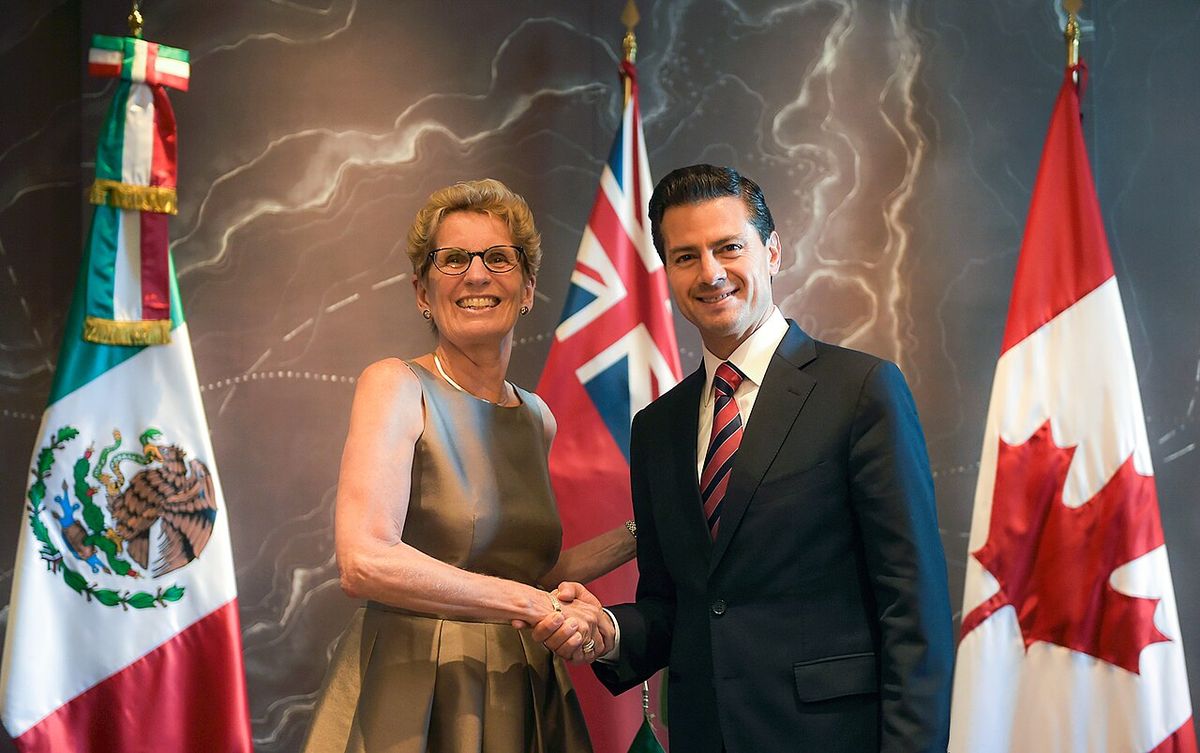
Entry into Politics: School Trustee and Early Provincial Roles
Kathleen Wynne's first foray into elected office was as a school trustee. After an unsuccessful run in 1994, she was elected to the Toronto District School Board in 2000, representing Ward 8. During her campaign, she was labelled an extremist lesbian in literature distributed by a local ratepayer group. As a trustee, Wynne strongly opposed education cuts by the Progressive Conservative government and, in 2001, helped pass a measure encouraging schools to purchase teaching materials that reflected the presence of gay and lesbian parents. That same year, she ran for chair of the school board but was defeated by Donna Cansfield in a 12 to 10 vote.
Wynne entered provincial politics in 2003, winning the Liberal nomination in Don Valley West. In the general election that year, she defeated Progressive Conservative cabinet minister David Turnbull by over 5,000 votes, becoming the Member of Provincial Parliament for the riding. The Liberals won the election under Dalton McGuinty, and Wynne was appointed parliamentary assistant to the Minister of Training, Colleges and Universities. In October 2004, she became parliamentary assistant to the Minister of Education. She also served on the Select Committee on Electoral Reform in 2005. Wynne was promoted to Minister of Education in September 2006, following a cabinet shuffle, becoming Ontario's first openly lesbian cabinet minister.
In the 2007 provincial election, Wynne faced a high-profile challenge from Progressive Conservative leader John Tory, who was seeking a seat in Toronto. Despite predictions of a close race, she was re-elected with 50.4 percent of the vote. She held the education portfolio until January 2010, when she was moved to Minister of Transportation. In 2011, she was appointed Minister of Municipal Affairs and Housing and Minister of Aboriginal Affairs, roles she held until resigning to run for the party leadership in 2012.
Leadership Race and Ascension to Premier
Premier Dalton McGuinty announced his resignation in October 2012, triggering a leadership race for the Ontario Liberal Party. Kathleen Wynne resigned her cabinet post on November 2 and launched her leadership bid three days later. She was considered one of the front runners, alongside former MPP Sandra Pupatello, and had the strongest on-the-ground organization, with supporters in all 107 provincial ridings. Days before delegate elections, candidate Glen Murray dropped out and endorsed Wynne. At the leadership convention on January 26, 2013, Wynne positioned herself as a consensus builder, pledging to repair relations with teachers and work with opposition parties. She also addressed her sexuality, stating that the people of Ontario do not judge leaders based on such characteristics.
The convention voting was highly competitive. On the first ballot, Wynne received 597 votes, trailing Pupatello by only two votes. After subsequent ballots and the endorsements of eliminated candidates Eric Hoskins, Gerard Kennedy, and Charles Sousa, Wynne secured victory on the third ballot with 57 percent of the vote compared to Pupatello's 43 percent. She was sworn in as Premier of Ontario on February 11, 2013, making history as the province's first female premier and Canada's first openly gay premier. Wynne recalled the legislature on February 17, ending a four-month prorogation that had been instituted by her predecessor.
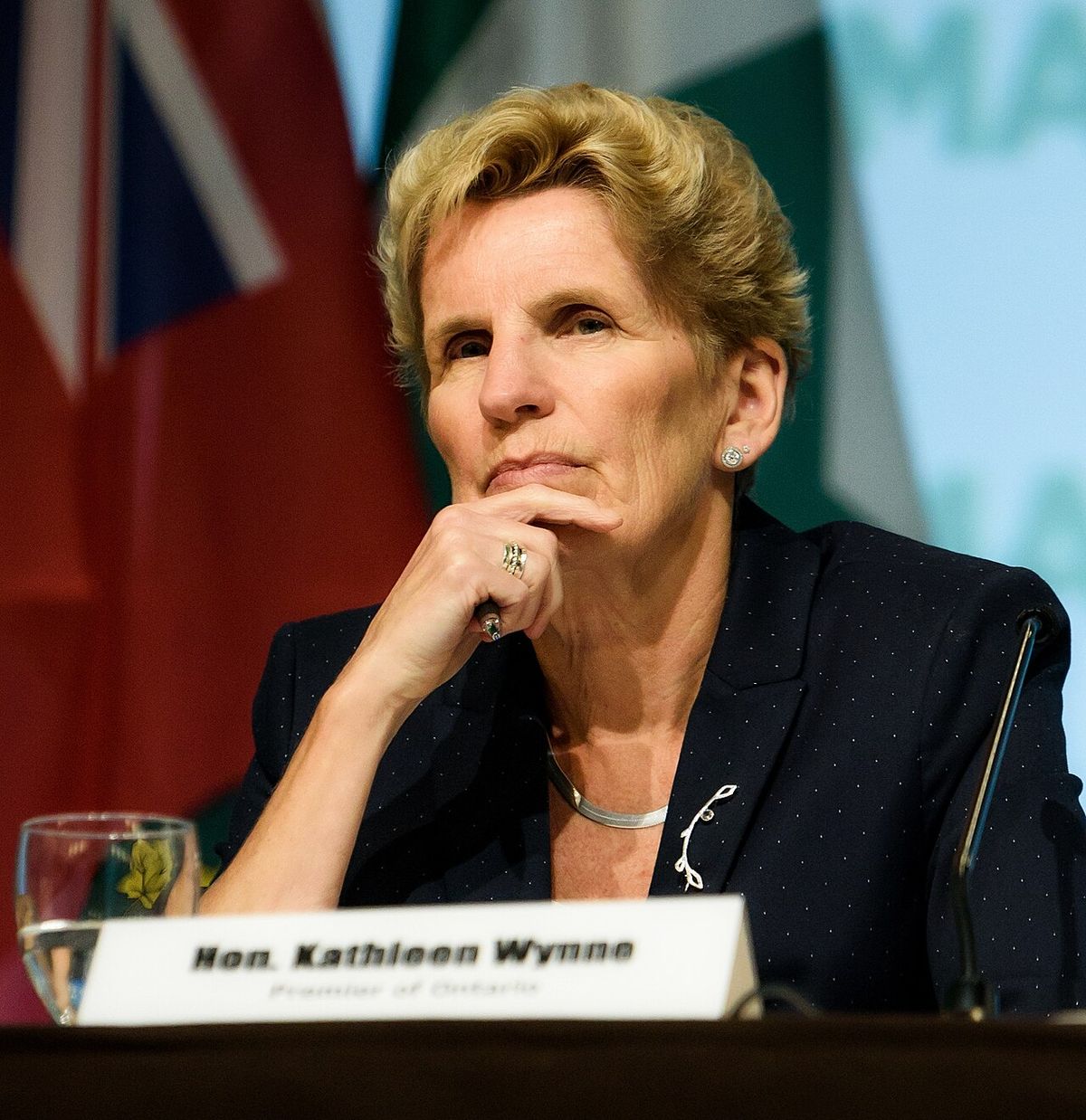
Premiership and Key Policy Initiatives
Kathleen Wynne's government pursued a wide-ranging policy agenda during her tenure from 2013 to 2018. Her first budget, introduced in March 2013, included a $295 million youth jobs strategy, a pledge to reduce auto insurance rates by 15 percent, and increased funding for home care and the Ontario Child Benefit. The budget passed with support from the New Democratic Party after the Progressive Conservatives declared their opposition. In education, Wynne's government reached a new bargaining agreement with teachers' unions in 2014, restoring collective bargaining rights and the right to strike while maintaining a wage freeze. A controversial update to the sex education curriculum in 2015 sparked protests from some parents and conservative groups.
Several signature social and economic policies were enacted under Wynne's leadership. Her government introduced free prescription drug coverage for children and youth under 24, increased the minimum wage from $11.60 to $14 an hour effective January 1, 2018, and implemented free post-secondary tuition for families with incomes under $50,000 through OSAP reforms. On environmental policy, Ontario joined a cap-and-trade pollution pricing regime with Quebec and California in 2016. However, her government also faced significant controversies, including the decision to partially privatize the electricity utility Hydro One by selling 30 percent of its shares to private owners, a move that was unpopular with the public and contributed to a decline in her approval ratings.
- 2013 Budget: Included youth job strategy, auto insurance rate cuts, and increased home care funding.
- Education Reforms: Restored teacher bargaining rights (2014) and updated sex education curriculum (2015).
- Social Programs: Free prescription drugs for children and youth, increased minimum wage, free tuition for low-income families.
- Environmental Policy: Joined cap-and-trade system with Quebec and California.
- Hydro One: Partial privatization through sale of 30% of shares.
Controversies and Challenges
One of the most significant challenges Wynne faced upon taking office was the Ontario power plant scandal, which originated under Premier Dalton McGuinty. The controversy involved the costly cancellation of gas plants in Mississauga and Oakville. Opposition parties alleged Wynne had a role in the decisions, but she denied involvement and asked the auditor general to investigate. The 2013 auditor's report estimated the cancellations could cost up to $1.1 billion, after which Wynne apologized. She testified before a legislative committee, maintaining she learned of the cancellations through media reports. A criminal investigation into the deletion of related emails by staff in McGuinty's office found no evidence implicating Wynne.
In response to the scandal, Wynne's government passed the Public Sector and MPP Accountability and Transparency Act in March 2014. The legislation required online posting of expense reports for MPPs and staff, expanded the powers of oversight officers, and introduced a $5,000 fine for the willful destruction of government records. Wynne also launched a libel lawsuit against PC MPP Lisa MacLeod and leader Tim Hudak in 2014 after they alleged she oversaw the criminal destruction of documents. The lawsuit was dropped in 2015 with a joint statement acknowledging the personal nature of the debate. The Hydro One privatization in 2016 proved deeply unpopular, with approximately 67 percent of Ontarians opposing the move, and her approval rating fell to a historic low of 12 percent in March 2017.
2018 Election Defeat and Post-Premiership
Kathleen Wynne led the Ontario Liberal Party into the 2018 provincial election seeking another mandate. However, amid low approval ratings and strong opposition from the Progressive Conservatives under Doug Ford, she conceded defeat five days before the election, acknowledging her party would not form government. The election resulted in a historic loss for the Liberals, who were reduced from a majority government to just seven seats, losing official party status. On election night, June 7, 2018, Wynne announced her resignation as Liberal leader. She formally resigned as premier on June 29, 2018, and was succeeded by Doug Ford. Wynne retained her seat as MPP for Don Valley West by a margin of 181 votes and continued to serve in the legislature as a backbencher.
Wynne did not contest the 2022 provincial election, retiring from politics after nearly two decades as an MPP. Since leaving office, she has remained engaged in public discourse. In 2021, she was appointed as the Hon. Newton W. Rowell Professor at Victoria College, University of Toronto. She continues to deliver speeches and participate in policy discussions.
Electoral Record and Political Legacy
Kathleen Wynne's electoral career spanned two decades, from her first win as a school trustee in 2000 to her final term as an MPP ending in 2022. Her tenure as premier included leading the Liberals to a majority government victory in the 2014 election, a significant achievement after taking over a minority government. However, the 2018 election resulted in a devastating defeat that reshaped Ontario's political scene. The table below outlines the provincial election results for the Ontario Liberal Party under Wynne's leadership.
| Election | Leader | Seats Won | Result |
|---|---|---|---|
| 2014 | Kathleen Wynne | Majority | Majority Government |
| 2018 | Kathleen Wynne | 7 | Loss of Official Party Status |
Wynne's legacy is complex, defined by groundbreaking social policies and significant political controversies. As the first woman and first openly gay premier of Ontario, she broke substantial barriers in Canadian politics. Her government's investments in education, pharmacare, and tuition support left a lasting mark on provincial social policy. Conversely, the gas plant scandal, Hydro One privatization, and the historic electoral defeat in 2018 are also central to her political record. Her post-premiership academic appointment indicates a continued, though more selective, role in public life.
Questions about Kathleen Wynne
What is Kathleen Wynne known for?
Kathleen Wynne is best known for serving as the 25th Premier of Ontario from 2013 to 2018. She made history as the first woman to hold that office and as Canada's first openly gay premier. Her government introduced policies like free prescription drug coverage for children and youth, an increase in the minimum wage to $14, and free post-secondary tuition for low-income families. She also led the Ontario Liberal Party to a majority victory in the 2014 election but suffered a historic defeat in 2018.
When was Kathleen Wynne premier?
Kathleen Wynne served as Premier of Ontario from February 11, 2013, to June 29, 2018. She was sworn in after winning the Ontario Liberal Party leadership in January 2013, succeeding Dalton McGuinty. Her premiership lasted for five years and four months, encompassing one full majority term after the 2014 election. She resigned as premier following the 2018 provincial election, which saw her party lose official party status.
What was the gas plant scandal under Kathleen Wynne?
The gas plant scandal involved the costly cancellation of two power plants in Mississauga and Oakville, decisions made under Premier Dalton McGuinty before Wynne took office. As premier, Wynne became embroiled in the controversy, with opponents alleging she was involved. She denied any role, asked the auditor general to investigate, and later apologized after the 2013 report estimated costs up to $1.1 billion. A criminal investigation into deleted emails focused on McGuinty's staff, not Wynne.
Why did Kathleen Wynne privatize Hydro One?
Kathleen Wynne's government decided to partially privatize Hydro One in 2016 to generate revenue for government priorities. The government sold 30 percent of the electricity utility Crown corporation to private owners, raising approximately nine billion dollars. Of that amount, about four billion dollars was used to pay down provincial government debt. The remaining five billion dollars was allocated to the Trillium Trust, which funded transit line improvements and other infrastructure projects across Ontario. This decision was met with significant public opposition, with approximately 67 percent of Ontario citizens disagreeing with the privatization. The controversy contributed to a severe drop in Wynne's approval rating, which fell to a historic low of 12 percent for an Ontario premier in March 2017.
Is Kathleen Wynne still involved in politics?
Kathleen Wynne is no longer an elected official but remains involved in public life. She formally retired from elected politics in 2022 when she chose not to contest the provincial election, ending her tenure as the MPP for Don Valley West which began in 2003. In 2021, she was appointed as the Hon. Newton W. Rowell Professor at Victoria College, University of Toronto. She continues to participate in public discourse through speaking engagements and academic work.
What did Kathleen Wynne do before becoming premier?
Before becoming premier, Kathleen Wynne had a substantial career in public service, education, and community activism. She was first elected to public office in 2000 as a trustee for the Toronto District School Board, where she advocated against education cuts. In 2003, she was elected as the MPP for Don Valley West and served as a parliamentary assistant in the ministries of Training, Colleges and Universities and later Education. Under Premier Dalton McGuinty, she held several cabinet positions, including Minister of Education starting in 2006, where she became Ontario's first openly lesbian cabinet minister. Her earlier community work included co-founding Citizens for Local Democracy to oppose the amalgamation of Toronto and founding the Metro Parent Network to support public education improvements.
Sources and further reading
- Kathleen Wynne (Wikipedia)
- Kathleen Wynne endorses Lee Fairclough for Ontario ... (nationalpost.com)
Checked by the Nosy Mag desk. Last updated 2026-10-27.