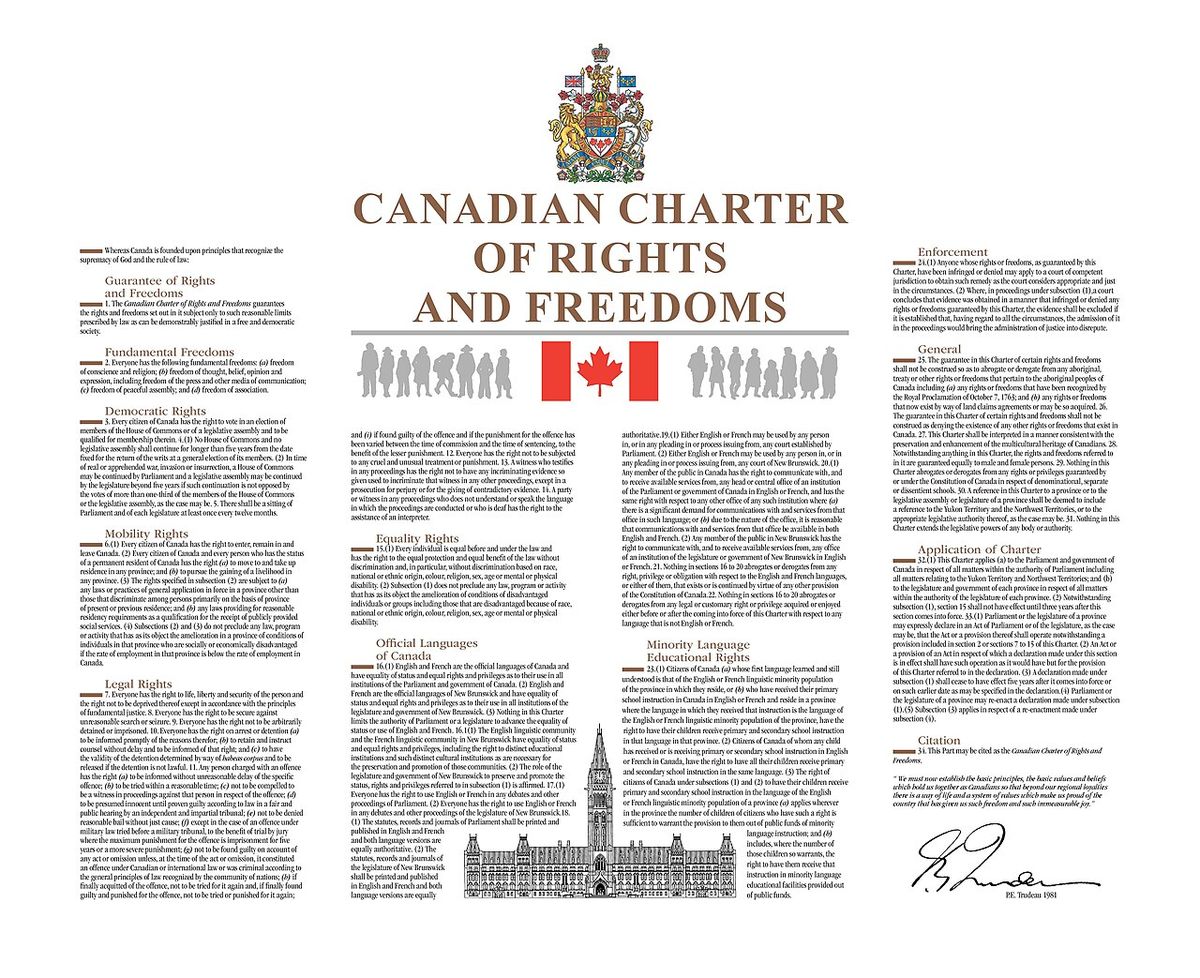
Section 11 of the Canadian Charter of Rights and Freedoms
Section 11 of the Canadian Charter of Rights and Freedoms is the constitutional provision that safeguards the legal rights of individuals charged with criminal or penal offences. Contained within Part I of the Constitution Act, 1982, it enumerates nine specific rights designed to ensure fairness in the criminal justice process. The Supreme Court of Canada has interpreted and applied these rights through a substantial body of case law, shaping their practical impact on Canadian law. These rights include protections such as the right to be informed of the offence and the right to a trial within a reasonable time.
Scope and application of Section 11
The rights under Section 11 are specifically triggered when a person is "charged with an offence." The Supreme Court of Canada has developed a two-branch test, established in R. v. Wigglesworth (1987), to determine when this condition is met. First, a proceeding is considered criminal by nature if it is of a public nature and intended to promote public order and welfare within a public sphere of activity. Second, even if a proceeding is not criminal by nature, Section 11 may apply if it involves the imposition of "true penal consequences," such as imprisonment or a fine of such magnitude that its purpose is to redress a wrong done to society. A "charge" is defined as a formal action marking the beginning of a prosecution, such as the swearing of an information or the laying of a direct indictment, as confirmed in R. v. Wilson (2025). In R. v. Finta (1994), the Supreme Court clarified that the period for assessing delay under Section 11(b) begins when the charge is laid.
The nine enumerated rights
Section 11 contains nine distinct rights granted to any person charged with an offence. These rights are lettered from (a) to (i) and cover the entire arc of the criminal process from charge to sentencing. The right to be informed without unreasonable delay of the specific offence is covered under subsection (a). Subsection (b) guarantees the right to be tried within a reasonable time. The right not to be compelled to be a witness against oneself is found in subsection (c). Subsection (d) provides the right to be presumed innocent until proven guilty in a fair and public hearing by an independent and impartial tribunal. Subsection (e) states the right not to be denied reasonable bail without just cause. The benefit of trial by jury for serious offences is protected by subsection (f). Subsection (g) protects against retroactive criminal liability. Subsection (h) provides protection against double jeopardy. Finally, subsection (i) grants the right to the benefit of the lesser punishment if the penalty for an offence changes between commission and sentencing.
Key rights and landmark interpretations
Several rights within Section 11 have been the subject of extensive judicial interpretation, setting critical precedents for the Canadian justice system. The right to be tried within a reasonable time under Section 11(b) was fundamentally reshaped by the Supreme Court's decision in R. v. Jordan (2016). That decision established a presumptive ceiling of 18 months for cases going to trial in provincial court, and 30 months for cases in superior court or with a preliminary inquiry. Delays beyond these ceilings are presumptively unreasonable and require a stay of proceedings unless the Crown can justify them by exceptional circumstances. The right to be presumed innocent under Section 11(d) has been central to challenges against reverse onus clauses, beginning with R. v. Oakes (1986). In that case, the Court struck down a reverse onus provision in the Narcotics Control Act and also developed the foundational test for justifying rights limitations under Section 1 of the Charter. The right has also been interpreted to require the appointment of counsel for an indigent accused facing a serious charge, as established in R. v. Rowbotham (1988). The right against self-incrimination in Section 11(c) was extended in R. v. Hebert (1990) to protect against police using "unfair tricks," such as an undercover officer posing as a sympathetic cellmate. The right to reasonable bail under Section 11(e) was clarified in R. v. Morales (1992), where the Court struck down the vague "public interest" ground for detention as unconstitutional.
Procedural safeguards and their evolution
The procedural rights in Section 11 have evolved through jurisprudence to address systemic issues and ensure substantive fairness. The right to a jury trial under Section 11(f) was examined in R. v. Pan. R. v. Sawyer (2001), where the Supreme Court upheld the secrecy of jury deliberations, finding that eroding this secrecy would negatively impact the jury's ability to decide a case. The protection against double jeopardy in Section 11(h) was carefully defined in R. v. Wigglesworth (1987), which held that it only applies where both proceedings are criminal in nature or involve true penal consequences. This means an acquittal in a criminal court does not bar subsequent administrative or disciplinary proceedings arising from the same facts, unless those proceedings themselves are deemed penal. The Supreme Court has also ruled that Section 11(h) only applies after a trial is "finally" concluded, meaning the Crown retains a right to appeal an acquittal. In Corp. Professionnelle des Médecins v. Thibault, the Court struck down a Quebec provision allowing de novo review of factual findings, holding it constituted a new trial in disguise. The right to the benefit of the lesser punishment under Section 11(i) has been interpreted by some appellate courts to apply only at the trial sentencing stage, not to subsequent appeals where the punishment may be reduced.
Interaction with other Charter rights
The rights in Section 11 do not exist in isolation but interact significantly with other Charter guarantees, particularly Section 7. Section 7's guarantee of life, liberty and security of the person and the right not to be deprived thereof except in accordance with the principles of fundamental justice provides a residual protection for the interests safeguarded by Section 11. For example, the right to make full answer and defence, integral to a fair hearing under Section 11(d), is also a principle of fundamental justice under Section 7. This interplay was central to the series of cases on rape shield laws, from R. v. Seaboyer (1991) to R. v. Mills (1999), which balanced the accused's right to a fair defence against a complainant's right to privacy and equality. The right against self-incrimination in Section 11(c) is complemented by Section 13, which protects a witness from having their testimony used to incriminate them in other proceedings. The requirement for an independent and impartial tribunal under Section 11(d) has been used to extend constitutional standards of judicial independence to lower-court judges, a principle further entrenched by the Supreme Court in the Provincial Judges Reference (1997). In Valente v. The Queen (1985), judicial independence under section 11 was held to include financial security, security of tenure and some administrative independence.
Contemporary issues and recent jurisprudence
Recent Supreme Court decisions continue to refine the application and scope of Section 11 rights. In R. v. Wilson (2025), the Court provided important clarification on what constitutes being "charged with an offence," linking it to the formal initiation of a prosecution. The definition of "true penal consequences" under the Wigglesworth test remains a live issue, particularly in contexts like civil forfeiture proceedings. While courts have acknowledged the punitive component of forfeiture, they have generally been reluctant to find that such proceedings attract full Section 11 protections. The Jordan framework for trial delay continues to dominate discussions about court efficiency and resources, forcing systemic reforms. The test for when Section 11 applies continues to be scrutinized in regulatory and administrative contexts, as seen in Guindon v. Canada (2015), where the Supreme Court affirmed the distinct two-branch structure of the Wigglesworth test. In R. v. Nova Scotia Pharmaceutical Society, the Court found that an open-ended statute was not a breach of Section 11(a). In R. v. Delaronde (1997), the Court found section 11(a) serves as an economic right, guaranteeing a person is informed of charges quickly to deal with career and family life.
- R. v. Oakes (1986): Struck down a reverse onus clause and created the Section 1 justification test.
- R. v. Askov (1990) and R. v. Morin (1992): Established the initial framework for analyzing trial delay under Section 11(b).
- R. v. Jordan (2016): Set presumptive ceilings for unreasonable delay and revolutionized delay jurisprudence.
- R. v. Wigglesworth (1987): Created the two-branch test for when a person is "charged with an offence."
- R. v. Morales (1992): Struck down the "public interest" ground for bail denial.
- R. v. Hebert (1990): Extended the right against self-incrimination to police "tricks."
- Valente v. The Queen (1985) and the Provincial Judges Reference (1997): Defined judicial independence under Section 11(d).
- R. v. Furtney (1991): Clarified that Section 11(g) does not prescribe how the existence of an offence must be made known.
Impact on the Canadian legal system
Section 11 has had a structural impact on Canada's criminal justice system, influencing legislation, police practice, and court administration. The reasonable time guarantee in Section 11(b), especially after the Jordan decision, has compelled governments and courts to address case backlogs and improve trial efficiency. This has led to increased funding for courts, more judicial appointments, and procedural reforms aimed at streamlining processes. The presumption of innocence in Section 11(d) has required Parliament to draft criminal laws carefully, avoiding reverse onus provisions unless they can be demonstrably justified. This has shaped legislation in areas from narcotics to impaired driving. The bail rights under Section 11(e) have made pre-trial detention a subject of rigorous judicial scrutiny, emphasizing release as the default. The right to a jury trial for serious offences remains a fundamental part of public confidence in the justice system. The requirement for an independent and impartial tribunal has bolstered the institutional independence of all levels of courts. The collective effect of these rights is to enforce a high standard of procedural fairness, making the Charter an active tool for accused persons and requiring the state to justify its actions within a strong constitutional framework.
Questions about Section 11 of the Canadian Charter of Rights and Freedoms
What does Section 11 of the Charter protect?
Section 11 of the Canadian Charter of Rights and Freedoms protects nine specific legal rights of any person charged with a criminal or penal offence. These include the right to be informed of the charge without unreasonable delay and the right to be tried within a reasonable time. It also provides the right not to be compelled to be a witness against oneself and the right to be presumed innocent until proven guilty. Further rights are the right not to be denied reasonable bail, the right to a jury trial for offences with a maximum punishment of five years or more, and protection against retroactive laws and double jeopardy. The final right is to receive the benefit of a lesser punishment if the law changes between the offence and sentencing.
When do Section 11 rights apply?
Section 11 rights apply specifically when a person is "charged with an offence. The Supreme Court of Canada uses a two-part test from R. v. Wigglesworth (1987) to determine this. First, if the proceeding is criminal by nature, meaning it is public and aims to promote public order. Second, if the proceeding could lead to "true penal consequences," like imprisonment or a very large fine intended to punish a wrong against society. A charge is formally initiated by swearing an information or laying a direct indictment.
What is the 'Jordan rule' and how does it relate to Section 11?
The 'Jordan rule' comes from the 2016 Supreme Court case R. v. Jordan, which interpreted the Section 11(b) right to be tried within a reasonable time. It established strict presumptive time limits: 18 months for cases in provincial court, and 30 months for cases in superior court or those involving a preliminary inquiry. If the total delay from charge to trial exceeds this ceiling, it is presumptively unreasonable and the charges must be stayed, unless the Crown can show exceptional circumstances caused the delay.
How does Section 11 protect against double jeopardy?
Section 11(h) protects against double jeopardy, meaning a person cannot be tried or punished twice for the same offence. However, this right applies only after a person has been "finally" acquitted or convicted. This means the Crown can appeal an acquittal. The protection also only applies to proceedings that are criminal in nature or that impose true penal consequences. So, an acquittal in criminal court does not necessarily bar related disciplinary or civil proceedings, as confirmed in R. v. Wigglesworth.
What is the difference between Section 11(c) and Section 13 of the Charter?
Both sections protect against self-incrimination but in different contexts. Section 11(c) applies to a person "charged with an offence" and gives them the right not to be compelled to be a witness in proceedings against themselves for that offence. This is a trial right. Section 13 is broader. It protects any witness in any proceeding from having their testimony used to incriminate them in other proceedings, except in a prosecution for perjury or giving contradictory evidence.
Can Section 11 rights ever be limited?
Yes, like all Charter rights, the rights in Section 11 are subject to reasonable limits under Section 1. The government can justify infringing a Section 11 right if it can demonstrate the limit is prescribed by law and is demonstrably justified in a free and democratic society. The test for this justification was established in R. v. Oakes (1986). For example, a reverse onus clause that infringes the presumption of innocence might be upheld under Section 1 if it addresses a pressing objective and impairs the right as little as reasonably possible.
Sources and further reading
- Section 11 of the Canadian Charter of Rights and Freedoms (Wikipedia)
- Section 11, General: legal rights apply to those “charged ... (justice.gc.ca)
Checked by the Nosy Mag desk. Last updated 2026-11-03.