List of First Nations peoples in Canada
First Nations peoples represent one of the three distinct Indigenous groups in Canada, alongside the Métis and Inuit. They encompass hundreds of distinct nations and communities, each with unique languages, cultures, and histories, primarily located across what is now Canada. This list organizes those peoples by linguistic-cultural area in accordance with the framework developed by the ethnologist and linguist Edward Sapir. The term 'First Nations' came into common usage in the 1980s, replacing the outdated term 'Indian,' and by definition this list excludes Métis and Inuit groups.
Definition and Terminology
The term First Nations specifically describes Indigenous peoples in Canada who are neither Métis nor Inuit. This definition is enshrined in Section 35 of the Constitution Act, 1982, which recognizes and affirms the existing Aboriginal and treaty rights of the Indian, Inuit, and Métis peoples of Canada. For legal and administrative purposes, the federal government uses the Indian Act to govern its relationship with First Nations people, maintaining an official Indian Register of those recognized as Status Indians. The shift from the term 'Indian' to 'First Nations' began in 1980 when hundreds of chiefs used it in their Declaration of the First Nations, a move solidified in 1982 when the National Indian Brotherhood became the Assembly of First Nations. While 'First Nation' can describe a large ethnic grouping like the Cree Nation, it is also synonymous with the term 'band,' which refers to smaller, federally recognized communities under the Indian Act, though many communities prefer the former term. The use of 'First Nations' is generally exclusive to Canada. Community members are more likely to define themselves by their specific nation, such as Kanien'kehá:ka (Mohawk), or their community and clan within that nation.
Cultural and Linguistic Diversity
First Nations in Canada are not a monolithic group but comprise hundreds of distinct nations traditionally organized across several broad cultural and linguistic areas. These groupings are based on shared environmental adaptations, economic practices, and language families. The ethnologist Edward Sapir's classifications, used by institutions like the Canadian Museum of History, provide a framework for understanding this vast diversity. Each area fostered unique ways of life, from the complex maritime societies of the Pacific Coast to the buffalo-hunting cultures of the Plains and the forest-based communities of the Eastern Woodlands. The linguistic diversity is immense, encompassing numerous language families such as Algonquian, Athapaskan, Salishan, Wakashan, and Iroquoian, among others. This deep cultural diversity was historically supported by complex social, political, economic and cultural systems developed over millennia. With colonization, traditional Indigenous ways of life were altered by colonial practices and policies designed to control and assimilate Indigenous peoples. These disruptive forces include the Indian Act, the pass system, the establishment of reserves, and the residential school system.
Northwest Coast Peoples
The First Nations of the Northwest Coast developed sophisticated cultures in the resource-rich environment of the Pacific coastline and adjacent forests. Their societies were historically hierarchical and known for complex art, ceremonial practices, and permanent villages. The traditional economy was centred on marine resources, particularly salmon and eulachon from the ocean, as well as fish from lakes and rivers, and roots and berries. Recent discoveries of ancient clam gardens indicate advanced marine management. They constructed dug-out canoes and large houses from the cedar forests using evenly split planks of wood and tools made of stone and wood. Major linguistic and cultural groups in this region include the Coast Salish, Nuu-chah-nulth, Kwakwaka'wakw, Tsimshianic peoples, Haida, and Nuxálk (Bella Coola). These groups are renowned for their artistic traditions, including totem poles, carved masks, and elaborate ceremonial regalia. A landmark modern achievement was the 2000 Nisga'a Final Agreement, a treaty that settled the Nisga'a land claim in British Columbia and returned over 2,000 square kilometres of land to Nisga'a control. Key nations within the Northwest Coast cultural area include:
- Coast Salish peoples, such as the shíshálh (Sechelt), Squamish, Musqueam, Tsleil-Waututh, and numerous Sto:lo communities like the Sumas and Skwah.
- Nuu-chah-nulth peoples, such as the Tla-o-qui-aht, Mowachaht-Muchalaht, and the Ahousaht formed from a 1951 merger.
- Kwakwaka'wakw peoples, including the 'Namgis and Laich-kwil-tach.
- Tsimshianic peoples, including the Tsimshian, Gitxsan, and Nisga'a.
- Haida.
- Nuxálk (Bella Coola).
- Haisla and Heiltsuk (Bella Bella) peoples of the central coast.
- Wuikinuxv (Owekeeno).
Plains Peoples
The First Nations of the Plains region are historically known as nomadic buffalo hunters who followed the massive herds of bison across the prairies. Their mobile lifestyle was facilitated by the use of the tipi, a portable dwelling made of buffalo hides stretched over a pole frame. The bison provided not only food but also materials for clothing, tools, and shelter, forming the complete basis for their sustenance and material culture. Societies were often organized into bands with leadership structures suited to hunting and warfare. The leaders of some Plains tribes wore large headdresses made of feathers. Well-known Plains groups include the Blackfoot Confederacy (Siksika, Kainai, Piikani), the Plains Cree, the Assiniboine, the Nakota (Stoney), and the Tsuut'ina (Sarcee). Other significant peoples include the Dakota and Lakota, with subgroups like the Mdewakanton and Hunkpapa, and the Anishinaabe Plains-Ojibwa.
Plateau, Western Subarctic, and Eastern Regions
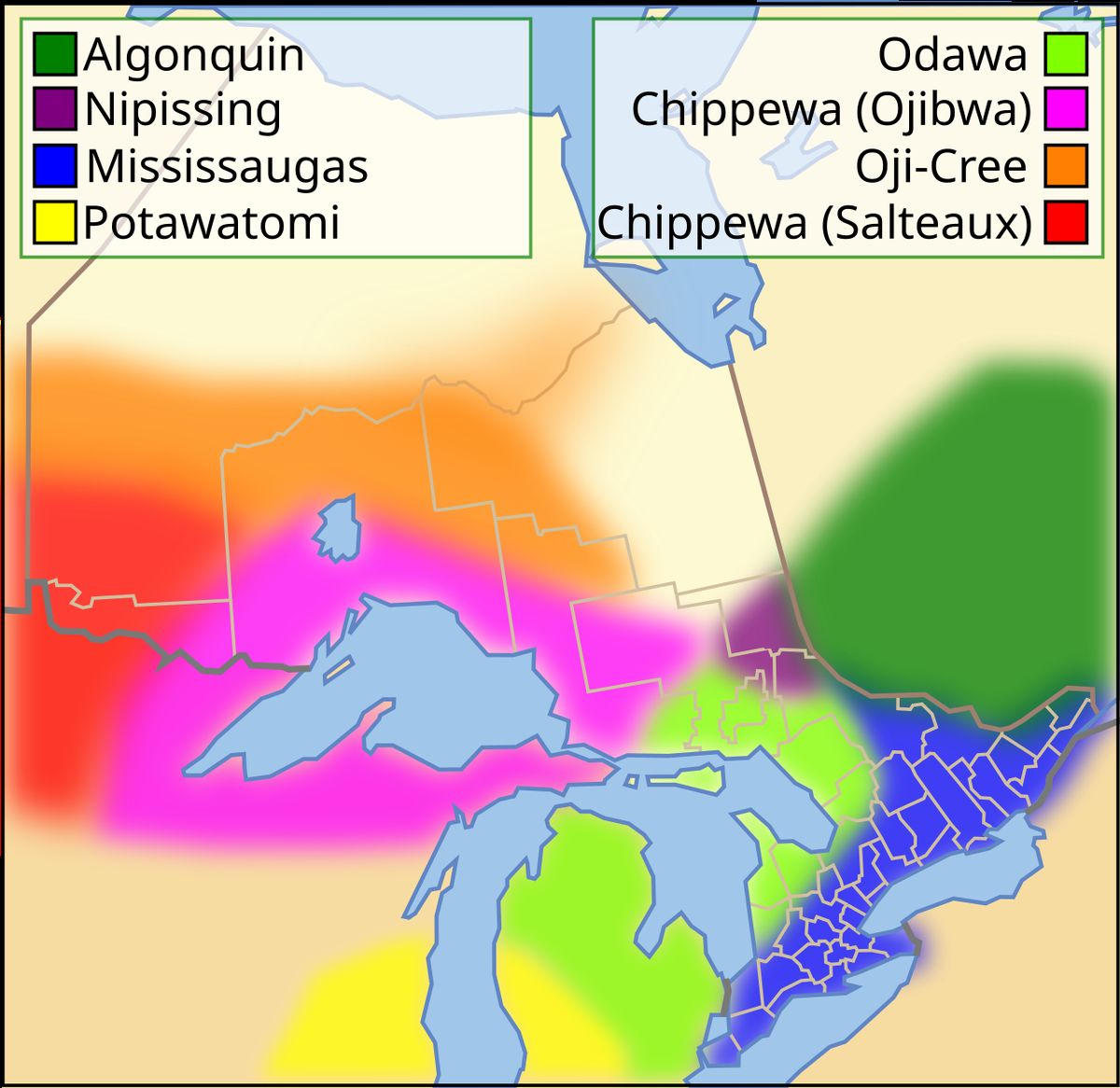
Beyond the coasts and plains, First Nations adapted to diverse inland environments. The Plateau region, between the coastal mountains and the Rockies, includes nations like the Secwepemc (Shuswap), Nlaka'pamux (Thompson), and Syilx (Okanagan), who traditionally relied on river fishing, hunting, and root gathering. Other Plateau peoples include the Ktunaxa (Kootenay), the St'at'imc (Lillooet) and their Lil'wat and Lower Stl'atl'imx neighbours, and the Sinixt and Nicola peoples, the latter including now-extinct Nicola Athapaskans. The Western Subarctic encompasses the vast boreal forests of the western provinces and territories, home to Dene peoples such as the Chipewyan, Tłı̨chǫ, and Gwich'in, as well as Cree and Inland Tlingit communities, who were primarily hunter-gatherers dependent on caribou, moose and the fur trade. This area also includes the Dane-zaa (Beaver), Kaska, Sekani, Tagish, Tahltan, Tsilhqot'in (Chilcotin), and the Southern and Northern Tutchone peoples. The Eastern Woodlands and Subarctic region includes the Anishinaabe (Ojibwa, Odawa, Potawatomi, Algonquin, Nipissing), Cree, and Innu peoples, while the Atlantic coastal region is the homeland of the Mi'kmaq, Wolastoqiyik (Maliseet), and Passamaquoddy, as well as the extinct Beothuk of Newfoundland. The St. Lawrence River Valley and surrounding areas are the traditional territory of the Haudenosaunee (Iroquois Confederacy or League of Six Nations), which includes the Mohawk, Oneida, Onondaga, Cayuga, Seneca, and Tuscarora Nations, as well as the Wyandot (Huron), Petun (Tobacco), Neutral, and Munsee Lenape (Delaware) peoples.
Contemporary Governance and Advocacy
First Nations exercise self-determination through a blend of traditional governance and modern political structures. The Assembly of First Nations (AFN) serves as a national advocacy organization representing First Nations citizens across Canada, evolving from the National Indian Brotherhood in 1982. In British Columbia, where many nations did not sign historic treaties, a unique collaborative body exists. The First Nations Leadership Council (FNLC) is a political collaborative formed on March 17, 2005, through a Leadership Accord signed by the political executives of the British Columbia Assembly of First Nations, the First Nations Summit, and the Union of B.C. Indian Chiefs. The FNLC does not hold Aboriginal title or rights itself but engages in advocacy and strategy development directed by resolutions from First Nations across the province. A significant achievement of this collaboration was co-developing British Columbia's Declaration on the Rights of Indigenous Peoples Act, which aims to align provincial laws with the United Nations Declaration on the Rights of Indigenous Peoples as a framework for reconciliation. The FNLC also played a role in creating the Reconciliation Charter for First Nations Child and Family Well-Being in B.C.
Programs and Services
The federal government administers several key programs specifically for First Nations communities, often in partnership with provinces and territories. A critical program is the First Nations and Inuit Policing Program (FNIPP), which funds policing services to improve safety outcomes. The FNIPP operates through four types of funding agreements, including Stream 1 for operations of stand-alone police services, Stream 2 for dedicated officers from existing services, Stream 3 for community safety officers, and Stream 4 for time-limited projects and research. A separate but related program, the First Nations and Inuit Policing Facilities Program, funds the infrastructure needed for these services. Funding is typically cost-shared, with the federal government covering 52 percent and the province or territory covering 48 percent. The Royal Canadian Mounted Police also receives a portion of FNIPP funding transferred each year to support a dedicated RCMP policing presence in First Nations and Inuit communities under separate Community Tripartite Agreements. Another notable initiative is the National First Nations Water Leadership Award, which recognizes outstanding contributions to water stewardship.
Population, Community Life, and Modern Context
First Nations people in Canada live in a variety of settings, including on-reserve and off-reserve in rural, urban, and remote areas. According to the Indian Act, a 'band' is a body of First Nations people for whom lands have been set apart, and the federal government holds moneys. Many First Nations prefer the term 'First Nation' over 'band' for their community. A key distinction is that most First Nations hold reserve lands, unlike Métis and Inuit, and members may live both on and off these reserves. Membership in a First Nation is a matter of community citizenship, often defined by the community itself, while 'Status' or 'Registered Indian' is a legal recognition under the Indian Act. The well-being of First Nations communities continues to be shaped by the legacy of colonial policies, which is addressed through ongoing efforts in areas like child welfare, justice reform, and the implementation of the United Nations Declaration on the Rights of Indigenous Peoples. Many First Nations have signed treaties with the Crown, which form the constitutional and moral basis of alliance between Indigenous peoples and Canada, while historic treaties were signed almost exclusively with First Nations rather than Métis or Inuit.
Questions about List of First Nations peoples in Canada
What is the difference between First Nations, Métis, and Inuit?
First Nations, Métis, and Inuit are the three distinct groups of Indigenous peoples recognized in Canada's Constitution. First Nations are diverse peoples with histories and connections to lands across Canada, most of whom hold reserve lands. Métis people are of mixed Indigenous and European ancestry who developed distinct cultures, primarily in the Prairie provinces. Inuit are the Indigenous peoples of the Arctic regions of Canada, Greenland, and Alaska. Each group has unique histories, cultures, and contemporary relationships with the Canadian state.
What does 'Status Indian' mean?
A Status Indian, or Registered Indian, is a person recognized by the federal government as an Indian under the Indian Act. This legal status is recorded in the Indian Register and can entitle individuals to certain rights, benefits, and restrictions outlined in the Act. These include the right to live on reserve land and access to some federal programs. not all First Nations people are Status Indians, and not all Status Indians are necessarily members of a specific First Nation community. Membership rules are determined by the communities themselves, separate from the federal registration process.
What is the First Nations Leadership Council in B.C.?
The First Nations Leadership Council is a political collaborative body in British Columbia formed on March 17, 2005. It is a working relationship between three major provincial First Nations political organizations: the British Columbia Assembly of First Nations, the First Nations Summit, and the Union of B.C. Indian Chiefs. The FNLC engages in advocacy and develops strategies to advance the interests of First Nations in B.C., but it is not a nation itself and does not hold Aboriginal title or rights. Its work is directed by resolutions passed by First Nations through the three member organizations.
How is policing provided in First Nations communities?
Policing in many First Nations communities is supported through the First Nations and Inuit Policing Program. This federal program funds several models, including standalone First Nations police services, dedicated officers from provincial or municipal forces assigned to a community, and community safety officer positions. Funding is typically cost-shared, with the federal government covering 52 percent and the relevant province or territory covering 48 percent. The related First Nations and Inuit Policing Facilities Program funds the infrastructure needed for these policing services.
Why did the term 'First Nations' replace 'Indian'?
The term 'First Nations' was adopted in the early 1980s to replace 'Indian,' which was seen as an outdated and imposed colonial label. The change began in 1980 when hundreds of chiefs used 'First Nations' in the Declaration of the First Nations. In 1982, the national political organization changed its name from the National Indian Brotherhood to the Assembly of First Nations. The new term is preferred as it recognizes the sovereign nature of Indigenous nations and their status as original inhabitants and founding peoples of Canada.
What are the major cultural groupings of First Nations in Canada?
First Nations in Canada are traditionally grouped into major cultural and linguistic areas based on their environment and traditional way of life. These groupings, classified by ethnologist Edward Sapir, include the Northwest Coast peoples, the Plains peoples, the Plateau peoples, the Western Subarctic peoples, and the Woodlands and eastern subarctic peoples. The Woodlands area includes the Atlantic coastal region and the St. Lawrence River Valley. These areas contain many distinct nations with their own languages and traditions.
Sources and further reading
- List of First Nations peoples in Canada (Wikipedia)
- First Nations Leadership Council: Homepage, FNLC (fnlc.ca)
- First Nations and Inuit Policing Program (FNIPP) (publicsafety.gc.ca)
- First Nations in Canada (thecanadianencyclopedia.ca)
Checked by the Nosy Mag desk. Last updated 2026-10-30.