Jordan's Principle
Jordan's Principle is a child-first legal and policy principle in Canada designed to ensure First Nations children have equitable access to government-funded public services. It is named in memory of Jordan River Anderson, a young boy from Norway House Cree Nation who died in 2005 after governments spent years disputing who should pay for his home care. The principle mandates that when a need is identified for a First Nations child, the government or department of first contact must pay for the service immediately, resolving any jurisdictional payment disputes afterwards. This principle is a central part of efforts to address systemic discrimination and achieve substantive equality for First Nations children, recognized in major national inquiries and enforced through orders from the Canadian Human Rights Tribunal.
The Story of Jordan River Anderson
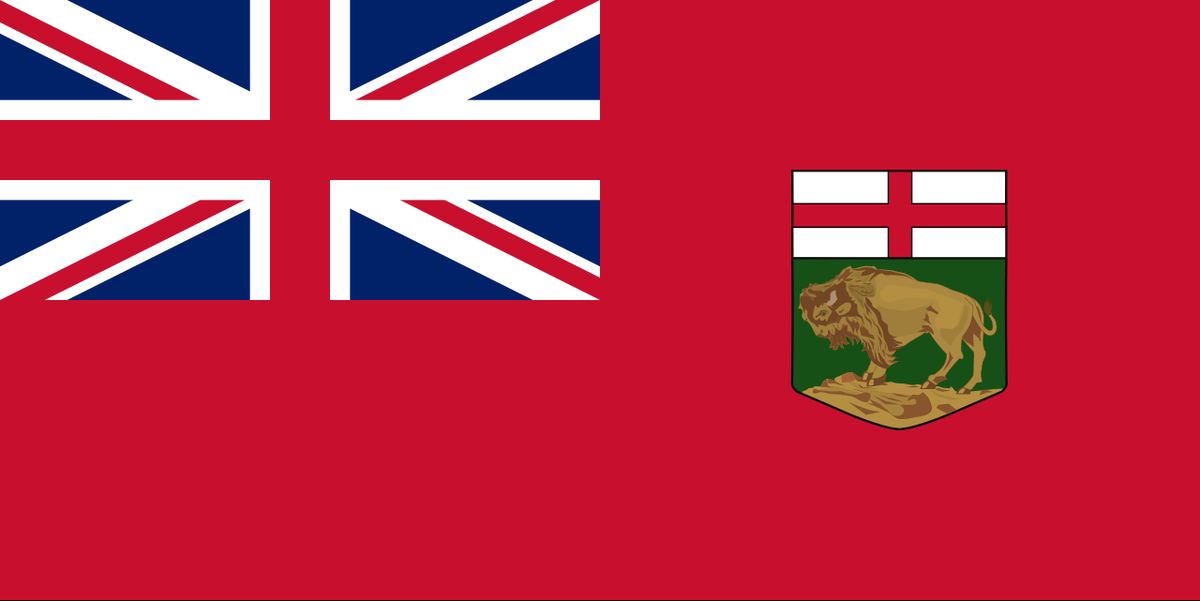
Jordan's Principle originates from the tragic case of Jordan River Anderson, a child from Norway House Cree Nation in Manitoba. Jordan was born with Carey Fineman Ziter syndrome, a rare muscular disorder that required extensive medical treatment at a hospital in Winnipeg. After his first two years in hospital, doctors determined he could live in a family home near the hospital with appropriate home care support. However, the federal government and the provincial government of Manitoba entered into a protracted dispute over which level of government was financially responsible for this necessary care. For over two years, while the governments argued, Jordan remained confined to the hospital. He died there in 2005 at the age of five, never having had the chance to live in a family home. In response to this preventable tragedy, Jordan's family, supported by their community and advocates, gifted his name to create a principle that would prevent such failures in the future.
Development and National Recognition
The formal push for Jordan's Principle began with policy research and advocacy. In 2005, the First Nations Child & Family Caring Society of Canada released the influential Wen:De report, which reviewed child and family services and recommended the adoption of Jordan's Principle to resolve jurisdictional disputes. Momentum built, leading to a significant political milestone on December 12, 2007, when Private Member's Motion 296 in support of Jordan's Principle passed unanimously in the House of Commons. National recognition expanded further when the Truth and Reconciliation Commission of Canada included full implementation of Jordan's Principle as the third of its 94 Calls to Action in June 2015. The principle was also affirmed in the National Inquiry into Missing and Murdered Indigenous Women and Girls, which called for its immediate implementation for all First Nations children in its 2019 final report. In February 2015, the Assembly of First Nations released a working group report highlighting gaps in implementation. In November 2018, the Alberta government signed a memorandum of understanding on Jordan's Principle with the First Nations Health Consortium and the federal government.
The Canadian Human Rights Tribunal Case and Orders
A landmark legal battle defined the modern implementation of Jordan's Principle. In January 2016, the Canadian Human Rights Tribunal ruled that the Government of Canada's narrow and improper application of Jordan's Principle constituted racial discrimination against First Nations children. The Tribunal ordered Canada to cease its restrictive definition and immediately implement the principle's full meaning and scope. Canada failed to comply adequately, leading the Tribunal to issue a series of follow-up orders, many of them non-compliance orders, to enforce its original decision. These orders have progressively clarified and expanded the principle's application. Key Tribunal rulings have mandated that Jordan's Principle applies to all First Nations children living on and off reserve, not only those with disabilities. The Tribunal established strict response timelines, requiring urgent individual requests to be addressed within 12 hours and non-urgent ones within 48 hours. It also ordered Canada to apply a needs-based standard, considering what is required for substantive equality rather than only what is typically available to other children.
The Tribunal has repeatedly had to intervene to broaden eligibility. In a significant 2020 ruling, it ordered Canada to recognize First Nations children who would become eligible for Indian Act status. Later in 2020, the Tribunal confirmed four eligibility categories, ensuring access for children without status who are recognized by their Nation. The categories for eligibility are:
- A child registered or eligible to be registered under the Indian Act.
- A child with a parent or guardian who is registered or eligible.
- A child recognized by their Nation for the purposes of Jordan's Principle.
- A child who is ordinarily resident on reserve.
The Canadian Human Rights Tribunal has made clear that Jordan's Principle is not a fixed budget program, but a legal obligation of the Government of Canada. This means funding expands with the number of eligible children. Despite these orders, the Government of Canada has frequently sought judicial reviews of Tribunal decisions. For example, Canada filed for judicial review of the 2020 eligibility orders in December 2020. In October 2019, Canada also sought judicial review of the Tribunal's 2019 compensation order. The Tribunal's orders remain in place while judicial reviews are underway.
How Jordan's Principle Works
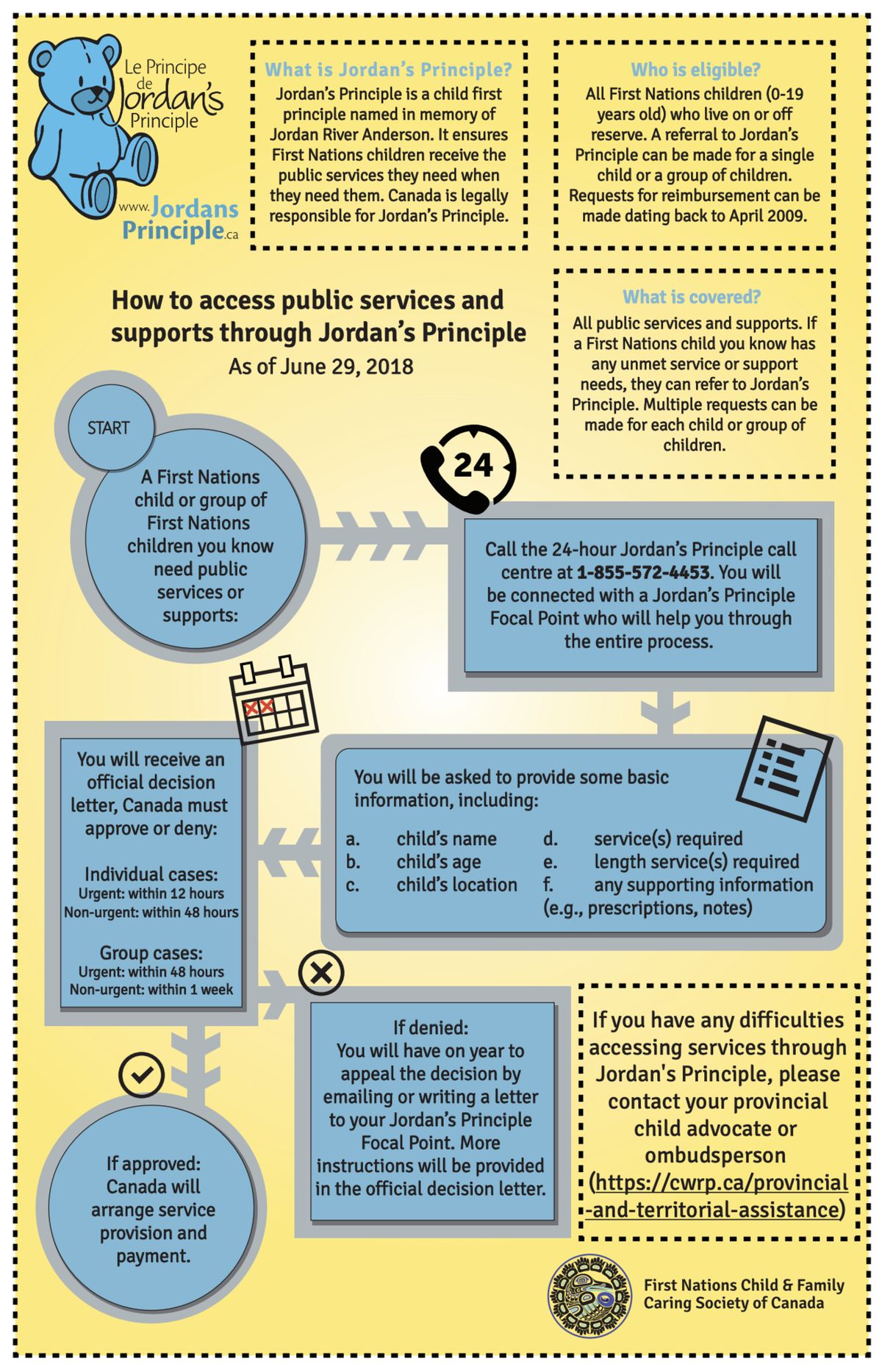
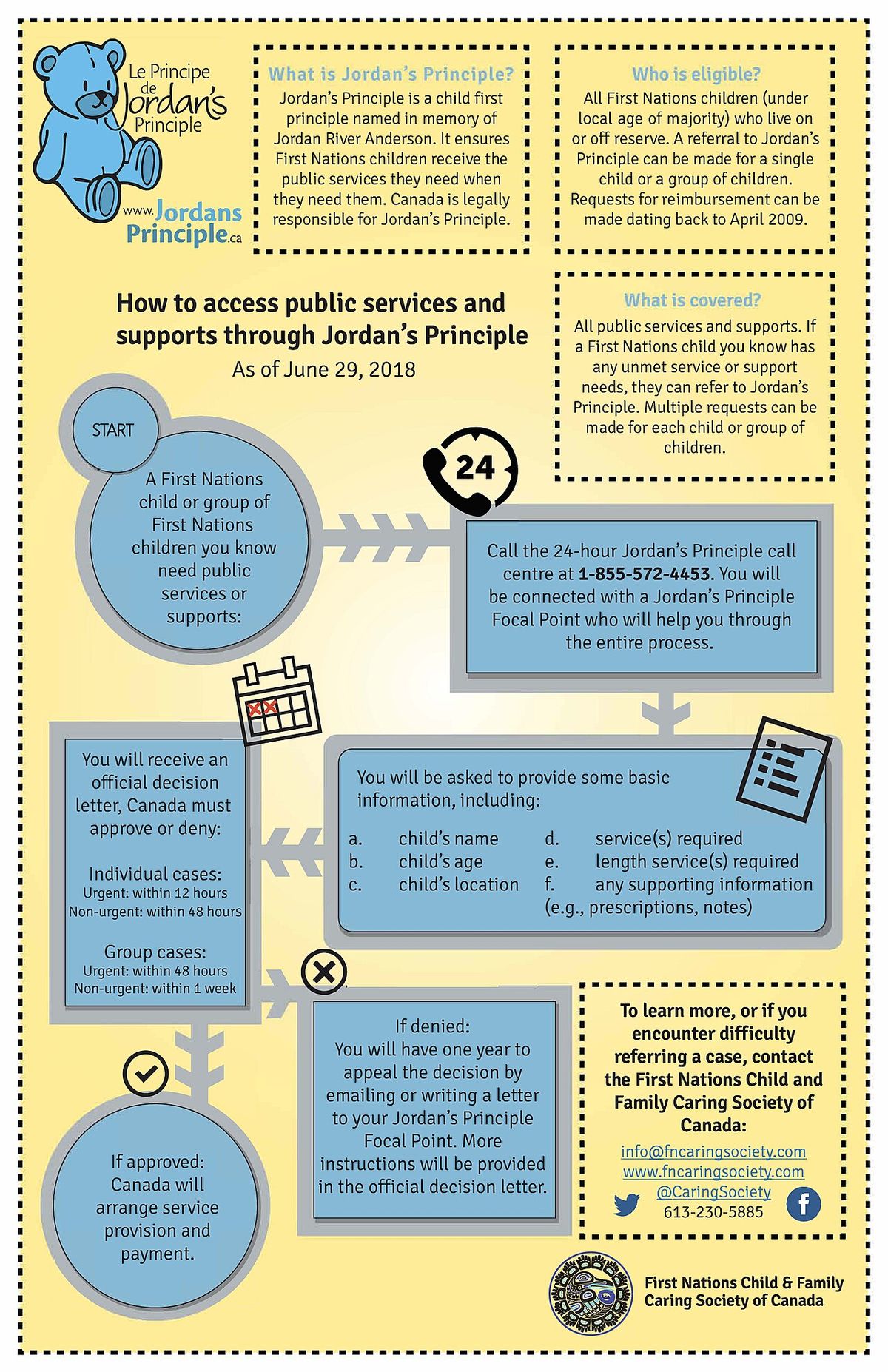
Jordan's Principle operates as a child-first mechanism to bridge gaps in public service delivery for First Nations children. Its primary purpose is to ensure these children can access the products, services, and supports they need without denial, delay, or disruption due to jurisdictional disputes or identity-based discrimination. When a need is identified for an eligible First Nations child, the government department or agency of first contact is required to pay for the service immediately. Any dispute over which level or department of government should ultimately bear the cost is resolved through established mechanisms after the child has received care. A formal jurisdictional dispute is not a prerequisite for invoking the principle. It applies whenever a service gap exists for a First Nations child that would not exist for a non-Indigenous child. The principle covers a wide range of needs across health, social, and educational domains, from medical equipment and therapeutic services to educational supports and cultural services. Requests are submitted through a dedicated 24-hour call centre or online, and are assessed on a case-by-case basis according to the child's specific circumstances and needs.
Eligibility and Covered Services
Eligibility for Jordan's Principle is defined by the Canadian Human Rights Tribunal orders and subsequent government directives. A First Nations child under the age of majority in their province or territory of residence, who permanently lives in Canada, can access the principle if they meet one of the four eligibility criteria established by the Tribunal. The criterion of being 'ordinarily resident on reserve' was further clarified in February 2025 to include children whose primary residence is on reserve, who are temporarily off reserve for specific purposes like medical treatment, or who are in the care of a child and family services agency with ties to a reserve. The scope of services covered is broad and needs-based. Indigenous Services Canada provides a non-exhaustive list of examples, which includes mental health services, speech therapy, medical supplies, respite care, educational supports, and transportation to access services. The principle is intended to fund services that are not otherwise available or accessible to the child through existing programs, always with the goal of achieving substantive equality. Jordan's Principle is not designed as a long-term income supplement, and funding for certain items like basic household furniture or recreational vehicles is typically not approved unless specifically required to meet a substantive equality need.
The Class Action Settlement and Compensation
A major component of redress for the historical discrimination in child and family services, including failures under Jordan's Principle, is the First Nations Child and Family Services and Jordan's Principle class action settlement. Approved by the Federal Court, it is one of the largest class action settlements in Canadian history. The settlement provides financial compensation to nine distinct classes of claimants who were harmed by discriminatory practices. Two key classes are First Nations children who were removed from their homes between April 1, 1991, and March 31, 2022, into care funded by Indigenous Services Canada, and their caregiving parents or grandparents. The claims period opened on March 10, 2025. The settlement also includes compensation for individuals who were denied or experienced delays in services under Jordan's Principle since November 2, 2017. The deadline for most adults to submit a claim is March 10, 2028. A dedicated administrator and network of Claims Helpers assist individuals through the application process, and mental wellness support is available 24/7 through the Hope for Wellness Helpline. In its 2019 compensation order, the Tribunal ruled that affected individuals would receive the maximum compensation under the Canadian Human Rights Act, which is $40,000.
Recent Developments and Ongoing Challenges
Implementation of Jordan's Principle continues to evolve, marked by both progress and persistent legal and administrative challenges. Financially, the federal government has invested nearly $10.5 billion since the 2016 Tribunal ruling to meet children's needs, approving tens of thousands of requests annually. Administratively, as of April 1, 2026, the First Nations Health Authority began operationalizing the Jordan's Principle Payment Centre on behalf of Indigenous Services Canada in British Columbia, representing a shift toward greater First Nations control. However, the federal government continues to challenge Tribunal rulings through judicial reviews. These ongoing legal manoeuvres highlight the tension between the Tribunal's enforcement of the principle as a human rights obligation and the government's litigation stance. Advocates and First Nations leadership continue to monitor compliance and push for a fully realized, non-discriminatory system that honours the spirit of Jordan's Principle. The principle is reflective of the non-discrimination provisions of the United Nations Convention on the Rights of the Child and Canadian domestic law.
Impact and Significance
The impact of Jordan's Principle has been significant in changing how services are delivered to First Nations children. The enforcement of the principle through the Canadian Human Rights Tribunal has directly facilitated access to over 1.4 million products, services, and supports for children who would otherwise have faced gaps or denials. It has established a critical legal precedent that government services for First Nations children must be provided on the basis of substantive equality, accounting for their distinct circumstances and historical disadvantages. The principle has become a key reference point in Canada's reconciliation framework, embedded in the Calls to Action of the Truth and Reconciliation Commission and the Calls for Justice from the Missing and Murdered Indigenous Women and Girls Inquiry. It represents a concrete mechanism to apply a child-first approach within the complex web of federal and provincial jurisdictions. The related class action settlement, delivering billions in compensation, acknowledges the deep harm caused by systemic discrimination. Ultimately, Jordan's Principle reflects the advocacy of Jordan's family, First Nations communities, and dedicated organizations.
Questions about Jordan's Principle
What is Jordan's Principle in simple terms?
Jordan's Principle is a rule that says when a First Nations child needs a government service, the first government department contacted must pay for it right away. It stops delays caused by arguments between federal and provincial governments over who should pay. The principle is named after Jordan River Anderson, a five-year-old boy who died in hospital while governments disputed his home care costs. Its goal is to ensure First Nations children have equitable access to health, social, and educational services based on their needs.
Who is eligible for Jordan's Principle?
A First Nations child under the age of majority in their province or territory of residence is eligible for consideration under Jordan's Principle. The child must meet one of four criteria established by the Canadian Human Rights Tribunal in 2020. A child is eligible if they are registered or eligible to be registered under the Indian Act. A child is also eligible if they have one parent or guardian who is registered or eligible to be registered under the Indian Act. A child is eligible if they are recognized by their Nation for the purposes of Jordan's Principle, or if the child is ordinarily resident on reserve.
How do I apply for services under Jordan's Principle?
To request services, you can call the national Jordan's Principle 24-hour Call Centre at 1-855-JP-CHILD (1-855-572-4453) or visit the Indigenous Services Canada website. Regional focal points and service coordinators can assist families for free in submitting requests. For urgent requests directly linked to a child's urgent circumstances, the call centre must be contacted, and a determination is made within 12 hours. Non-urgent requests typically have a 48-hour response time. Documentation of the child's need is required for the application process.
What kind of services does Jordan's Principle cover?
Jordan's Principle covers a wide range of health, social, and educational needs based on the individual child's requirements. Examples include mental health services, speech therapy, medical equipment, respite care, educational supports, assessments, and transportation to access services. The principle uses a needs-based standard, meaning it can fund services not ordinarily available to other children if needed to achieve substantive equality for a First Nations child. It is not an income supplement program and does not typically cover basic household items unless specifically required for the child's care.
What is the Jordan's Principle class action settlement?
The First Nations Child and Family Services and Jordan's Principle Settlement is a class action providing compensation for discrimination. It offers financial payments to First Nations children removed from their homes between 1991 and 2022, their caregivers, and those denied or delayed services under Jordan's Principle since 2017. The claims period opened on March 10, 2025. Eligible individuals have until March 10, 2028, to submit a claim. Claims Helpers and a dedicated helpline provide free assistance with the application. The Tribunal's 2019 compensation order set the maximum payment at $40,000 per affected individual under the Canadian Human Rights Act.
Why has the Canadian Human Rights Tribunal issued so many orders about Jordan's Principle?
The Canadian Human Rights Tribunal has issued many orders because the federal government repeatedly failed to fully implement the principle after the Tribunal's landmark 2016 discrimination ruling. The orders have been necessary to force Canada to broaden eligibility, speed up response times, apply a proper needs-based standard, and stop its narrow interpretation. The Tribunal has clarified that Jordan's Principle is a legal obligation, not a limited program, and funding must expand to meet demand. Despite these orders, Canada has often sought judicial reviews, leading to ongoing legal disputes over implementation.
Sources and further reading
- Jordan's Principle (Wikipedia)
- Jordan's Principle, Indigenous Services Canada (sac-isc.gc.ca)
- Jordan's Principle (fncaringsociety.com)
- More than $1.2 Billion in compensation provided for ... (fnchildclaims.ca)
- Jordan's Principle Applications (abfnhc.com)
Checked by the Nosy Mag desk. Last updated 2026-10-31.