Education in Canada
Education in Canada is for the most part provided publicly, funded and overseen by provincial and territorial governments. The federal government's responsibilities are limited to funding the education of Indigenous peoples and operating specific institutions like the Canadian Military Colleges and the Canadian Coast Guard College. It is structured into primary, secondary, and post-secondary levels, with instruction available in both English and French in most regions. Canada consistently ranks among the world's most educated nations, with over 57 per cent of adults holding a tertiary qualification as of 2022. The system is characterized by high performance in international assessments, constitutional protections for minority language and religious education, and a historical development intertwined with the country's social and cultural evolution.
Constitutional and Legal Framework
The governance of education in Canada is defined by the constitutional division of powers, placing it firmly under provincial jurisdiction. The federal government's responsibilities are limited to funding the education of Indigenous peoples and operating a few specialized institutions like the Canadian Military Colleges and the Canadian Coast Guard College. This provincial control results in significant variation in curriculum, funding models, and policy across the country. Section 93 of the Constitution Act, 1867 originally provided constitutional guarantees for publicly funded religious-based separate schools in provinces where they existed prior to Confederation, namely Ontario, Quebec, Saskatchewan, Alberta, and Newfoundland and Labrador. Constitutional amendments repealed this provision for Quebec in 1997 and for Newfoundland and Labrador in 1998, leaving it in force for Ontario, Saskatchewan, and Alberta.
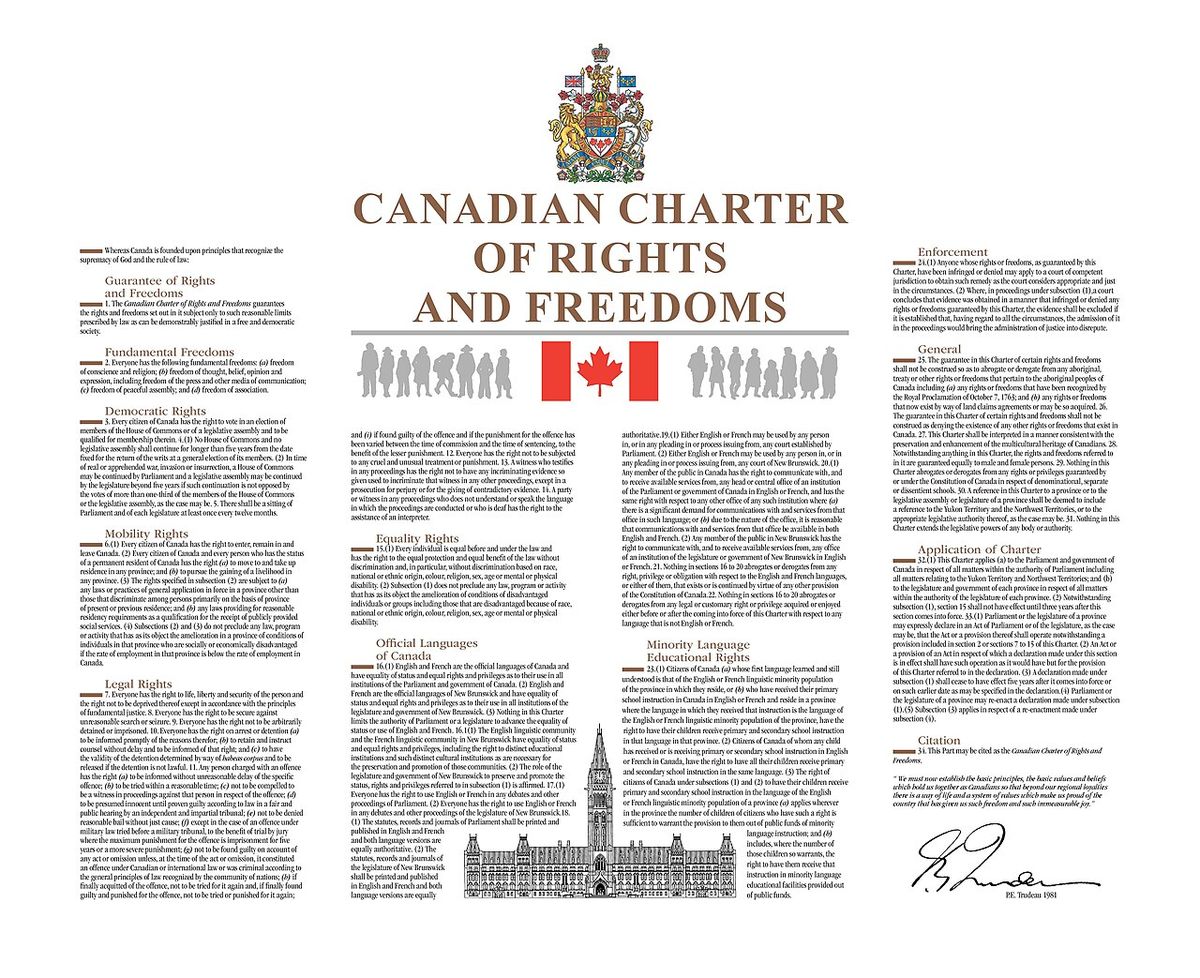
Language rights in education are protected by Section 23 of the Canadian Charter of Rights and Freedoms. This section guarantees that citizens educated in the minority language of their province have the right to have their children educated in that language through publicly funded schools. In practice, this means publicly funded French-language schools exist in predominantly English provinces, and publicly funded English-language schools operate in Quebec, subject to specific eligibility rules. Section 15(2) of the Charter permits governments and school boards to implement programs aimed at improving conditions for disadvantaged groups, which has informed equity initiatives like identity-based data collection used by boards such as the Toronto District School Board to address achievement gaps.
Historical Development
During the French colonial period, education was largely integrated into family and community life, with formal instruction being the exception rather than the rule. The family served as the primary unit for teaching practical skills and, in some cases, basic literacy, with parish priests occasionally establishing petites écoles. By the mid-17th century, more advanced institutional education emerged with the founding of the Collège des Jésuites in 1635 and the Séminaire de Québec in the 1660s, which later became Université Laval. Catholic religious orders, including the Ursulines and the Congregation of Notre Dame, provided limited formal education, with a particular focus on girls in both urban and rural settings. Missionary efforts aimed at assimilating Indigenous peoples through formal schooling had minimal impact on Indigenous societies, where learning remained an embedded part of daily life.
Following the British conquest in 1759-60, education became a tool for promoting Protestantism, the English language, and British customs. The 19th century saw the gradual establishment of more formal, state-influenced school systems. A key development was the introduction of compulsory attendance laws, which provinces enacted over a seventy-year period. Ontario was the first province to legislate compulsory education in 1871, with other provinces following suit, and Newfoundland being the last in 1942. This shift reflected a growing societal view of schooling as a collective concern for peace, order, and good government, moving education from a private, family-centred activity to a public responsibility.
Structure and Provincial Variations
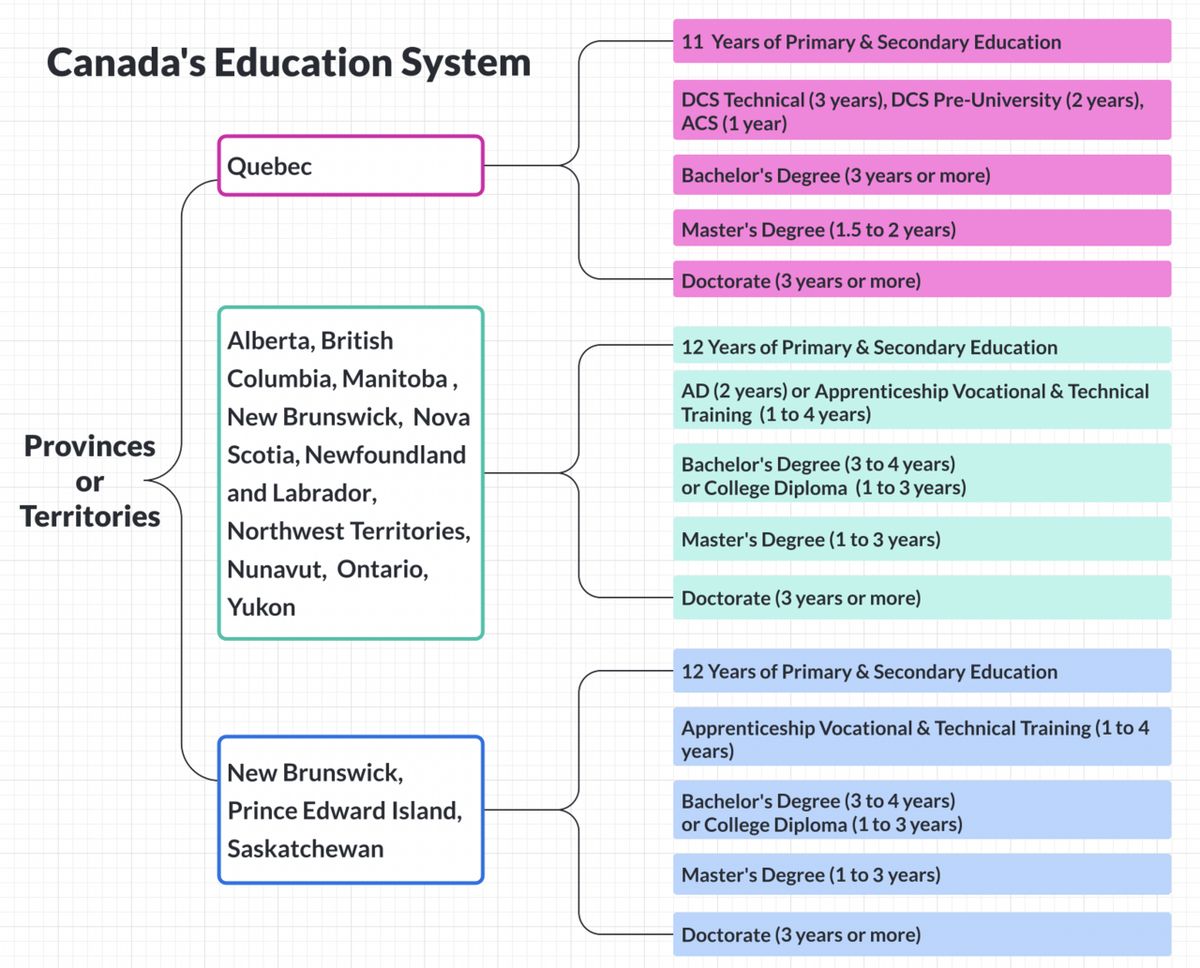
The structure of schooling in Canada, often referred to as K-12, typically begins with kindergarten and proceeds to secondary school graduation at Grade 12. However, there are notable provincial variations in the length and organization of programs. Kindergarten starting age and duration differ, with Nova Scotia, the Northwest Territories, Ontario, and Quebec offering two-year programs beginning at age four, while other provinces provide a single year starting at age five. Full-day kindergarten is not universally available, being absent in Alberta, Manitoba, Nunavut, Saskatchewan, and Yukon. The age at which attendance becomes mandatory ranges from five to seven across provinces, and the age at which it ends is usually 16, except in Manitoba, New Brunswick, and Ontario, where it is 18 or upon earning a diploma.
Secondary education concludes at Grade 12 in all provinces except Quebec, where secondary school ends at Grade 11 (Secondaire V). Ontario historically had a fifth year of secondary education known as Grade 13 or the Ontario Academic Credit, which was phased out in 2003. Despite this, a practice known as a victory lap persists, where students take additional secondary school courses beyond the standard four years. In 2013, Ontario introduced a 34-credit threshold to discourage extended study, as the standard diploma requires 30 credits. School governance is primarily conducted through locally elected district school boards, which administer publicly funded schools following provincial curriculum guidelines, with Alberta being the only province to also allow independent public charter schools.
Post-Secondary Education and International Standing
Canada's post-secondary sector is extensive, comprising almost entirely publicly funded universities and colleges. The country is home to some of the world's top-ranked institutions, with the University of Toronto, University of British Columbia, McGill University, and McMaster University regularly appearing among the top 100 globally. According to a 2022 OECD report, Canada is the most educated country in the world, with over 57 per cent of adults aged 25 to 64 having attained at least an undergraduate college or university degree. As of 2022, 89 per cent of adults aged 25 to 64 have earned the equivalent of a high-school degree, compared to an OECD average of 75 per cent. The nation invests heavily in tertiary education, spending more than US$20,000 per student. Canadian students consistently perform above the OECD average on the Programme for International Student Assessment (PISA), which tests 15-year-olds in mathematics, science, and reading. In the 2015 assessment, the average Canadian student scored 523.7, compared to the OECD average of 493, ranking Canada sixth overall in the world. This strong performance is supported by significant public investment, with Canada spending an average of about 5.3 per cent of its GDP on education.
Contemporary Initiatives and Debates
The Canadian educational landscape continues to evolve with new initiatives focused on equity, Indigenous reconciliation, and professional development. School boards across the country have implemented programs in Native studies, antiracism, and Indigenous cultures, often including visits from elders and content on Indigenous languages and knowledge. The federal government has also introduced fast-track immigration systems for foreign students with Canadian work experience to become permanent residents. Professional gatherings remain vital, with events like the PHE Canada Event Week 2026 in Vancouver combining a Healthy Schools Summit, a Research Forum, and a National Conference to advance physical and health education.
Equity measures, particularly those enacted under Section 15(2) of the Charter, have sparked public debate. The collection of identity-based data by school boards to inform targeted supports for racialized students has raised questions about methodology, transparency, and the inclusion of comparison groups. There is no overarching federal or provincial legislation governing these demographic data practices at the school board level. Curriculum focus often prioritizes subjects that are formally assessed, such as language arts and mathematics, over non-assessed areas like music and visual arts. Some scholars critique certain pedagogical approaches for potentially emphasizing what to think over how to think, while others point to social promotion and reform mathematics as factors affecting skill development.
Key Conferences and Future Directions
The Canadian education community is supported by a strong calendar of national and international conferences that facilitate research sharing and professional networking. These events highlight current trends and future directions in pedagogy and policy. Major upcoming gatherings include the 17th Canada International Conference on Education (CICE-2027), scheduled for July 27-29, 2027, which is an international refereed conference promoting collaborative excellence between academics and professionals. The conference accepts submissions in English and French and publishes proceedings and selected papers in peer-reviewed journals. Other significant events for 2026 include the PHE Canada Event Week in Vancouver from April 29 to May 2, which consolidates the Healthy Schools Summit, the PHE Canada Research Forum, and the PHE National Conference.
The Higher Education Summit hosted by Colleges Ontario explores top issues affecting post-secondary education. Events like the National Day for Truth and Reconciliation live presentation and professional development sessions for teachers show the system's engagement with Indigenous history. Most schools have introduced initiatives such as programs in Native studies and Aboriginal cultures and crafts. These initiatives also include visits by elders and other community members as well as content in areas like indigenous languages. Although these classes are offered, most appear to be limited by the area or region in which students reside. The curriculum is designed to elicit development through the guiding of accommodations of individuals to their natural environment and their changing social order.
Timeline of Compulsory Education Introduction
The establishment of compulsory school attendance laws was a foundational step in standardizing education across Canada, though it occurred over many decades. Each province enacted its own legislation, reflecting local priorities and social conditions. Ontario led the way in 1871, with western and Atlantic provinces following in the late 19th and early 20th centuries. The final province to introduce compulsory education was Newfoundland in 1942, prior to it joining Confederation. This staggered timeline illustrates the provincial nature of educational policy and the gradual acceptance of schooling as a universal obligation. The implementation of these laws was crucial for increasing literacy rates and creating a more uniformly educated citizenry.
- 1871: Ontario
- 1873: British Columbia
- 1877: Prince Edward Island
- 1883: Nova Scotia
- 1905: New Brunswick
- 1909: Saskatchewan
- 1910: Alberta
- 1916: Manitoba
- 1942: Newfoundland
- 1943: Quebec
The introduction of compulsory education marked a shift to a state-mandated responsibility. The mandatory education age ranges between 5-7 to 16-18 years across the provinces. Attendance in school is compulsory up to the age of 16 in all provinces except Manitoba, New Brunswick, and Ontario, where attendance is compulsory until the student turns 18 or as soon as a secondary school diploma has been achieved. This contributes to an adult literacy rate of 99 percent. These laws helped shape the modern Canadian education system by ensuring near-universal participation. Education in Canada is for the most part provided publicly, funded and overseen by provincial and local governments.
Selected Upcoming Education Conferences (2026 to 2027)
The Canadian education sector maintains a dynamic schedule of conferences that cater to researchers, teachers, policymakers, and other stakeholders. These events are essential for disseminating new research, discussing pedagogical innovations, and addressing systemic challenges. The following table lists a selection of notable conferences scheduled for 2026 and 2027, highlighting the breadth of topics from history and social sciences to physical health and higher education leadership. Participation in these events helps professionals stay current with research, network with colleagues, and contribute to the ongoing development of educational practices in Canada and beyond.
| Event Name | Date | Primary Focus |
|---|---|---|
| PHE Canada Event Week 2026 | April 29-May 2, 2026 | Physical & Health Education, Healthy Schools |
| Higher Education Summit 2026 | 2026 (Date TBA) | Post-Secondary Education Issues |
| Symposium on Philosophy, Education, Art and History of Science | November 25-26, 2026 | Interdisciplinary History & Education |
| National Day for Truth and Reconciliation Live Presentation | September 30, 2026 | Indigenous History & Reconciliation |
| Canada International Conference on Education (CICE-2027) | July 27-29, 2027 | International Education Research & Practice |
Conferences provide forums for collaboration among educational sectors. The range of topics reflects diverse priorities within the Canadian educational landscape. These topics include truth and reconciliation, as many schools have introduced programs in Native studies and antiracism. Other topics relate to physical health education, which is often considered a non-assessed subject. Subjects that typically get assessed, like language arts and science, assume greater importance than non-assessed subjects like music and physical education. These events draw in government representatives and other organizations involved in education.
Questions about Education in Canada
At what age do children start school in Canada?
The starting age for compulsory schooling varies by province and territory. In British Columbia, New Brunswick, Nova Scotia, and Yukon, children must begin school if they turn five by December 31 of that school year. In Alberta, Newfoundland and Labrador, the Northwest Territories, Ontario, Prince Edward Island, and Quebec, the compulsory age is six. Manitoba and Saskatchewan have the latest start age, requiring attendance at age seven. Kindergarten programs for younger children are widely available but are not always mandatory.
How does Canada's education system rank internationally?
Canada consistently ranks highly in international comparisons. According to the OECD's 2022 report, Canada is the most educated country in the world, with over 57 per cent of adults holding a tertiary education degree. In the Programme for International Student Assessment (PISA), which tests 15-year-olds, Canadian students perform well above the OECD average in mathematics, science, and reading, ranking sixth globally in overall knowledge and skills as of the 2015 assessment. The country also has an adult literacy rate of 99 per cent.
Are there French-language schools outside of Quebec?
Yes, French-language education is available across Canada. Section 23 of the Canadian Charter of Rights and Freedoms guarantees the right of citizens who were educated in the minority language of their province to have their children educated in that language through publicly funded schools. This means there are publicly funded French-language school boards in all provinces and territories outside Quebec. Conversely, in Quebec, publicly funded English-language schools are available for eligible students, typically those whose parents were educated in English in Canada.
What is the role of the federal government in education?
The federal government's responsibilities in education are limited to the Canadian Military Colleges, the Canadian Coast Guard College, and funding the education of Indigenous peoples. All other matters of education in Canada fall under provincial responsibility. The federal government participates in national data collection through bodies like the Canadian Education Statistics Council. This council works with provinces on the Pan-Canadian Education Indicators Program and submits an annual report called Education Indicators in Canada: An International Perspective.
What are the major types of school boards in Canada?
Publicly funded school boards in Canada are typically divided by language and, in some provinces, religion. The main types are public secular boards and separate (usually Catholic) boards, each operating in either English or French. For example, in Toronto, there are four public boards: the secular Toronto District School Board (English), the separate Toronto Catholic District School Board (English), the secular Conseil scolaire Viamonde (French), and the separate Conseil scolaire catholique MonAvenir (French). These divisions are rooted in constitutional protections and provide choice for families based on language and religious affiliation.
What is the oldest university in Canada?
The oldest post-secondary institution in Canada is Université Laval, established in 1663. This university is located in Quebec City and is a publicly funded institution, like most universities in Canada. It holds the distinction of being the first French-language university in North America. Its long history is part of Canada's extensive post-secondary education system, which includes many other notable institutions. Canada's university system is a key reason the country is considered the most educated in the world.
Sources and further reading
- Education in Canada (Wikipedia)
- History of Education in Canada (thecanadianencyclopedia.ca)
Checked by the Nosy Mag desk. Last updated 2026-11-01.