Criminal Code
The Criminal Code is the principal federal statute that codifies most criminal offences and procedural law in Canada. Its full title is An Act respecting the Criminal Law, and it is indexed as R.S.C. 1985, c. C-46. The Code applies uniformly across the country, establishing a single body of criminal law under the exclusive jurisdiction of Parliament. It is a living document, subject to regular amendment, with significant reforms enacted as recently as July 2026.
Legal Foundation and Scope
The constitutional authority for the Criminal Code is derived from section 91(27) of the Constitution Act, 1867, which grants the Parliament of Canada exclusive legislative power over criminal law. This centralization means the Code applies uniformly in every province and territory, creating a consistent national standard for what constitutes a crime. As a result, offences defined within the Code are considered federal crimes, and prosecutions can be initiated anywhere in Canada. The Code's comprehensive nature means it covers a wide spectrum of unlawful conduct, from minor summary conviction offences to the most serious indictable offences like murder. It also establishes fundamental principles of criminal procedure, including rules for arrest, bail, trial, and sentencing, providing the procedural framework for the administration of justice.
One of the Code's foundational principles is that no person can be convicted of a crime unless the offence is specifically outlined and stated within a statute. This principle of legality is a fundamental part of Canadian criminal law. The Code's scope is extensive, but it does not contain all Canadian criminal law. Several important statutes operate alongside it, including the Controlled Drugs and Substances Act, which governs drug offences, and the Youth Criminal Justice Act, which sets out a distinct legal regime for young persons. The Firearms Act regulates the possession and use of firearms, while the Canada Evidence Act governs rules for evidence in court proceedings. Other key federal criminal laws include the Food and Drugs Act, the Customs Act, and the Contraventions Act. These acts complement the Code, and lawyers and judges must often reference multiple statutes in a single case.
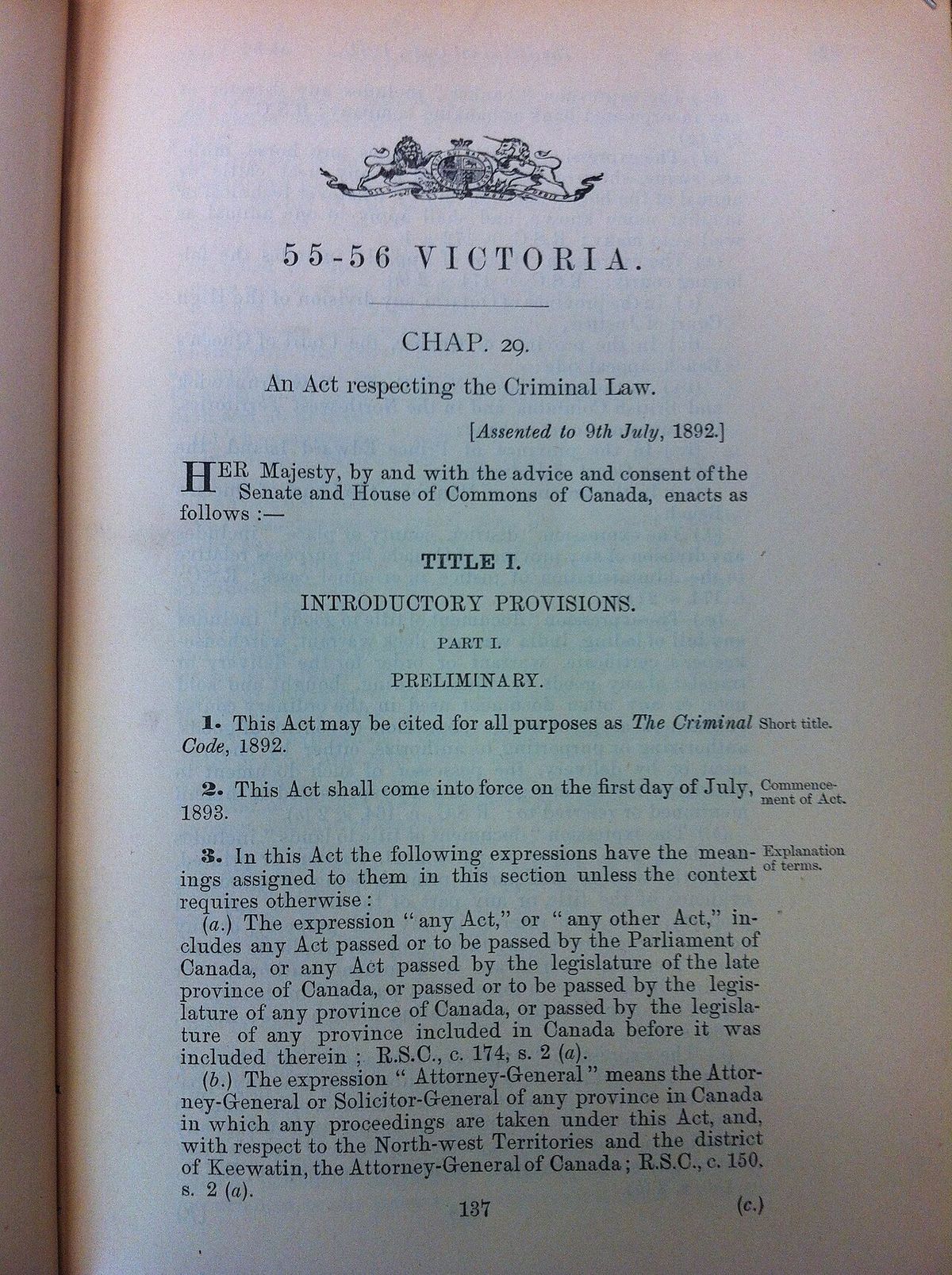
Structure and Major Offence Categories
The structure begins with Part I, which contains general provisions and interpretations applicable throughout the Code. The subsequent Parts systematically categorize different types of criminal conduct. Part II covers offences against public order, such as rioting and unlawful assemblies, while Part II.1, added in 2001, deals specifically with terrorism offences. Part III governs crimes involving firearms and other weapons, detailing licensing offences and prohibitions on certain devices. Part IV outlines offences against the administration of law and justice, including perjury, obstructing justice, and bribery of officials.
Other major categories include sexual offences and crimes against public morals in Part V, and invasion of privacy in Part VI. Part VII addresses disorderly houses, gaming, and betting. Part VIII is one of the most frequently referenced, containing offences against the person and reputation, such as assault, sexual assault, and homicide. Part VIII.1, added in 2018, consolidates offences relating to conveyances, primarily impaired driving and other dangerous operation of vehicles. Property crimes, including theft, break and enter, and mischief, are found in Part IX. The Code also covers fraudulent transactions, wilful damage to property, offences relating to currency, and the proceeds of crime. Part XIII deals with inchoate offences like attempts and conspiracies, while the latter Parts from XIV onward are largely procedural, covering jurisdiction, trial processes, appeals, and sentencing.
Procedural Framework and Classifications
The Criminal Code establishes a dual system for classifying offences, which directly impacts how a case proceeds through the courts. Indictable offences are the more serious crimes, such as murder, robbery, and aggravated assault. For these offences, there is generally no statute of limitations, meaning a prosecution can be commenced at any time, with the sole exception of treason, which has a three-year limitation period. Summary conviction offences are less serious matters, like causing a disturbance or minor theft under a certain value. These offences must be prosecuted within 12 months of the alleged incident. Some offences, known as hybrid or dual procedure offences, can be prosecuted either by indictment or summarily, with the choice made by the Crown prosecutor.
The procedural Parts of the Code provide a detailed roadmap from investigation to sentencing. Parts XVI and XXV govern the compelling appearance of an accused, interim release (bail), and the enforcement of release orders. Part XVII guarantees an accused's right to a trial in their official language. Parts XVIII through XXII outline procedures for preliminary inquiries, jury and non-jury trials, and appeals for indictable offences. Part XXIII is dedicated to sentencing principles and available penalties, while Part XXIV deals with the designation of dangerous and long-term offenders. Part XXVII sets out the distinct, simplified process for summary conviction proceedings. This comprehensive framework ensures that criminal cases are handled in a consistent, orderly manner that balances the state's interest in prosecution with the rights of the accused.

Recent Amendments and the 2026 Reforms
The Criminal Code is subject to continual amendment by Parliament to respond to new challenges and societal priorities. A major package of reforms, the Protecting Victims Act, received Royal Assent on June 18, 2026, with most provisions coming into force on July 15, 2026. These amendments introduced significant changes aimed at enhancing protections for victims of intimate partner violence and reforming bail provisions. The law created a new specific offence of first-degree murder when the victim is the offender's intimate partner and the death occurs in the context of a pattern of coercive or controlling conduct. This provision applies irrespective of whether the murder was planned and deliberate, recognizing the unique dynamics of domestic violence.
The 2026 amendments also mandated that courts consider imposing a life sentence for manslaughter committed against an intimate partner in a similar context of coercive control. The Act created new standalone offences for committing any crime where violence is used, threatened, or attempted against an intimate partner, with increased penalties. On procedural matters, the reforms extended the detention period for seized items under section 490 from three months to 180 days. Bail provisions were also tightened for those charged with offences involving violence against an intimate partner who have a prior related conviction. These changes reflect a concerted effort to address systemic issues in the justice system's response to domestic violence.
Key Legal Resources and Publications
Given the Code's complexity and frequent amendments, several annotated publications are essential tools for legal practitioners, students, and law enforcement. The Practitioner's Criminal Code, often called the 'Gold Code' after its author Alan D. Gold, is a leading portable annotated edition favoured by the criminal bar. It is updated annually and provides practitioner-centric commentary on noteworthy cases, contentious issues, and potential arguments. Its 2026/2027 edition includes a complimentary e-book with hyperlinks to full-text cases. Another major resource is Martin's Annual Criminal Code, a comprehensive annotated version used widely across the country.
For academic study, the 2026 Release of 'Criminal Law and the Canadian Criminal Code' by Jochelson et al. represents a significant update. This edition features a new author team from the University of Manitoba, including Dean Richard Jochelson and Marc Kruse, Director of Indigenous Legal Learnings and Services. The text underwent a full redesign, streamlining from 13 to 8 chapters and adopting an integrated approach that blends foundational concepts with discussions of significant offences. Key updates include separating actus reus and mens rea into distinct chapters, moving the Code text online for real-time updates, and thoughtfully interweaving Indigenous perspectives throughout, particularly in a new chapter on sentencing and restorative approaches.
- The Practitioner's Criminal Code (Gold Code): Leading annotated edition with annual updates and case commentary.
- Martin's Annual Criminal Code: Comprehensive annotated version used nationally.
- Jochelson's Criminal Law and the Canadian Criminal Code (2026): Academic text with a new author team and integrated Indigenous perspectives.
- Justice Canada Website: Provides the official, up-to-date text of the Code, current to September 30, 2026.
- Canadian Legal Information Institute (CanLII): Offers a free, searchable database of the Code and case law.
History and Evolution
The Criminal Code stems from a long history of legal documents. The Code underwent a major revision in 1954, which came into force in April 1955. It remains the fundamental criminal law of Canada despite several initiatives at major reform or the enactment of a new criminal code entirely. In 2018, and later in 2019, the Trudeau government made a large revision to the Code. The addition of the terrorism category in 2001 with the Anti-terrorism Act and the conveyance offences category in 2018 are examples of legislative responses to emerging issues. The 2026 intimate partner violence reforms demonstrate a shift towards recognizing patterns of coercive control as central to understanding the severity of domestic crimes. As the fundamental criminal law of Canada, the Code remains a dynamic instrument, continually interpreted by the courts and amended by Parliament.
Questions about Criminal Code
What is the Criminal Code of Canada?
The Criminal Code is the main federal law that defines most criminal offences and sets out the procedures for prosecuting them in Canada. It is an Act of Parliament titled 'An Act respecting the Criminal Law' and is cited as R.S.C. 1985, c. C-46. The Code applies uniformly across all provinces and territories, creating a single national standard for criminal conduct. It covers everything from minor summary offences to serious indictable offences like murder and establishes the rules for arrests, trials, and sentencing.
What are the different types of offences in the Criminal Code?
The Code classifies offences into three main types. Indictable offences are the most serious, such as murder or robbery, and typically carry heavier penalties. Summary conviction offences are less serious matters with simpler procedures and a 12-month limitation period for prosecution. Hybrid or dual procedure offences can be prosecuted either as indictable or summary offences, with the choice made by the Crown prosecutor based on the circumstances. For indictable offences, there is generally no time limit on when a prosecution can begin, except for treason which has a three-year limitation period.
What major changes were made to the Criminal Code in 2026?
In 2026, the Protecting Victims Act introduced significant reforms, most of which came into force on July 15, 2026. These changes created a new offence of first-degree murder for killing an intimate partner in the context of a pattern of coercive or controlling conduct. The amendments also require courts to consider life sentences for manslaughter in similar domestic contexts and created new offences for committing any crime with violence against an intimate partner. The law tightened bail provisions for those with prior convictions for intimate partner violence and extended the detention period for seized items from three to 180 days.
Does the Criminal Code include all criminal laws in Canada?
No, the Criminal Code does not include all Canadian criminal laws. While it is the central statute, several other important federal acts address specific areas. Key examples include the Controlled Drugs and Substances Act for drug offences, the Firearms Act for firearm regulations, and the Youth Criminal Justice Act for offences committed by young persons. Other significant federal criminal laws are the Canada Evidence Act, the Food and Drugs Act, the Customs Act, and the Contraventions Act. Lawyers must often consult multiple statutes when dealing with a criminal case.
Where can I find the most up-to-date version of the Criminal Code?
The most current official version of the Criminal Code is maintained by the Department of Justice Canada on its website, which provides the full text in PDF and HTML formats. As of the latest update, the Act is current to September 30, 2026, and was last amended on July 18, 2026. For annotated versions with expert commentary, practitioners rely on annual publications like The Practitioner's Criminal Code (the Gold Code) or Martin's Annual Criminal Code. The Canadian Legal Information Institute (CanLII) also offers a free, searchable online database of the Code and related case law.
What is the history of the Criminal Code?
The Criminal Code underwent a major revision in 1954, which came into force in April 1955. It remains the fundamental criminal law of Canada despite several initiatives at major reform or the enactment of a new criminal code entirely. In 2018, and later in 2019, the Trudeau government made a large revision to the Code. The addition of the terrorism category in 2001 with the Anti-terrorism Act and the conveyance offences category in 2018 are examples of legislative responses to emerging issues. The 2026 intimate partner violence reforms are the latest significant amendments.
Sources and further reading
- Criminal Code (Wikipedia)
- Criminal Law And The Canadian Criminal Code - 2026 ... (mheducation.ca)
- The Practitioner's Criminal Code, 2026/2027 Edition + E- ... (store.lexisnexis.com)
- An Act to amend the Criminal Code ( SC 2026, c. 12) (lois.justice.gc.ca)
Checked by the Nosy Mag desk. Last updated 2026-10-24.