Conservative Party of Canada
The Conservative Party of Canada (CPC) is a major federal political party in Canada, positioned on the centre-right to right of the political spectrum. Formed in 2003 through the merger of the Progressive Conservative Party and the Canadian Alliance, the party is the modern political heir to Canada's historical conservative traditions and is often referred to as the Tories. The Conservatives governed Canada from 2006 to 2015 under Prime Minister Stephen Harper, implementing significant economic and social policies, and have since served as the Official Opposition following electoral defeats in 2015, 2019, 2021, and 2025. As a 'big tent' party, it encompasses a broad coalition of members and remains a dominant force in Canadian politics, consistently winning a plurality of the popular vote in recent federal elections.
Historical Predecessors and Merger
The Conservative Party of Canada is the direct successor to a long lineage of right-of-centre parties in Canada, beginning with the Upper Canada Tories of the 19th century. Sir John A. Macdonald and George-Étienne Cartier founded the Liberal-Conservative Party, which later became known simply as the Conservative Party and, after 1942, the Progressive Conservative Party. The modern party legally assumed the assets and liabilities of the Progressive Conservatives upon its creation. A major realignment of conservative politics began in the late 1980s with the rise of the western-based, populist Reform Party under Preston Manning, which fractured the Progressive Conservative coalition. The 1993 federal election was a catastrophe for the PCs, reducing their caucus to just two seats, while Reform became the dominant conservative force in Western Canada. For over a decade, vote-splitting between the PCs and Reform (which later became the Canadian Alliance) allowed the Liberal Party to win elections despite the combined conservative vote often exceeding the Liberal total. This persistent electoral disadvantage led to sustained calls for a merger to unite the right-of-centre vote. After months of negotiations, the leaders of the Canadian Alliance, Stephen Harper, and the Progressive Conservative Party, Peter MacKay, announced an agreement in principle on October 15, 2003. The merger was ratified by the memberships of both parties, and the new Conservative Party of Canada was officially registered with Elections Canada on December 7, 2003.
The merger process was contentious and faced organized opposition, particularly from some Progressive Conservative members. Former PC leadership candidate David Orchard launched an unsuccessful legal challenge based on an agreement with MacKay that he argued precluded a merger. Several sitting PC MPs, including former prime minister Joe Clark, André Bachand, and John Herron, announced they would not join the new party's caucus. In the following months, other prominent figures like Scott Brison and Keith Martin also left, with some later joining the Liberal Party. A rump caucus of Progressive Conservative senators, including William Doody, Norman Atkins, and Lowell Murray, initially declined to join the new party. Senator John Lynch-Staunton, a PC, was named the party's interim leader pending its first leadership election. The party's inaugural leadership contest in March 2004 featured three candidates: Stephen Harper, business executive Belinda Stronach, and former Ontario cabinet minister Tony Clement. Harper won decisively on the first ballot with 56.2 percent of the vote from 97,397 cast ballots, becoming the first leader of the unified Conservative Party.
The Harper Era: Government and Policy
Under Stephen Harper's leadership, the Conservative Party quickly became a credible government-in-waiting. In the June 2004 election, the party won 99 seats, reducing the governing Liberals to a minority. Harper then led the party to a minority victory in the January 2006 election, winning 124 seats and forming Canada's first Conservative government in over a decade. The Harper government's first budget in 2006 recorded a nearly $14 billion surplus and initiated major policy shifts, including increased military spending and the cancellation of funding for the Kyoto Protocol. Key domestic policy achievements during its tenure included the creation of the tax-free savings account (TFSA), the introduction of the Universal Child Care Benefit, and the passage of the Veterans' Bill of Rights. The government also passed a motion recognizing the Québécois as a nation within a united Canada. In 2008, after a political deadlock, another election was called, resulting in a stronger Conservative minority. The government's response to the 2008 global financial crisis involved significant stimulus spending and personal income tax cuts, which contributed to a record federal deficit of $55.6 billion. A non-confidence vote in March 2011, which found the government in contempt of Parliament, triggered an election that delivered the Conservatives their first majority government since the merger.
Harper's majority government pursued an ambitious policy agenda marked by fiscal conservatism and a focus on law and order. The government formally withdrew Canada from the Kyoto Protocol in 2011 and repealed the federal long-gun registry. In economic policy, it launched Canada's Global Markets Action Plan to promote trade and investment abroad and successfully balanced the federal budget by 2014, posting a minor deficit of $550 million. Major international trade agreements, namely the Comprehensive Economic and Trade Agreement (CETA) with the European Union and the Trans-Pacific Partnership (TPP), were negotiated during this period. The government also passed the Anti-terrorism Act and launched Operation Impact to combat ISIL. However, the tenure was also marred by controversies, including the Canadian Senate expenses scandal and the Robocall scandal, which involved allegations of voter suppression during the 2011 election. After nearly a decade in power, the Conservatives were defeated by Justin Trudeau's Liberal Party in the 2015 federal election. Harper resigned as party leader on election night, ending an era described by some commentators as the most conservative government in Canadian history.
Return to Opposition and Leadership Changes
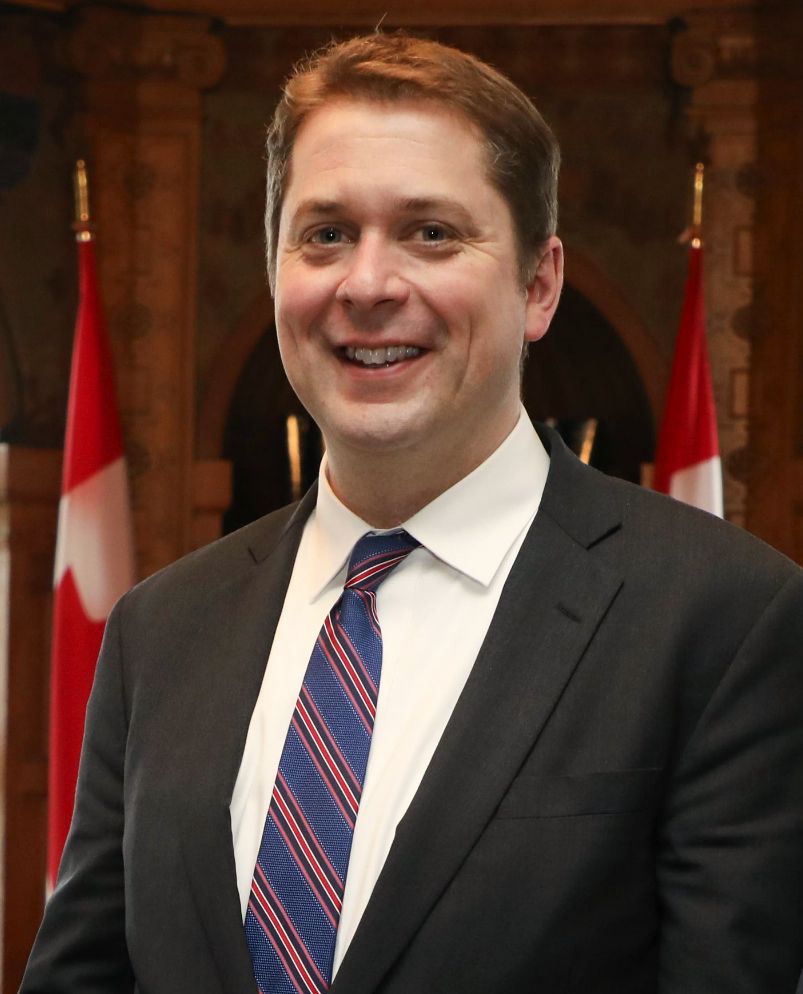
Following the 2015 election defeat, the Conservative caucus selected Rona Ambrose as interim leader in November 2015. The party scheduled a leadership convention for May 2017 to choose a permanent successor. The 2017 leadership race was highly competitive, featuring over a dozen candidates including Andrew Scheer, Maxime Bernier, and Erin O'Toole. After 13 rounds of voting, Andrew Scheer, the former Speaker of the House of Commons, was elected leader on May 27, 2017, with 50.95 percent of the vote. Scheer's leadership platform emphasized repealing the federal carbon tax, supporting pipeline construction, and balancing the budget within five years. A social conservative, Scheer was personally opposed to abortion and same-sex marriage but stated he would not seek to reopen those laws. Under his leadership, the party entered the 2019 election competitive with the Liberals but ultimately lost, though it won the popular vote and gained 26 seats, sweeping Alberta and Saskatchewan. Scheer resigned as leader in 2020, leading to another leadership contest. Erin O'Toole won the party's leadership in August 2020, defeating Peter MacKay among others. O'Toole led the party through the 2021 federal election, where it again won the popular vote but failed to secure a plurality of seats, resulting in another Liberal minority government. O'Toole was removed as leader by a caucus vote in early 2022.
The party's most recent leadership election was held in September 2022. Pierre Poilievre, a long-serving MP and former cabinet minister, won a decisive victory, securing 68.2 percent of the national points and 70.7 percent of the national popular vote. Poilievre led the Conservative Party into the 2025 federal election. The party achieved its highest popular vote share in its modern history, at 41.3 percent, and gained 24 seats, making significant gains in British Columbia and southern Ontario. Despite this performance, the Conservatives did not dislodge the Liberal government and remained the Official Opposition. Following the election, as mandated by the party constitution, a leadership review was held at the first policy convention after an election where the leader did not resign. This review took place at the party's 2026 policy convention in Calgary. Poilievre received 87.4 percent support in the leadership review vote. The party has continued to hold fundraising events, such as 'An Evening with Pierre Poilievre' in Winnipeg in April 2026 and earlier events in Toronto in December 2025 and January 2026.
Policy Framework and Political Positioning
The Conservative Party of Canada operates as a 'big tent' or brokerage party, practising a form of politics that seeks to accommodate a broad coalition of members from across the country. This includes both 'Red Tories,' who traditionally emphasize communitarian values and a role for government in society, and 'Blue Tories,' who prioritize economic liberalism and fiscal conservatism. The party's official policy declaration outlines the principles guiding its constitutional framework and policy basis. Historically, the party's platform has centred on several core pillars. Fiscal policy has focused on tax reduction, including cuts to the Goods and Services Tax, income taxes, and business taxes, as well as balanced budgets and debt reduction. The creation of the tax-free savings account (TFSA) is a signature policy achievement from its time in government. In the area of law and order, the party has advocated for mandatory minimum sentences for violent crimes, raising the age of consent, and repealing what it terms 'catch-and-release' laws for criminals. Under recent leadership, a central policy commitment has been the repeal of the federal carbon tax, which is framed as a measure to address cost-of-living concerns.
Social policy is an area where the party's 'big tent' approach is most evident, encompassing a spectrum of views. While the party has included many social conservatives among its membership and MPs, its leadership under Stephen Harper and his successors adopted a pragmatic stance, stating they would not reopen debates on issues like abortion or same-sex marriage despite personal convictions. The party's foreign policy has traditionally emphasized strong support for the State of Israel, strong military spending, and the pursuit of free trade agreements. Under Harper, Canada withdrew from the Kyoto Protocol, a move consistent with the government's focus on domestic economic priorities over international climate commitments. The party's approach to federalism often involves advocating for greater provincial autonomy in areas of shared jurisdiction. In opposition, the party has consistently criticized Liberal government spending and management, positioning itself as the responsible fiscal alternative. The party's policy direction is formally debated and shaped at national policy conventions, such as the one held in Calgary from January 29 to 31, 2026, where delegates debated policy resolutions and constitutional amendments.
Electoral Performance and Contemporary Status
Since its formation, the Conservative Party of Canada has been a dominant force in federal elections, though its success in translating votes into seats has varied. The party formed government for nearly a decade after winning three consecutive elections. Following its defeat in 2015, the party has remained in opposition but has consistently won the plurality of the popular vote in the subsequent elections. The most recent federal election in 2025 marked a high point in popular support for the modern party, as it secured 41.3 percent of the popular vote, its highest share since the merger. The party also gained 24 seats compared to the previous election, though this was insufficient to form government.
The party's regional strength is a defining characteristic of its electoral map. It holds overwhelming dominance in the prairie provinces of Alberta and Saskatchewan, where it won every seat in 2019 and nearly every seat in subsequent elections. It also maintains strong support in rural and suburban areas across the country, particularly in British Columbia, Ontario, and Manitoba. The party's challenge has historically been breaking through in urban centres, especially in Toronto, Montreal, and Vancouver, and in Atlantic Canada. The departure of some caucus members following the 2025 election and the continued presence of smaller parties like the People's Party of Canada, founded by former Conservative MP Maxime Bernier, have presented ongoing strategic considerations. As of 2026, under the leadership of Pierre Poilievre, the Conservative Party continues as the Official Opposition. Its immediate political focus includes critiquing the governing Liberals' policies, promoting its own policy alternatives such as plans to repeal bills C-5 and C-75, and preparing for the next federal election. The party's organizational activities continue with fundraising events and national conventions designed to mobilize its base and refine its platform.
Key Leadership Elections
The Conservative Party of Canada has held several consequential leadership elections since its founding, each shaping the party's direction. These contests have determined who would lead the party into general elections and define its policy priorities. The party's inaugural leadership contest was held on March 20, 2004. Stephen Harper, former leader of the Canadian Alliance, won on the first ballot with 56.2% of the vote, defeating Belinda Stronach (34.5%) and Tony Clement (9.4%). A total of 97,397 ballots were cast. The 2017 leadership election was held on May 27, 2017, following Stephen Harper's resignation. Andrew Scheer, former Speaker of the House of Commons, was elected after 13 rounds of voting, securing 50.95% of the vote to defeat runner-up Maxime Bernier and over a dozen other candidates. Following Andrew Scheer's resignation, Erin O'Toole won the party leadership on August 24, 2020, defeating former cabinet minister Peter MacKay, among others, in a race conducted under a modified points system. The most recent contest was held in September 2022 after Erin O'Toole's removal, and was decisively won by Pierre Poilievre, who secured 68.2% of the national points and 70.7% of the national popular vote. In addition to these permanent leadership elections, the party has also selected interim leaders during transitions, such as Rona Ambrose in November 2015. Leadership reviews are also a formal part of the party's process, as seen at the 2026 policy convention where Poilievre received 87.4% support.
Federal Election Results (2004 to 2025)
The Conservative Party's electoral record since its founding demonstrates its evolution from a new merger to a perennial contender for government. The data illustrates the party's trajectory: initial growth leading to government, a period of majority rule, and then a return to opposition where it has consistently captured the largest share of the popular vote but not a plurality of seats. The 2025 election result is particularly notable for the record popular vote share of 41.3 percent, the highest for the party in the modern era, though it did not translate into a change in government. This pattern shows the impact of Canada's single-member plurality electoral system and regional concentration of votes on the party's ability to form government. The party won 99 seats in 2004, 124 in 2006, and a stronger minority in 2008. It won its first majority government in 2011. After its defeat in 2015, it has remained the Official Opposition, winning the popular vote in 2019, 2021, and 2025.
Questions about Conservative Party of Canada
Who is the current leader of the Conservative Party of Canada?
Pierre Poilievre is the current leader of the Conservative Party of Canada. He was elected leader in September 2022, winning 68.2 percent of the national points and 70.7 percent of the national popular vote. He led the party to a 41.3 percent popular vote in the 2025 election. In a mandatory leadership review at the 2026 policy convention, he received 87.4 percent support.
When was the Conservative Party of Canada founded?
The Conservative Party of Canada was founded on December 7, 2003, when it was officially registered with Elections Canada. This registration followed the ratification of a merger agreement between the Progressive Conservative Party and the Canadian Alliance. The agreement in principle had been announced by Stephen Harper and Peter MacKay on October 15, 2003. The party was formed to unite the two main right leaning parties after the 1993 federal election.
What are the main policy positions of the Conservative Party?
The Conservative Party's policy framework is guided by principles of fiscal conservatism, limited government, and individual freedom. Key historical policy positions include reducing taxes such as the GST, balancing the federal budget, and creating the tax-free savings account. The party has advocated for stronger law and order measures, including mandatory minimum sentences and repealing the long-gun registry. In recent years, a central policy commitment has been the repeal of the federal carbon tax. The party also emphasizes support for free trade agreements, a strong military, and provincial autonomy within the federation.
How many times have the Conservatives formed government?
The Conservative Party of Canada has formed the federal government once since its founding in 2003. Under the leadership of Stephen Harper, the party won the 2006 election, forming a minority government. It was re-elected with a stronger minority in 2008 and then won a majority government in 2011. The party governed Canada from February 6, 2006, until its defeat in the October 2015 election. It has served as the Official Opposition following the elections of 2015, 2019, 2021, and 2025.
What is the difference between Red Tories and Blue Tories?
Within the Conservative Party's 'big tent,' Red Tories and Blue Tories represent two broad traditions. Red Tories are generally associated with a more communitarian and paternalistic approach, accepting a role for government in addressing social issues and supporting a mixed economy. Blue Tories prioritize economic liberalism, fiscal conservatism, free markets, and smaller government. The party's brokerage politics aims to accommodate both these strands, along with other groups like social conservatives, to build a winning national coalition. This internal diversity is a defining feature of the modern Conservative Party.
What happened at the 2026 Conservative Party convention?
The Conservative Party of Canada held a national policy convention in Calgary, Alberta, from January 29 to 31, 2026. Delegates debated policy resolutions and proposed changes to the party constitution. A mandatory leadership review vote for leader Pierre Poilievre was held, in which he received 87.4 percent support. The convention also featured opening ceremonies with MPs and plenary sessions where the party's future direction was discussed.
Sources and further reading
- Conservative Party of Canada (Wikipedia)
- 2026 Conservative Convention (cpac.ca)
- Events (conservative.ca)
Checked by the Nosy Mag desk. Last updated 2026-10-26.