Andrew Scheer
Andrew James Scheer is a Canadian politician who has served as the member of Parliament for the Saskatchewan riding of Regina, Qu'Appelle since 2004. A prominent figure in the Conservative Party of Canada, Scheer served as its leader from 2017 to 2020 and as the leader of the Official Opposition during that period, as well as briefly in 2025. He previously made history as the youngest person ever elected speaker of the House of Commons, holding that role from 2011 to 2015. Scheer's political career has been defined by his advocacy for fiscal restraint, opposition to the federal carbon tax, and his role in leading the Conservatives through the 2019 federal election.
Early life and education
Andrew Scheer was born on May 20, 1979, at Riverside Hospital in Ottawa, Ontario. He is the son of Mary Gerarda Therese Enright, a nurse, and James D. Scheer, a librarian, proofreader for the Ottawa Citizen, and Catholic deacon. His father was born in the United States, which conferred American citizenship on Andrew at birth despite his being born in Canada. Scheer spent his youth in Ottawa, graduating from Immaculata High School, which later honoured him with its Distinguished Catholic Alumni Award in 2012. He began his post-secondary studies in 1998 at the University of Ottawa, focusing on criminology, political science, and history. During his university years, Scheer was active in political campaigns, including the Unite the Right effort to merge the Progressive Conservative and Reform parties and Preston Manning's campaign to lead the Canadian Alliance. He also worked in the correspondence department of the Office of the Leader of the Opposition under Stockwell Day and served on Ottawa city councillor Karin Howard's youth advisory committee. In 2000, he ran unsuccessfully as a school trustee for the Ottawa-Carleton Catholic School Board. After meeting his future wife, Jill Ryan, at university, Scheer moved to her hometown of Regina, Saskatchewan, where he continued his studies at the University of Regina. He ultimately received his Bachelor of Arts degree in 2008, four years after first being elected to Parliament.

Early career and entry into politics
After moving to Regina, Andrew Scheer held several jobs before entering federal politics. He worked as an insurance clerk, a waiter, and an assistant in the constituency office of Canadian Alliance MP Larry Spencer. In 2005, Scheer's blog as an MP listed that he was an accredited insurance broker, and in 2007 his MP biography stated he passed the Canadian Accredited Insurance Broker program in Saskatchewan and started his career at Shenher Insurance in Regina. During the 2019 election, his party biography stated he had worked as an insurance broker. The Globe and Mail later reported it found no evidence he was ever accredited, prompting a review by the Insurance Councils of Saskatchewan. Scheer maintained he received his accreditation after leaving Shenher Insurance. His political career began in earnest with his first campaign for Parliament in the 2004 federal election. At the age of 25, he ran as the Conservative candidate in Regina, Qu'Appelle, defeating longtime New Democratic Party MP Lorne Nystrom by 861 votes. Near the end of that race, Scheer accused Nystrom of being soft on child pornography, a controversial tactic in a tight contest. He solidified his hold on the riding in the 2006 election, defeating Nystrom again by a margin of 2,740 votes.
Parliamentary career and role as speaker
After his re-election in 2006, Andrew Scheer quickly assumed parliamentary responsibilities. In April 2006, during the 39th Parliament, he was appointed assistant deputy chairman of Committees of the Whole, one of three deputy speaker positions. He also sponsored private member's Bill C-343, which sought to establish minimum sentences for motor vehicle theft. His role expanded on November 21, 2008, when he was named deputy speaker of the House of Commons and chairman of Committees of the Whole for the 40th Parliament, succeeding NDP MP Bill Blaikie. Following the Conservative Party's majority victory in the 2011 federal election, Scheer's experience made him a leading candidate for speaker. On June 2, 2011, after six rounds of balloting, he defeated the lone opposition candidate, NDP MP Denise Savoie. At age 32, Scheer became the youngest speaker in the history of the House of Commons, a role he held for the entirety of the 41st Parliament until 2015. His tenure was not without controversy, as some opposition MPs questioned his impartiality on certain rulings, including decisions related to the 2011 robocall scandal and interventions concerning his riding association's financial dealings. Following the Conservative defeat in the 2015 election, Scheer was appointed opposition House leader by interim party leader Rona Ambrose. He held this role until September 2016, when he resigned to explore a bid for the permanent leadership of the Conservative Party.
Conservative Party leadership
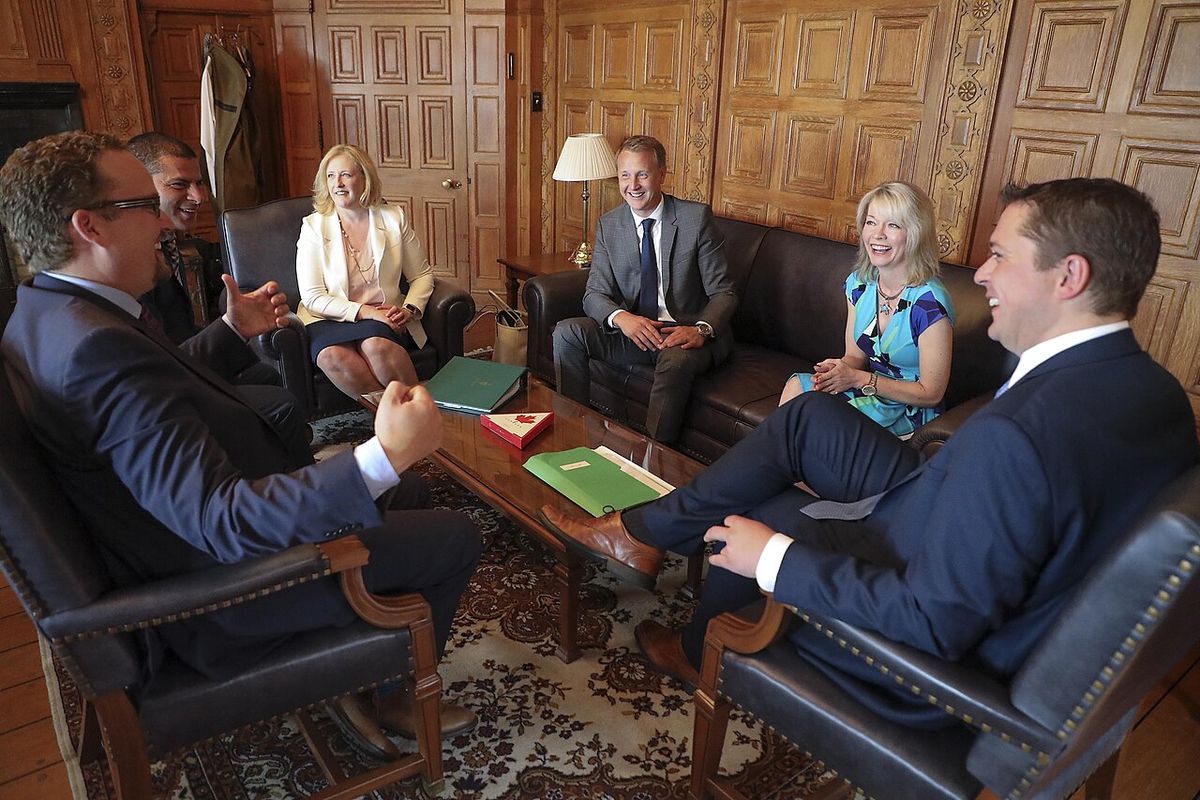
Andrew Scheer announced his bid for the leadership of the Conservative Party on September 28, 2016, entering a crowded field of more than a dozen candidates. His campaign operated under the slogan "Real conservative. Real leader" and focused on economic issues like scrapping the carbon tax and balancing the budget, while largely avoiding championing social conservative causes to appeal to a broader audience. On May 27, 2017, after 13 rounds of ranked ballot voting, Scheer won a narrow victory over former cabinet minister Maxime Bernier, securing 50.95 percent of the vote. His campaign benefited from strategic support, including from social conservative candidate Brad Trost, though reports later surfaced that some Trost supporters may have contravened election rules by offering incentives to vote. As leader, Scheer took several definitive actions. In August 2017, following the Charlottesville "Unite the Right" rally, he denounced Rebel News for its sympathetic coverage and stated he would no longer grant it interviews. In January 2018, he expelled Senator Lynn Beyak from the Conservative caucus after she refused to remove letters from her website that suggested Indigenous people wanted benefits for "no effort," stating that racism would not be tolerated. Scheer also made international outreach a priority, travelling to the United Kingdom in March 2018 to discuss a potential Canada-UK trade agreement should he become prime minister, where he met with Prime Minister Theresa May and other senior ministers.
During his leadership, Scheer was involved in several notable parliamentary disputes. In March 2018, he led a 21-hour opposition filibuster demanding transparency from the government regarding a trip to India, which cost an estimated $50,000 per hour in overtime fees. It was later revealed his office had been offered a Privy Council briefing on the matter beforehand, a claim Scheer initially dismissed as "fake news" before later accepting a briefing. After the 2018 Conservative Convention, he denied allegations that the Dairy Farmers of Canada worked with his office to block a motion to change party policy on supply management. His campaign manager, Hamish Marshall, who was also a director for The Rebel Media, was appointed campaign chair for the 2019 federal election, a decision Scheer defended.
2019 federal election and resignation
Andrew Scheer led the Conservative Party into the 2019 federal election. The campaign resulted in a gain of 26 seats for the Conservatives, bringing their total to 121 seats in the House of Commons. However, the party finished 36 seats behind the governing Liberals, who formed a minority government. Notably, the Conservatives won a plurality of the popular vote with 34.4 percent, compared to 33.1 percent for the Liberals, a margin of approximately 240,000 votes. This marked the first time since 1979 that a party won the most seats without winning the popular vote. The Conservative strength was concentrated in Western Canada, where they won 70 percent of the vote in Alberta and 65 percent in Saskatchewan. The party struggled in urban centres, winning only five seats in the Greater Toronto Area suburbs and none in the city of Toronto itself, a result partly attributed to the unpopularity of Ontario's provincial Conservative government. On December 12, 2019, following weeks of internal party criticism over the election outcome, Scheer announced he would resign as party leader and leader of the Official Opposition, staying on until a successor was chosen. The same day, it was confirmed that the Conservative Party had been covering the difference between private school tuition costs for Scheer's children in Saskatchewan and the higher costs in Ottawa, though the party insisted this was not the reason for his resignation. He was succeeded as leader by Erin O'Toole in August 2020.
Post-leadership roles and recent activities
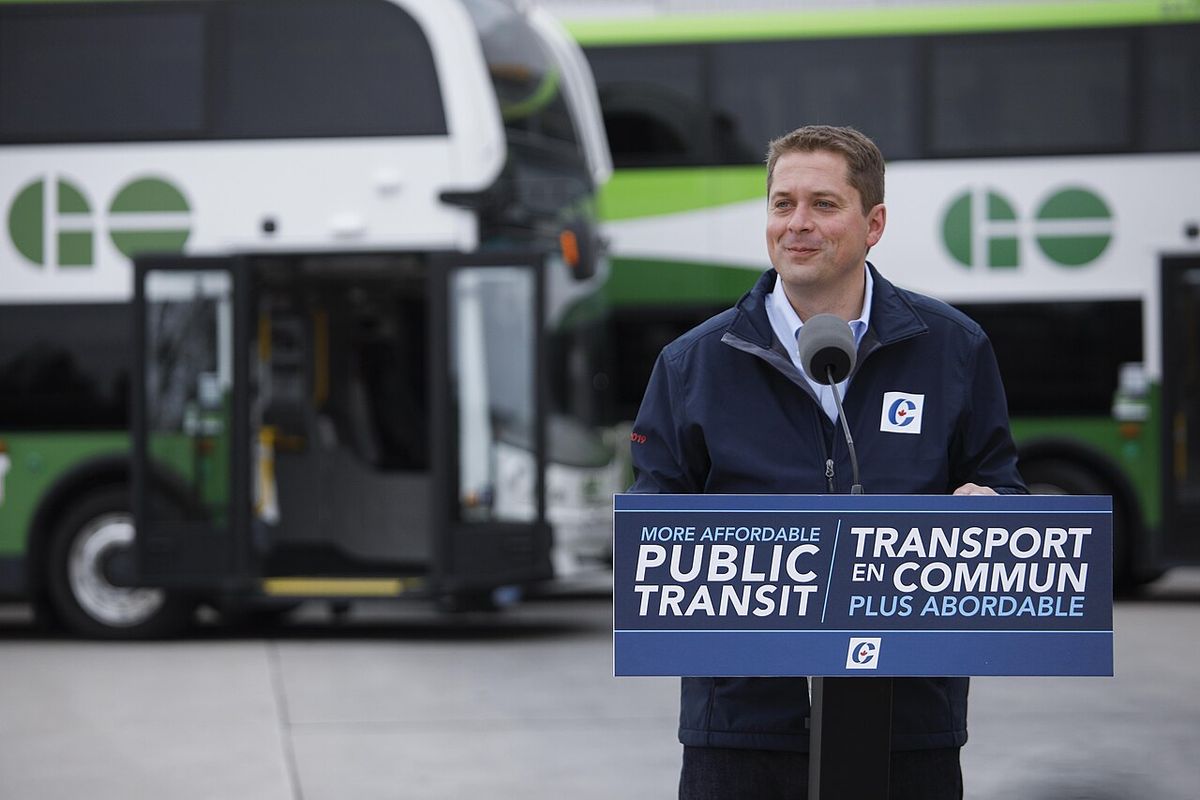
After stepping down as party leader, Andrew Scheer remained an active member of Parliament. In September 2020, he was appointed Opposition Critic for Infrastructure and Communities in Erin O'Toole's shadow cabinet. In that role, he sponsored private member's Bill C-269, which sought to amend the Fisheries Act to prohibit the deposit of raw sewage into fish-frequented waters. Scheer endorsed Pierre Poilievre's successful campaign in the 2022 Conservative leadership election. Following Poilievre's victory, Scheer was appointed to the role of House leader for the Official Opposition on September 13, 2022. He held this role during the crucial fall session of Parliament in 2026, where he reiterated his party's pledge to work cooperatively with the minority Liberal government on issues like trade and affordability. In February 2022, Scheer was photographed with several other Saskatchewan Conservative MPs and a senator posing with the Saskatchewan flag at the Freedom Convoy protest in Ottawa, an action for which Ottawa Mayor Jim Watson demanded an apology. Following the 2025 federal election, in which Conservative leader Pierre Poilievre lost his own riding of Carleton, Scheer was selected to serve as the interim leader of the Official Opposition. He held that role for the first three months of the 45th Parliament until Poilievre was elected in a by-election in Battle River, Crowfoot.
Political positions and public image
Andrew Scheer has consistently positioned himself as a fiscal conservative focused on economic development, restraint, and reducing government inefficiency. A staunch opponent of the federal carbon tax, he has advocated for the construction of multiple pipelines to support Canada's energy sector. On crime, he has supported tougher sentencing, as evidenced by his sponsorship of Bill C-343 on motor vehicle theft. During the 2017 leadership race, he pledged to balance the federal budget within two years of forming a government, though specific policy details were sparse. Scheer has often been compared to former prime minister Stephen Harper, earning nicknames like "Harper with a smile" for his similar policy leanings but more affable public demeanour. He has cited former prime minister John Diefenbaker and British politician Daniel Hannan as political influences and has described U.S. senators Ted Cruz and Marco Rubio as "strong conservative voices." Scheer has been a vocal critic of Prime Minister Justin Trudeau and his policies, and has also criticized the legacy of former prime minister Pierre Trudeau. His public statements have occasionally drawn attention, such as his 2016 support for Brexit, which he later joked about by tweeting "I was pro-Brexit before it was cool" in 2018. His political identity is firmly within the Blue Tory tradition of the Conservative Party, emphasizing economic liberalism and a smaller federal government.
Scheer has proposed a tax cut for the lowest income tax bracket from 15 percent to 13.75 percent over four years. He promised to restore the Children's Fitness Tax Credit and cancel Canada's annual contribution to the Asian Infrastructure Investment Bank. Scheer voted against the ratification of the Paris Agreement in 2016 but voted to reaffirm it in 2017. He opposes a long-gun registry and a ban on handgun ownership. Scheer is a dual citizen of Canada and the United States and is a practising Catholic.
Electoral performance in Regina, Qu'Appelle
Andrew Scheer has represented the riding of Regina, Qu'Appelle since his first election in 2004, demonstrating consistent electoral strength in this Saskatchewan constituency. His initial victory in 2004 was a narrow upset over veteran New Democratic Party MP Lorne Nystrom, whom he defeated by 861 votes. He subsequently expanded his margins of victory in the 2006 federal election, defeating Nystrom again by a larger margin of 2,740 votes. Scheer was re-elected again in the 2008 and 2011 federal elections before becoming Speaker of the House.
Questions about Andrew Scheer
How old was Andrew Scheer when he became speaker of the House of Commons?
Andrew Scheer was 32 years old when he was elected speaker of the House of Commons on June 2, 2011. This made him the youngest person ever to hold that position in Canadian parliamentary history. He served as speaker for the entire duration of the 41st Parliament, from 2011 until the Conservative government's defeat in the 2015 federal election. His experience as deputy speaker from 2008 to 2011 made him a front-runner for the role.
Why did Andrew Scheer resign as Conservative leader?
Andrew Scheer announced his resignation as leader of the Conservative Party on December 12, 2019, following the October federal election. While the Conservatives gained 26 seats and won the popular vote, they failed to defeat the Liberal minority government, finishing 36 seats behind. This result led to weeks of internal party criticism about the campaign's strategy and outcome. The party also confirmed on the day of his resignation that it had been covering tuition cost differences for his children's schooling.
What is Andrew Scheer's current role in Parliament?
As of 2026, Andrew Scheer continues to serve as the member of Parliament for Regina, Qu'Appelle, a role he has held since 2004. He also holds the position of Opposition House Leader, a senior parliamentary role responsible for managing the Conservative Party's legislative strategy in the House of Commons. He was appointed to this role by Conservative leader Pierre Poilievre on September 13, 2022. Scheer previously served as leader of the Official Opposition from 2017 to 2020 and again briefly in 2025.
Did Andrew Scheer ever work as an insurance broker?
Andrew Scheer has stated that he worked in the insurance industry after moving to Regina. His official biography as an MP listed that he passed the Canadian Accredited Insurance Broker program in Saskatchewan and began his career at Shenher Insurance in Regina. However, during the 2019 election, The Globe and Mail reported it could find no evidence he was ever accredited as an insurance broker, prompting a review by the provincial regulator, the Insurance Councils of Saskatchewan. Scheer maintained that he did receive accreditation for general insurance after leaving his position at Shenher Insurance.
What are Andrew Scheer's key political positions?
Andrew Scheer describes himself as a fiscal conservative focused on economic development and government restraint. He is a staunch opponent of the federal carbon tax and has been a strong advocate for constructing new pipelines to support Canada's energy sector. He has supported tougher criminal sentencing, exemplified by his private member's bill on motor vehicle theft. During his leadership campaign, he pledged to balance the federal budget within two years. He has proposed a tax cut for the lowest income bracket and opposes a long-gun registry.
How did Andrew Scheer become Opposition leader again in 2025?
Andrew Scheer briefly resumed the role of leader of the Official Opposition in 2025 following that year's federal election. Conservative Party leader Pierre Poilievre lost his own riding of Carleton in the election, creating a temporary vacancy in the party's parliamentary leadership. Scheer, as a senior and experienced MP, was selected to lead the opposition in the House of Commons during the interim period. He held the role for the first three months of the 45th Parliament until Poilievre returned to Parliament by winning a by-election in Battle River, Crowfoot.
Sources: Wikipedia and current public reporting, checked by the Nosy Mag desk. Last updated 2026-10-25.