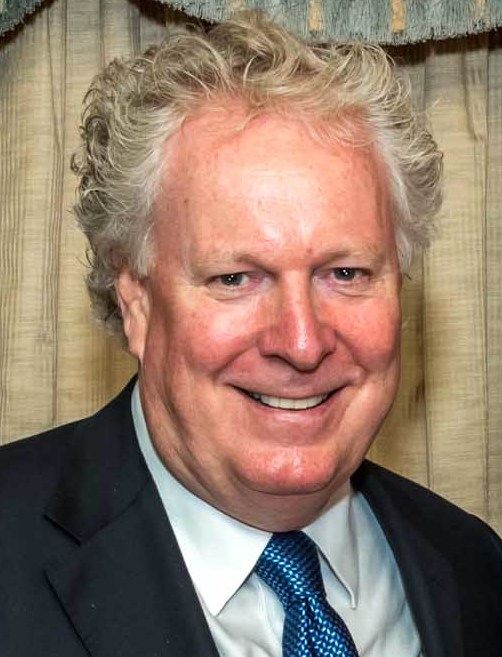
Tom Mulcair
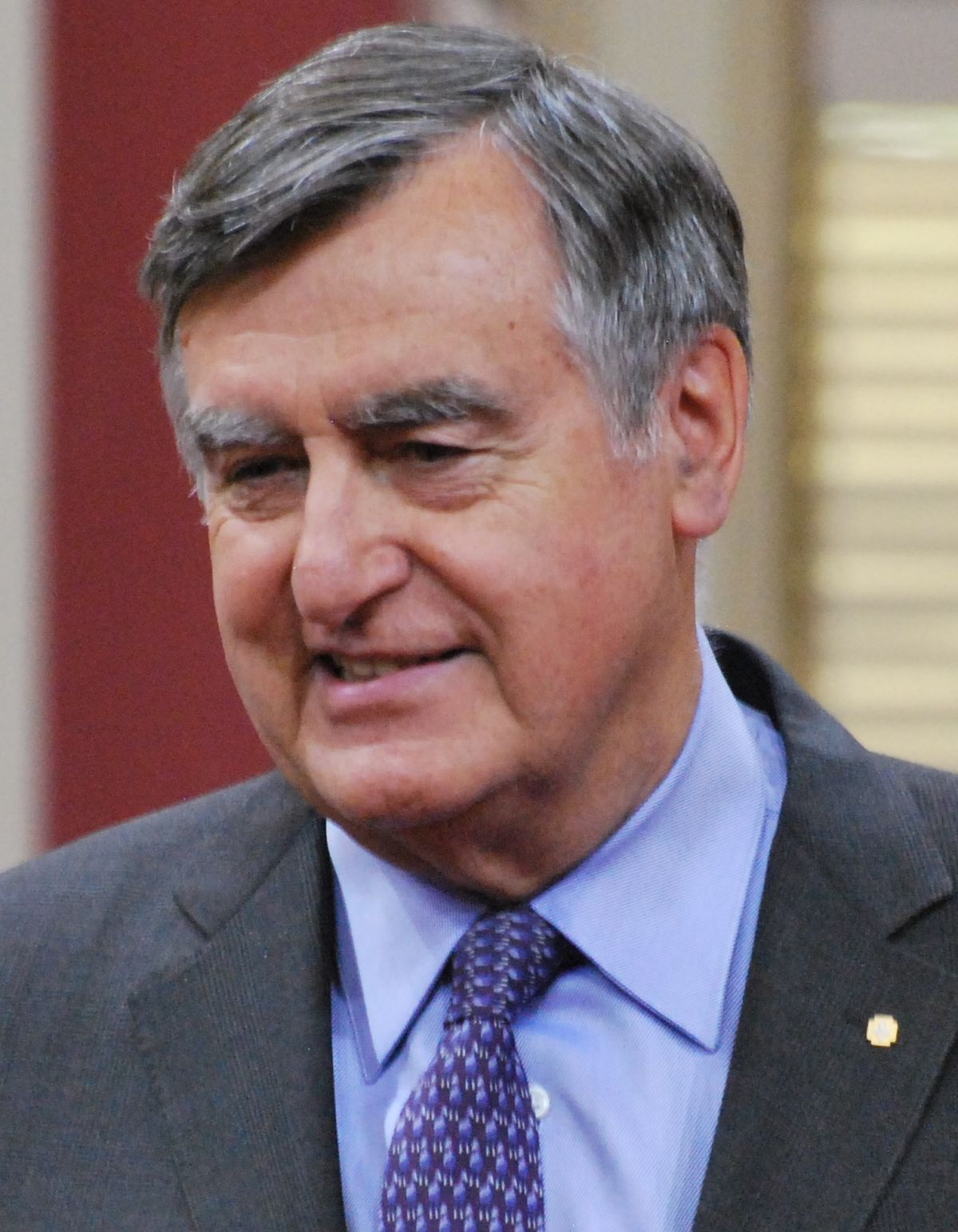
Thomas Joseph "Tom" Mulcair is a Canadian lawyer, retired politician, and political commentator who served as leader of the New Democratic Party (NDP) from 2012 to 2017. As Leader of the Official Opposition from 2012 to 2015, he led the party after its historic breakthrough in Quebec. Prior to his federal career, Mulcair was a Quebec Liberal member of the National Assembly for Chomedey from 1994 to 2007 and served as the province's minister of sustainable development, environment and parks under Premier Jean Charest from 2003 to 2006. Since leaving politics, he has become a media analyst and joined the Strategic Advisory Board of Wellington Advocacy in January 2026.
Early life and education
Thomas Joseph Mulcair was born on October 24, 1954, at the Ottawa Hospital in Ottawa, Ontario. His parents lived in the Wrightville district of Hull, now part of Gatineau, Quebec. His father, Harry Donnelly Mulcair, was an insurance agent of Irish descent. His mother, Jeanne Hurtubise, was a French Canadian schoolteacher and the great-granddaughter of two former Quebec premiers, Pierre-Joseph-Olivier Chauveau and Honoré Mercier. Her father was the founding mayor of Sainte-Anne-des-Lacs. The family, which included ten children, moved to the middle-class suburb of Chomedey in Laval. Raised in a bilingual, Catholic household, Mulcair attended Laval Catholic High School where he organized a sit-in to protest the cancellation of recess. He graduated in social sciences from Vanier College in 1973. He entered McGill University's law school at age 18, working summers in construction to pay tuition. He was elected president of the McGill Law Students Association. He obtained his Civil Law degree in 1976, graduated in common law in 1977, and was admitted to the Quebec Bar in 1979. He joined the federal NDP at the age of 19 in 1974.
Early career and public service
Mulcair began his career in Quebec City, working in the Legislative Affairs branch of the Ministry of Justice from 1978 to 1980. He then worked in the Legal Affairs Directorate of the Superior Council of the French Language from 1980 to 1982, while also teaching introductory law at Saint Lawrence College from 1979 to 1982. In 1983, following a 20 per cent salary cut for provincial civil servants, he moved to Montreal to become director of legal affairs for Alliance Quebec, an anglophone rights lobby group. He played a role in amending the Charter of the French Language. He started a private law practice in 1985 and was named reviser of the statutes of Manitoba following a Supreme Court language rights ruling. He also taught law at Concordia University and the Université du Québec à Trois-Rivières. From 1986 to 1987, he was a commissioner on the Appeals Committee on the Language of Instruction, appointed by Education Minister Claude Ryan, whom Mulcair credits as his political mentor. Mulcair was appointed president of the Office des professions du Québec in 1987, a role he held until 1993. In this position, he introduced reforms to make professional disciplinary hearings more transparent and led efforts on cases of alleged sexual abuse of patients. He also served on the board of the Conseil de la langue française and as president of the English speaking Catholic Council.
Provincial political career
Mulcair entered provincial politics in the 1994 Quebec election, winning the riding of Chomedey as a member of the Quebec Liberal Party. He was re-elected in 1998 and again in 2003 when the Liberals returned to power. After the 1995 sovereignty referendum, Mulcair was prominent in calling for an inquiry into the rejection of thousands of 'No' ballots. According to journalist Michel David, Mulcair coined the expression "Pinocchio syndrome" regarding political lies. In 2003, Premier Jean Charest appointed him Minister of Sustainable Development, Environment and Parks. He was a supporter of the Kyoto Protocol. His major legislative achievement was spearheading a bill that amended the Quebec Charter of Human Rights and Freedoms to include the right to live in a healthy environment, which passed unanimously in April 2006. He launched Quebec's Sustainable Development Plan in November 2004, based on a European model. He oversaw infrastructure projects including the completion of Autoroute 30 and Autoroute 50. In 2005, he was ordered to pay $95,000 in damages after losing a defamation suit filed by former Parti Québécois minister Yves Duhaime. In 2010, Quebec's anti-corruption squad contacted Mulcair regarding a suspected bribe offered to him in 1994 by Laval mayor Gilles Vaillancourt, which Mulcair claims he returned unopened. Mulcair resigned from cabinet in 2006 after opposing a condominium development in Mont-Orford National Park and refusing a demotion to the government services portfolio. He announced he would not be a Liberal candidate in the 2007 provincial election.
Entry into federal politics and the Orange Wave
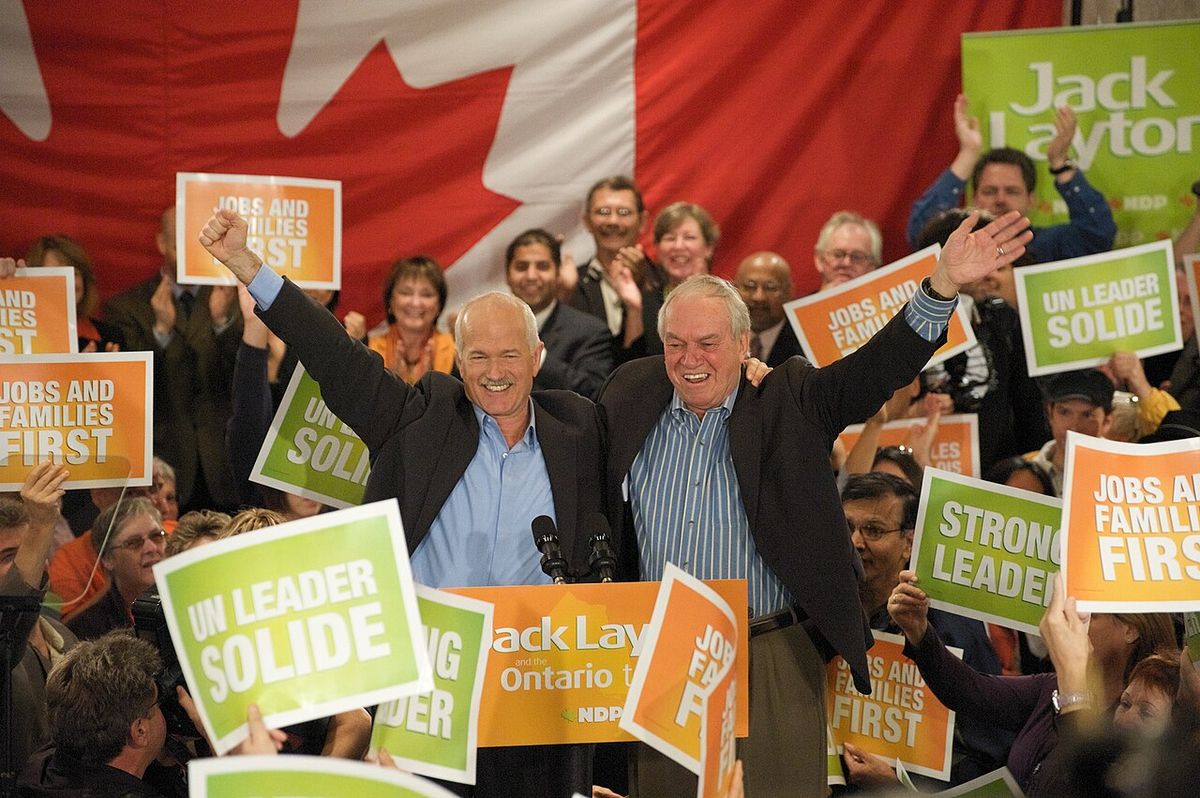
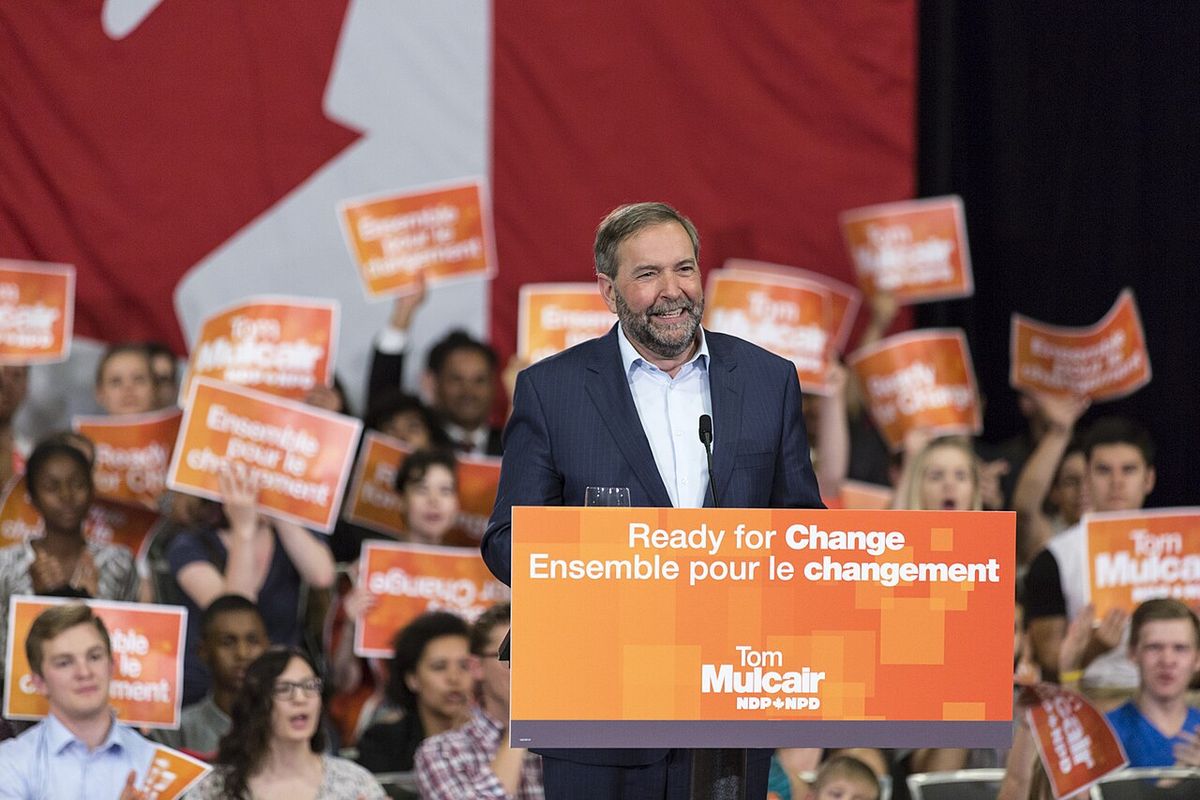
After leaving provincial politics, Mulcair explored entry into federal politics, having discussions with the Liberal, Conservative, and New Democratic parties. Talks with the Conservatives failed over differing views on the Kyoto Protocol. He was persuaded by NDP leader Jack Layton to run for the party in Quebec. On April 20, 2007, he confirmed he would be the NDP candidate in the riding of Outremont. He won a by-election on September 17, 2007, defeating Liberal candidate Jocelyn Coulon. He became only the second NDP MP ever elected from Quebec, following Phil Edmonston in 1990. Layton named him the party's Quebec lieutenant and co-deputy leader alongside Libby Davies. Mulcair defended the Quebec NDP's Sherbrooke Declaration, which argued a simple majority vote was sufficient for Quebec secession. He was re-elected in the 2008 general election, defeating Liberal Sébastien Dhavernas, making him the first New Democrat to win a Quebec riding in a general election. In the 2011 federal election, the NDP achieved a historic breakthrough, winning 59 of Quebec's 75 seats to become the Official Opposition for the first time. This surge was dubbed the 'Orange Wave'. Mulcair was re-elected in Outremont, defeating former Liberal justice minister Martin Cauchon.
Leadership of the New Democratic Party
Following Jack Layton's death in August 2011, Mulcair declared his candidacy for the NDP leadership in October 2011. He attracted support from 60 of the 101 other NDP MPs. The 2012 leadership race framed a debate about the party's direction, with rival Brian Topp and former leader Ed Broadbent arguing against moving toward the political centre. At the convention in March 2012, Mulcair was elected leader on the fourth ballot with 57.2 per cent of the vote. As Leader of the Official Opposition, he was sworn into the Privy Council in September 2012 and moved into the official residence, Stornoway. His leadership faced early challenges with the defection of MPs Bruce Hyer and Claude Patry. Mulcair positioned the party with a focus on fiscal discipline, advocating for balanced budgets. He favoured the Energy East pipeline proposal over Keystone XL, arguing it would create more Canadian jobs. He reiterated the NDP's call for Senate abolition. During the 2015 election campaign, polls initially suggested the NDP could form a minority government. However, the party lost 51 seats, falling to third place with 44 seats. Factors in the loss included Mulcair's stance on the niqab issue in Quebec and his dual Canadian-French citizenship, which a poll found made 26 per cent of respondents less likely to vote NDP. A leadership review at the 2016 NDP convention saw 52 per cent of delegates vote to hold a new leadership election. Mulcair announced in May 2016 that he would remain leader until a replacement was chosen but would retire from politics. His tenure ended with the election of Jagmeet Singh as leader on October 1, 2017. Mulcair was subsequently appointed energy critic in the NDP's shadow cabinet.
Post-political career and commentary
Mulcair resigned his seat in the House of Commons on August 3, 2018. He joined the political science department as a visiting professor at the University of Montreal in the summer of 2018. In January 2018, he became chair of the board of Jour de la terre Québec, an environmental non-profit. He announced in July 2018 that he had accepted a position as a political analyst on Montreal talk radio station CJAD, effective August 28, 2018. He also appears on CTV News Channel and TVA. In November 2019, as a consultant for homeopathy giant Boiron, he launched a public relations campaign to create a professional order for homeopaths in Quebec, drawing criticism from science communicators. After being voted out as leader, he criticized successor Jagmeet Singh's leadership during the 2019 and 2025 federal elections and for calling a Bloc Québécois MP a racist in 2020. In January 2026, he joined the Strategic Advisory Board of lobbying firm Wellington Advocacy. His commentary addresses issues like national unity, energy policy, and immigration. He has been critical of politicians he accuses of scapegoating immigrants. Mulcair has used homeopathic remedies for about 30 years and has dual Canadian and French citizenship.
Electoral record and political milestones
Tom Mulcair's electoral career includes significant firsts for the New Democratic Party in Quebec. His by-election victory in Outremont in 2007 broke a Liberal hold on the riding dating back to 1935. His success in the 2008 general election proved that result was not a fluke. The 2011 Orange Wave propelled the NDP to Official Opposition status. The table below outlines his federal electoral performances and the concurrent national result for the NDP.
| Election | Riding | Result | Key Opponent |
|---|---|---|---|
| 2007 by-election | Outremont | Elected | Jocelyn Coulon (Liberal) |
| 2008 general | Outremont | Elected | Sébastien Dhavernas (Liberal) |
| 2011 general | Outremont | Elected | Martin Cauchon (Liberal) |
| 2015 general | Outremont | Elected | Rachel Bendayan (Liberal) |
His provincial record was consistent, winning Chomedey for the Quebec Liberals in 1994, 1998, and 2003. His federal seat was won by Liberal Rachel Bendayan in the subsequent by-election after his resignation. In the 2011 election, the NDP won 59 seats in Quebec and formed the Official Opposition for the first time. In the 2015 election, the NDP lost 51 seats, finishing with 44 seats nationally.
Questions about Tom Mulcair
What is Tom Mulcair doing now in 2026?
As of January 2026, Tom Mulcair serves on the Strategic Advisory Board of the lobbying firm Wellington Advocacy. He continues his work as a political analyst for media outlets including CJAD, CTV News Channel, and TVA. Since 2018, he has also been a visiting professor in the political science department at the University of Montreal. He holds the volunteer position of chair of the board for the environmental organization Jour de la terre Québec.
Why did Tom Mulcair leave the Quebec Liberal Party?
Mulcair left the Quebec Liberal Party in 2006 after a conflict with Premier Jean Charest. He opposed a condominium development in Mont-Orford National Park. During a February 2006 cabinet shuffle, Charest removed him as environment minister and offered him the government services portfolio. Mulcair resigned from cabinet rather than accept the demotion and did not run in the 2007 provincial election.
What was the 'Orange Wave' and what was Mulcair's role in it?
The 'Orange Wave' was the NDP's historic breakthrough in Quebec during the 2011 federal election, winning 59 of 75 seats. Mulcair played a foundational role. Elected in a 2007 by-election, he was the only NDP MP from Quebec for several years. As Quebec lieutenant, he worked to improve the party's francophone materials and organization, helping lay the groundwork for the surge.
How long was Tom Mulcair the NDP leader and what were his major policies?
Tom Mulcair served as NDP leader from March 2012 to October 2017. His major policies included advocating for balanced budgets and lowering the small business tax rate to 9 per cent. He supported the Energy East pipeline, Senate abolition, and a cap-and-trade system for carbon emissions. He promised to launch a national inquiry into missing and murdered Indigenous women and to decriminalize marijuana.
What was the result of the 2016 NDP leadership review for Mulcair?
At the 2016 federal NDP convention, 52 per cent of delegates voted for a motion to hold a leadership election within two years. This vote was a leadership review that effectively ended his tenure as party leader, marking the first such defeat for a federal party leader in Canadian politics. Mulcair stayed on as leader until the party chose a replacement. His successor, Jagmeet Singh, was elected as the new NDP leader on October 1, 2017.
What is Tom Mulcair's personal life?
Mulcair married psychologist Catherine Pinhas in 1976. They have two sons: Matt, a sergeant in the Sûreté du Québec, and Greg, an aerospace engineer. He has five grandchildren. He is fluently bilingual and holds dual Canadian and French citizenship. He uses the name "Tom" in English and "Thomas" in French. He has used homeopathic remedies for about 30 years.
Sources and further reading
- Tom Mulcair (Wikipedia)
- Mulcair: Alberta chooses Canada. Now what? (montrealgazette.com)
Checked by the Nosy Mag desk. Last updated 2026-10-28.