Scott Moe
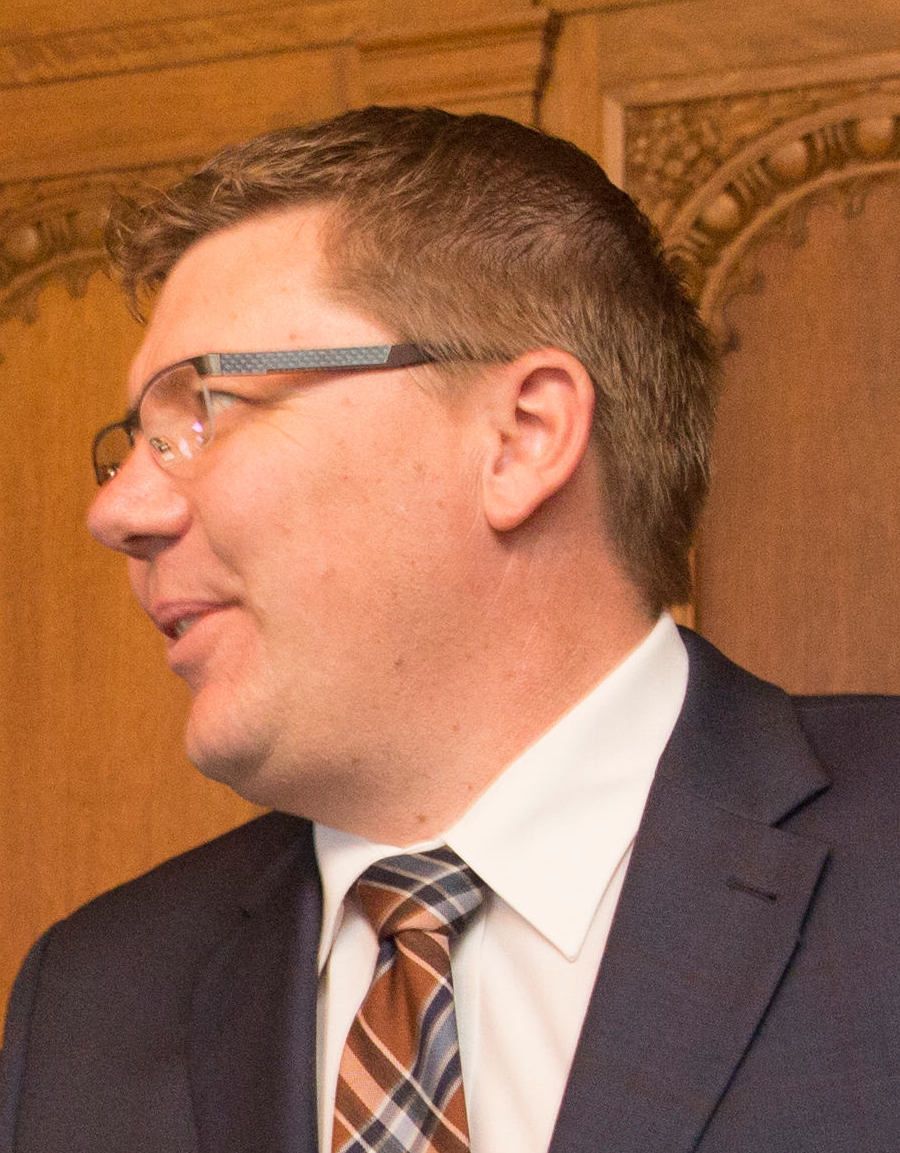
Scott Moe is a Canadian politician serving as the 15th Premier of Saskatchewan since February 2, 2018. A member of the Saskatchewan Party, Moe represents the riding of Rosthern-Shellbrook in the Legislative Assembly, a seat he has held since 2011. His tenure has been defined by an adversarial relationship with the federal government, including a failed court challenge against federal carbon pricing, and by leading his party to its fourth and fifth consecutive majority governments in 2020 and 2024. Moe has consistently ranked among the most popular premiers in Canada, governing through a period marked by the COVID-19 pandemic.
Early Life and Business Career
Scott Moe was born on July 31, 1973, in Prince Albert, Saskatchewan, and was raised on a farm near Shellbrook as the eldest of five children. After high school, he briefly lived in Yellowknife before returning to Saskatchewan to attend the University of Saskatchewan, where he graduated with a Bachelor of Science in Agriculture. In the mid-1990s, while still a university student, Moe and his wife established a farming business, purchasing equipment and renting land. By early 2000, this business venture had ended in bankruptcy, with Moe declaring $208,500 in assets against $320,900 in liabilities.
Following this financial setback, he moved to Vermilion, Alberta, to work selling farm equipment before returning to Saskatchewan in 2003. Upon his return, Moe became involved in various community initiatives in the Shellbrook area, including work with the local Economic Development Corporation and the Shellbrook and District Physician Recruitment committee, which focused on attracting general practitioners to underserved rural areas. During the 1990s, Moe faced legal issues related to impaired driving, including a 1992 conviction for impaired driving while under the legal drinking age. In 1994, he was again charged with impaired driving and leaving the scene of an accident, though these charges were ultimately stayed by the court.
On May 29, 1997, Moe ran a stop sign and caused a collision that resulted in the death of Joanne Balog, who was a passenger in another vehicle. Balog's 18-year-old son, Steve Balog, survived the crash with dislocated ribs and lacerations. Moe later stated that he could not specifically recall the collision. An RCMP investigation concluded Moe had attempted to cross the highway when it was unsafe and issued him a ticket for driving without due care and attention. Moe has stated that alcohol was not a factor in this collision and that the event deeply shaped his life thereafter.
Early Political Career and Rise to Leadership
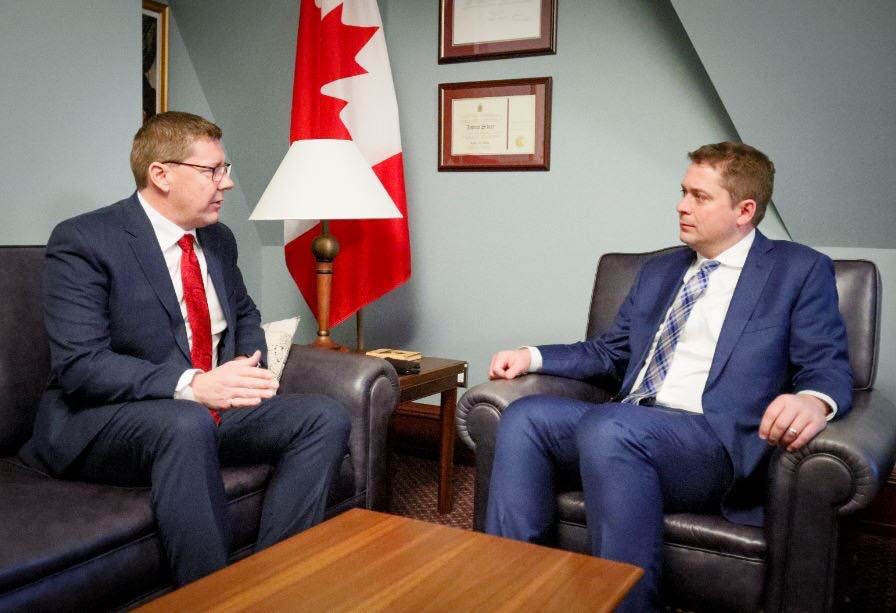
Scott Moe entered provincial politics by winning the Saskatchewan Party nomination for the riding of Rosthern-Shellbrook, defeating incumbent MLA Denis Allchurch. He was first elected to the Legislative Assembly in the 2011 provincial election and was subsequently appointed to the Standing Committee on Crown and Central Agencies. Moe also served as deputy chair of the Standing Committee on Public Accounts. His rise within the party continued when Premier Brad Wall appointed him to cabinet on June 5, 2014, as Minister of Environment and Minister responsible for SaskWater and the Water Security Agency.
Moe’s cabinet portfolio changed on May 21, 2015, when he was appointed Minister of Advanced Education. After being re-elected in the 2016 election, he returned to the role of Minister of Environment on August 23, 2016. It was during this second stint that Moe first gained national attention for his opposition to federal climate policy. On October 3, 2016, during a meeting of provincial environment ministers with federal minister Catherine McKenna, Prime Minister Justin Trudeau announced plans for a federal carbon tax. Moe, along with ministers from Nova Scotia and Newfoundland and Labrador, walked out of the meeting in protest, describing the federal move as reminiscent of a 'national energy program 2.0.' Saskatchewan subsequently refused to sign the Pan-Canadian Framework on climate change, forgoing more than $60 million in federal funding.
Following Brad Wall's August 2017 announcement of his retirement, Moe resigned from cabinet and launched a campaign for the leadership of the Saskatchewan Party on September 1, 2017. His campaign platform included several key promises. After a six-person contest, Moe was elected leader at the party's convention in Saskatoon on January 27, 2018, winning 54% of the vote on the fifth ballot and defeating former deputy minister to the premier, Alanna Koch. During his campaign, Moe stated that he did not personally support abortion and said he would support a discussion of parental notification and parental consent for women to have an abortion. In an interview with the anti-abortion group Right Now, Moe suggested he would be open to legislation to limit the time frame in which a woman could have an abortion.
- Balancing the provincial budget by 2019.
- Restoring $30 million of $50 million in recently cut education funding.
- Reinstating the provincial sales tax (PST) exemption on life, health, and accident insurance.
- Creating a new Ministry of Trade and Export Development.
- Continuing to fight a federal carbon tax.
Premiership: Elections and Popularity
Scott Moe was sworn in as Saskatchewan's 15th premier on February 2, 2018, and promptly appointed his first cabinet, notably not retaining Alanna Koch in her previous senior role. For much of his early tenure, Moe consistently ranked as Canada's most popular premier in public opinion polls. His popularity dipped in the summer of 2020 following the onset of the COVID-19 pandemic but recovered, and by the summer of 2023 he was tied with Nova Scotia's Tim Houston as the most popular. Although his approval rating fell from above 60% to below 50% a year later, he remained among the highest-rated premiers in the country.
Moe led the Saskatchewan Party into the 2020 provincial election, campaigning on a platform of economic recovery from the pandemic, avoiding future business closures, and a renewed promise to balance the budget by 2024. He had considered a snap election in the spring of 2020 but abandoned the idea with the pandemic's onset. As part of his pitch, Moe touted the province's handling of the pandemic and appealed to homeowners with promises of energy bill rebates and a home renovation tax credit. The party was re-elected to its fourth consecutive majority government on October 26, 2020, with Moe winning his Rosthern-Shellbrook seat with nearly 80% of the vote.
Scott Moe led the Saskatchewan Party to its fifth consecutive majority government victory in the 2024 Saskatchewan general election. This matched the record of Tommy Douglas's CCF government which held power from 1944 until 1964. However, the party's majority was significantly reduced as it was nearly swept from the major urban centres of Regina and Saskatoon. The party retained just one Saskatoon seat by a margin of 136 votes as the Opposition NDP made large urban gains.
Economic and Fiscal Policy
Upon taking office, Premier Scott Moe implemented key campaign promises including restoring $30 million in education funding and reinstating the PST exemption on life, health, and accident insurance products. His 2018 budget, the first after the deeply unpopular 2017 austerity budget, ran a $365 million deficit and added $2.3 billion of provincial debt. Moe also replaced the Ministry of the Economy with the Ministry of Trade and Export Development. He has undertaken international trade missions in the United States, China, India, Japan, and South Korea.
The promise to balance the budget was later abandoned. In March 2021, Finance Minister Donna Harpauer signaled the government would not meet the 2024 target, a position Moe attributed to pandemic-related economic uncertainty. Moe admitted that the economic recovery period was uncertain and therefore would no longer commit to a specific date for balancing the budget. In 2025, he signed agreements with other provinces to reduce interprovincial trade barriers, a move contextualized within ongoing trade tensions with the United States. His government's Budget 2026, as promoted by the Saskatchewan Party, included income tax cuts for the second consecutive year. In January 2026, Moe accompanied Prime Minister Mark Carney during a state visit to China, where they agreed to lower tariffs on Canadian canola oil from 85% to 15%.
Environment and Carbon Pricing Battle
Moe's relationship with the federal government has been predominantly adversarial, centred on energy and environmental policy. His government launched a constitutional challenge against the federal Greenhouse Gas Pollution Pricing Act in April 2018, arguing it was unconstitutional. Polling showed 88% support within Saskatchewan for the challenge. After the Saskatchewan Court of Appeal upheld the law in May 2019, and following similar challenges from Ontario and Alberta, the case moved to the Supreme Court of Canada, which heard arguments in September 2020.
In March 2021, the Supreme Court ruled the federal carbon pricing law was constitutional. In response, Moe signaled the province would develop its own carbon pricing scheme to succeed the federal one. He re-opened the debate in November 2023 after a federal exemption for home-heating oil, criticizing the move as unfair. Moe ultimately introduced legislation to enable provincial utilities to stop remitting the federal tax on natural gas and later extended this measure to electric heating bills. Premier Scott Moe has based his approach to climate and environment on technology like carbon capture and storage and on agriculture, encapsulated in the province's 'Prairie Resilience' climate change strategy. He has been a staunch advocate for the building of new pipelines, and in February 2020 he formed a cabinet committee tasked with assessing how the government could help the cause. However, this approach has been criticized by environmental organizations, including the Saskatchewan Environmental Society, as inadequate, especially in failing to reduce the province's greenhouse gas emissions, which are the highest per capita in Canada.
Provincial Autonomy and Federal Relations
Beyond carbon pricing, Premier Moe has been a frequent critic of the federal Liberal government, advocating for a significant rebalancing of provincial-federal powers. After the Liberals failed to win a seat in Saskatchewan in the 2019 federal election, Moe issued a statement calling for 'A New Deal with Canada,' including a revised equalization formula. He stated he would explore how Saskatchewan could gain more control over taxation and immigration, citing Quebec's unique powers in these areas as an example. He has maintained a hard line compared to other conservative premiers. After the 2020 provincial election, in which the separatist Buffalo Party received more than 2.5 percent of the popular vote, Premier Scott Moe stated that he shared many of their objectives and called for more independence and autonomy for the province. Moe has also criticized federal firearms legislation, and in anticipation of a provision allowing cities to ban handguns, his government passed its own legislation banning municipalities from setting independent gun laws.
In November 2021, after the federal government announced a future cap on oil and gas emissions, Moe again referenced Quebec's relationship with the federal government and suggested that Saskatchewan should be considered a nation within a nation. In October 2022, Moe released a white paper titled 'Drawing the Line: Defending Saskatchewan's Economic Autonomy,' which claimed federal environmental policies could cost the province over $100 billion by 2035. The paper was widely criticized by economists for flawed analysis and by Indigenous leaders for ignoring Indigenous rights. Its principles were later enacted through the Saskatchewan First Act, legislation meant to affirm provincial jurisdiction over natural resources. Moe endorsed Pierre Poilievre's Conservative Party ahead of the 2025 federal election.
Other Notable Events and Actions
In February 2018, protesters established the 'Justice For Our Stolen Children' teepee camp in Regina's Wascana Park to raise awareness about anti-Indigenous racism and the disproportionate apprehension of Indigenous children. Premier Moe refused to meet with camp organizers, arguing the camp violated local bylaws and expressing concern over potential disruptions to Canada Day celebrations. After issuing an eviction notice in early June, police arrested six campers and dismantled the camp on June 18. The camp was re-established on June 21 with a larger presence, and although government representatives met with organizers in early July, Moe did not participate. Both the province and the camp filed court cases, with the province seeking the camp's removal. The camp disbanded on September 12, 197 days after it was first erected.
In July 2020, another camp was set up in Wascana Park to address a suicide crisis in northern Saskatchewan. Moe refused to meet with the organizer, Tristen Durocher, and the government filed a court case to evict the camp for violating park bylaws. The court ruled against the government, striking down the bylaws for infringing on constitutional protections. Moe continued to call the camp illegal despite the decision. Premier Scott Moe criticized Prime Minister Justin Trudeau's decision to call the 2021 Canadian federal election, calling it the most pointless election in Canadian history. His government's approach during the COVID-19 pandemic prioritized limiting public health measures, and Saskatchewan was the first province to lift its pandemic-related public health orders on two separate occasions. With the rise of new populist conservative parties in the province since he became premier, commentators have noted that Moe has increasingly adopted right-wing populist rhetoric. This has resulted in controversial legislation such as the Saskatchewan First Act and the Parents' Bill of Rights.
Electoral Performance Under Moe's Leadership
Scott Moe has led the Saskatchewan Party through two general elections. He led the party to its fourth consecutive majority government in the 2020 provincial election. Moe based his first campaign as leader on an economic recovery from the pandemic and a promise to balance the provincial budget by 2024. He again led the Saskatchewan Party to victory in the 2024 Saskatchewan general election, which was the party's fifth consecutive victory. However, the party's majority was significantly reduced as it was nearly swept from the major urban centres of Regina and Saskatoon.
The 2024 election result demonstrated a notable geographic split for the Saskatchewan Party under Scott Moe's leadership. The party retained strong support in rural areas but lost nearly all its seats in Regina and Saskatoon to the NDP. The party's fifth consecutive victory matched the historic record for consecutive terms in government in Saskatchewan, set by Tommy Douglas's CCF from 1944 to 1964. The reduced majority signaled new political challenges for Moe's leadership in the province's urban centres.
Questions about Scott Moe
How did Scott Moe become Premier of Saskatchewan?
Scott Moe became premier after winning the leadership of the Saskatchewan Party on January 27, 2018, succeeding the retiring Brad Wall. He won a six-person contest, securing 54% of the vote on the fifth ballot and defeating former deputy minister Alanna Koch. Moe was then sworn in as the province's 15th premier on February 2, 2018. He had previously served as a cabinet minister under Wall and was the MLA for Rosthern-Shellbrook since 2011.
What is Scott Moe's stance on the federal carbon tax?
Scott Moe has been a staunch and vocal opponent of the federal carbon tax. His government launched a constitutional challenge against the federal Greenhouse Gas Pollution Pricing Act in 2018, arguing it was unconstitutional. After the Supreme Court of Canada upheld the law in March 2021, Moe signaled Saskatchewan would develop its own carbon pricing scheme. In late 2023, he introduced legislation to stop remitting the federal tax on natural gas and electric heating bills after criticizing a federal exemption for home-heating oil as unfair.
What positions did Scott Moe hold before becoming premier?
Before becoming premier, Scott Moe served in the Saskatchewan Party cabinet under Premier Brad Wall. He was first appointed Minister of Environment on June 5, 2014, with responsibility for SaskWater and the Water Security Agency. On May 21, 2015, he was appointed Minister of Advanced Education. After the 2016 election, he returned to the role of Minister of Environment on August 23, 2016, a position he held until resigning to run for the party leadership in 2017.
How has Scott Moe performed in provincial elections?
Scott Moe has led the Saskatchewan Party to its fourth and fifth consecutive majority governments in 2020 and 2024, respectively. In the 2020 election, he was re-elected in his riding of Rosthern-Shellbrook with nearly 80 percent of the vote. In the 2024 Saskatchewan general election, Moe again led the party to victory, matching the historic run of Tommy Douglas's CCF. However, the party's majority was significantly reduced as it was nearly swept from the major urban centres of Regina and Saskatoon, retaining just one Saskatoon seat by a narrow margin of 136 votes.
What is Scott Moe's educational and early career background?
Scott Moe graduated with a Bachelor of Science in agriculture from the University of Saskatchewan. In the mid-1990s, while attending university, he and his wife established a farming business. By early 2000, Moe had filed for bankruptcy with $208,500 in assets and $320,900 in liabilities. He has also owned gas stations and a pharmacy. After the bankruptcy, he worked selling farm equipment in Alberta before returning to Saskatchewan in 2003, where he worked on community initiatives like the Shellbrook and District Physician Recruitment committee.
What was Scott Moe's role in the 1997 fatal vehicle collision?
On May 29, 1997, Scott Moe ran a stop sign and caused a collision that killed Joanne Balog. Balog's 18-year-old son survived the collision with dislocated ribs and lacerations. An RCMP investigation gave Moe a ticket for driving without due care and attention. Moe has stated that alcohol was not a factor and that he could not specifically recall the collision, but that the event has shaped his life since.
Sources and further reading
- Scott Moe (Wikipedia)
- Saskatchewan Party, Premier Scott Moe (saskparty.com)
- Sask. premier says he'll work with Alberta to strengthen ... (cbc.ca)
Checked by the Nosy Mag desk. Last updated 2026-10-24.