Sun Dance
The Sun Dance is a ceremony practiced by some Native Americans in the United States and Indigenous peoples in Canada, primarily those of the Plains cultures. It is a rite of renewal and community sacrifice where members of independent bands gather to reaffirm beliefs through rituals of personal and community sacrifice. Participants dance, fast, and in some traditions undergo piercing as acts of prayer for the well-being of the people. Typically, young men would dance semi-continuously for several days and nights without eating or drinking, and self-mortification was or is currently practiced in some cultures.
Ceremonial Description and Core Elements
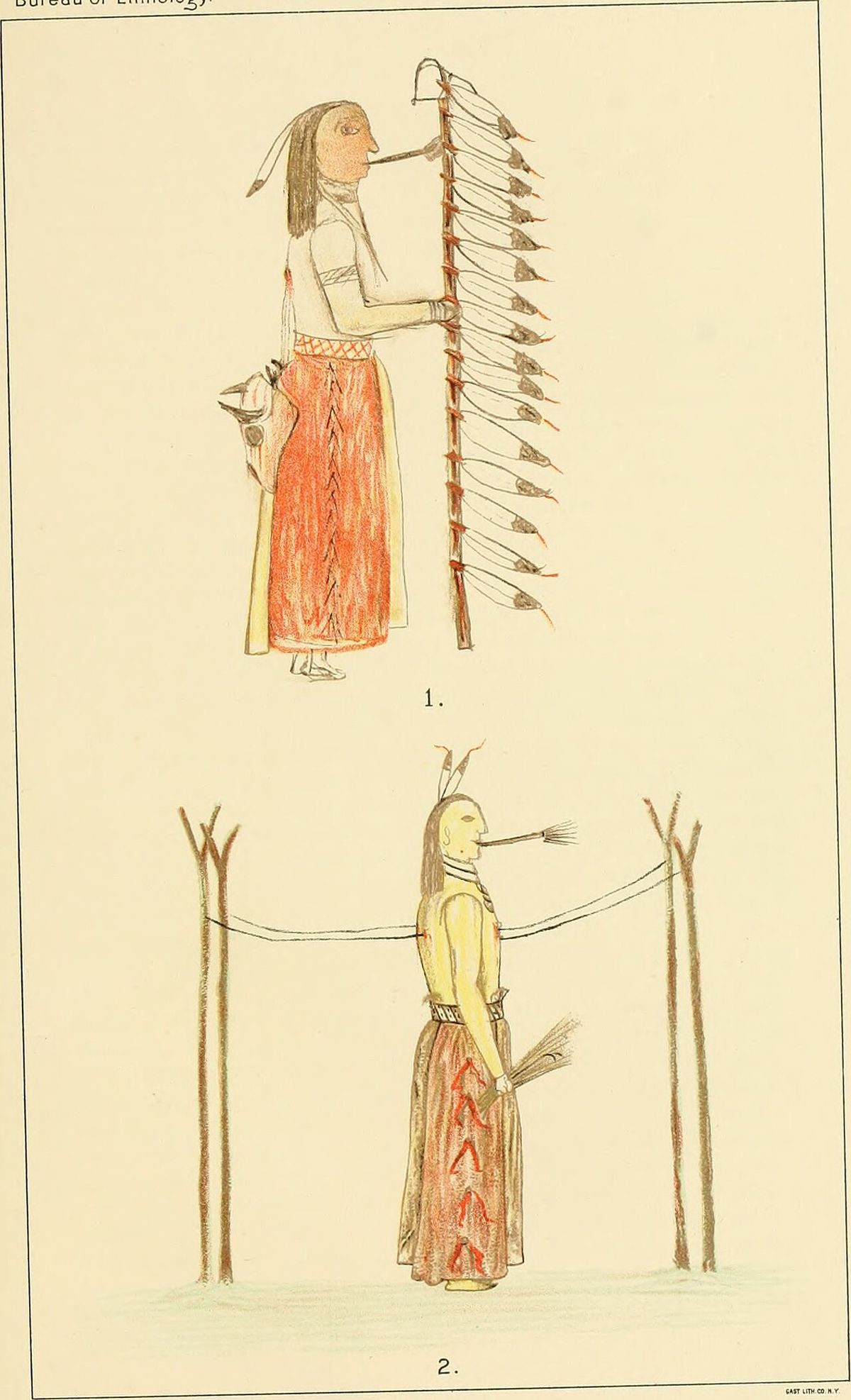
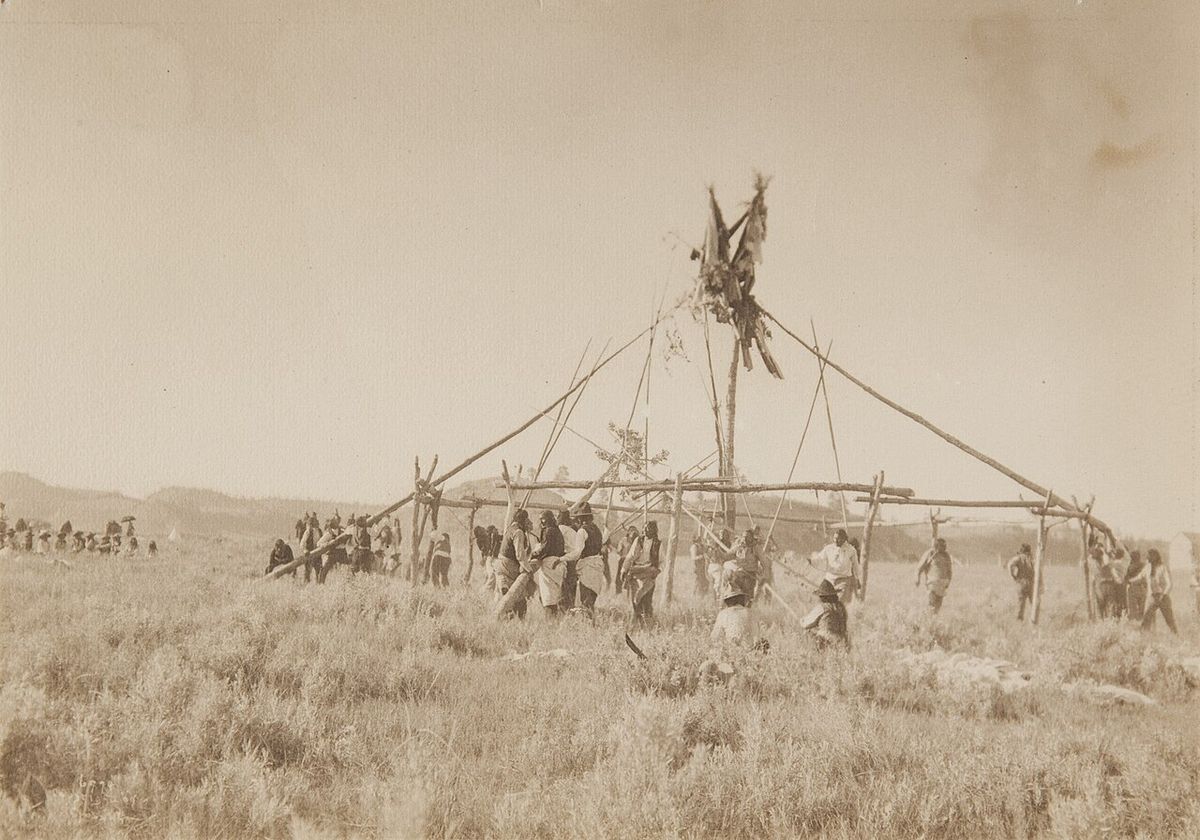
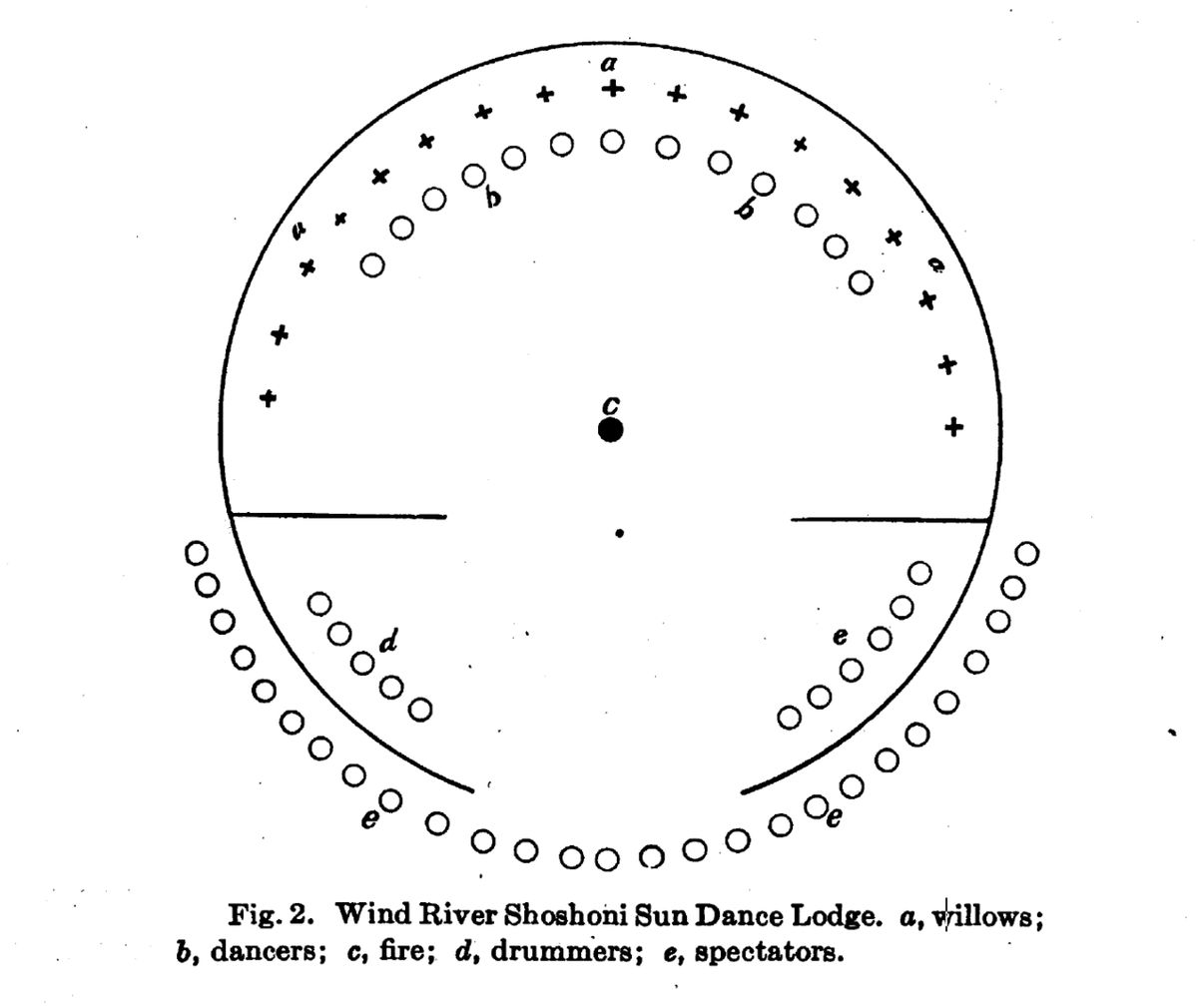
The Sun Dance is a ceremony with common features across Plains cultures. Communities plan for the event at least a year in advance. The ceremony revolves around a sacred circular lodge with a centre pole, often a cottonwood tree. This pole represents the axis mundi connecting the earthly and spiritual worlds. A Thunderbird nest or a bundle of sage and cloth is placed at its top. The lodge is often built with 28 posts, symbolizing the days of the lunar month. Participants engage in rituals including purification in sweat lodges, praying with a ceremonial pipe, and the use of sacred plants like white sage for bracelets. A sacred fire is maintained throughout the ceremony.
The core of the dance involves participants dancing semi-continuously for several days and nights without eating or drinking. They dance to the beat of traditional drums and sing prayers for their families and the renewal of all life. The ceremony concludes with a communal feast. In some traditions, such as those of the Lakota, Cheyenne, and Arapaho, dancers have wooden skewers or piercing needles inserted through a small fold of skin on the chest or back. These are attached by rawhide thongs to the centre pole or to heavy objects like buffalo skulls. The dancer pulls until the skin tears free. This act is an offering of one's body and soul for the people. Not all nations include piercing. The Plains Cree developed a related Thirst Dance where dancers fast from water and perform strenuous movements without piercing. The Shoshoni focus on prolonged fasting and spiritual seeking through exhaustion.
The dance is a grueling ordeal and a physical and spiritual test. According to the Oklahoma Historical Society, young men dance around the pole to which they are fastened by rawhide thongs pegged through the skin of their chests. At most ceremonies, family members and friends stay in the surrounding camp to pray in support. Usually one leader or a small group is in charge, with many elders helping and advising.
Key Ritual Elements- Construction of a sacred circular arbor with a central cottonwood pole (Tree of Life).
- Purification ceremonies, including sweat lodge rituals before the dance.
- Continuous drumming, singing, and dancing for several days and nights.
- Fasting from food and water by the core participants (dancers).
- Prayers offered for community, family, and the renewal of the Earth.
- In some traditions, the ceremonial piercing of skin as an act of sacrifice.
- Honouring of the bison, with a buffalo skull or specific parts used.
- Use of sacred plants like Artemisia ludoviciana (white sage).
- A concluding communal feast to celebrate the ceremony's completion.
Historical Suppression and Legal Ban
The Government of Canada, through the Department of Indian Affairs, persecuted Sun Dance practitioners as part of broader policies aimed at suppressing Indigenous cultures and enforcing assimilation. Indian agents, based on directives from their superiors, routinely interfered with, discouraged, and disallowed sun dances in many Canadian plains communities from 1882 until the 1940s. This persecution was codified into law with an 1895 amendment to the Indian Act. The amendment outlawed any celebration or dance of which the wounding or mutilation of the dead or living body of any human being or animal forms a part or is a feature. This law directly targeted the piercing practices. Anyone who engaged, assisted or encouraged the ceremony was liable to imprisonment.
Enforcement of the ban was inconsistent. In at least one instance, police are known to have given permission for the ceremony to be conducted. The First Nations people simply conducted many ceremonies quietly and in secret. Sun dance practitioners, such as the Plains Cree, Saulteaux, and Blackfoot, continued to hold sun dances throughout the persecution period. Some practiced in secret, others with permissions from their agents, and others without the body piercing to comply with the law. This period of prohibition demonstrated the resolve of Indigenous communities to preserve their spirituality. The legal ban remained in force for over five decades. In 1951, government officials amended the Indian Act, dropping the prohibition against practices of flesh-wounding.
In the United States, similar suppression occurred, though not through a single federal law like the Indian Act. The American government also sought to suppress Indigenous ceremonies to force assimilation. Legal protection came later with the American Indian Religious Freedom Act (AIRFA) passed by Congress in 1978. This act was enacted to protect and preserve the traditional religious rights and cultural practices of Native Americans, Eskimos, Aleuts, and Native Hawaiians.
Contemporary Practice and Revitalization
The Sun Dance is a living tradition practiced annually in many Native communities in Canada and the United States. The Cree and Saulteaux have conducted at least one Rain Dance each year since 1890 somewhere on the Canadian Plains. Contemporary ceremonies are scheduled regularly on reserves and traditional lands. These include the annual White Eagle Sundance at Elsipogtog First Nation and gatherings in Cross Lake, Manitoba, and on the Fort Berthold Indian Reservation. These ceremonies serve as crucial occasions for spiritual reaffirmation, community bonding, and the transmission of cultural knowledge to younger generations.
In recent decades, a significant movement has emerged to protect the ceremony from exploitation and cultural appropriation. In 1993, representatives from 40 Lakota, Dakota, and Nakota bands convened at the Lakota Summit V. They unanimously issued a Declaration of War Against Exploiters of Lakota Spirituality. This declaration condemned the conduct of sacrilegious imitations of the Sun Dance by non-Indigenous charlatans for profit. Further, in 2003, the 19th-Generation Keeper of the Sacred White Buffalo Calf Pipe, supported by traditional leaders from Cheyenne and Sioux nations, proclaimed that non-Native people should no longer approach the sacred altars during the Sun Dance, though they could pray in support from outside the lodge. The proclamation stated this was for the survival of the future generations.
The ceremony has also been at the centre of land rights assertions. In 1995, efforts to practice the Sun Dance on a tract of unceded Secwepemc territory in British Columbia contributed to the armed confrontation known as the Gustafsen Lake standoff. The dance has also been part of new religious movements within Native American spirituality. Organizations like the World Council of Elders have established International Sundance gatherings to foster connections among Indigenous communities globally.
Spiritual Meaning, Symbolism and Ascetic Elements
The Sun Dance includes pronounced ascetic practices that carry deep spiritual meaning in Plains Indigenous cultures. Participants voluntarily engage in physical sacrifice as acts of prayer and devotion for the benefit of the wider community. These rituals reflect values of endurance, humility, and the renewal of life through sacrificial offering. The guiding principle is often expressed as sacrificing so that others shall live.
Across Sun Dance traditions, a core ascetic element is fasting from both food and water for several days within the sacred lodge. This fast is a spiritual discipline aimed at purification and focus. Anthropologist Alice Kehoe explains that dancers embody the strength of their people through physical exertion. Ethnographer Ruth Underhill described the Sun Dance as a rite of renewal.
In many ceremonies, piercing plays a central role. Dancers have skewers inserted through the skin, attached to thongs connected to the centre pole or buffalo skulls. As the dance progresses, participants lean back until the skin tears free. James R. Walker’s early 20th-century account records this as the culmination of the dancer’s vow to offer up my body and soul for the sake of the people. The tearing of flesh is interpreted as a gift of life force to the Creator. Ethnographer Ella Cara Deloria, a Dakota Sioux scholar, emphasized that the Sun Dance signified the ultimate offering of one’s own body.
The symbolism is deep. The sacred lodge represents the universe. The centre pole symbolizes the axis mundi, the world center connecting fields. The circular lodge is constructed to reflect cosmic order. Not all communities practiced piercing, but all emphasized personal endurance. The Plains Cree Thirst Dance and Shoshoni practices focus on fasting and exhaustion. Contemporary interpretations emphasize the ethical dimensions. Fritz Detwiler argued the willingness to sacrifice creates a moral community rooted in reciprocity. Arthur Amiotte, a Lakota artist-scholar, notes these trials are expressions of intergenerational responsibility performed for the survival of future generations.
Representation and Filming
In most Sun Dance cultures, it is forbidden to film ceremony or prayer. Many First Nations people believe that when money or cameras enter, the spirits leave. Consequently, few authentic images of the ceremony exist publicly. A notable exception was the filming of the Kainai Nation's Sun Dance in the late 1950s, which was permitted for preservation purposes. This resulted in the National Film Board of Canada documentary Circle of the Sun (1960), produced by Colin Low. The film remains a significant visual record from that era. Manitoba archival photos show that the ceremonies have been consistently practiced since at least the early 1900s.
A separate but namesake entity, the Sundance Institute Indigenous Program, operates in the field of film and storytelling with no direct connection to the religious ceremony. Founded by Robert Redford's Sundance Institute, this program champions Indigenous-created narratives on a global scale. It is dedicated to decolonizing the screen and uplifting the voices of Native and Indigenous filmmakers. The program's core mission is to support the development of storytellers from Native and Indigenous backgrounds working in feature film and episodic content.
The program actively cultivates new talent through initiatives like the Native Lab and the Graton Fellowship for Artists from California-Based Tribes. It also tours curated selections of short films, such as the 2025 Sundance Institute Indigenous Film Tour, a 98-minute theatrical program featuring seven short films. This tour is available for rental from July 2025 through March 2026 and partners with museums and cultural centres. The program is supported by major foundations including the Andrew W. Mellon Foundation and the Federated Indians of Graton Rancheria.
Selected Supporters of the Sundance Institute Indigenous Program- Andrew W. Mellon Foundation
- Federated Indians of Graton Rancheria
- John D. and Catherine T. MacArthur Foundation
- The 11th Hour Project (Schmidt Family Foundation)
- Nia Tero
- Indigenous Screen Office
- NBCUniversal
- Additional philanthropic and tribal partners
Ceremonial Participation and Community Role
Participation in the Sun Dance involves serious commitment and follows specific protocols. To be a Sundancer often requires a multi-year pledge, sometimes for four years, with each year dedicated to one of the four cardinal directions. This represents a deepening journey of personal growth, healing, and service. Dancers prepare for months under the guidance of elders, which can include time spent alone in the wilderness fasting on a vision quest. During the ceremony itself, dancers fast again and may choose to make flesh offerings. The community plays an equally major role. Family members and friends camp around the sacred lodge to pray in support, prepare food for the concluding feast, and uphold the dancers throughout their ordeal.
The ceremony is led by a designated spiritual leader, often called the Sundance Chief, who is responsible for organizing the event and guiding participants. Many elders assist and advise, ensuring the rituals are conducted properly according to tradition. The host of the ceremony, who may be fulfilling a vow made at a previous Sun Dance, carries significant responsibility for the gathering's success. The entire process, from the selection and cutting of the centre pole to the final feast, is a collective endeavour that reinforces kinship ties, communal responsibility, and intergenerational learning.
For the wider community, the Sun Dance is a powerful social and spiritual gathering that renews cultural identity. It is an occasion that strengthens communal bonds, provides a context for social interaction, and reaffirms a shared worldview. The presence and prayers of the community are considered essential to the ceremony's efficacy, creating a reciprocal relationship where the dancers sacrifice for the people, and the people support the dancers. This interdependence highlights the ceremony's function as a fundamental component of social cohesion and spiritual resilience for Plains Indigenous societies. The dance is also part of a new movement within Native American religions, where members of independent bands gather to reaffirm beliefs.
Related Ceremonies and Cultural Context
The Sun Dance exists within a broader context of Indigenous Plains culture and related ceremonies. One related legend is the Great Race, a narrative that explains the origins of the relationship between humans and buffalo. The Sun Dance ceremony often honours the bison, a central figure in Plains subsistence and spirituality. Another related seasonal celebration is the Ohuokhai dance carried out by the Sakha people of Siberia around Midsummer, tied to a solar deity, showing parallel cultural developments around sun veneration.
The Sun Dance was one of several ceremonies prohibited by colonial governments. In Canada, the potlatch of the Pacific Northwest peoples was also outlawed. In the United States, the Sun Dance was suppressed alongside other practices. The American Indian Religious Freedom Act of 1978 provided broader protection for these traditions. The ceremony's structure, with its sacred lodge and centre pole, shares symbolic elements with other Indigenous spiritual constructions, such as the sweat lodge and the medicine wheel.
The number 28, often seen in the lodge's post count, is significant in many Plains cosmologies, relating to lunar cycles and cosmic balance. The use of the cottonwood tree is specific. It is chosen for its spiritual properties and because it is often the only tall tree available on the plains. The ceremony's timing in early spring to midsummer aligns with the renewal of life and the strength of the sun. These details embed the Sun Dance deeply within the ecological and spiritual landscape of the Plains.
Questions about Sun Dance
Can non-Indigenous people attend a Sun Dance?
Access is determined by the specific community and ceremony leaders. In 2003, a proclamation by traditional Lakota, Cheyenne, and Sioux spiritual leaders stated that non-Native people should not approach the sacred altars during the Sun Dance, though they could pray in support from outside the lodge. The primary reason given was to protect the ceremony's sanctity and its purpose of ensuring the survival of future generations. Participation as a dancer is typically reserved for members of the Indigenous community.
What is the difference between the Sun Dance and the Sundance Institute?
The Sun Dance is a sacred Indigenous religious ceremony. The Sundance Institute is a separate, unrelated organization founded by Robert Redford that runs film festivals and artist development programs. Its Indigenous Program supports Native and Indigenous filmmakers but is not connected to the spiritual practice. The shared name is coincidental and does not indicate any affiliation.
What is the significance of the centre pole in the Sun Dance?
The centre pole, often a cottonwood tree, is the most sacred symbol. It represents the Tree of Life or the axis mundi, the world center connecting the Earth and the spiritual world. A Thunderbird nest or sacred bundle is placed at its top. Dancers focus their prayers and gaze on this pole throughout the ceremony, and it is the focal point for the rituals of renewal and sacrifice.
Why was the Sun Dance banned in Canada?
The Sun Dance was banned through an 1895 amendment to the Indian Act as part of broader government policies to suppress Indigenous cultures and force assimilation. The amendment specifically prohibited any ceremony involving the wounding or mutilation of the human body, which directly targeted piercing practices. Indian agents interfered from 1882 until the 1940s. The ban was lifted in 1951.
Do all Sun Dances involve piercing?
No. Piercing is a central ascetic element for nations such as the Lakota, Cheyenne, and Arapaho. Other communities have variations without it. The Plains Cree developed a Thirst Dance where participants fast from water and perform strenuous movements without piercing. The Shoshoni focus on prolonged fasting and spiritual seeking through exhaustion. The common thread is personal endurance and sacrifice as prayer.
Is the Sun Dance still practiced today?
Yes, it is a living tradition practiced annually. The Cree and Saulteaux have conducted at least one Rain Dance each year since 1890 on the Canadian Plains. Contemporary ceremonies are held regularly across Canada and the United States, such as the White Eagle Sundance at Elsipogtog First Nation. The practice persisted through legal suppression and remains vital for spiritual renewal and cultural continuity.
What legal protections exist for the Sun Dance now?
In Canada, the legal prohibition against the Sun Dance was lifted in 1951 when the Indian Act was amended. In the United States, the American Indian Religious Freedom Act (AIRFA) of 1978 protects the traditional religious rights and cultural practices of Native Americans, including the practice of the Sun Dance. This act was enacted to protect basic civil liberties and preserve these practices against government interference. These legal changes helped to end the active suppression of the ceremony by Canadian and United States governments.
Sources and further reading
- Sun Dance (Wikipedia)
- Sun Dance, Indigenous Saskatchewan Encyclopedia (teaching.usask.ca)
- Sun Dance (thecanadianencyclopedia.ca)
- Recovering an Indigenous View of the World: The Sundance (giselawendling.com)
Checked by the Nosy Mag desk. Last updated 2026-10-27.