Thunderbird
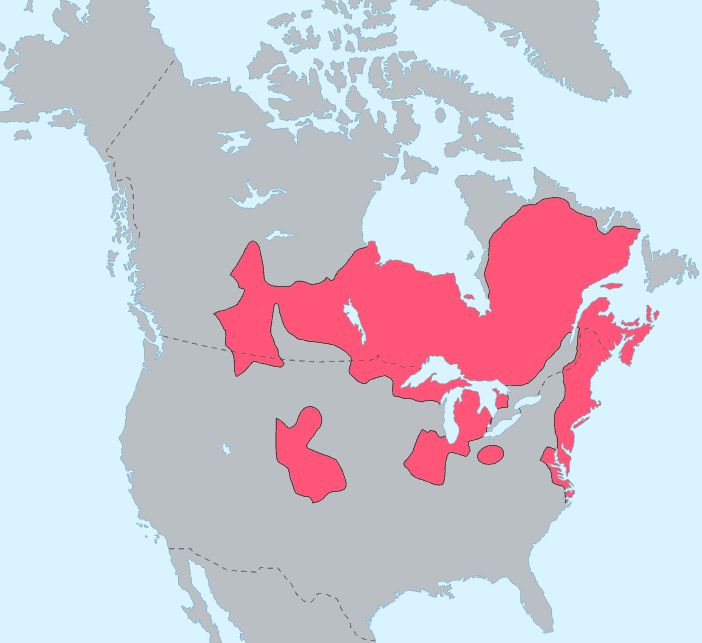
The thunderbird is a mythological birdlike spirit in North American Indigenous peoples' history and culture. It is considered a supernatural being of power and strength. It is frequently depicted in the art, songs, and oral histories of many Pacific Northwest Coast cultures, but is also found in various forms among some peoples of the American Southwest, US East Coast, Great Lakes, and Great Plains. The thunderbird is said to create thunder by flapping its wings and lightning by flashing its eyes. Its enduring cultural significance is reflected in contemporary Indigenous-led organizations and initiatives that bear its name, symbolizing strength, leadership, and protection for communities.
Mythological Roles and Descriptions
The thunderbird's characteristics and roles vary across different Indigenous traditions, though common themes of immense power and control over natural forces are widespread. In many stories from the Pacific Northwest Coast, the thunderbird is said to create thunder by flapping its immense wings and generate lightning by flashing its eyes. This being is often described as so large that its wingspan equals two canoes, and it possesses the strength to carry a killer whale from the water with its talons. Among Algonquian and Iroquois peoples in Eastern Canada and the Great Lakes region, the thunderbird is similarly associated with creating weather and is viewed as a ruler of the upper world, in opposition to underworld creatures like the underwater panther or Great Horned Serpent. Thunderbirds are frequently seen as protectors who can intervene on behalf of people, but they also demand respect, veneration, and offerings.
In Ojibwe tradition, thunderbirds were created by the culture hero Nanabozho specifically to fight the underwater spirits. These thunderbirds also punished humans who broke moral rules. The thunderbirds lived in the four directions and arrived with the other birds in the springtime. In the fall, they migrated south after the end of the underwater spirits' most dangerous season. The Menominee people of Northern Wisconsin tell of thunderbirds living on a floating mountain in the west, where they control rain and hail and wage constant war against great horned snakes to prevent them from overrunning the earth.
For the Ho-Chunk, a vision of a thunderbird during a solitary fast could designate a man as a future war chief. In some Pacific Northwest Coast narratives, the thunderbird plays a direct role in human history and ceremony. One story recounts how a thunderbird appeared to a great chief named Namoquayalis during a world-threatening flood, transforming into a human to offer rescue. After the flood, the thunderbird searched for survivors and, upon finding them, was instructed by the chief to invite them to witness a thunderbird dance, a privilege passed down through generations. This narrative shows the thunderbird's role as a bridge between the spiritual and human worlds and as a bestower of cultural practices.
Stories about the struggle between the Thunderbird and Whale have been traditionally told by various Pacific coast tribal groups. Studies have scrutinized the possible connection with the Cascadia subduction zone earthquake in the year 1700 that sent a tsunami to Japan. Ethnographer George Amos Dorsey transcribed a tale from the Arikaras titled The Boy Who Befriended the Thunderbirds, and the Serpent. In this story, a boy named Antelope-Carrier finds a nest with four young thunderbirds and is told by their mother that a two-headed Serpent comes out of the lake to eat the young.
Artistic Depiction and Symbolism
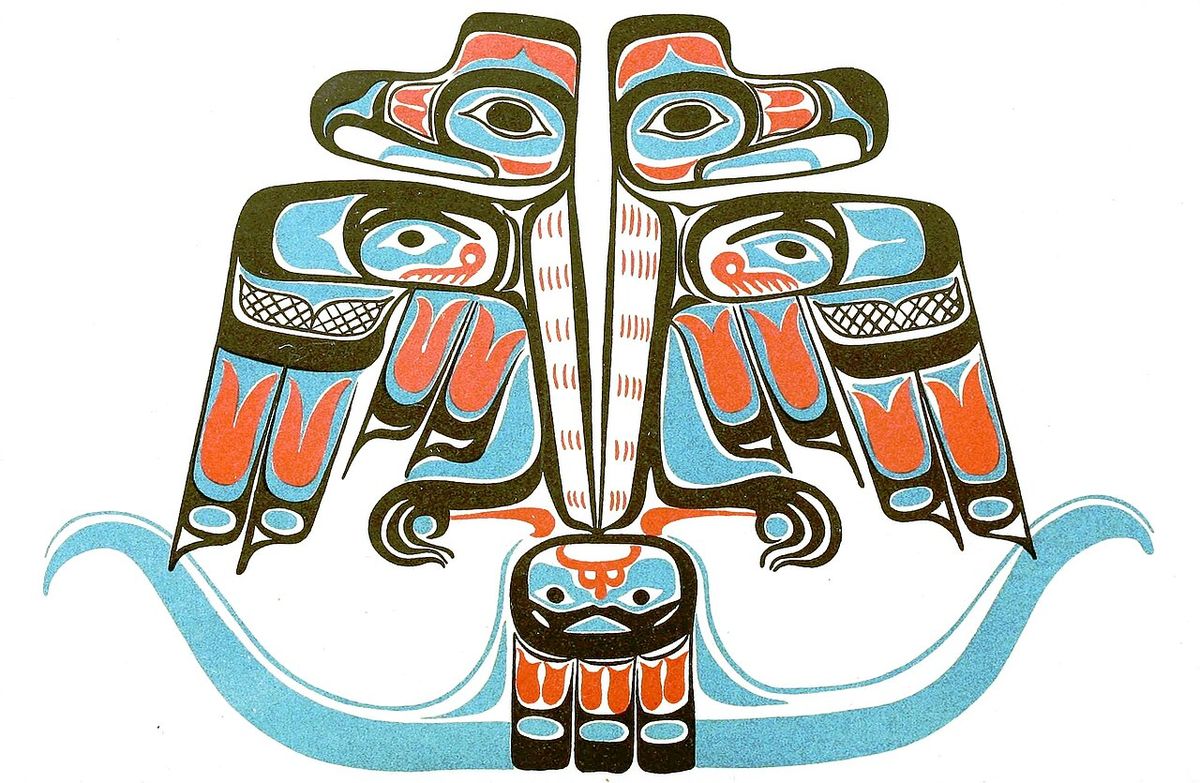
The thunderbird is one of the most prominent figures in Indigenous art, serving as a crest symbol for high-ranking families and chiefs, particularly on the Northwest Coast. It is commonly depicted at the top of totem poles, a position of honour. The thunderbird resembles an eagle but is distinguished by two curved horns or a distinctive crest of plumage on its head. Artistic representations range from highly detailed and realistic to abstract and stylized forms, often showing the creature with its wings outstretched.
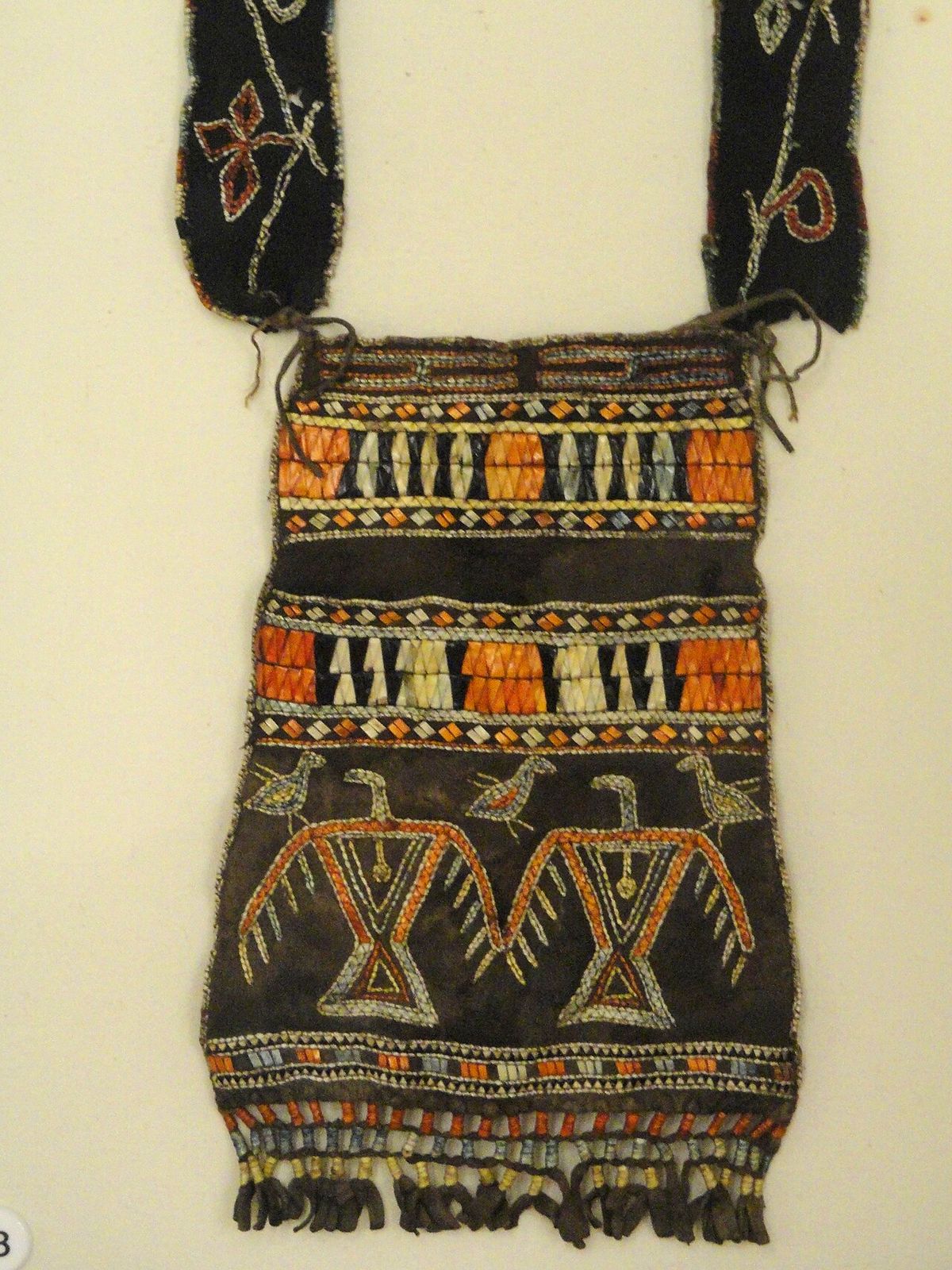
A specific and widespread iconographic form, especially in Algonquian art, is the X-shaped thunderbird. This depiction shows the bird with its head facing forward and its wings extended down along its body, creating an X silhouette. This form can be highly stylized, with examples found on historical artifacts like an Ojibwe midewiwin disc dating from 1250 to 1400 CE. The simplicity of the X-shape allowed it to be easily incised or painted, as seen in an 18th-century ledger from New England where thunderbird pictograms ranged from recognizable birds to simple X marks.
The thunderbird is also associated with lightning snakes, sometimes shown under its wings, which it uses as tools or weapons. The thunderbird's symbolism extends beyond visual art into ceremonial objects and contemporary goods. It is featured on masks, jewelry, carvings, prints, and bentwood boxes. A related being, the Ko'lus, is a young thunderbird depicted with a thick coat of white down.
The Ko'lus is also a protector spirit and, like the thunderbird, can transform into a human by removing its downy coat. In some origin stories, a Ko'lus transforming into a human became the founding ancestor of a clan, further cementing the deep spiritual and genealogical connections embodied by these beings. Thunderbirds are generally depicted as birds of prey, or hybrids of humans and birds. They are often viewed as protectors, sometimes intervening on people's behalf, but expecting veneration, prayers, and gifts.
Archaeological and Landscape Features
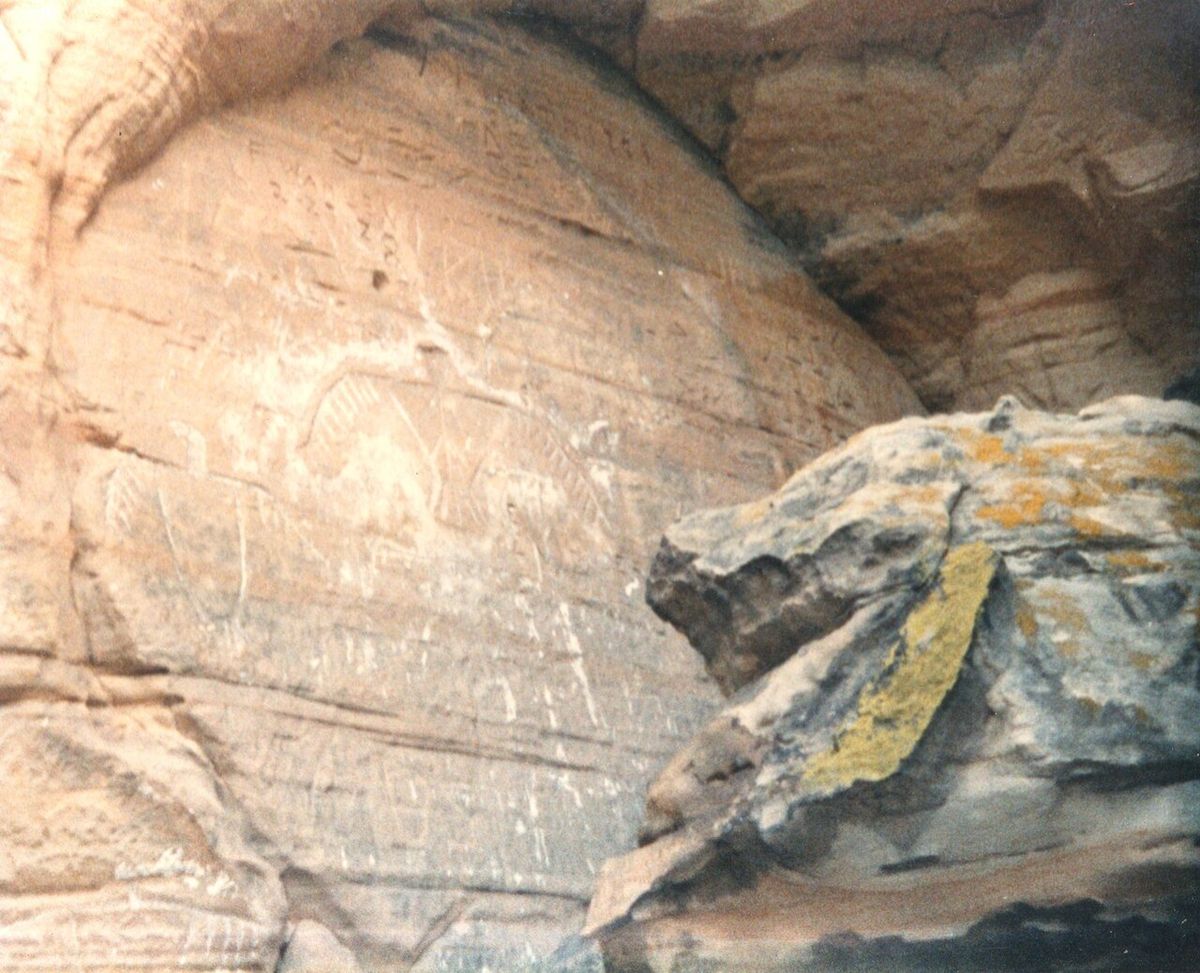
Evidence of the thunderbird's longstanding cultural importance is found in archaeological sites across North America. Depictions of thunderbirds in art have been identified at sites dating back approximately 4,000 years. Notable examples include petroglyphs located near Twin Bluffs, Wisconsin, within a rock shelter believed to have been used from around 250 BCE to 1500 CE. These ancient images connect the mythological being to specific geographical locations and historical periods of Indigenous occupation.
A distinct category of archaeological features known as 'thunderbird nests' is found in various landscapes, particularly in the boreal forests of central Canada. These features, named from Indigenous terminology, are generally circular formations. Some are doughnut-shaped rings constructed from large boulders. A key site excavated by archaeologist Patrick H. Carmichael on the shore of Lake Wanipigow in Manitoba, known as EgKx-15, was referred to locally as a Thunderbird Nest.
This ring had an outer diameter of about 6.5 metres, stood at least one metre high, and was built from hundreds of boulders each weighing an estimated 20 to 50 kilograms. While associated pottery and stone projectile points suggested occupation around 500 CE, the exact purpose of the nest remained unclear. Carmichael concluded that the exact function of the Wanipigow Thunderbird Nests remains enigmatic. Local oral tradition, however, attributed its construction to the thunderbird.
Other thunderbird nests are large pits or deep depressions in boulder fields. Elders from the Pikangikum First Nation described such features in the Whitefeather Forest as circular depressions 10 to 30 metres deep and 50 to 150 metres in diameter. From a geological perspective, these are often seen as features created during the last glacial period. However, their cultural significance is deep, and elders have expressed concern over the damage caused to these sites by clear-cut forestry operations. Similar stone rings and depressions have been documented from Manitoba to Ontario and as far east as New Hampshire, indicating a wide geographical distribution.
Contemporary Indigenous Organizations
The thunderbird's symbolism of power, protection, and leadership is actively carried forward by modern Indigenous organizations in Canada. The Thunderbird Partnership Foundation is a national organization dedicated to supporting First Nations wellness, particularly in addressing substance use and related challenges. The foundation provides free training for frontline Indigenous wellness workers and hosts significant gatherings like the National First Nations Substance Use Summit scheduled for 2026. Throughout 2025 and 2026, the foundation advanced key initiatives to enhance support for First Nations in tackling substance use issues, demonstrating an ongoing commitment to community health and resilience.
The Thunderbird Collective represents another vital contemporary application of the thunderbird's protective ethos. This national group consists of Indigenous fire knowledge holders, Elders, youth, and leaders working together to advance Indigenous-led fire stewardship. The collective operates a grant program that directly funds Indigenous Nations, communities, and organizations to support fire-related projects. The funded initiatives focus on four key pillars designed to strengthen community-led approaches to fire management and cultural practice.
- Knowledge-sharing: Projects host community gatherings and create resources like research articles and storybooks to share fire teachings.
- Land-based learning: Activities include cultural burning practices, youth education programs, and land-based camps.
- Sovereignty: Funding supports developing community fire stewardship policies and governance structures.
- Advocacy: Initiatives strengthen local capacity for fire management and promote Indigenous leadership in wildland fire policy.
The Thunderbird Collective is guided by a steering committee of Indigenous fire practitioners from across Canada. Its grant program awarded funding to Indigenous-led fire projects across Canada. This represents a sustained investment in Indigenous sovereignty and environmental stewardship under the thunderbird's symbolic guidance. The collective's work helps enable intergenerational knowledge transfer and upholds Indigenous sovereignty over land and fire.
The Thunderbird in Wider Culture
The powerful imagery of the thunderbird has been adopted and referenced in numerous aspects of wider Canadian and North American culture, from military insignia to sports teams. Within Canadian institutions, the thunderbird has been the cap badge and symbol of the Canadian Forces Military Police since 1968. Several academic and athletic bodies also use the name, including the sports teams of the University of British Columbia's Vancouver campus. The Seattle Thunderbirds are a major junior hockey team in the Western Hockey League, a use that highlights the symbol's reach across the Canada-US border.
In popular media, the thunderbird appears as a creature or inspiration in various films, television shows, and video games. The creature's name has been used for X-Men characters since 1975. In the Horizon video game series, a giant machine called the Stormbird resembles a thunderbird and can create thunderstorms. The Pokémon Zapdos is explicitly based on First Nations folklore surrounding the thunderbird. Other uses range from the name of a roller coaster in Indiana to the open-source email client Mozilla Thunderbird.
Historical adoption of the term is also documented, such as in 1925 when Aleuts were recorded using 'thunderbird' to describe the Douglas World Cruiser aircraft that had flown past Atka. This occurred during the first aerial circumnavigation by a US Army team the previous year. A WWII-era airfield for pilot training in Arizona was called Thunderbird Field, which inspired other names. The Thunderbird School of Global Management at Arizona State University derives its name from this airfield.
| Entity/Item | Category | Note |
|---|---|---|
| 45th Infantry Division Patch | Military | US Army National Guard unit adopted thunderbird patch in 1939. |
| Ford Thunderbird | Automotive | American car model. |
| Thunderbird School of Global Management | Education | Part of Arizona State University, inspired by Thunderbird Field airfield. |
| Gibson Thunderbird | Musical Instrument | Electric bass guitar model. |
| US Air Force Thunderbirds | Military | Air demonstration squadron named after the mythological being. |
| Southern Utah University Teams | Sports | University athletic teams are called the Thunderbirds. |
The concept of the powerful thunderbird has been applied to modern technology and institutions. For instance, the US Air Force's air demonstration team is named the Thunderbirds. The Gibson Thunderbird is the bass counterpart to the Firebird guitar. Various sports teams are called the Thunderbirds or have Thunderbird mascots, including the teams of Southern Utah University.
Interpretations and Scholarly Perspectives
Scholars have offered secular interpretations of thunderbird narratives. Indigenous traditions hold that the thunderbird is a spirit, not a physical entity. Some researchers suggest stories may be based on discoveries of pterosaur fossils by Native Americans. Others, like Canadian anthropologist Paulette Steeves, suggest the tradition describes memories of the extinct bird Teratornis.
Another line of inquiry considers whether discoveries of prehistoric fossils influenced thunderbird stories. American folklorist Adrienne Mayor and British historian Tom Holland have both suggested that unrecorded discoveries of pterosaur fossils by Indigenous peoples could have inspired narratives of giant, bird-like creatures. Similarly, Canadian anthropologist Paulette Steeves has proposed that oral traditions of the thunderbird may describe cultural memories of the extinct giant bird of prey Teratornis. It is crucial to note that these are speculative theories from outside the Indigenous epistemological framework.
The scientific community widely dismisses modern claims of 'thunderbird' sightings as alleged undiscovered animals. These reports are typically attributed to the misidentification of known large birds like condors or cranes. Proponents have argued the possibility that a prehistoric animal like a teratorn could have survived extinction. The scientific consensus, however, rejects such cryptozoological speculation.
The enduring power of the thunderbird lies in its spiritual and cultural meaning, not in cryptozoological speculation. Its stories encode worldviews, explain natural phenomena, and reinforce social values. This makes it a fundamental part of many Indigenous cultural systems across Canada. The thunderbird's role as a protector and symbol of sovereignty continues to resonate powerfully in both traditional contexts and modern Indigenous-led initiatives.
Questions about Thunderbird
What is the thunderbird in Indigenous culture?
The thunderbird is a mythological birdlike spirit and a supernatural being of power and strength in North American Indigenous peoples' history and culture. It is frequently depicted in the art, songs, and oral histories of many Pacific Northwest Coast cultures, but is also found among peoples of the American Southwest, US East Coast, Great Lakes, and Great Plains. The thunderbird is said to create thunder by flapping its wings and lightning by flashing its eyes. It is often viewed as a protector but expects veneration.
What does the thunderbird symbolize?
The thunderbird primarily symbolizes power, strength, and protection. It is often seen as a dominating force of nature that controls weather and intervenes in the human world. In many Northwest Coast cultures, it is a high-ranking crest symbol, used only by powerful chiefs and families. The thunderbird also represents sovereignty and leadership, qualities reflected in contemporary Indigenous organizations that bear its name.
Are there real archaeological sites called 'thunderbird nests'?
Yes, circular landscape features in North America are known as 'thunderbird nests'. Some are doughnut-shaped stone rings, like one excavated on the shore of Lake Wanipigow, Manitoba, with an outer diameter of about 6.5 metres. Others are large pits or depressions, such as those in the Whitefeather Forest described as 10 to 30 metres deep. The term has moved from Indigenous languages into archaeological terminology. Local Indigenous inhabitants have referred to such stone rings as being built by the Thunderbird.
What is the Thunderbird Partnership Foundation?
The Thunderbird Partnership Foundation is a national organization dedicated to supporting First Nations wellness, particularly in addressing substance use and related challenges. It provides free training for frontline Indigenous wellness workers and hosts the National First Nations Substance Use Summit scheduled for 2026. The foundation advances initiatives to enhance support for First Nations in tackling substance use issues. It demonstrates an ongoing commitment to community health and resilience.
Which Indigenous peoples have thunderbird stories?
Thunderbird stories are found among many Indigenous peoples across North America. They are frequently depicted in the art, songs, and oral histories of many Pacific Northwest Coast cultures. The stories are also prevalent among Algonquian peoples in Eastern Canada and the Northeastern United States and among Iroquois peoples surrounding the Great Lakes. The thunderbird motif is seen in Siouan-speaking peoples, including the Ho-Chunk. Stories also exist among some peoples of the American Southwest, US East Coast, and Great Plains.
What is the Thunderbird Collective's grant program?
The Thunderbird Collective's grant program funds Indigenous-led fire stewardship projects across Canada. Funding is provided through four pillars: knowledge-sharing, land-based learning, sovereignty, and advocacy. The program seeks to support initiatives that strengthen community well-being, enable intergenerational knowledge transfer, and uphold Indigenous sovereignty. Projects include community gatherings, cultural burning practices, youth education programs, and the development of community fire stewardship policies.
Sources and further reading
- Thunderbird (Wikipedia)
- The Thunderbird Indigenous Symbol (spiritsofthewestcoast.com)
- Thunderbird Collective Supports 15 Indigenous-Led Fire ... (thunderbirdcollective.ca)
- Thunderbird (thecanadianencyclopedia.ca)
Checked by the Nosy Mag desk. Last updated 2026-10-25.