History of the Haudenosaunee
The Haudenosaunee, historically known as the Iroquois Confederacy or League of Five Nations, is one of the world's oldest participatory democracies, formed by a union of Indigenous nations in northeastern North America. The Confederacy originally comprised the Mohawk, Oneida, Onondaga, Cayuga, and Seneca nations, with the Tuscarora joining in the 18th century. Its history, dating back to around 1450, has been influential in the colonial and national histories of both Canada and the United States. The Haudenosaunee's political structure, embodied in the Great Law of Peace, and their strategic diplomacy shaped centuries of interaction with European powers. Today, the Haudenosaunee maintain their distinct governance and cultural identity, with significant communities in Ontario and New York.
Origins and Formation of the Confederacy
The formation of the Haudenosaunee Confederacy is rooted in oral tradition, centring on the teachings of a spiritual leader known as the Peacemaker, or Dekanawida. According to these traditions, the Peacemaker was born near present-day Deseronto, Ontario, and was destined to bring a message of peace, power, and righteousness to warring nations. He was aided in his mission by Aionwatha, commonly known as Hiawatha, and Jigonhsasee, the Mother of Nations, whose home became a council site. The Peacemaker's journey culminated in the conversion of a powerful and hostile Onondaga leader named Tadodaho, who was persuaded to embrace peace and became the first titular chair of the League's Council. This event is said to have taken place at Onondaga Lake, which remains the symbolic central fire of the Confederacy.
Scholars have attempted to date the Confederacy's founding by cross-referencing oral history with archaeological and astronomical evidence. A prominent theory suggests the League formed around 1142 AD, following a solar eclipse that is thought to be referenced in the origin stories. Many archaeologists, however, argue for a later date around 1450 based on material evidence. The Haudenosaunee themselves regard the League's formation as an event from time immemorial, emphasizing the enduring principles of the Great Law of Peace over a specific calendar date. The founding united five distinct but culturally related Iroquoian-speaking nations: the Mohawk, Oneida, Onondaga, Cayuga, and Seneca, creating a metaphorical longhouse stretching across their territories.
The political structure established was highly sophisticated and egalitarian. Each founding nation maintained its own local council for internal affairs. The Mohawk, Seneca, and Onondaga were considered Elder Brothers within the council, while the Cayuga and Oneida were Younger Brothers. This system created a powerful political and military alliance that ended generations of internecine warfare among the member nations, redirecting their collective strength outward. The Tuscarora, an Iroquoian-speaking people from the south, were adopted into the Confederacy as a sixth nation in 1722, after being displaced from the Carolinas, leading to the common reference of the Six Nations.
Society and Economy at the Time of Contact
Women held central economic and political power, controlling agricultural production, family lineages, and the nomination of male chiefs. The core of their diet came from the "Three Sisters", corn, beans, and squash, which were cultivated together using sustainable agricultural techniques. These crops were supplemented by a wide variety of gathered foods, including berries, nuts, ramson (wild onion), and maple syrup tapped in the spring. Men were primarily responsible for hunting game such as deer, turkey, and beaver, and for fishing in the abundant rivers and lakes of their territory. The Haudenosaunee also hunted muskrat and bison, and fished for salmon, trout, bass, perch and whitefish. After European contact, they began to raise pigs, geese, and chickens acquired from the Dutch.
The Haudenosaunee lived in large, fortified longhouse villages, which were also the social units organized by clan. Their society operated as a composite of many peoples, largely due to the practice of "mourning wars." To cope with population loss from disease or conflict, the Haudenosaunee would conduct raids to take captives from other nations. These captives were often adopted directly into grieving families to replace lost relatives, a process called "requickening." This practice allowed the Confederacy to maintain its population strength and assimilate conquered peoples. During the intense conflict of the 17th-century Beaver Wars, it is estimated that adoptees may have come to outnumber native-born Haudenosaunee. The clan system was the foundation of social organization, with each person belonging to a clan such as Turtle, Wolf, or Bear, inherited through the mother's line. Clan mothers were the heads of these lineages and wielded significant authority, including the power to appoint and depose the male chiefs, or Royaner, who sat on the Grand Council. This matrilineal and matrilocal system was frequently misunderstood by European patriarchal observers.
Villages were moved every five to twenty years as soil and firewood were depleted. Longhouses, built of elm bark on a wooden frame, could be up to 150 feet long and housed multiple families. Government was conducted by the Council of Fifty Royaner, chosen by clan mothers. Assisting them were "Pinetree Chiefs" who served as diplomats and "War Chiefs" who led war parties, though neither of the latter two groups had a vote in council. The total population for the five nations before 1634 has been estimated at 20,000, but this dropped to around 6,800 after smallpox epidemics introduced by Europeans.
Expansion and the Beaver Wars
Following their unification, the Haudenosaunee entered a period of significant expansion, driven by the desire for new hunting grounds, the fur trade, and the dynamics of mourning wars. This era, known as the Beaver Wars or the French and Iroquois Wars (roughly 1609 to 1701), saw the Confederacy become the dominant military and political power in the Northeast. Their success has been attributed to their political cohesion, martial prowess, and strategic location between French and English colonies. Historian Pekka Hämäläinen described the Five Nations League as unprecedented in North America for its reach, ambitious foreign policy, and command of fear and respect. The Haudenosaunee directed their forces against neighbouring Iroquoian and Algonquian nations to control the lucrative fur trade, particularly with Dutch and later English traders at Fort Orange (Albany).
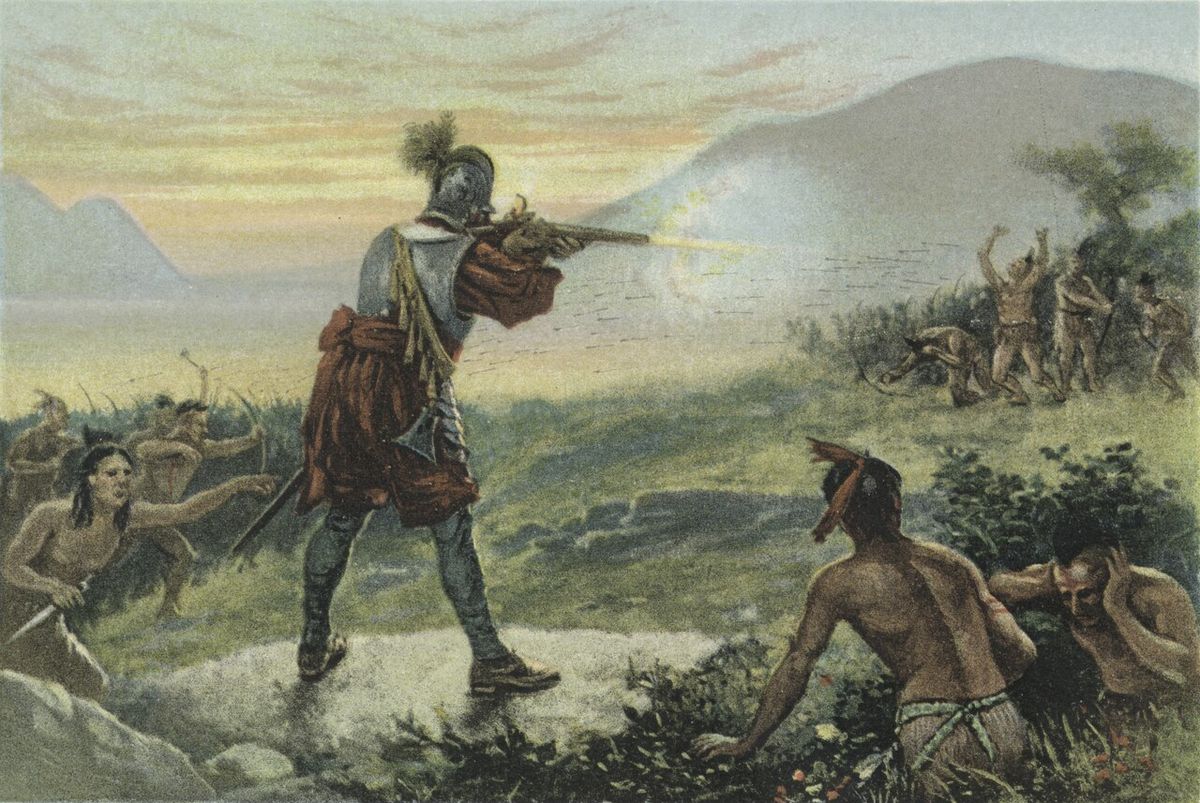
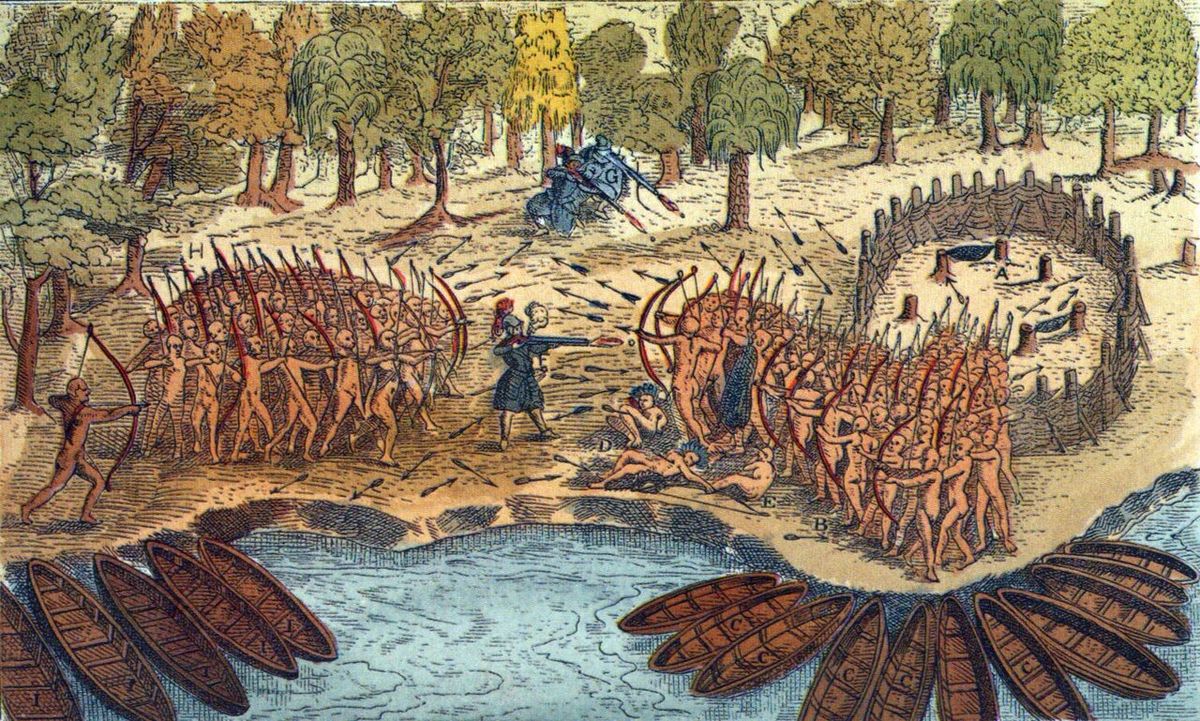
A series of devastating campaigns in the mid-17th century broke the power of rival confederacies. In 1649, a war party composed largely of Senecas and Mohawks destroyed the Huron (Wendat) nation. They subsequently turned on the Neutral Nations and the Erie, defeating them by 1654, and later subjugated the Susquehannock. These victories gave the Haudenosaunee effective control over a vast territory. Key events during this expansion included the expulsion of Haudenosaunee groups from the Gaspé Peninsula by the Mi'kmaq around 1535 to 1600, Samuel de Champlain's battles against Mohawk war parties in 1609 and 1610, and the displacement of the Mosopelea from the Ohio River Valley in the mid-1670s.
This expansion had paradoxical consequences. While it established Haudenosaunee supremacy, the constant warfare and incorporation of adoptees may have weakened broader Indigenous resistance to European encroachment. Their dependence on European trade goods led to over-hunting and significant cultural changes. The period concluded with the Great Peace of Montreal in 1701, where the Haudenosaunee, having exhausted many of their enemies and the beaver population in their own lands, made peace with the French and declared neutrality between the European powers.
- c. 1535 to 1600: Expulsion of Haudenosaunee (likely Mohawk) groups, referred to as Kwedech by the Mi'kmaq, from the Gaspé Peninsula.
- 1609 & 1610: Samuel de Champlain engages in battles against Mohawk war parties, allying with their northern enemies.
- Mid-1670s: The Haudenosaunee defeat the Mosopelea, displacing them from the Ohio River Valley.
- 1665 to 1670: Establishment of seven Haudenosaunee villages on the northern shore of Lake Ontario (Haudenosaunee du Nord), which were abandoned by 1701.
- 1670 to 1710: Achievement of political dominance over much of Virginia west of the Fall Line and into the Ohio River Valley.
- 1678: The Confederacy's council begins to exert greater centralized power in diplomacy with Pennsylvania and New York.
- 1680: The Haudenosaunee eliminate the Susquehannock as a tribe, adopting many survivors into their nation.
- 1690: The French Governor Frontenac destroys Schenectady and other Mohawk villages during ongoing conflicts.
Diplomacy and Influence on Colonial Powers
The Haudenosaunee became renowned for their sophisticated and pragmatic diplomacy, skillfully managing relations between European colonial powers to maintain their sovereignty and advantage. Their first major diplomatic agreement with Europeans was the 1613 Two Row Wampum treaty with the Dutch, symbolizing parallel, non-interfering paths of coexistence. This was followed by the Covenant Chain alliance with the English colonies, first recorded in writing in 1677, which framed their relationship as one of peace and friendship. The Haudenosaunee also maintained a complex relationship with New France, alternating between war and negotiation.
The Confederacy's political structure and success fascinated European intellectuals and colonists. In 1744, Onondaga chief Canasatego, during treaty negotiations in Lancaster, Pennsylvania, urged the fractious English colonies to unite, using the Haudenosaunee League as an example. This advice was noted by Benjamin Franklin, who later wrote in 1751 that the colonists should form a similar union. Franklin's Albany Plan of Union in 1754 was directly inspired by the Haudenosaunee model, proposing a colonial grand council for common defense. Although the plan failed, it set a precedent for later unified colonial action. The Haudenosaunee influence extended to major treaties like the 1713 Treaty of Utrecht, where England and France recognized their rights to travel and trade, and the 1768 Treaty of Fort Stanwix, which defined a western boundary for settlement.
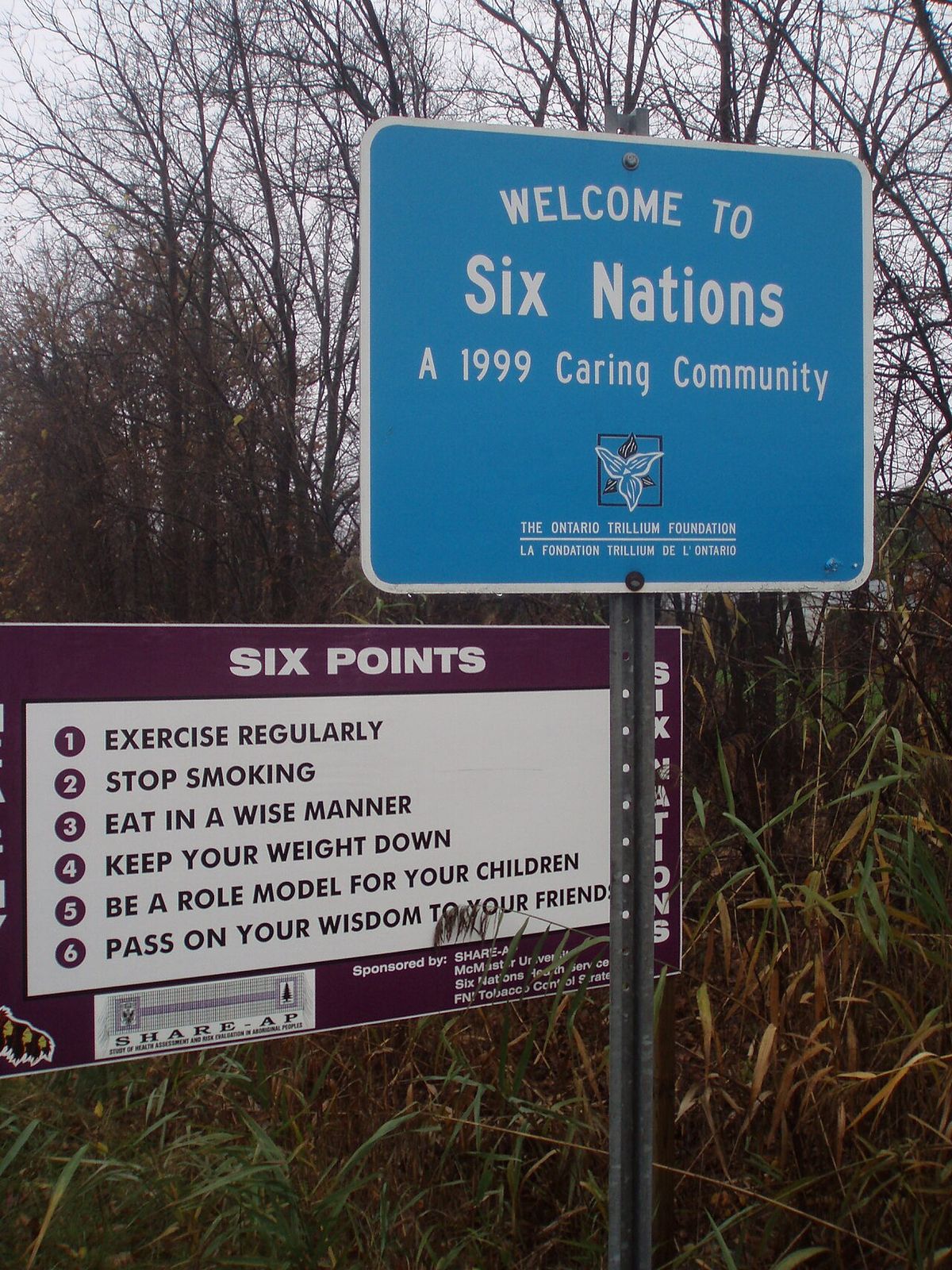
Despite these agreements, the period following the American Revolution was devastating for the Haudenosaunee who had allied with the British. In 1779, General George Washington ordered the Sullivan-Clinton Campaign, a scorched-earth expedition that destroyed dozens of Haudenosaunee villages and crops, forcing many to flee to Canada. This led to the establishment of the Six Nations of the Grand River reserve in Ontario. Post-war treaties like the 1784 Second Treaty of Fort Stanwix and the 1790 U.S. Trade and Intercourse Act were attempts to manage relations, but they were often undermined by state-level land purchases.
- 1713 Treaty of Utrecht: Ended war between England and France. Both European powers recognized Haudenosaunee rights to travel and trade across their claimed territories.
- 1721 to 1722 Treaty at Albany: Lieutenant Governor Alexander Spotswood of Virginia renewed the Covenant Chain and agreed to recognize the Blue Ridge as the demarcation line.
- 1743: Governor Sir William Gooch paid the Haudenosaunee 100 pounds sterling for settled land in the Shenandoah Valley claimed by them.
- 1768 Treaty of Fort Stanwix: With British representative Sir William Johnson, established a western boundary for colonial settlement, confirming Haudenosaunee claims to lands as far as eastern Ohio.
- 1775: At Fort Pitt, Haudenosaunee delegates agreed to a request from the Continental Congress to remain neutral in the coming American Revolution.
- 1794 Treaty of Canandaigua: Signed with the United States under President George Washington, it established peace and affirmed Haudenosaunee land rights.
- 1794 Jay Treaty: Between the U.S. and Britain, guaranteed Haudenosaunee people the right to freely cross the newly established international border.
Historiography and Cultural Legacy
The writing of Haudenosaunee history has evolved through distinct phases, heavily influenced by the perspectives of the recorders. Early European accounts, primarily from French Jesuit missionaries in the 17th century, often portrayed the Haudenosaunee as savages lacking formal government, law, or religion, though some Jesuits developed deep respect for them after studying their languages and cultures. A major source of confusion was the matrilineal power structure, which patriarchal European scribes largely overlooked or misunderstood. Eighteenth-century English historiography focused more on diplomatic relations, publishing treaty proceedings and creating images like John Verelst's "Four Mohawk Kings." A persistent 19th and 20th-century narrative cast the Haudenosaunee as an expansive military power that acted as the fulcrum of colonial balance of power.
In the 19th century, Haudenosaunee people began to directly influence the writing of their own history. John Arthur Gibson (Seneca) was central in recounting epic versions of the Peacemaker story. In the following decades, notable women historians emerged, including Laura "Minnie" Kellogg (Oneida) and Alice Lee Jemison (Seneca). Modern scholars like historian Scott Stevens critique earlier European historiography for its racialized prejudice stemming from the overvaluation of written sources over strong oral tradition. Contemporary historiography acknowledges the League as a model of participatory democracy.
The Haudenosaunee cultural legacy remains strong and influential. The 1815 death of Seneca prophet Handsome Lake marked the founding of the Gaiwiio (Good Message), a religious movement that blended traditional and Christian elements. In the modern era, the Haudenosaunee have asserted their sovereignty in international arenas. In 1990, after years of denial, World Lacrosse admitted the Haudenosaunee Nationals to international competition, recognizing the sport's origins with them. The team, ranked among the top three globally, is now actively seeking to compete as a sovereign nation at the 2028 Summer Olympics in Los Angeles. This ongoing activism shows the enduring political and cultural presence of the Haudenosaunee Confederacy. Traditional games like the snow-snake game and the peach-stone game (Guskä′eh) were also important parts of Haudenosaunee culture, with lacrosse being the favorite sport.
Historical Timeline of Key Events
| Year | Event | Significance |
|---|---|---|
| c. 1450 | Widely accepted scholarly date for Confederacy formation | Based on archaeological evidence. Oral tradition states an earlier, timeless origin. |
| 1613 | Two Row Wampum Treaty with the Dutch | Established first diplomatic relations with Europeans, symbolizing mutual non-interference. |
| 1649 | Destruction of the Huron (Wendat) Nation | Major victory in the Beaver Wars, eliminating a key northern rival and trade competitor. |
| 1677 | Covenant Chain alliance recorded | Formalized alliance between the Haudenosaunee and English colonies of New York, Massachusetts, and Connecticut. |
| 1701 | Great Peace of Montreal | Haudenosaunee made peace with the French, declaring official neutrality between European powers. |
| 1722 | Tuscarora adopted into the Confederacy | The League became the Six Nations after the Tuscarora, displaced from the Carolinas, were welcomed. |
| 1768 | Treaty of Fort Stanwix | With Britain, defined a western boundary for colonial settlement, reserving the Ohio Country for the Haudenosaunee. |
| 1779 | Sullivan-Clinton Campaign | U.S. military campaign ordered by George Washington destroyed Haudenosaunee villages, leading to a migration to Canada. |
| 1794 | Treaty of Canandaigua | Affirmed peace and Haudenosaunee land rights with the newly formed United States. |
| 1794 | Jay Treaty | Guaranteed Haudenosaunee the right to freely cross the border between the U.S. and Canada. |
| 1815 | Death of Handsome Lake | Marked the founding of the Gaiwiio (Good Message) religious movement. |
| 1990 | Haudenosaunee Nationals admitted to World Lacrosse | International recognition of the team representing the Confederacy in the sport they invented. |
Questions about History of the Haudenosaunee
What does 'Haudenosaunee' mean and who are the member nations?
Haudenosaunee translates to "people who build a house" or "people of the longhouse," referring to their political confederacy. The original five founding nations, from east to west, are the Mohawk, Oneida, Onondaga, Cayuga, and Seneca. In 1722, the Tuscarora, an Iroquoian-speaking people displaced from the Carolinas, were adopted into the Confederacy, which is then often called the Six Nations. Each nation maintains its own council and internal affairs but is united under the overarching Grand Council for matters of common concern.
When was the Haudenosaunee Confederacy formed?
The exact date is a matter of ongoing scholarly and cultural discussion. Haudenosaunee oral tradition states the Confederacy was formed in "time immemorial," emphasizing its ancient origins. Some scholars, cross-referencing oral history with astronomical data, propose a date around 1142 AD, linking it to a documented solar eclipse. Many archaeologists argue for a later formation around 1450 based on material evidence. The Haudenosaunee perspective prioritizes the enduring principles of the Great Law of Peace over a specific calendar date.
What role did the Haudenosaunee play in the Beaver Wars?
During the Beaver Wars (approximately 1609 to 1701), the Haudenosaunee became the dominant military and political power in the Northeast. Motivated by the desire to control the fur trade with European colonists and to acquire new hunting grounds, they launched campaigns against rival Indigenous nations. They destroyed the Huron (1649), Neutral, and Erie (1654) confederacies, and broke the power of the Susquehannock. The wars also involved complex adoption practices, where captives were integrated into Haudenosaunee society. The period ended with the 1701 Great Peace of Montreal.
How did the American Revolution affect the Haudenosaunee?
The American Revolution was catastrophic for many Haudenosaunee communities. Although the Confederacy initially agreed to neutrality in 1775, divisions occurred, with some nations, notably the Mohawk under Joseph Brant, siding with the British. In retaliation, General George Washington ordered the 1779 Sullivan-Clinton Campaign, a scorched-earth military expedition that systematically destroyed dozens of villages and food stores. This campaign forced thousands of Haudenosaunee to flee as refugees to British-held territory in Canada, leading to the establishment of the Six Nations of the Grand River reserve in Ontario.
What is the significance of the Haudenosaunee Nationals lacrosse team?
The Haudenosaunee Nationals lacrosse team is a direct embodiment of Haudenosaunee sovereignty and cultural heritage, as lacrosse is a game they invented. The team represents the Confederacy in international competition, not Canada or the United States. After being denied entry for years, World Lacrosse admitted them in 1990, recognizing their unique national status. The team is now ranked among the top three in the world and is campaigning to compete as a sovereign nation at the 2028 Summer Olympics in Los Angeles.
What was the social structure of Haudenosaunee society?
Haudenosaunee society was matrilineal and organized around clans such as Turtle, Wolf, and Bear, with membership inherited through the mother's line. Clan mothers held significant economic and political power, controlling agricultural lands and nominating the male chiefs, or Royaner, who sat on the Grand Council. Families lived in large longhouses, often housing multiple related families. Society was highly egalitarian, with a council of fifty chiefs ruling on disputes and seeking consensus. This structure was frequently misunderstood by European observers from patriarchal societies.
Sources and further reading
- History of the Haudenosaunee (Wikipedia)
- Who We Are (haudenosauneeconfederacy.com)
- They Made the House (canadashistory.ca)
- Timeline (onondaganation.org)
Checked by the Nosy Mag desk. Last updated 2026-11-01.